Are you looking for a travel destination that is completely off the beaten path, rich in living history, and bursting with raw, authentic energy? If so, the Republic of Benin should be at the very top of your travel bucket list for 2026.
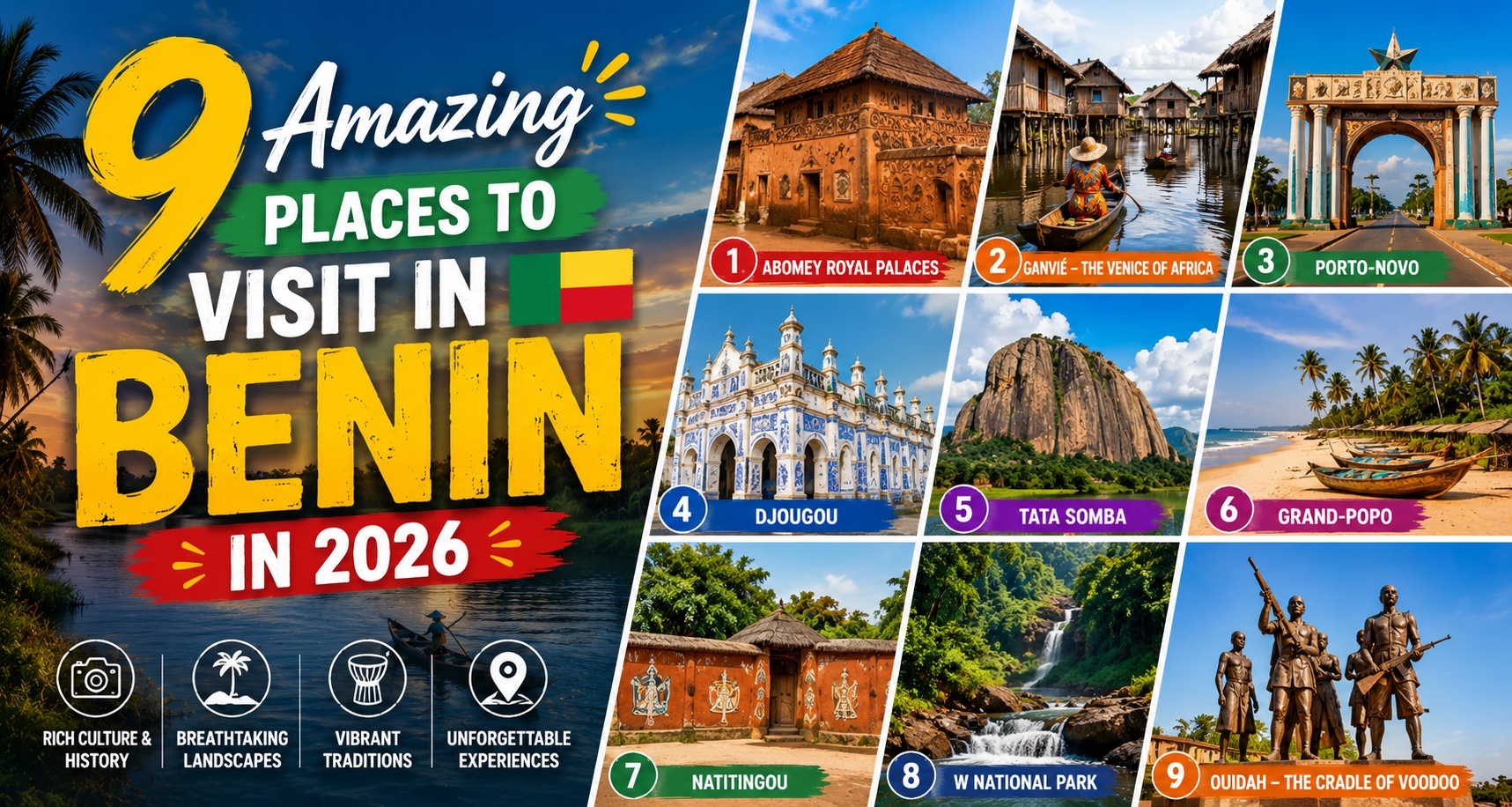
Unlike over-commercialized tourist traps, Benin offers a deeply moving journey through ancient kingdoms, unique stilt villages, sacred forests, and pristine coastal beaches. Whether you are a history buff, a nature lover, or someone looking to experience a deeply spiritual culture, this guide will show you exactly why Benin is West Africa's best-kept secret.
Why is Benin becoming West Africa's hottest travel destination in 2026?
For a long time, Benin was a destination spoken of only in quiet whispers among seasoned backpackers and cultural researchers. But in 2026, the secret is officially out.
Benin is the historical cradle of the Vodun (Voodoo) religion and was once the heart of the powerful Dahomey Kingdom. Today, the Beninese government is actively investing in preserving its historical landmarks, upgrading its national parks, and making it easier than ever for international travelers to visit. With a highly efficient online visa system and a reputation as one of the safest, most peaceful countries in West Africa, Benin is ready to welcome the world.
1. What secrets does Cotonou, Benin's vibrant heartbeat, hold for travelers?
Most travelers start their journey in Cotonou, Benin’s largest city and economic capital. Cotonou is loud, colorful, fast-paced, and absolutely packed with energy. It is a city of contrast, where modern galleries sit just a few streets away from bustling traditional markets.
What to do in Cotonou:
Get lost in Dantokpa Market: Spanning over 20 hectares, Dantokpa is one of the largest open-air markets in West Africa. You can find everything here—from vibrant wax-print fabrics and fresh tropical fruits to handmade local crafts and traditional spiritual medicines. It can be overwhelming, but walking through its crowded pathways is an unforgettable sensory experience.
Relax at Fidjrosse Beach: When the city heat gets to be too much, head to Fidjrosse Beach. Lined with tall coconut palms, this sandy strip is the perfect spot to sip on fresh coconut water, enjoy grilled fish, and watch locals play soccer as the sun sets over the Atlantic.
Visit the Fondation Zinsou: If you appreciate modern art, this world-class exhibition space showcases incredible contemporary African art, helping you understand the modern creative pulse of the continent.
2. Why is Ganvié celebrated as the "Venice of Africa"?
Just a short drive north of Cotonou lies Lake Nokoué, home to Ganvié, one of the most remarkable human settlements in the world. Ganvié is a complete, functioning town built entirely on wooden stilts above the water.
The fascinating history of Ganvié:
In the 16th and 17th centuries, the Tofinu people fled onto the waters of Lake Nokoué to escape slave raiders from the Dahomey Kingdom. Because the raiders' religious beliefs forbade them from entering or fighting on water, the lake became a safe haven.
Over the centuries, this temporary refuge grew into a permanent home. Today, more than 30,000 people live in Ganvié. They have floating houses, floating schools, a floating market, and even floating churches. Everything in daily life is done by wooden canoe. Taking a slow, guided boat ride through the water "highways" of Ganvié is a humbling look at human resilience and adaptation.
3. How does Ouidah let you walk through the moving history of the transatlantic slave trade?
Located about 40 kilometers west of Cotonou, the quiet coastal town of Ouidah is a place of deep historical and spiritual significance. Between the 17th and 19th centuries, Ouidah was one of the most active slave-exporting ports in Africa.
The Slave Route (Route des Esclaves):
Today, you can walk the actual 4-kilometer path that millions of enslaved Africans were forced to walk from the old slave market in the center of town down to the shore. Along the trail, you will encounter memorial statues, the Tree of Forgetfulness (where captives were forced to walk circles to symbolically forget their past), and the Tree of Return (where they walked to ensure their spirits would return home after death).
At the end of the path on the edge of the Atlantic Ocean stands the Gate of No Return (La Porte du Non-Retour). This massive, beautifully carved concrete arch serves as a powerful monument to those who were taken from African soil forever. It is a highly emotional, quiet place that demands deep respect from every visitor.
4. Can you really touch a live snake at Ouidah’s Temple of Pythons?
Ouidah is not only a historical site; it is also the spiritual capital of the Vodun religion. Right in the center of town, opposite the historic Catholic Basilica, sits the famous Temple of Pythons.
In Vodun belief, the Royal Python is not feared; it is highly respected as a physical manifestation of a protective deity named Dagbe. The temple houses dozens of harmless royal pythons that roam freely inside the clay structures.
If you are brave enough, the local priests will gently drape one of these cool, calm snakes around your neck for a photo. It is a wonderful way to challenge your fears and learn firsthand about the deep connection between nature, animals, and spirituality in Beninese culture.
5. What is left of the powerful Dahomey Kingdom at the Royal Palaces of Abomey?
If you want to understand the military might and royal heritage of Benin, you must travel inland to Abomey, the ancient capital of the Dahomey Kingdom.
Abomey was ruled by a succession of 12 powerful kings between 1625 and 1900, creating one of the most organized and feared empires in West Africa. Today, the Royal Palaces of Abomey are a protected UNESCO World Heritage Site.
What makes Abomey special?
Clay Bas-Reliefs: The earthen walls of the palaces are decorated with beautiful, historic clay carvings that tell the stories of battle victories, royal symbols, and daily life.
The Legend of the Dahomey Amazons: Abomey is the birthplace of the Mino, an elite all-female military regiment (often called the Dahomey Amazons) who fought fiercely to protect their king. Their bravery inspired the modern blockbuster movie The Woman King.
The Royal Throne: Inside the museum, you can view the historic throne of King Ghézo, which rests on the actual skulls of defeated enemy leaders—a vivid reminder of the kingdom's intense historical power.
6. Where can you find the best wildlife safari in West Africa?
When people think of African safaris, they usually think of Kenya or South Africa. However, northern Benin is home to Pendjari National Park, which is widely considered the best-managed wildlife reserve in West Africa.
As part of the massive W-Arly-Pendjari (WAP) conservation complex, Pendjari protects a vast, stunning savanna ecosystem against the dramatic backdrop of the Atakora Mountains.
What wildlife can you see in Pendjari?
If you visit during the dry season (from November to May), the watering holes dry up, bringing animals out in large numbers. You can easily spot:
West African lions and leopards
Large herds of elephants
Hippos lounging in the Pendjari River
Buffaloes, waterbucks, and baboons
More than 460 species of colorful birds
Travel Tip: Because of its remote location, it is highly recommended to book a guided multi-day safari package that includes a stay at one of the park’s beautiful eco-lodges.
7. What makes Grand-Popo the perfect beach escape for slow travelers?
After days of dusty roads and heavy history, Grand-Popo is the ultimate place to rest your feet. Situated on a thin strip of land between the Atlantic Ocean and the peaceful Mono River, this small, sleepy town near the Togo border offers true tranquility.
The beaches here are wide, golden, and virtually empty. You can spend your days swinging in a hammock under a straw hut, listening to the crashing waves, or watching local fishermen pull their massive nets out of the surf.
Do not miss the Mono River Boat Tour:
Take a traditional motorized pirogue down the Mono River. The boat will glide through peaceful mangrove forests where you can see locals gathering oysters, extracting salt from the sand using traditional techniques, and practicing small Vodun ceremonies on the riverbanks.
8. How do the unique Tata Somba mud castles of Boukoumbé protect ancient traditions?
In the mountainous northwest corner of Benin, near the Togo border, lies the region of Boukoumbé. This area is home to the Tammari (or Betamaribé) people, who are famous for their unique, highly functional architecture called the Tata Somba.
A Tata Somba is not just a house; it is a miniature, double-story mud fortress.
Inside a Tata Somba:
The Ground Floor: This dark, cool area is used to shelter livestock at night and features small shrines dedicated to ancestral spirits.
The Upper Deck: A ladder leads up to an open-air clay terrace. Here, you will find sleeping quarters, small thatched-roof clay granaries for storing grain, and flat spaces for drying crops in the sun.
Fortified Design: These homes were originally designed to protect families from slave raiders and wild animals. They have tiny windows, defensive turrets, and narrow entryways.
Visiting Boukoumbé offers a rare, respectful window into a traditional way of life that has remained unchanged for centuries.
9. Why should you add Porto-Novo, the capital of art and heritage, to your itinerary?
While Cotonou is the commercial center, Porto-Novo is the official administrative capital of Benin. It is a much calmer, quieter city with a unique, distinct personality.
Porto-Novo is heavily influenced by "Yoruba" culture and the history of the "Aguda"—freed Afro-Brazilian slaves who returned to Benin in the 19th century. This history is reflected beautifully in the city’s stunning architecture.
Highlights of Porto-Novo:
The Great Mosque of Porto-Novo: This is one of the most unique buildings in West Africa. Built in the late 19th century, its architecture is styled after the grand colonial churches of Bahia, Brazil, featuring bright pastel colors and elaborate stucco work.
Musée Honmè: The former palace of King Toffa, which provides an intimate look at how local royalty lived during the colonial transition.
The Ethnographic Museum: A fantastic museum housing a massive collection of sacred ceremonial masks, traditional weapons, and musical instruments.
When is the absolute best time to plan your trip to Benin?
To make the absolute most of your trip to Benin, timing is key.
The Dry Season (November to February): This is widely considered the best time to visit. The weather is pleasantly warm, the humidity is lower, and the roads are easily passable.
The Voodoo Festival (January 10th): If you want to experience the peak of Beninese culture, plan to be in Ouidah on January 10th. This is a national holiday where thousands of Vodun practitioners, chiefs, dancers, and tourists gather on the beaches for vibrant ceremonies, drumming, and colorful mask dances.
The Safari Season (December to April): This is the prime time to visit Pendjari National Park in the north, as the dry weather makes wildlife spotting much easier.
Is Benin safe for solo and first-time tourists?
Yes, Benin is widely recognized as one of the safest and most politically stable countries in Africa. The local people are incredibly warm, welcoming, and proud to share their culture with visitors.
However, like traveling anywhere, you should follow standard safety precautions:
Keep an eye on your belongings in busy places like Cotonou's Dantokpa Market.
Learn a few basic French phrases (such as "Bonjour", "S'il vous plaît", and "Merci"), as French is the official language and English is not widely spoken.
Always ask for permission before taking photos of local people, their homes, or their spiritual shrines.
Keep some local currency (West African CFA franc - XOF) on hand, as credit cards are rarely accepted outside of major hotels in Cotonou.
What is the official Benin e-Visa policy for global travelers?
Before you pack your bags and book your flights, you need to make sure your travel documents are in order. Thankfully, the Government of Benin has made the entry process incredibly simple.
Under the current Benin eVisa policy, citizens from almost all countries can apply for their tourist visa entirely online. There is no need to mail your physical passport to an embassy or wait in long, exhausting lines at the airport.
You can apply for a single-entry or multiple-entry eVisa, with validity ranging from 30 days up to 90 days depending on your travel plans. To make sure you meet all the necessary requirements and understand the official guidelines, be sure to review the complete, up-to-date rules at the Benin eVisa Policy .
Why choose us for your Benin visa application?
Planning an international trip can be stressful, and dealing with government paperwork is often the hardest part. That is where we come in. We take the hassle out of the visa process so you can focus on planning your exciting West African itinerary.
Here is why thousands of travelers trust us to handle their travel documents:
Reliable Travel Visa Services Our global approach has assisted numerous travelers in obtaining their Visa. We understand the specific nuances of international travel regulations, ensuring your documents are processed perfectly.
Round-the-Clock Assistance Travel plans don't stick to a 9-to-5 schedule, and neither do we. Reach out to us 24/7, and our experts will respond within 72 hours to solve any issues or answer your questions.
Experienced Visa Consultants Avoid simple mistakes that could lead to a visa rejection. With us, you receive expert guidance to ensure the acceptance of your application the very first time.
Efficient Visa Application Process No complicated portals or confusing legal jargon. Apply for your Visa in minutes with our simplified form, designed to save you time and effort.
How do you start planning your unforgettable journey to Benin today?
Benin is a destination that promises to change the way you look at the world. From the floating streets of Ganvié to the deep spiritual traditions of Ouidah and the beautiful clay castles of Boukoumbé, this beautiful country is waiting to be explored.
Don't let complicated visa paperwork stand between you and the adventure of a lifetime. Get started on your application today, and get ready to experience the sights, sounds, and soul of Benin in 2026!