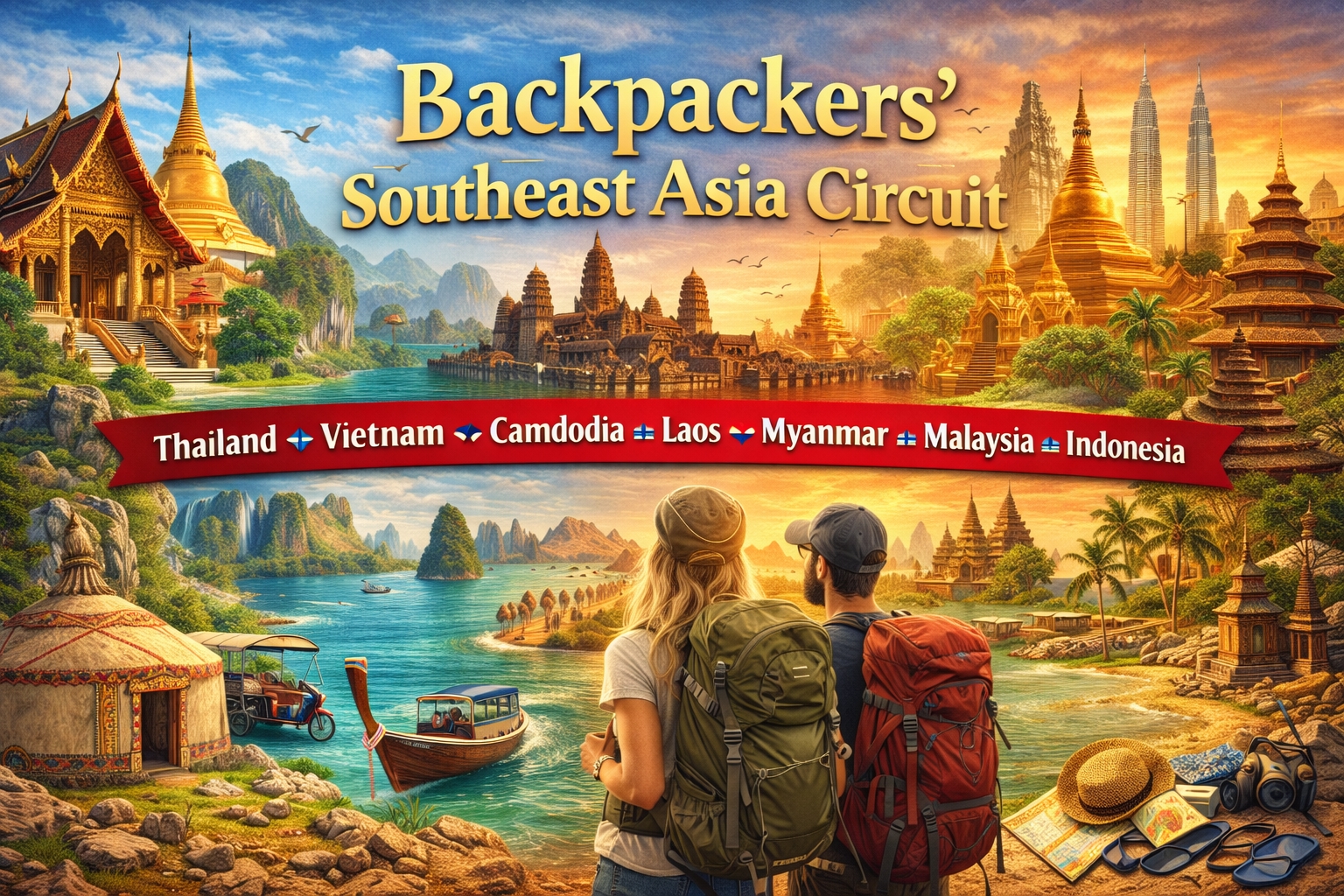
Backpacking through Southeast Asia is more than just a holiday; it is a life-changing rite of passage. The legendary circuit encompassing Thailand, Vietnam, Cambodia, Laos, Myanmar, Malaysia, and Indonesia offers a kaleidoscope of experiences—from the neon-lit streets of Bangkok and the misty mountains of Northern Vietnam to the spiritual silence of Angkor Wat.
Whether you have eight weeks or half a year, navigating seven different countries requires careful planning, especially when it comes to border crossings and document preparation. This guide is designed to help you master the "Banana Pancake Trail" with ease, ensuring your focus remains on the adventure rather than the paperwork.
1. What is the classic Southeast Asia backpacking route for beginners?
The most famous route, often called the "Banana Pancake Trail," traditionally begins in Bangkok, Thailand. As the region’s main aviation hub, it is the perfect place to find your feet. From Bangkok, travelers usually head north to Chiang Mai and Pai for mountain trekking and night markets.
From Northern Thailand, you can cross into Laos at Huay Xai and take a two-day slow boat down the Mekong River to Luang Prabang. From Laos, the trail heads east into Northern Vietnam (Hanoi and the Ha Giang Loop) before traveling down the coast to Ho Chi Minh City. The circuit then cuts west into Cambodia, moves back into Thailand for the southern islands, and continues down through the Malaysian peninsula toward the sprawling archipelago of Indonesia.
2. How long do you actually need to backpack Southeast Asia?
While some try to "do it all" in a month, a 2 to 6-month timeframe is much more realistic.
2 Months: Focus on the "Mainland Loop" (Thailand, Laos, Vietnam, and Cambodia).
4 Months: Add Malaysia and a deep dive into Indonesia (Bali, Java, and Lombok).
6 Months: The ultimate pace. This allows for "slow travel," where you can spend weeks in one village, volunteer, or take a month-long yoga or diving course without feeling rushed.
3. How much does a 6-month Southeast Asia trip cost in 2024-2025?
On average, a budget backpacker should aim for a budget of $1,200 to $1,500 per month. This covers hostel dorms, street food, local transport, and a few activities like temple tours or cooking classes.
Budget Countries: Laos, Vietnam, and Northern Thailand are incredibly cheap.
Mid-Range: Cambodia and Indonesia (especially Bali) have seen price increases recently.
Higher End: Malaysia and Singapore will take a larger chunk of your daily budget due to higher accommodation and alcohol costs.
4. How do I handle border crossings and entry requirements?
Crossing borders in Southeast Asia is generally straightforward, but it requires being organized. Most land borders are open to tourists, but you must ensure you have the correct documentation before arriving at the gate. Many countries have moved toward electronic systems to reduce corruption and long wait times at the physical border. Always check if your specific entry point (e.g., a small mountain pass between Laos and Vietnam) accepts e-Visas, as some smaller crossings still require paper visas from an embassy.
5. How can I apply for a Cambodia eVisa for land borders?
Cambodia is a highlight for many, but the land border crossings (like Poipet or Moc Bai) can sometimes be intimidating due to "touts" and unofficial fees. The best way to avoid stress is to have your paperwork ready in advance. You can easily apply for Cambodia eVisa online to ensure a smooth transition. Having your electronic visa printed and ready allows you to bypass the "Visa on Arrival" queues and avoids the risk of overpaying at the border station.
6. What are the current Laos entry requirements for tourists?
Laos is the "hidden gem" of the region, known for its laid-back atmosphere. To enter, you will need a passport with at least six months of validity and a visa. While you can get a stamp at the airport, the process is much faster if you use the official electronic portal. Travelers are encouraged to secure a Laos tourist eVisa before their trip. This is particularly useful if you are taking the slow boat from Thailand, as it speeds up the processing time at the Friendship Bridge.
7. Is a tourist visa required for Myanmar in 2024-2025?
Myanmar offers a unique cultural experience that feels different from its neighbors. However, the entry process is stricter compared to Thailand or Malaysia. Tourism is currently restricted to specific zones, and you must have a pre-approved visa to enter. You can process your Myanmar eVisa application through professional consultants who stay updated on the latest travel advisories and entry gate openings, ensuring you don't arrive only to be turned away.
8. How can I extend my stay in Bali with an Indonesia eVisa?
Indonesia is massive, and 30 days is rarely enough to see Java, Bali, and the Gili Islands. While many people get a Visa on Arrival at the airport, it requires a physical visit to an immigration office to extend it. A better alternative for long-term travelers is the Electronic Visa on Arrival (e-VoA). You can obtain an Indonesia eVisa for backpackers which allows for easier online extensions, saving you multiple days of sitting in government offices in Denpasar or Jakarta.
9. When is the best time of year to visit Southeast Asia?
Weather varies across the region, but generally:
Mainland (Thailand, Vietnam, Laos, Cambodia, Myanmar): The best time is November to February. It is dry and relatively cool. March to May is "shoulder season"—it is incredibly hot but great for the Songkran water festival.
The Islands (Indonesia): Indonesia follows a different pattern. Their dry season is April to October, making it the perfect escape when the mainland is experiencing the monsoon rains of June and July.
10. What are the best transportation options between countries?
Buses: "Sleeper buses" in Vietnam are famous (and sometimes a bit cramped), but they save you the cost of a night's accommodation.
Trains: Thailand has an excellent rail network. The overnight train from Bangkok to Chiang Mai is a must-do experience.
Budget Flights: AirAsia and VietJet offer "puddle jumper" flights that can be as cheap as $30 if booked a few weeks in advance. This is often the best way to get from Malaysia to Indonesia.
11. Top 5 cultural experiences you cannot miss in the circuit
Sunrise at Angkor Wat (Cambodia): It is a cliché for a reason. Seeing the sun rise behind the lotus towers is unforgettable.
The Ha Giang Loop (Vietnam): A multi-day motorbike journey through the highest mountains in the north.
Alms Giving in Luang Prabang (Laos): A silent, spiritual tradition where monks collect food at dawn.
Island Hopping in Southern Thailand: From the party vibes of Koh Phangan to the diving paradise of Koh Tao.
Bagan Temples (Myanmar): Thousands of ancient pagodas dotting a dusty plain.
12. How to stay safe and healthy while traveling for months?
The most common health issue is "Bali Belly" or general stomach upset. To avoid this, only drink bottled or filtered water and eat at street food stalls that have a high turnover of local customers. Safety-wise, Southeast Asia is very safe, but petty theft can happen. Always use a "dummy wallet" with a small amount of cash, and keep your passport and main credit cards in a secure, hidden pouch or the hostel locker.
13. What should be on my ultimate backpacking packing list?
The biggest mistake new travelers make is packing too much. You only need:
Clothes: 5 T-shirts, 2 pairs of shorts, 1 pair of long linen trousers (for temples), and a light rain jacket.
Electronics: A universal travel adapter and a high-capacity power bank for long bus rides.
Health: Rehydration salts (ORS), charcoal tabs, and high-SPF sunscreen (which is expensive in Asia).
The "Temple Outfit": Always have a sarong or scarf in your daypack to cover your shoulders and knees.
14. How to manage money and avoid high ATM fees?
Thailand is notorious for charging around $7-$8 per ATM withdrawal. To combat this, try to withdraw the maximum amount allowed each time to minimize fees. Better yet, use a travel-specific bank card (like Revolut or Wise) that offers better exchange rates. Always keep a "stash" of $100 in crisp, new US dollar bills—they are the best emergency currency if you find yourself at a border where the card machines are broken.
15. Why choose our professional visa services for your journey?
Navigating the various government portals for seven different countries can be overwhelming. Each site has different photo requirements, payment gateways, and processing times. We simplify this journey so you can focus on your itinerary.
Reliable Travel Visa Services: Our global approach has successfully assisted thousands of international travelers in obtaining their visas without the stress of technical errors.
Round-the-Clock Assistance: Travel doesn't stop at 5 PM. Reach out to us 24/7, and our dedicated experts will respond to your concerns within 72 hours.
Experienced Visa Consultants: Every application is reviewed by experts to ensure it meets the latest government standards, significantly increasing the acceptance rate of your application.
Efficient Visa Application Process: Time is precious. Apply for your visa in minutes using our simplified, user-friendly forms designed for travelers on the move.
16. Where are the best places to meet other travelers?
The social heart of Southeast Asia is the hostel. Even if you aren't a "party person," hostels often organize group tours, "family dinners," and walking tours that make meeting people incredibly easy. Areas like Khao San Road (Bangkok), Bui Vien (Ho Chi Minh City), and Ubud (Bali) are the primary hubs where you will find like-minded adventurers to share your journey with.
Plan Your Border Crossings Today
Don't let paperwork stand in the way of your dream trip.