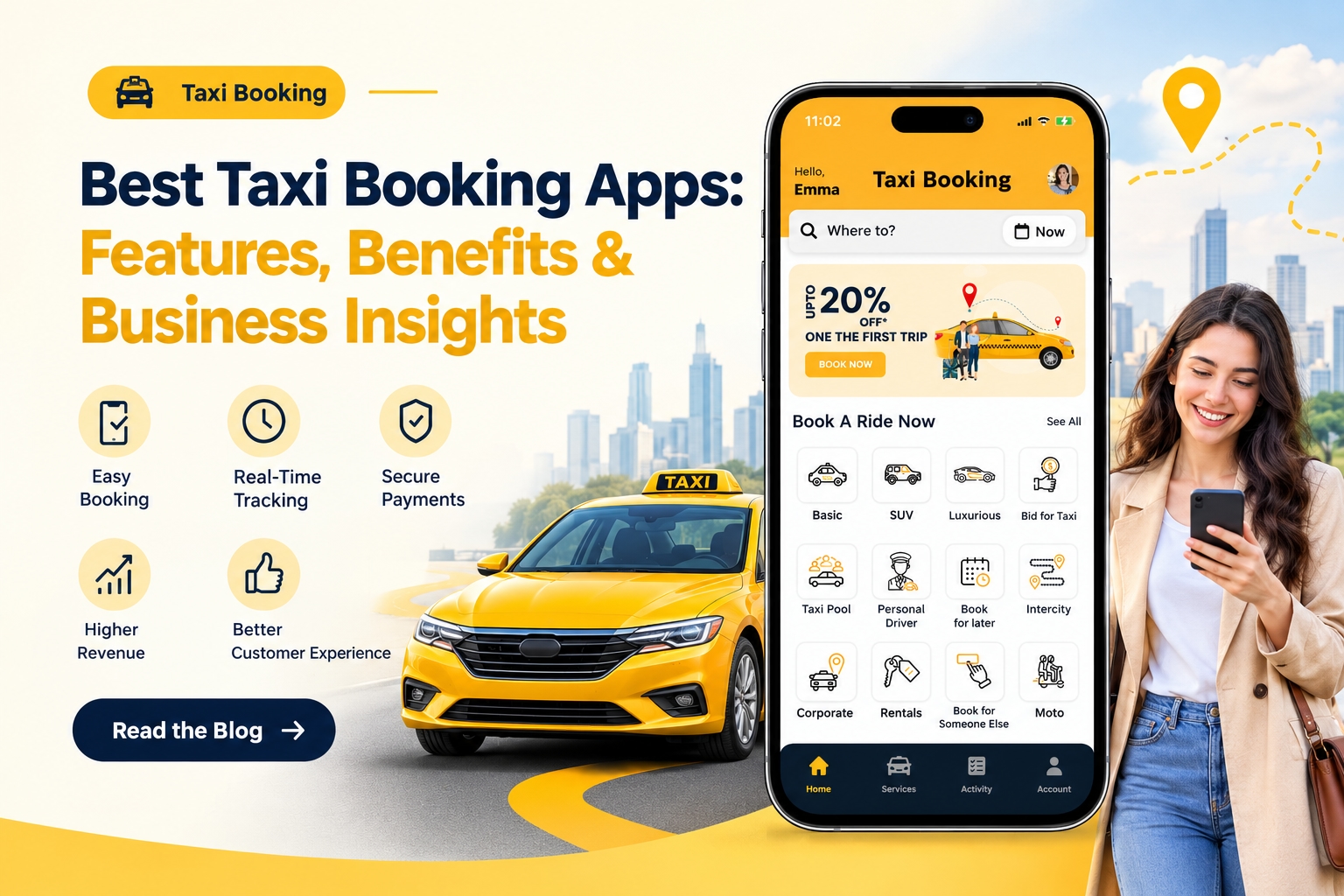
Taxi booking apps have changed the way people travel in cities. Instead of standing on the roadside or calling a taxi operator, passengers can use a smartphone to book a ride, track the driver, estimate fares, and make payments. At the same time, taxi businesses can use these platforms to manage drivers, monitor trips, optimize operations, and increase revenue.
The growing adoption of smartphones, digital payments, GPS technology, and on-demand services has made taxi booking apps an important part of modern transportation. Whether you are a passenger looking for convenient transportation or an entrepreneur planning to launch a ride-hailing business, understanding the features and benefits of these apps can help you make better decisions.
What Is a Taxi Booking App?
A taxi booking app is a mobile application that connects passengers with taxi or private-hire drivers. Users can enter their pickup and destination locations, select a vehicle type, view an estimated fare, and request a ride.
Once a driver accepts the request, passengers can typically view the driver's profile, vehicle information, estimated arrival time, and real-time location. After completing the trip, passengers can pay through available payment methods and rate their experience.
For businesses, the platform generally includes separate applications or interfaces for passengers, drivers, and administrators. Together, these components create an integrated ride-booking ecosystem.
How Do Taxi Booking Apps Work?
Most taxi booking apps follow a straightforward booking process:
Passenger enters the pickup location: The app detects or allows the user to select their current location.
Destination is added: The passenger enters the desired destination.
Vehicle category is selected: Available options may include economy, premium, SUV, or other vehicle types.
Fare is estimated: The system calculates an approximate fare using factors such as distance, time, vehicle category, and local pricing rules.
Ride request is submitted: Nearby drivers receive the booking request.
Driver accepts the ride: Once accepted, the passenger receives driver and vehicle details.
Real-time tracking begins: GPS allows the passenger to monitor the driver's location.
Trip is completed: The driver navigates to the destination and ends the trip.
Payment is processed: The passenger pays using the selected payment method.
Rating and feedback: Both parties may be able to rate the completed trip.
This automated process reduces the effort required to arrange transportation and helps businesses manage a large number of bookings.
Top Features of the Best Taxi Booking Apps
A successful taxi booking app needs more than a simple booking button. It should provide useful features for passengers, drivers, and administrators.
1. Easy Ride Booking
Passengers should be able to book a ride quickly with a simple interface. Pickup and destination fields, vehicle selection, fare estimates, and booking confirmation should be easy to understand.
2. GPS and Real-Time Tracking
GPS tracking allows passengers to monitor the driver's location and estimated arrival time. Drivers can also use navigation tools to reach pickup and destination points efficiently.
3. Multiple Vehicle Categories
Offering different vehicle categories can help businesses serve a wider range of customers. Options may include standard cars, premium vehicles, SUVs, electric vehicles, or larger vehicles for groups.
4. Fare Estimation
Fare estimation gives passengers an approximate trip cost before confirming a booking. Pricing can be calculated using distance, estimated travel time, vehicle type, demand, and other business rules.
5. Multiple Payment Options
The best taxi booking apps support convenient payment methods. Depending on the market, these may include credit and debit cards, digital wallets, bank transfers, cash, and other local payment solutions.
6. Driver Profiles
Passengers generally want to know who will pick them up. Driver profiles can display information such as the driver's name, profile image, rating, vehicle details, and registration information.
7. Push Notifications
Notifications can keep users informed about booking requests, driver acceptance, arrival updates, trip completion, promotions, and payment status.
8. Ratings and Reviews
A two-way rating system can help businesses monitor service quality. Passengers can rate drivers, while drivers can also provide feedback about passengers where supported.
9. Ride Scheduling
Scheduled rides allow customers to arrange transportation in advance. This can be particularly useful for airport transfers, business travel, medical appointments, and important events.
10. Ride History
Passengers can view previous bookings, trip details, fares, payment information, and receipts. This makes it easier to track transportation expenses.
11. Promo Codes and Discounts
Businesses can use promotional campaigns to attract new customers and encourage existing users to book more rides.
12. Driver Management
An administrative system can help businesses manage driver registrations, documents, availability, earnings, trips, ratings, and performance.
Benefits of Taxi Booking Apps for Passengers
Taxi booking apps provide several advantages compared with traditional taxi-booking methods.
Convenient Transportation
Passengers can request rides from almost anywhere using their smartphones. They do not need to search for a taxi on the street or make repeated phone calls.
Better Ride Visibility
Real-time tracking provides greater visibility into the driver's location and estimated arrival time.
Transparent Pricing
Fare estimates can help passengers understand the expected cost before confirming their trip. Digital receipts can also make payment records easier to manage.
Cashless Payments
Digital payment options provide a convenient alternative to carrying cash. Customers can select their preferred supported payment method.
Access to Driver Information
Driver and vehicle details can help passengers identify their assigned vehicle and driver before the trip begins.
Convenient Ride History
Previous trips can be stored within the application, allowing passengers to review bookings and receipts whenever needed.
Benefits of Taxi Booking Apps for Drivers
Taxi booking apps can also improve the working experience for drivers.
Access to More Customers
Instead of relying exclusively on street pickups or traditional taxi stands, drivers can receive ride requests through the application.
Navigation Support
Integrated maps and navigation can help drivers identify pickup and destination locations.
Digital Earnings Tracking
Drivers can view completed trips, fares, commissions, incentives, and other earnings information through their dashboard.
Flexible Availability
Depending on the business model, drivers may be able to control when they become available to receive ride requests.
Performance Insights
Ratings, trip history, acceptance rates, and other metrics can help drivers understand their performance.
Business Benefits of Launching a Taxi Booking App
For entrepreneurs, a taxi booking app can become the foundation of a scalable transportation business.
1. Create a Digital Transportation Platform
An app allows businesses to manage bookings through a centralized digital platform instead of depending entirely on traditional booking methods.
2. Improve Operational Efficiency
Automated booking, driver allocation, notifications, payments, and reporting can reduce manual administrative work.
3. Expand Into New Locations
Once the platform is established, businesses can adapt the operational model to additional cities or service areas, subject to local regulations and market conditions.
4. Generate Multiple Revenue Streams
Taxi businesses can explore several revenue models, including:
Commission from completed rides
Booking or convenience fees
Driver subscription plans
Premium ride categories
Corporate transportation packages
Advertising partnerships
Cancellation fees where legally and commercially appropriate
Delivery or additional mobility services
5. Understand Customer Behavior
Analytics can provide insights into booking volumes, popular locations, peak periods, vehicle preferences, cancellations, and other operational metrics.
6. Build Customer Loyalty
Loyalty programs, personalized offers, referral programs, and reliable service can encourage customers to continue using the platform.
Key Revenue Models for Taxi Booking Apps
Choosing the right monetization strategy is essential for long-term sustainability.
Commission-Based Model
The platform charges a percentage of each completed ride. This is one of the most common approaches in ride-hailing businesses.
Subscription Model
Drivers may pay a recurring subscription or access fee instead of, or alongside, a per-trip commission.
Surge or Dynamic Pricing
Prices can increase during periods of high demand, depending on local laws, market practices, and the business's pricing policy.
Advertising Model
Businesses can generate additional revenue by offering advertising opportunities within the app, provided advertisements do not negatively affect the user experience.
Corporate Accounts
Companies can provide transportation services to employees and manage business rides through dedicated corporate accounts.
How to Choose the Best Taxi Booking App
Whether you are a passenger or a business owner, different factors should be considered when evaluating a taxi booking app.
For Passengers
Consider:
Availability in your location
Vehicle choices
Estimated fares
Payment methods
Driver verification
Safety features
Customer support
Ride tracking
Cancellation policies
User reviews and ratings
For Business Owners
Entrepreneurs should evaluate:
Passenger and driver app functionality
Admin dashboard
Scalability
GPS and mapping integration
Payment gateway support
Driver management
Analytics and reporting
Security
Customization options
Multi-language and multi-currency support
Integration capabilities
Ongoing maintenance and updates
Taxi Booking App vs Traditional Taxi Services
Traditional taxi services can still be useful, particularly in locations with established taxi networks. However, app-based services offer several digital advantages.
Feature | Taxi Booking App | Traditional Taxi Service |
|---|---|---|
Online Booking | Yes | Often limited |
GPS Tracking | Yes | Usually limited |
Digital Payments | Supported | Depends on operator |
Driver Information | Usually available | May vary |
Ride History | Digital | Often unavailable |
Fare Estimate | Usually available | Depends on service |
Ratings & Reviews | Common | Limited |
Notifications | Available | Limited |
Analytics | Extensive for operators | Usually limited |
The right solution depends on the market, customer expectations, business model, and available infrastructure.
How to Start a Taxi Booking Business With an App
Launching a taxi booking business requires more than developing an application. Entrepreneurs should begin by researching their target market and identifying customer needs.
Step 1: Research the Market
Study competitors, transportation demand, customer preferences, pricing, vehicle availability, and local regulations.
Step 2: Define the Business Model
Decide whether the business will operate through commissions, subscriptions, corporate accounts, or a combination of revenue models.
Step 3: Choose the App Development Approach
Businesses can develop a taxi app from scratch or use a ready-made taxi booking solution that can be customized for their requirements.
Step 4: Develop the Core Platform
A complete ecosystem may include a passenger app, driver app, admin dashboard, backend infrastructure, payment integration, mapping, notifications, and analytics.
Step 5: Recruit Drivers
A reliable driver network is essential. Businesses should establish appropriate driver onboarding, verification, documentation, and service-quality procedures.
Step 6: Test the Platform
Conduct functional, security, usability, payment, GPS, and performance testing before launching publicly.
Step 7: Launch and Market the Service
Start with a defined service area and use digital marketing, referral programs, partnerships, promotions, and local campaigns to attract initial customers.
Step 8: Monitor and Improve
Track customer feedback, booking performance, driver activity, cancellations, revenue, and operational costs. Continuous optimization can improve the overall platform.
Future Trends in Taxi Booking Apps
The taxi and ride-hailing industry continues to evolve as technology advances.
Artificial Intelligence
AI can help businesses analyze demand, improve customer support, detect unusual activity, and optimize operational decisions.
Electric and Sustainable Mobility
As electric vehicles become more accessible, taxi platforms can introduce EV categories and support more sustainable transportation options.
Voice-Based Booking
Voice interfaces may allow passengers to request rides without manually entering every booking detail.
Advanced Safety Technology
Features such as emergency assistance, trip sharing, driver verification, route monitoring, and abnormal-route alerts can contribute to safer ride experiences.
Super App Integration
Taxi services can become part of broader mobility or multi-service platforms that combine transportation with deliveries, payments, food services, and other on-demand services.
Final Thoughts
The best taxi booking apps combine convenience, reliable transportation, digital payments, GPS tracking, driver management, and a smooth user experience. For passengers, these platforms make it easier to request, track, and pay for rides. For drivers, they can provide access to customers and digital tools for managing trips and earnings.
For entrepreneurs, taxi booking apps offer an opportunity to build a technology-driven transportation business. However, success depends on more than the application itself. Market research, driver supply, customer acquisition, pricing, safety, local compliance, operational efficiency, and continuous improvement all play important roles.
Businesses planning to enter the ride-hailing market should therefore focus on building a dependable platform that addresses the specific needs of their target customers and drivers.
Frequently Asked Questions
1. What is the best taxi booking app?
The best taxi booking app depends on factors such as location, pricing, vehicle availability, payment options, safety features, customer support, and service quality. An app that works well in one city may not be the best option in another.
2. What features should a taxi booking app have?
Important features include ride booking, GPS tracking, fare estimation, driver profiles, multiple payment options, push notifications, ratings and reviews, ride history, scheduled rides, customer support, and driver management.
3. How does a taxi booking app make money?
Taxi booking apps can generate revenue through ride commissions, booking fees, subscriptions, premium services, corporate accounts, advertising, and other transportation-related services.
4. Can I start my own taxi booking business with an app?
Yes. Entrepreneurs can build a taxi booking platform for a specific city, region, or target market. However, they should conduct market research, understand local transportation regulations, recruit drivers, and develop a suitable business and monetization strategy.
5. How much does it cost to build a taxi booking app?
The cost varies depending on the number of apps, features, design, technology stack, integrations, location, development approach, and ongoing maintenance requirements. A basic platform will generally cost less than a highly customized, multi-city solution.
6. What apps are needed for a taxi booking business?
A typical taxi platform includes a passenger app, driver app, and admin dashboard. Additional interfaces, such as corporate portals, support dashboards, or fleet-management tools, may be added based on business requirements.
7. Can taxi booking apps support multiple payment methods?
Yes. Taxi platforms can integrate multiple payment methods depending on the target market and supported payment providers. Common options include cards, wallets, bank payments, and cash.
8. How does GPS tracking work in taxi apps?
GPS technology allows the platform to determine the approximate location of the driver and passenger. Mapping and location services can then be used for driver allocation, navigation, estimated arrival times, and real-time trip tracking.
9. Is it possible to add electric vehicles to a taxi booking app?
Yes. Businesses can create separate vehicle categories for electric vehicles and allow customers to select them during booking if suitable vehicles are available.
10. What is the future of taxi booking apps?
The future of taxi booking apps is likely to involve greater use of AI, electric mobility, automated customer support, advanced safety technology, predictive analytics, voice interfaces, and integration with broader mobility platforms.