Selling into India looks simple on paper. You have a product that works, buyers who want it, and a distributor ready to place orders. Then someone mentions BIS, and the project stalls. Standards, test reports, factory audits, an Indian representative, portal logins. If you are sitting in Germany, Vietnam or the United States, none of it feels familiar.
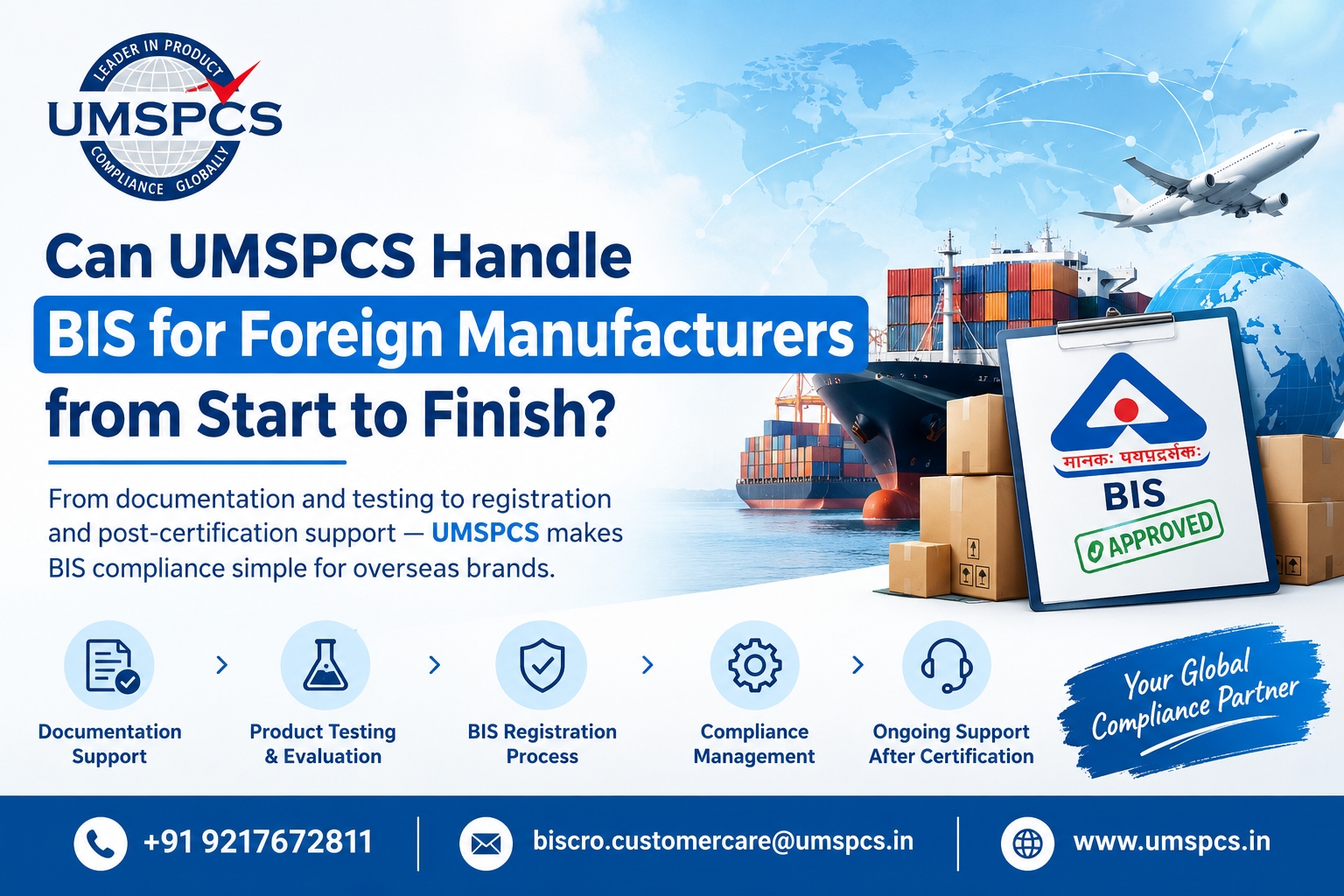
So the question we hear most often is a fair one: can one partner really take care of BIS for foreign manufacturers without handing you a to-do list every week? At UMSPCS, the answer is yes. Here is how the work is handled from the first call to the final licence.
Why BIS for Foreign Manufacturers Is Different
The Bureau of Indian Standards runs a few certification routes, and the one you need depends on what you make. Electronics and IT products usually fall under the Compulsory Registration Scheme, known as CRS. Many industrial and consumer goods, such as steel, cement, cables and furniture, fall under the ISI mark through the Foreign Manufacturers Certification Scheme, or FMCS.
Indian factories deal with BIS officers close by. A manufacturer abroad does not have that luxury. You must appoint an Authorised Indian Representative, test your product in a BIS-recognised laboratory, and in many cases allow a BIS official to inspect your plant overseas. Forms are filed online, in a set format, with exact documents. One wrong model number can send an application back by weeks.
That is why BIS for foreign manufacturers is rarely a do-it-yourself job. Every step depends on the one before it.
What "Start to Finish" Actually Means
Plenty of consultants will fill in a form for you, but BIS for foreign manufacturers needs more than that. That is one slice of the work. For us, start to finish covers the following.
Scheme and standard check. Before anything is filed, we confirm whether your product needs CRS, ISI or no BIS approval at all, and match it to the right Indian Standard. A wrong choice here is the costliest mistake we see.
Document preparation. Typical items include business registration, manufacturing unit details, product drawings, a block diagram, trademark proof and an authorisation letter. We review everything before submission so nothing bounces back.
Authorised Indian Representative. A foreign company cannot apply without one. UMSPCS can act in this role, so you are not hunting for a local entity you may not trust.
Sample testing. We tell you which samples to send, how many, and how to label them. We coordinate with the lab and chase the report, because test delays are a common reason timelines slip.
Application and portal work. Registration, filing, fee payment and replies to BIS queries all run through official portals. We handle them and answer any objections.
Factory inspection support. For ISI licences, a BIS officer may visit your facility. We help you prepare the quality control setup, testing equipment list and records an inspector will ask for.
Grant and labelling. Once approved, you receive the CRS registration number or ISI mark licence for UK. We check the details on the certificate and advise on how the BIS mark should appear on your product, since wrong labelling can cause trouble at customs.
What Happens After You Are Certified
Getting the certificate is not the end. Registrations and licences need renewal. Models change. Factories relocate. Standards get revised, and a product that was compliant last year may need retesting. A steady partner for BIS for foreign manufacturers tracks these dates so you do not discover a lapse when a shipment is stuck at the port.
We also help add new models or series to an existing certificate, which is far quicker than starting over when handled properly.
How Long Does It Take?
Honest answer: it depends. A simple CRS registration with a ready sample and clean documents can move fairly quickly. FMCS cases take longer because they involve testing, an inspection and a licence decision. Lab queues, missing papers and slow replies are the usual causes of delay.
We do not promise unrealistic dates. We give you a plan with each stage, the owner of every task and a sensible time range, then update you as it moves. The best way to shorten the route is to send complete documents early.
Who Do We Work With?
We deliver BIS for foreign manufacturers and exporters from Europe, North America, the Middle East and across Asia. Some are known brands with a compliance team. Others are mid-sized factories entering India for the first time with nobody on staff who has seen a BIS form. Both get the same attention, though the second group usually needs more explanation along the way.
Read more about BIS for Taiwan manufacturers .
Why Choose UMSPCS
One point of contact. You are not passed between a lab, an agent and a filing team.
Plain communication. We explain status in simple language, not jargon.
Clear scope. You know what is covered before you pay.
Support after approval. Renewals, changes and queries continue after the certificate arrives.
Choosing support for BIS for foreign manufacturers is really about trust. You are handing over part of your market entry plan. We would rather tell you early in any BIS for foreign manufacturers project that a product does not need BIS than collect a fee for work you do not need.
Ready to Begin?
Send us your product name, model details and country of manufacture. We will tell you which scheme applies, what to prepare and what the process is likely to look like. That first conversation costs nothing, and it usually saves a lot of guessing. Talk to UMSPCS about BIS for foreign manufacturers today.
Read also BIS for Canada Manufacturers: A Practical Guide to Selling in India .
Frequently Asked Questions
1. Can UMSPCS manage BIS for foreign manufacturers entirely on its own?
Yes. Scheme selection, documents, testing coordination, portal filing, inspection support and the final certificate are all handled by our team. You provide documents, samples and timely replies.
2. Do I need an Indian office to apply for BIS as a foreign manufacturer?
No. You must appoint an Authorised Indian Representative, and UMSPCS can serve in that role. You do not need a branch in India.
3. What is the difference between CRS and FMCS?
CRS covers specified electronics and IT products and works through registration after lab testing. FMCS covers products under the ISI mark and usually involves a factory inspection plus a licence.
4. Will a BIS officer visit my factory?
For FMCS licences, an inspection is generally part of the process. For CRS registration, a visit is usually not required.
5. How long does BIS for foreign manufacturers take?
It varies by product, scheme, lab schedule and how quickly documents are ready. We share a stage-wise timeline after reviewing your product details.
6. Does BIS certification expire?
Yes. Registrations and licences carry a validity period and need renewal. We track the dates and help you renew before they lapse.
7. What if my product does not need BIS?
We will tell you honestly. Not every product is covered, and we confirm that before any work begins.