Code review practice means deliberately reading and evaluating source code, not just running a scanner against it to build the pattern recognition needed to spot injection flaws, broken access control and authentication mistakes. The fastest way to get good at it is repetition: work through small, purpose-built vulnerable code samples on a fixed schedule, check your findings against a known answer key and gradually move from singlefunction snippets to multifile applications. Reading advice about code review does not build the skill; reading code does.
What Code Review Practice Actually Means
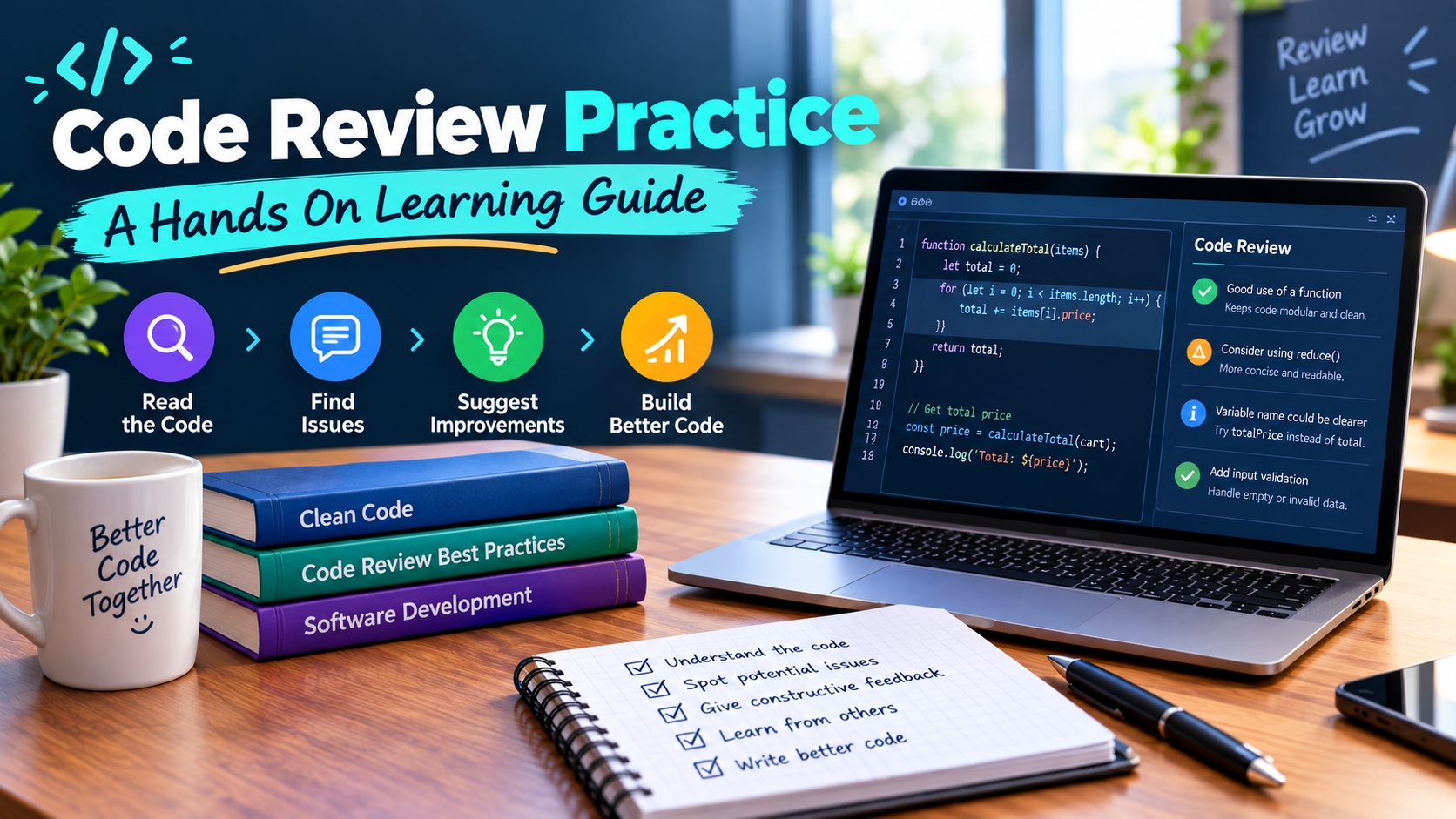
There is a gap between knowing what a SQL injection flaw looks like on a slide and spotting one buried inside forty lines of a Java data access object at 11 p.m. during a real review. That gap only closes through repetition. Code review challenges is the deliberate, repeated act of reading source code with the specific goal of finding security weaknesses, logic errors and deviations from secure coding standards done often enough that the recognition becomes automatic rather than effortful.
This is different from code review in a production sense, where the goal is shipping a working pull request. Practice review has no deadline pressure and no business context to distract you. Its only job is training your eye. You look at a snippet, you form a hypothesis about where the danger is, you check your hypothesis and you move to the next one. Over weeks, the categories of flaws: unsanitized input reaching a query, a missing ownership check on an object ID, a session token that never expires start to jump off the screen instead of hiding in it.
Most engineers who are strong at security focused review did not get there by reading a checklist once. They got there by looking at hundreds of small, deliberately flawed examples and building a mental library of what wrong looks like in each language and framework they work in.
Why Reading Code Beats Reading About Code
It is tempting to treat code review as something you can learn by memorizing the OWASP Top 10 categories and moving on. That gets you vocabulary, not skill. Knowing that broken access control exists is not the same as noticing that a getInvoice(id) function trusts a client supplied ID without checking who owns the invoice.
Deliberate practice closes that gap in three ways. First, it forces active retrieval. You have to decide, line by line, whether something is safe, which is a fundamentally different cognitive task than passively reading an explanation. Second, it exposes you to variation. The same underlying flaw (say, an injection vulnerability) looks different in a raw SQL string concatenation, in an ORM misconfiguration and in a stored procedure call and only repeated exposure teaches you to recognize the pattern across all three shapes. Third, it builds speed. In a live review, you rarely get to spend twenty minutes per function; practice compresses the time it takes to form an accurate first impression of a piece of code.
If you have spent time in web application hacking labs, you already know this principle from the offensive side. You learn to find a reflected input flaw faster by attacking dozens of intentionally vulnerable applications than by reading a single writeup. Defensive code review skill is built the same way, just from the reviewer's chair instead of the attacker's.
The Skills You Build Through Repeated Practice
A structured practice habit develops several distinct abilities at once and it helps to know what you are actually training so you can track progress rather than just doing exercises.
Pattern recognition is the ability to glance at a block of code and immediately flag the shape of a risky operation string concatenation feeding a query, unescaped output rendering into HTML, a redirect built from a query parameter. This is the skill that eventually lets an experienced reviewer scan a diff in minutes instead of hours.
Data flow tracing is the discipline of following a piece of untrusted input from where it enters an application (a form field, a URL parameter, an API payload) through every function it touches until it either gets validated, sanitized, or reaches a dangerous sink. Most serious vulnerabilities live in that gap between entry point and sink.
Context judgment separates a true finding from a false one. Not every string concatenation is a SQL injection risk; it depends on whether the value ever includes attackercontrolled input and whether that input is parameterized somewhere upstream. Practice teaches you to ask "does this data flow to a dangerous place from an untrusted source" instead of patternmatching on syntax alone.
Prioritization is knowing which of ten findings in a file actually matters. A missing rate limit on a low value endpoint is not the same severity as an authentication bypass and reviewers who practice regularly develop an instinct for triage that saves enormous time in real audits.
Setting Up a Personal Code Review Practice Routine
Consistency beats intensity. A reviewer who works through three short exercises a week for three months will outperform someone who does one marathon weekend of study and then stops. Here is a routine that scales from complete beginner to intermediate practitioner.
Start with singlefunction snippets, ten to twenty lines each, in a language you already know. Set a timer for five minutes per snippet and write down every suspicious line before checking an answer key. The time pressure matters; it forces you to trust your pattern recognition instead of exhaustively reasoning through every possibility, which is closer to how real reviews happen.
After two or three weeks of singlefunction practice, move to full request handlers the code that receives a request, processes it and returns a response. This is where data flow tracing becomes essential, because the vulnerable sink is often several function calls away from the entry point.
By week six or so, introduce multifile review: a controller, a service layer and a data access layer together. This mirrors how real applications are structured and teaches you to hold context across files, which is one of the hardest parts of realworld review. The source code review lab is built for exactly this stage; it gives you realistic, multifile applications with planted vulnerabilities and lets you verify your findings against a scored answer set instead of guessing whether you caught everything.
Keep a running log of what you missed, not just what you found. The misses are more valuable than the hits because they tell you which vulnerability category needs another round of deliberate attention.
Practice Exercises by Vulnerability Category
Structuring practice around specific vulnerability classes, rather than reviewing random code, accelerates learning because you can drill a single pattern until it becomes automatic before moving on.
Injection flaws. Work through code samples where user input reaches a database query, a shell command, or a template engine. Look specifically for string concatenation or formatting functions building a query and check whether parameterized queries or prepared statements are used instead. The SQL injection lab is a strong companion here because it lets you pair the reviewer perspective of this query with the attacker's perspective of actually exploiting the unsafe version, which cements the pattern far faster than review alone.
Crosssite scripting. Practice tracing output rather than input. Find every place a variable gets written into an HTML response, a JavaScript context, or an HTML attribute and check whether the templating engine autoescapes by context or whether raw concatenation is happening. The crosssite scripting lab gives you exploitable examples across reflected, stored and DOMbased variants, which matters because each one shows up differently in source.
Crosssite request forgery. Review statechanging endpoints (anything that writes, updates, or deletes) and check for antiCSRF tokens, samesite cookie attributes, or origin validation. A shockingly common finding in practice sets is a statechanging GET request with no token requirement at all.
Insecure direct object references. This is one of the most instructive categories to practice because the code often looks completely correct at a glance. Find every place an identifier from the request, a record ID, a file path, a user ID is used to fetch or modify a resource and check whether there is an explicit ownership or permission check before that lookup happens.
Authentication and session flaws. Review login flows, password reset logic and session management code for issues like predictable tokens, missing rate limiting on login attempts, session identifiers that don't rotate after login, or reset tokens that never expire.
From Practice Exercises to Real Labs
Isolated snippets are the right starting point, but they eventually plateau in value because real vulnerabilities rarely live in a clean, tenline function; they live in the interaction between components. Once singlefile exercises start feeling easy, the next step is realistic, intentionally vulnerable applications where you review the source and then confirm your findings by exploiting them.
This is where handson labs earn their place in a practice routine. Reviewing a login controller and correctly flagging a broken authentication check is good; then using that same finding to actually bypass the login is what proves the finding was real and not a false positive. The challenges section organizes exactly this kind of progressive, scoring practice, moving from focused single vulnerability exercises toward multistep scenarios that combine several flaw categories the way real applications do.
It's also worth remembering that code review as a discipline is not limited to traditional web backends. Mobile applications carry their own review patterns, insecure local storage, weak certificate pinning, exported components with no permission checks and the overview in this guide to mobile application security testing is a useful next step once webfocused review starts feeling comfortable.
Common Mistakes Beginners Make During Practice
New practitioners tend to repeat a small set of avoidable errors. The first is reviewing too slowly and too exhaustively on every exercise, trying to reason through every theoretical edge case instead of trusting pattern recognition and moving on. Real reviews have time constraints and practice should build the instinct to prioritize likely issues over chasing every hypothetical.
The second is skipping the why. Finding a vulnerability without being able to explain the exploit path and the correct fix means the pattern has not actually been internalized. It was luck. Every finding during practice should come with a one sentence explanation of how an attacker would abuse it and what the correct remediation looks like.
The third is only ever practicing on code that is already known to be vulnerable. Real codebases are a mix of safe and unsafe patterns and reviewers who only ever see guaranteed vulnerable samples can develop a bias toward overflagging safe code once they move to real work. Mixing in clean, correctly written examples during practice trains the equally important skill of recognizing when code is actually fine.
The fourth is practicing in isolation with no accountability. Working alongside a small group, or at minimum tracking scored results over time, keeps practice honest and surfaces blind spots that selfreview alone tends to miss.
Measuring Your Progress
Track three numbers over time rather than relying on a subjective sense of improvement. First, time to first finding on a new exercise that should shrink as pattern recognition improves. Second, precision the ratio of real findings to false positives you flagged, which should climb as context judgment sharpens. Third, cover the percentage of planted vulnerabilities in an exercise set that you catch before checking the answer key, which is the most direct measure of whether the practice is working.
Revisit exercise sets you completed a month or two earlier. If your time and accuracy have both improved on material you've already seen, that's a reasonable signal the underlying skill, not just memorization of that specific answer key, is transferring. It also helps to keep a simple spreadsheet: exercise name, date attempted, vulnerabilities found, vulnerabilities missed and time taken. Patterns emerge quickly; most learners discover that one or two categories, often authorization logic or session handling, account for the majority of their misses and that data point tells you exactly where the next few weeks of practice should focus.
Using a Checklist Alongside Practice
Deliberate practice teaches recognition, but a checklist keeps recognition from becoming inconsistent under pressure. Even reviewers with strong pattern recognition benefit from a written reference that lists the categories to confirm before signing off input validation, output encoding, authentication state, authorization checks and error handling among them. A checklist is not a replacement for the judgment built through practice; it is a safety net that catches the categories your attention happened to drift past on a busy day. The code review checklist guide breaks down exactly which items belong on that list and why each one earns its place and it pairs naturally with a practice routine using the exercises to build the instinct and the checklist to verify nothing got missed on the days your instinct was rushed.
Conclusion
Code review practice is a skill built through repetition, not a fact learned through reading. Starting with small, focused snippets, working systematically through each major vulnerability category and graduating to realistic multifile applications gives you a training path that mirrors how real reviewers actually developed their eye. The habit matters more than any single exercise: a consistent, modest weekly routine, checked against scored labs and real exploitation, will outperform sporadic bursts of study every time. For anyone serious about building this skill, pairing structured practice with the exercises and labs at AppSecMaster turns abstract vulnerability categories into pattern recognition you can actually rely on under real deadline pressure.
Frequently Asked Questions (FAQs)
How much time should I spend on code review practice each week?
Thirty to sixty minutes, three times a week, produces better long term results than one long session. Short, frequent repetition builds pattern recognition more reliably than occasional marathon study.
Do I need to know how to exploit a vulnerability to review code for it effectively?
It helps significantly. Understanding the exploit path makes it far easier to judge whether a given code pattern is actually dangerous versus theoretically imperfect, which is why pairing review practice with handson labs produces stronger reviewers than review alone.
What programming language should I start practicing with?
Whichever language you already read comfortably. The vulnerability patterns injection, broken access control, unsafe output are largely languageagnostic, so early practice should focus on the pattern, not on learning new syntax at the same time.
Is automated static analysis a substitute for manual code review practice?
No. Automated tools catch known patterns reliably but routinely miss business logic flaws like broken access control or authorization gaps that depend on understanding what the code is supposed to do. Manual review skill remains necessary even in teams with mature scanning pipelines.
How do I know when I am ready to move from exercises to real pull requests?
When you can consistently catch the majority of planted flaws in a multifile exercise within a reasonable time limit and explain the exploit path for each one, you have enough pattern recognition to start reviewing real code under supervision.