FOB or CIF for Essential Oil Shipments from India: What Changes in Your Landed Cost
By Piyush Gupta, Founder & CEO, Kanha Nature Oils · 27 years in the fragrance and essential oils industry · Regional Secretary (North Zone), FAFAI · Treasurer, EOAI · Vice President, Sugandh Vyapar Sangh North Zone
Two Indian suppliers quote you for the same bulk lavender oil. One says FOB, the other says CIF, and the CIF price looks higher. Which is cheaper once the drums reach your warehouse?
For most buyers comparing FOB and CIF on an essential oil import from India, the short answer is this. FOB gives you control of freight, insurance and the carrier, and usually the lower total if you have a reliable forwarder. CIF is simpler when you do not, but you pay for freight you cannot see and get only minimum insurance. Where you import also matters: the US charges duty on a value that excludes freight, while the EU charges it on a value that includes it.
This guide shows exactly what each term covers, where risk moves, how each one changes your landed cost, and when neither is the right term at all.
FOB vs CIF at a glance
Both are Incoterms 2020 rules published by the International Chamber of Commerce. The cost split is the main difference.
| FOB (Free On Board) | CIF (Cost, Insurance and Freight) |
|---|---|---|
Named place | Port of shipment in India, e.g. FOB Nhava Sheva | Port of destination, e.g. CIF Rotterdam |
Inland transport to Indian port | Seller | Seller |
Indian export clearance | Seller | Seller |
Loading on the vessel | Seller | Seller |
Ocean freight | Buyer | Seller |
Cargo insurance | Buyer’s choice | Seller, at minimum cover |
Who chooses the carrier | Buyer | Seller |
Destination port charges, import clearance, duty, tax | Buyer | Buyer |
Risk passes to buyer | When goods are on board in India | When goods are on board in India |
The last row surprises many buyers. Under both terms the risk is yours from the moment the drums are loaded in India. CIF moves cost, not risk.
Where risk moves, and why CIF insurance may not be enough
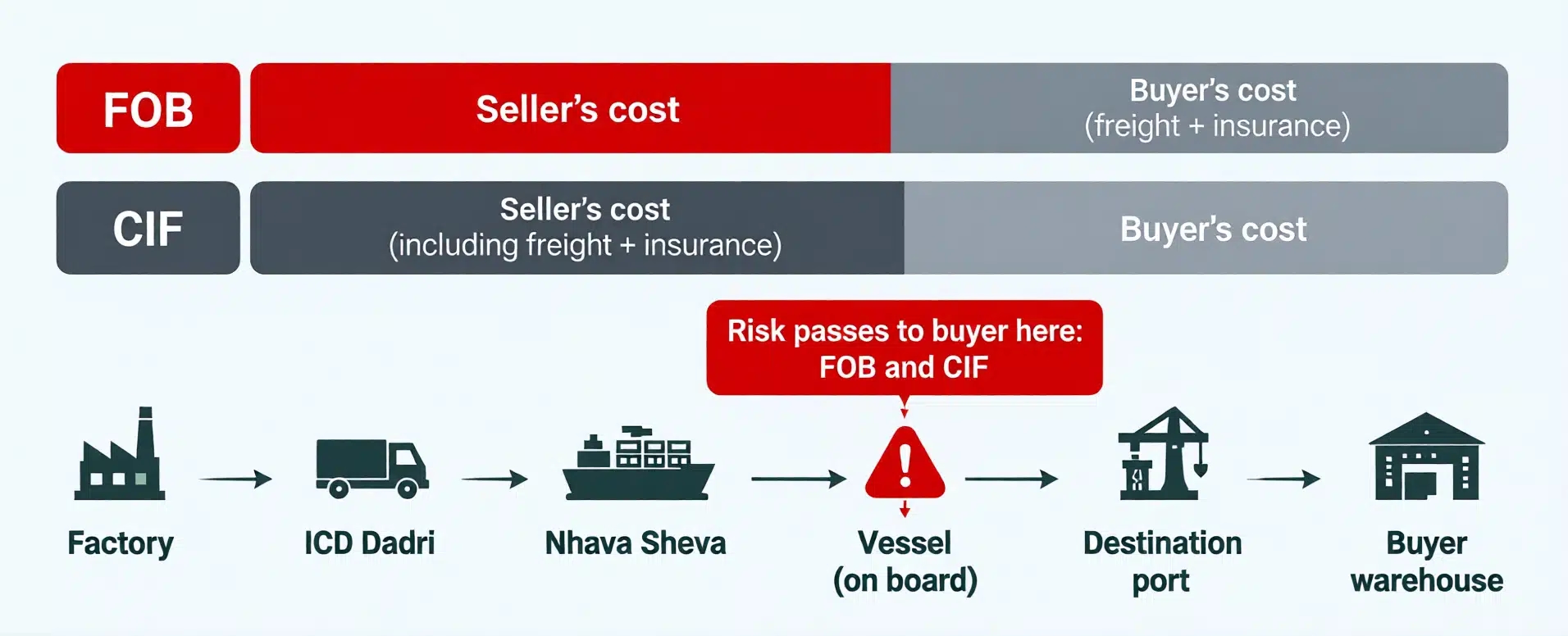
Because risk transfers at loading under both FOB and CIF, any loss at sea is your claim to make. Under CIF the seller must insure the goods for you, but Incoterms 2020 sets that cover at the minimum. The seller insures at least 110% of the contract value under Institute Cargo Clauses (C), unless you agree otherwise.
Clauses (C) is a named-perils policy. It covers events such as fire, sinking and collision, not all loss. For essential oils, the realistic losses are leaking drums, contamination and temperature damage, which sit outside that narrow cover.
If you buy CIF, ask the supplier to quote Institute Cargo Clauses (A), or top up the cover yourself. If you buy FOB, your own policy or your forwarder’s open cover applies from loading.
How FOB and CIF change your landed cost
Landed cost is everything you pay until the oil is in your warehouse:
product price
inland transport and export clearance in India (in the price under both terms)
ocean or air freight
cargo insurance
destination port and terminal charges
customs duty and import tax
customs broker fees
delivery to your warehouse
Only freight and insurance change hands between the two terms. Everything after the destination port is yours either way.
Worked example on one essential oil consignment
The figures below are illustrative, not quotes or real tariff rates.
Line | FOB route | CIF route |
|---|---|---|
Supplier price | USD 20,000 FOB Nhava Sheva | USD 22,300 CIF destination port |
Ocean freight booked by your forwarder | USD 1,800 | Included in price |
Insurance, Clauses (A) | USD 60 | Included, Clauses (C) only |
Cost to destination port | USD 21,860 | USD 22,300 |
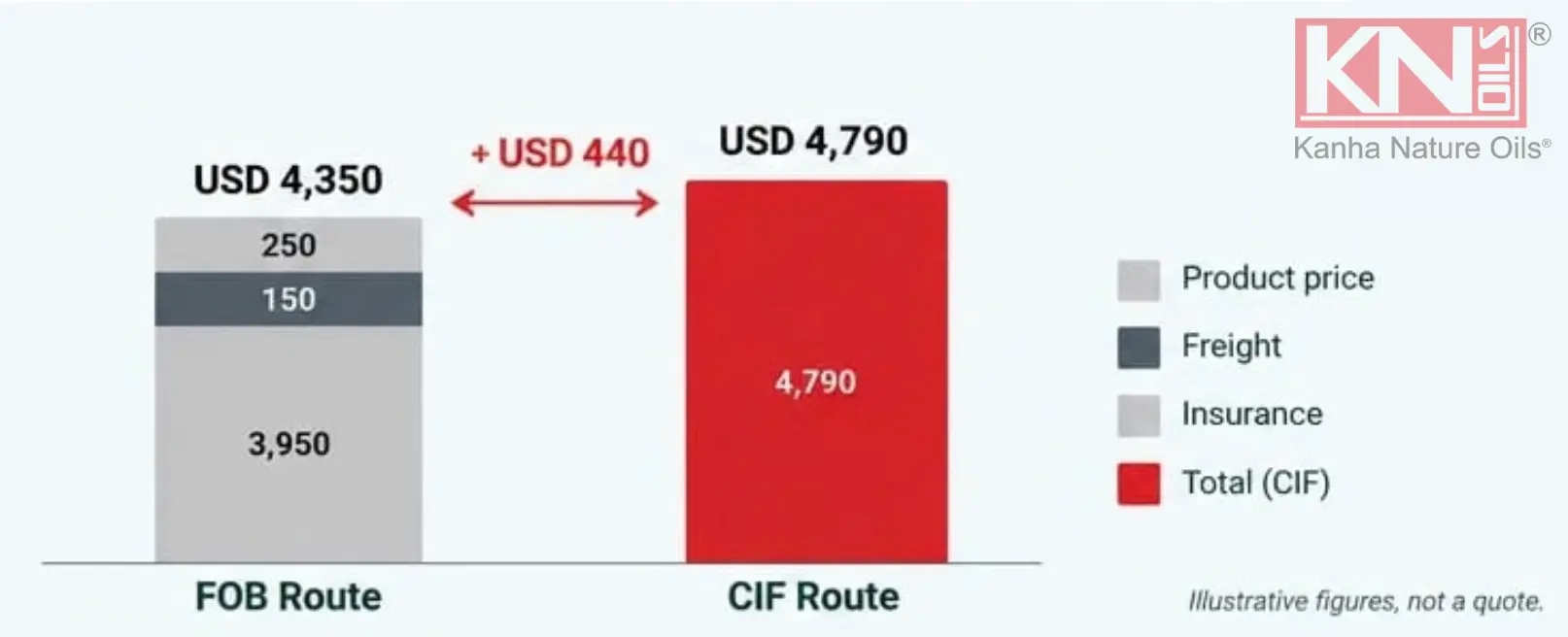
The CIF quote carries USD 440 more than the FOB route, plus thinner insurance. That gap is common, because the seller’s freight booking can include a margin you cannot see. It can also go the other way when the seller ships volume and has better contract rates. The point is to compare like with like: ask the CIF supplier to show freight and insurance as separate lines on the invoice.
The cost a CIF quote does not show
Under CIF the seller chooses the carrier, often a consolidator (NVOCC) that offers the seller a low freight rate. Some consolidators recover that margin at destination, billing the buyer for terminal handling, documentation, delivery order release and de-stuffing. You did not choose that carrier, so you have little room to negotiate, and those charges can exceed the saving the CIF quote appeared to offer.
Before accepting a CIF quote, ask which carrier or consolidator will be used and request an estimate of its destination charges at your port.
Your customs duty base depends on where you import
This is the part most generic Incoterms guides skip.
United States. US Customs and Border Protection appraises most imports at transaction value, which excludes international freight and insurance under 19 CFR 152.103. If your invoice is CIF, those costs need to be shown separately to be deducted.
European Union. Under the Union Customs Code, transport and insurance costs up to the EU border are added to the customs value. Duty is effectively charged on a CIF value, whichever term you bought on.
Take the FOB route from the example above and a hypothetical 5% duty rate. A US importer pays duty on USD 20,000 (USD 1,000). An EU importer on the same FOB route pays duty on roughly USD 21,860 (about USD 1,093), because freight and insurance to the border are added.
On the CIF route, the EU duty base is the full USD 22,300 (about USD 1,115). A US importer buying CIF can still deduct freight and insurance, but only if the invoice shows them separately. In both markets, import tax such as EU import VAT is then calculated on top. Check your own tariff line, usually under HS heading 3301 for essential oils, with your customs broker.
The question to ask first: are FOB and CIF the right terms for your shipment?
Under Incoterms 2020, FOB, CFR, CIF and FAS apply only to sea and inland waterway transport. That rules them out for two of the most common essential oil shipments.
Read more :- Kanha Nature Oils