
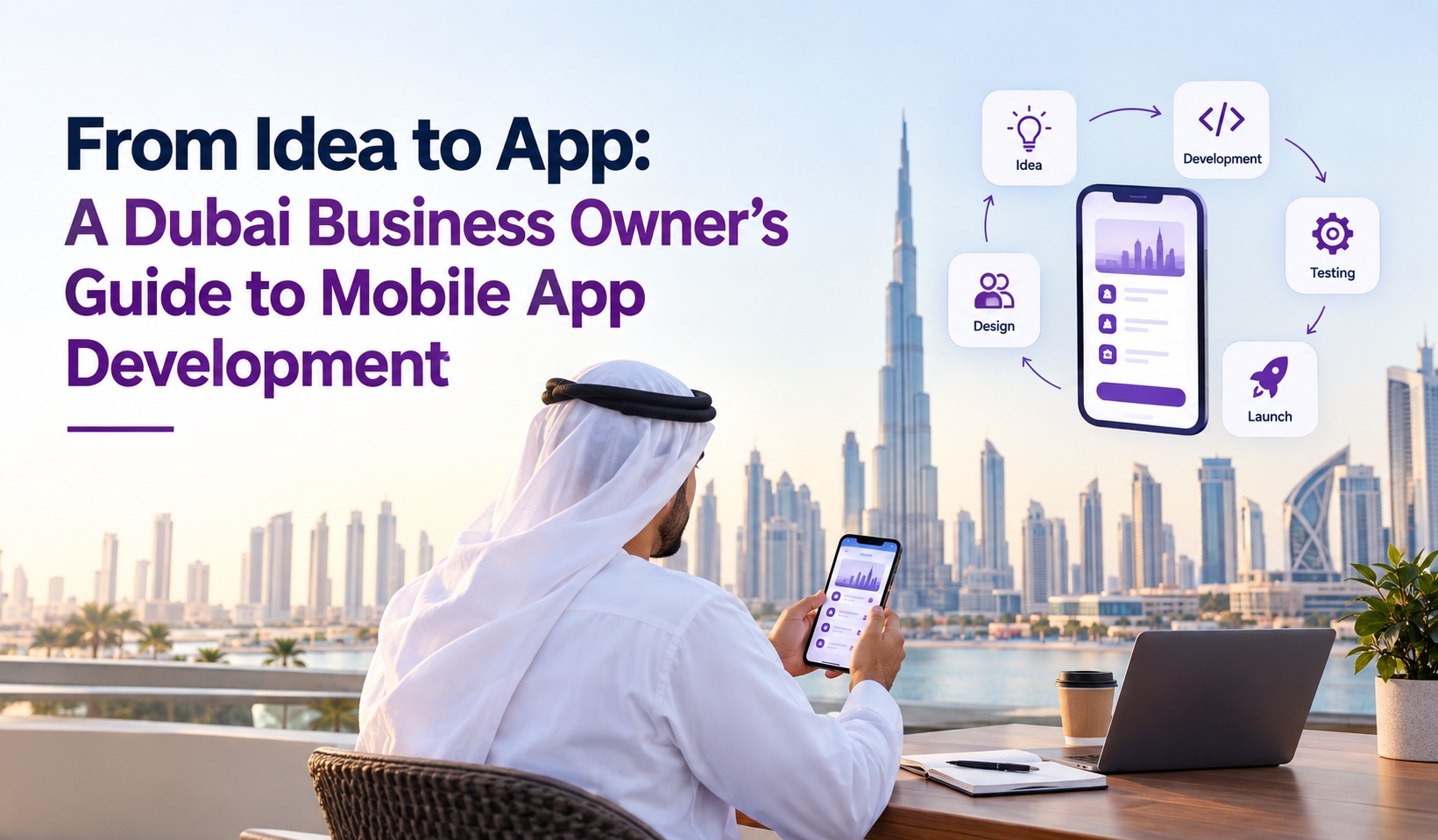
Having an app idea is easy. Turning that idea into a mobile application that customers actually use is where the real work begins.
For businesses in Dubai, a mobile app can become a customer-facing channel, an internal business tool, a booking platform, an e-commerce storefront, a loyalty system, or a way to deliver completely new digital services. But building an app successfully requires more than hiring developers and starting to code.
You need to define the business problem, understand your users, choose the right technology, plan the features, estimate the investment, and have a clear strategy for launching and improving the product.
This guide explains the process from the initial idea to a finished mobile app and highlights the decisions Dubai business owners should consider along the way.
Start With the Business Problem, Not the App
The first question should not be, “What features should our app have?”
Instead, ask:
“What business problem are we trying to solve?”
For example, a Dubai business might want an app to:
Allow customers to book appointments
Accept and manage online orders
Provide home-service bookings
Manage memberships and subscriptions
Offer loyalty rewards
Connect customers with service professionals
Provide real-time delivery updates
Digitize internal workflows
Give customers access to their accounts and documents
Create a new digital revenue channel
Once the problem is clear, the app becomes much easier to plan.
A restaurant that wants to reduce dependence on third-party ordering platforms will need a very different application from a healthcare provider that wants patients to schedule appointments and communicate with clinicians.
Define Your Target Users
Dubai has a highly diverse customer and business environment, so assuming that everyone is your target user can make an app unnecessarily complicated.
Identify your primary users before defining the feature list.
Consider:
Who will use the app?
What problem are they experiencing?
How frequently will they use it?
What device are they likely to use?
What action do you want them to complete?
What could prevent them from using the application?
For a B2C application, this could mean understanding customer behavior and purchasing habits.
For a B2B application, you may need to consider different user roles, such as administrators, employees, managers, and customers.
Creating user personas and basic user journeys at this stage can prevent expensive changes later.
Decide Which Features Are Actually Necessary
One of the most common mistakes businesses make is trying to put every possible feature into version one.
A better approach is to separate features into three categories:
Priority | What it means | Example |
|---|---|---|
Essential | Required for the app to work | Registration, login, booking |
Valuable | Improves the experience | Notifications, reviews, saved preferences |
Future | Can be added later | AI recommendations, advanced analytics |
This approach allows you to build a Minimum Viable Product (MVP) instead of spending heavily on features that have not yet been validated.
For example, a home-service business might initially need:
Customer registration
Service selection
Booking
Staff assignment
Online payment
Booking status
Notifications
Admin dashboard
Advanced AI recommendations or complex reporting could come later.
The goal is not to build the smallest possible app. It is to build the smallest useful version of the product.
Choose the Right App Development Approach
Once your requirements are defined, you need to decide how the application will be developed.
The main options include native and cross-platform development.
Native app development
Native applications are developed specifically for platforms such as iOS or Android.
They can provide strong performance and access to platform-specific capabilities, but maintaining separate applications can increase development and maintenance requirements.
Cross-platform development
Cross-platform technologies allow businesses to develop applications that can operate across multiple platforms using a shared codebase.
This can be useful for businesses that want to launch on both iOS and Android while managing development resources efficiently.
The right choice depends on the application's functionality, performance requirements, integrations, target users, budget, and long-term roadmap.
A professional development team should recommend the technology based on these requirements rather than simply choosing the technology it already prefers.
Think About the Backend Too
The mobile application is only one part of the product.
Behind the app, you may need:
APIs
Databases
Authentication
Admin dashboards
Cloud infrastructure
Payment integrations
Analytics
Push notification services
Third-party integrations
Security controls
For example, when a customer books a service through an app, several things may happen behind the scenes:
Customer → Mobile App → API → Database → Business Dashboard → Notification
A well-designed backend makes it possible to manage these processes reliably as the number of users grows.
This is particularly important if your Dubai business expects the application to become an important operational or revenue channel.
Plan Your UI and UX Before Development
A technically functional application can still fail if users find it confusing.
UI refers to the visual interface, while UX focuses more broadly on how people experience and navigate the product.
Before development begins, consider creating:
User flows
Wireframes
Screen designs
Clickable prototypes
Design guidelines
For example, a booking application should make the path from select service → choose date → choose time → confirm booking as straightforward as possible.
Every unnecessary screen or confusing interaction can create friction.
For Dubai businesses competing in digitally mature markets, user experience should be treated as part of the product strategy rather than simply a design task.
Consider Payments and Third-Party Integrations
Many business applications depend on external services.
Depending on your business model, your app may need integrations with:
Payment gateways
Maps and location services
CRM platforms
ERP systems
Accounting software
Marketing platforms
Communication services
Booking systems
Inventory platforms
Healthcare systems
Analytics tools
The integration requirements should be identified before development starts.
A business that discovers halfway through development that its existing software cannot communicate properly with the new app may face additional development work, delays, or architectural changes.
Security Should Be Part of the Development Process
Security should not be something added immediately before launch.
Mobile applications can handle sensitive information such as:
Customer profiles
Contact details
Payment information
Business data
Location information
Login credentials
Healthcare information
Depending on the industry and type of information processed, different legal, regulatory, and security requirements may apply.
Your development plan should therefore consider authentication, authorization, secure APIs, encryption where appropriate, data handling, access controls, logging, and regular security testing.
For businesses operating in regulated sectors such as healthcare and financial services, requirements should be reviewed with appropriate legal and compliance professionals alongside the technology team.
How Much Does Mobile App Development Cost in Dubai?
There is no single price for building a mobile app.
The cost depends on the scope and complexity of the project.
Some of the major factors include:
Number of platforms
Number of screens
UI/UX complexity
Backend requirements
Admin dashboard
Third-party integrations
Payment functionality
Real-time features
Security requirements
User roles
Testing requirements
Post-launch maintenance
A basic business application with a limited number of features will naturally require a different investment from an enterprise platform with multiple user roles, complex integrations, and real-time functionality.
Instead of asking only for an hourly rate, business owners should request a clear breakdown of features, technology, development stages, integrations, testing, deployment, and ongoing maintenance.
This makes vendor comparisons more meaningful.
How Long Does It Take to Build an App?
Development timelines also vary considerably.
A simple MVP may require significantly less time than a feature-rich enterprise application.
A typical development process can include:
Discovery → Planning → UI/UX → Development → Integration → Testing → Deployment → Maintenance
The timeline is affected by the same factors that influence cost.
Adding features during development can also extend the schedule. This is why defining the MVP before coding begins is important.
If a business has a fixed launch date, the development team should identify the must-have functionality early and separate it from features that can be released in later versions.
Choosing a Mobile App Development Company in Dubai
Choosing a development partner in Dubai is one of the most important decisions in the process.
Instead of evaluating companies only on their portfolio or quoted price, look at how they approach your business problem.
Ask potential development partners:
Have they built similar applications?
Can they explain the proposed architecture?
How will they handle integrations?
What testing process do they follow?
How will security be addressed?
Who owns the source code?
What happens after launch?
How are changes handled?
Can they scale the application as users increase?
Will they provide documentation and technical support?
A good development conversation should involve more than a list of technologies.
The company should understand what your business is trying to achieve and explain how the application can support that objective.
Where RowthTech Fits Into the Process
For businesses looking for a mobile app development partner in Dubai, RowthTech provides custom software and mobile app development services for businesses across international markets, including the Middle East.
Its approach can cover different stages of the product lifecycle, from understanding the initial idea and defining requirements to UI/UX design, application development, integrations, testing, deployment, and ongoing support.
For a Dubai business, this can be particularly useful when the application needs to connect with existing business systems rather than operate as a standalone product.
The important point is to start with the business requirement and then determine the appropriate technology, architecture, and feature set.
Don't Treat Launch as the Finish Line
Getting an app published is not the end of the project.
After launch, you need to understand how users interact with it.
Track metrics such as:
Downloads
Registrations
Active users
Feature usage
Booking or purchase completion
User retention
Drop-off points
App crashes
Customer feedback
This information can reveal which features are actually delivering value and where users are encountering problems.
The next versions of the application should be based on real usage data and business priorities rather than simply adding features because competitors have them.
A Practical Roadmap for Dubai Business Owners
If you have an app idea but do not know where to start, use this roadmap:
Step 1: Define the problem
Identify the business or customer problem the app will solve.
Step 2: Identify users
Determine who will use the application and what they need.
Step 3: Define the MVP
Separate essential features from future enhancements.
Step 4: Plan the user experience
Create user flows, wireframes, and prototypes.
Step 5: Select the technology
Choose native or cross-platform development based on actual requirements.
Step 6: Plan integrations
Identify APIs, payment systems, CRMs, ERPs, and other required connections.
Step 7: Build and test
Develop the application and test functionality, usability, security, and performance.
Step 8: Launch
Deploy the application to the relevant app stores and prepare your backend infrastructure.
Step 9: Measure and improve
Use user feedback and analytics to determine what should be improved or added next.
Final Thoughts
Turning an app idea into a working product is not simply a coding exercise. It is a business project that involves strategy, user experience, technology, security, integrations, testing, and continuous improvement.
For Dubai business owners, the best starting point is therefore not a technology stack or a feature list.
Start with the problem.
Understand your users. Define what the first version genuinely needs to accomplish. Choose technology around those requirements, and work with a development partner that can support the product beyond the initial launch.
With the right planning, an app can move from an idea on paper to a practical digital product that supports your business and gives customers a simpler way to interact with your services.