
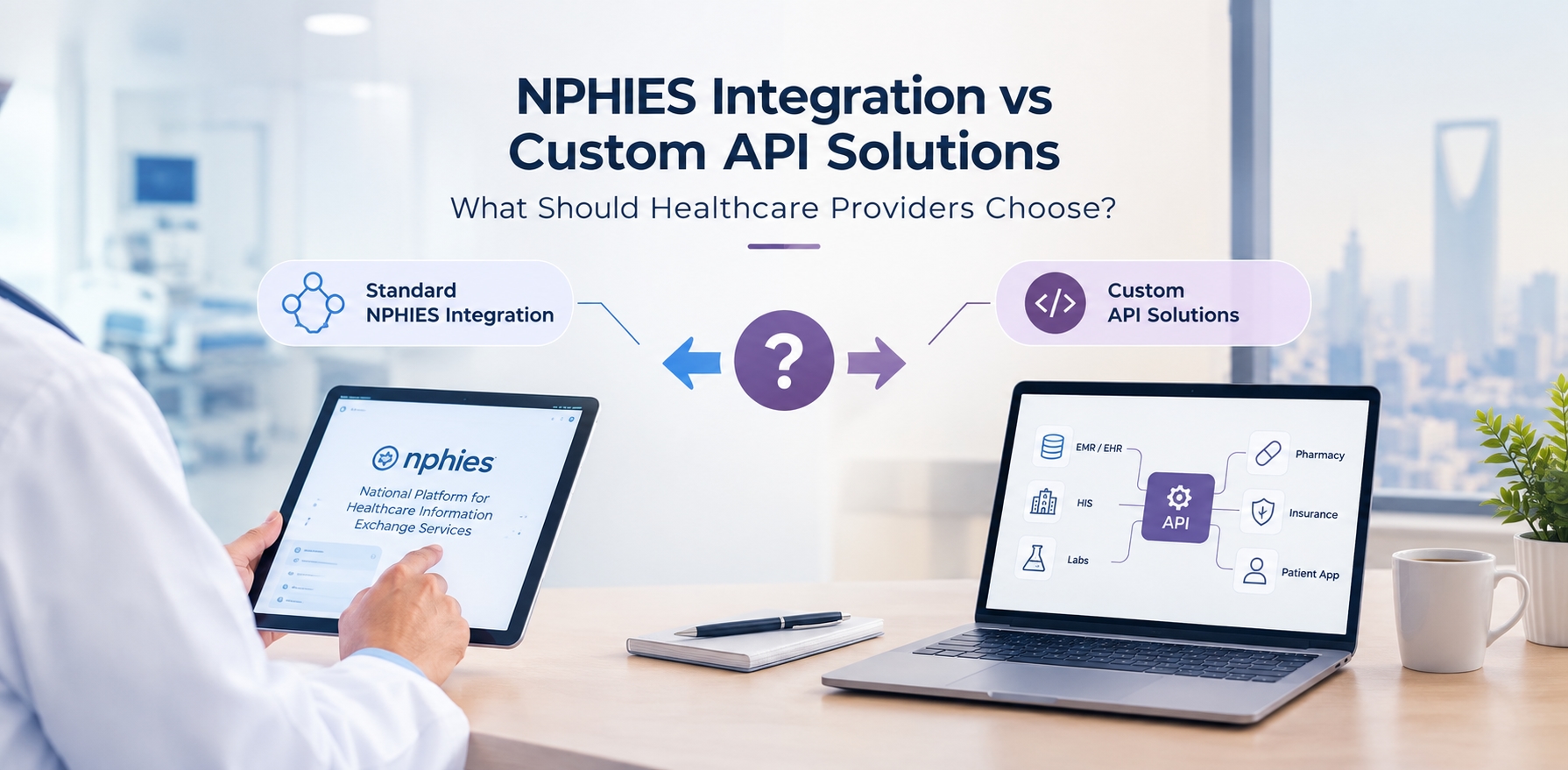
Saudi Arabia’s healthcare sector is becoming increasingly connected. Hospitals, clinics, laboratories, pharmacies, insurers, and healthcare software providers are expected to exchange information digitally rather than operate through isolated systems.
For organizations working with the National Platform for Healthcare Information Exchange Services (NPHIES), the question is often not simply whether to integrate with NPHIES. The bigger question is how that integration should fit into the organization’s existing technology environment.
Should a healthcare provider use a standard NPHIES integration approach? Should it build a custom API layer around its existing EMR, EHR, HIS, RCM, or patient platform? Or should it combine both approaches?
There is no universal answer.
The right choice depends on the organization's existing software architecture, workflows, interoperability requirements, scalability plans, internal technical capabilities, and the level of customization required.
This guide explains the practical trade-offs between NPHIES integration and custom API solutions and how healthcare providers can choose an approach that works for their environment.
What Is NPHIES Integration?
NPHIES is Saudi Arabia's national platform for healthcare information exchange and is closely associated with healthcare insurance and claims-related transactions.
For a healthcare organization, integrating with NPHIES generally means enabling its software systems to exchange the required information with the NPHIES ecosystem.
Depending on the organization and use case, this can involve systems such as:
Electronic Medical Records (EMR)
Electronic Health Records (EHR)
Hospital Information Systems (HIS)
Clinic management software
Laboratory information systems
Pharmacy systems
Revenue cycle management platforms
Insurance and claims systems
Patient-facing applications
The technical challenge is often not simply connecting one API to another.
Healthcare organizations may already have multiple systems with different databases, data structures, workflows, and integration methods. NPHIES connectivity therefore needs to be considered as part of the wider software architecture.
What Is a Custom API Solution?
A custom API solution is an integration layer designed around the specific requirements of a healthcare organization's software ecosystem.
Instead of forcing every application to communicate directly with an external healthcare platform, developers can create APIs or middleware that manage communication between systems.
For example, a healthcare provider could have:
EMR → Custom Integration Layer → NPHIES
At the same time, the same integration layer could connect the EMR with:
Insurance systems → RCM → Laboratory systems → Pharmacy → Patient app
This approach gives organizations greater control over how data is transformed, validated, routed, logged, and exchanged.
However, greater flexibility also means greater development and maintenance responsibility.
NPHIES Integration vs Custom APIs: They Are Not Always Alternatives
One of the most important distinctions is that NPHIES integration and custom API development are not necessarily competing options.
In many projects, they work together.
NPHIES defines the external connectivity and healthcare exchange requirements, while custom APIs or middleware can provide the internal integration architecture needed to connect NPHIES with existing applications.
For example:
Existing EMR → Custom API/Middleware → NPHIES
This can be particularly useful when an organization has legacy software that was not originally designed for modern interoperability.
The real decision is therefore often:
How much of the integration should follow a standardized implementation, and how much of the integration architecture needs to be customized around the provider's existing systems?
When a More Standard NPHIES Integration Approach Makes Sense
A relatively standard integration approach can be appropriate when the healthcare provider already has software that is technically prepared for the required NPHIES workflows.
It may be a good fit when:
1. The software architecture is modern
If the EMR, EHR, or healthcare platform already exposes APIs and uses structured data, integration can be more straightforward.
2. Workflows closely match required transactions
If the organization's clinical, administrative, billing, and insurance workflows do not require extensive customization, a more standardized approach may reduce development complexity.
3. The organization wants to reduce development effort
Using established integration patterns can help avoid building unnecessary infrastructure from scratch.
4. There are limited third-party systems
A healthcare provider operating a relatively centralized technology environment may not need a large integration layer.
5. The organization has a clear and stable use case
If the software requirements are well-defined and unlikely to change significantly, a standardized implementation may be easier to maintain.
Where Standard Integration Can Become Challenging
The situation changes when a healthcare organization has complex technology requirements.
For example, imagine a hospital using:
A legacy HIS
A separate EMR
An external laboratory system
A pharmacy platform
A standalone billing application
An RCM system
Multiple insurance workflows
A patient mobile application
Connecting every system directly can create a complicated architecture.
A change in one system could affect multiple integrations.
This is where an API or middleware layer can become valuable.
When Custom APIs Make More Sense
Custom API development becomes more attractive when the organization needs control over how different systems communicate.
Legacy system integration
Many healthcare organizations cannot simply replace their existing systems because those platforms contain years of operational data and established workflows.
A custom integration layer can help modernize connectivity without requiring the organization to immediately replace every legacy application.
Multiple software systems
If data needs to move between several applications, a centralized integration layer can simplify the architecture.
Instead of creating:
System A ↔ System B
System A ↔ System C
System A ↔ NPHIES
System B ↔ NPHIES
and so on, organizations can use an integration layer to manage communication between systems.
Complex business workflows
Healthcare organizations often have workflows that differ from the default assumptions of a software product.
For example, a provider may need custom validation, routing, data transformation, approval workflows, audit logging, or exception handling.
Custom APIs provide more control over these requirements.
Future integrations
A healthcare provider may initially need NPHIES connectivity but later want integrations with additional healthcare platforms, insurers, laboratories, pharmacies, analytics platforms, or patient applications.
A well-designed API architecture can make those future integrations easier to manage.
The Main Trade-Offs
There are several factors healthcare providers should evaluate before choosing an approach.
1. Speed vs flexibility
A standardized integration approach can potentially reduce implementation complexity when the existing software already fits the required workflows.
Custom development provides more flexibility but generally requires additional architecture, development, testing, and documentation.
Trade-off:
Standardized approach → potentially faster implementation
Custom APIs → greater flexibility
Neither is automatically better.
2. Initial cost vs long-term control
Custom API development can require more upfront investment.
Developers may need to build:
API endpoints
Authentication mechanisms
Data transformation logic
Error handling
Logging
Monitoring
Security controls
Documentation
Testing infrastructure
However, the investment may make sense if the organization expects to integrate multiple systems over time.
A cheaper initial integration is not necessarily cheaper over the lifetime of the software.
3. Simplicity vs customization
A standard approach can be easier to understand and maintain when the organization has straightforward requirements.
Custom APIs become valuable when the business processes do not fit neatly into an existing integration architecture.
The more unique the workflow, the more useful customization can become.
4. Direct connectivity vs integration architecture
Direct connections may work for smaller environments.
But as the number of systems increases, point-to-point integrations can become difficult to manage.
A dedicated API or middleware layer can act as a controlled integration boundary.
For example:
EMR
↓
Integration/API Layer
↓
NPHIES
↓
Insurance and claims workflows
The same architecture can potentially support other internal and external systems as requirements grow.
5. Maintenance responsibility
Integration does not end after the software goes live.
Healthcare organizations need to account for:
API changes
authentication changes
data validation
system upgrades
monitoring
failed transactions
security updates
documentation
testing
With a highly customized architecture, more responsibility falls on the development and integration team.
This makes choosing an experienced healthcare software development partner important.
A Practical Comparison
Factor | Standard NPHIES Integration Approach | Custom API Solution |
|---|---|---|
Implementation | Potentially simpler | More development required |
Flexibility | Moderate | High |
Custom workflows | More limited | Highly configurable |
Legacy integration | May require additional work | Strong use case |
Multiple systems | Can become complex | Better suited to centralized integration |
Initial development effort | Usually lower when requirements fit | Usually higher |
Long-term customization | Limited by architecture | Greater control |
Maintenance | Integration-specific | API and middleware maintenance required |
Scalability | Depends on implementation | Can be designed for future integrations |
Best fit | Straightforward integration requirements | Complex healthcare ecosystems |
What About Security and Compliance?
Security should not be treated as an afterthought when developing healthcare integrations.
A healthcare API layer may handle sensitive information and therefore needs appropriate security controls throughout the integration lifecycle.
Depending on the architecture, development teams may need to consider:
Authentication and authorization
Encryption in transit
Secure credential management
Access controls
Audit logs
API monitoring
Input validation
Error handling
Data minimization
Secure infrastructure
Backup and recovery
Vulnerability management
The exact requirements depend on the systems involved, the organization's obligations, and the applicable Saudi regulations, standards, and NPHIES technical requirements.
A custom API does not automatically make an integration more secure.
Likewise, a standardized integration does not eliminate the need for proper security engineering.
The implementation matters.
Can Custom APIs Work With Existing EMR and EHR Systems?
Yes, and this is one of the strongest reasons organizations consider custom integration architecture.
An existing EMR or EHR may use its own database structure and internal terminology.
The NPHIES-facing integration may require information in a particular structure or workflow.
An API or middleware layer can act as the translation and orchestration layer between them.
For example:
Existing EMR/EHR
↓
Data validation
↓
Transformation / mapping
↓
Integration API
↓
NPHIES
This architecture can allow organizations to modernize interoperability without rebuilding the entire core healthcare application.
However, the exact architecture should be determined after reviewing the existing software, available APIs, data models, workflows, and NPHIES requirements.
What Should Healthcare Providers Choose?
There are several questions healthcare organizations should ask before deciding.
Choose a more standardized approach when:
Your existing software is already integration-ready.
Your workflows closely match the required implementation.
You have a limited number of systems.
You want to minimize custom development.
Your requirements are relatively straightforward.
Consider custom APIs when:
You have legacy healthcare software.
Multiple applications need to exchange information.
Your workflows require significant customization.
You need a reusable integration layer.
You expect additional integrations in the future.
You need greater control over data transformation and routing.
Consider a hybrid approach when:
Your organization needs NPHIES connectivity but also has a complex internal technology ecosystem.
In that situation, NPHIES can remain the external healthcare exchange target while a custom API or middleware layer manages communication with internal systems.
For many growing healthcare organizations, this can provide a practical balance between standardization and flexibility.
Questions to Ask Your Healthcare Software Development Partner
Before starting an NPHIES integration project, do not only ask:
“Can you integrate our system with NPHIES?”
Ask more detailed questions:
How will the integration connect with our existing EMR or EHR?
Do we need middleware or an API gateway?
How will existing data be mapped?
How will failed transactions be handled?
How will API errors be monitored?
How will authentication and credentials be managed?
How will integration changes be tested?
Can the architecture support future healthcare integrations?
Who will maintain the integration after deployment?
How will the implementation be validated against current NPHIES requirements?
These questions help separate a simple connectivity project from a sustainable healthcare interoperability strategy.
How RowthTech Can Help With NPHIES-Ready Healthcare Software
For healthcare organizations in Saudi Arabia, RowthTech can help design and develop software around their existing technology environment rather than treating NPHIES integration as an isolated API connection.
Our healthcare software development approach can include:
NPHIES integration planning
EMR/EHR integration
Custom API development
Healthcare middleware development
Legacy system integration
Data mapping and transformation
Healthcare workflow automation
Secure API architecture
Integration testing
Healthcare application development
Patient and provider-facing applications
Ongoing software maintenance and support
The right architecture depends on the organization's existing systems and requirements. In some cases, a straightforward integration may be enough. In others, a custom API layer can provide the flexibility needed to connect NPHIES with legacy applications and multiple healthcare systems.
The goal should not be to build the most complicated integration.
It should be to build the right integration architecture for the healthcare organization.
Final Takeaway
NPHIES integration and custom API development should not always be viewed as an either-or decision.
A standard NPHIES integration approach can make sense when an organization's software and workflows are already well aligned with the required connectivity.
Custom APIs become more valuable when healthcare providers need to connect multiple systems, support legacy applications, manage complex workflows, or prepare their technology architecture for future integrations.
For many healthcare organizations, the most practical solution may be a combination: NPHIES connectivity supported by a carefully designed API or middleware layer.
Before choosing an approach, evaluate your existing software architecture, integration requirements, data flows, security needs, future scalability, and long-term maintenance requirements.
That assessment can help determine whether a standard implementation, custom API architecture, or hybrid model is the right fit.