
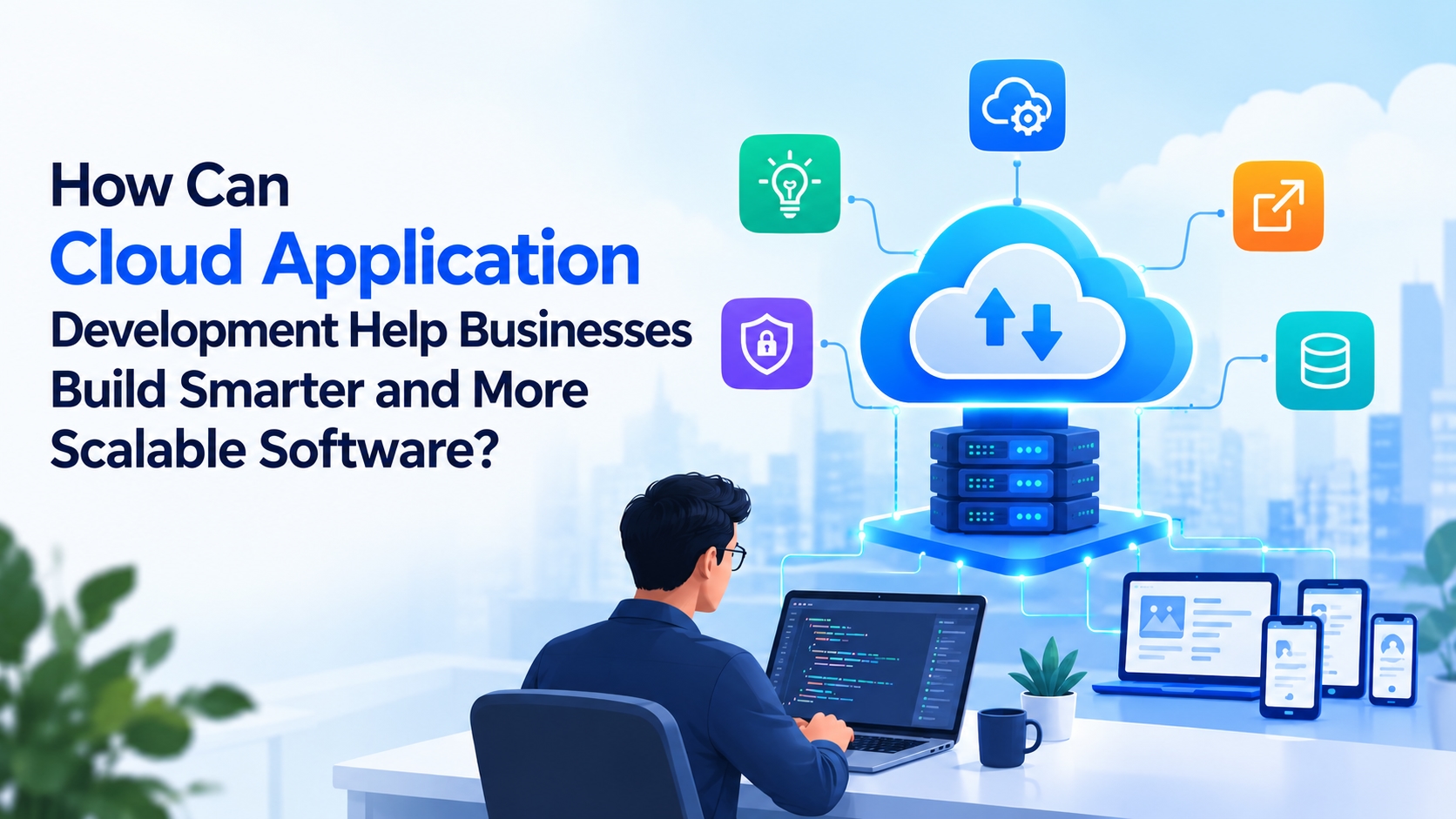
Businesses need software that can handle changing customer expectations, growing workloads, and evolving technology. Traditional development approaches can make scaling infrastructure and managing resources more challenging. Cloud application development provides a flexible approach for building applications that can grow with business needs.
What Is Cloud Application Development?
Cloud application development is the process of designing, developing, testing, deploying, and maintaining applications that run on cloud infrastructure. Instead of depending entirely on physical servers, applications can use cloud-based computing, storage, databases, networking, security, and monitoring services.
This approach is suitable for web applications, mobile backends, SaaS platforms, e-commerce applications, enterprise software, and data-driven solutions.
How Does Cloud Application Development Support Scalability?
One of the biggest advantages of cloud application development is scalability. Businesses may experience changing workloads throughout the day or during seasonal periods. Cloud infrastructure allows applications to use additional computing resources when demand increases and reduce resources when demand falls.
Technologies such as load balancing, caching, containers, and automated scaling can further improve application performance and help applications handle growing numbers of users.
How Can Cloud Applications Improve Development Speed?
Cloud platforms provide ready-to-use infrastructure and managed services that can simplify development. Developers can use cloud databases, storage, authentication, monitoring, and deployment services rather than creating every component from the beginning.
Cloud application development can also work with DevOps and CI/CD practices. Automated testing and deployment pipelines can help teams release updates more efficiently while reducing repetitive manual tasks.
What Are the Benefits of Cloud Application Development?
Cloud application development can provide several benefits, including:
Scalability: Applications can adapt to changing workloads.
Flexibility: Businesses can select resources based on their requirements.
Faster deployment: Cloud tools and automation can accelerate releases.
Reliability: Cloud architectures can incorporate backup, monitoring, and redundancy.
Integration: Applications can connect with APIs, databases, analytics, and AI services.
Cost flexibility: Resources can be adjusted according to application demand.
What Challenges Should Businesses Consider?
Cloud application development also requires careful planning. Businesses need to monitor cloud expenses, protect application data, manage access controls, and meet applicable security or compliance requirements.
Choosing the right architecture is also important. Microservices, containers, serverless technologies, and distributed systems can provide flexibility but may increase technical complexity.
Conclusion
Cloud application development gives businesses a modern foundation for building flexible, scalable, and reliable software. By combining cloud infrastructure with automation, modern architectures, and strong security practices, organizations can create applications that adapt to changing business requirements.
A well-planned cloud strategy can help businesses improve development efficiency, support growth, and prepare their applications for future digital demands.