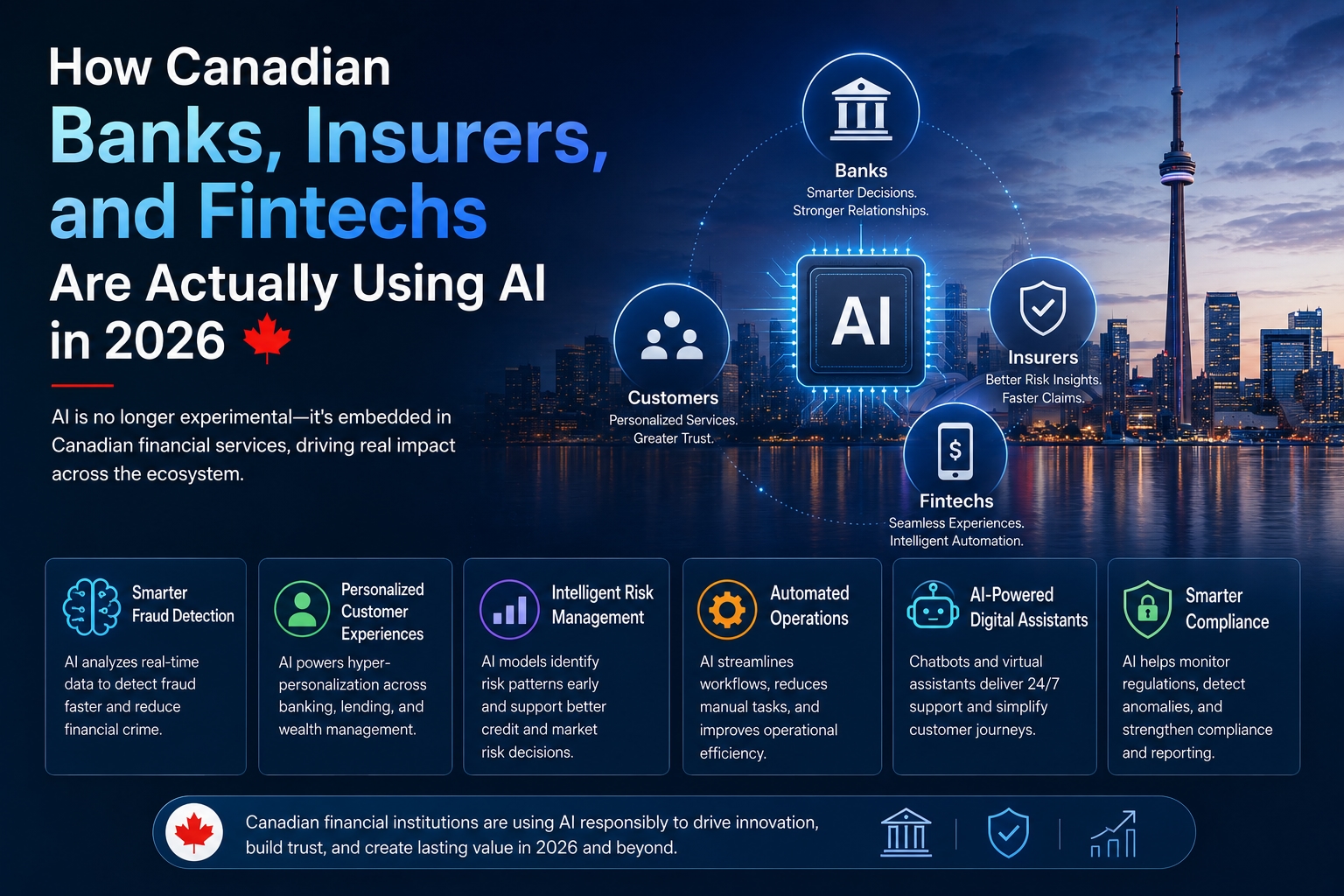
Ask ten Canadian financial services executives what "AI in banking" means and you'll get ten different answers, most of them shaped by whatever pilot their own institution happens to be running. Some point to fraud detection. Others mention chatbots. A few, usually the ones further along, talk about document processing buried three layers inside underwriting. The truth is that Canadian banks, insurers, and fintechs are running AI in more places than most outside observers realize, and the pattern of what's actually working by 2026 looks different from the hype cycle of a few years ago.
Toronto sits at the center of a lot of this activity. Between the concentration of federally regulated banks along Bay Street, a fast-growing insurtech sector, and academic hospital networks that increasingly intersect with health insurance data, Toronto has become one of the more advanced testing grounds for financial institutions looking to move AI beyond pilots into production. AI development companies such as Mobcoder AI are part of this broader ecosystem, helping businesses explore practical applications across fraud detection, workflow automation, financial advisory, and other data-intensive use cases. Here's what's actually being deployed, and where the real value is showing up.
Fraud Detection and Transaction Monitoring
This remains the most mature AI use case in Canadian financial services, and for good reason: the ROI is measurable almost immediately. Machine learning models trained on historical transaction data can flag anomalies in real time, catching patterns a rules-based system would miss entirely.
What's changed recently isn't the core technology, it's the sophistication of the models and how they're integrated into the broader compliance stack. Modern fraud detection systems increasingly combine transaction-level anomaly detection with behavioral biometrics and device fingerprinting, reducing false positives that used to frustrate legitimate customers.
Where this creates value: faster fraud response, fewer manual reviews, and lower false-positive rates that used to mean legitimate transactions getting declined at checkout.
KYC and AML Workflow Automation
Know Your Customer and Anti-Money Laundering compliance has traditionally been one of the most labor-intensive parts of financial services operations. Analysts manually review documents, cross-reference sanctions lists, and investigate flagged transactions, work that's necessary but doesn't scale well with headcount alone.
This is one of the clearest applications of Agentic AI development services in the sector. Rather than a single model flagging a transaction and stopping there, agentic systems can pull customer documentation, cross-reference multiple databases, apply institutional risk rules, and escalate only the genuinely ambiguous cases to a human analyst. The audit trail this produces, showing exactly what the agent checked and why it escalated, matters as much as the speed gain, since these decisions face regulatory scrutiny.
Claims Processing and Underwriting in Insurance
Insurance has been slower to adopt AI at the same pace as banking, largely because claims data tends to be messier and underwriting decisions carry direct financial consequences that make institutions cautious. That's shifting as generative AI improves at document extraction and summarization.
Practical applications now in production include:
Automated extraction of claims details from unstructured documents, adjuster notes, photos, and correspondence
AI-assisted damage assessment using computer vision, particularly in auto and property claims
Underwriting support tools that summarize risk factors from application data and flag inconsistencies for human reviewers
Claims triage models that route straightforward claims for fast processing and flag complex ones for senior adjusters
The institutions seeing the strongest results aren't the ones trying to fully automate underwriting decisions. They're the ones using AI to compress the time between claim submission and human review, keeping a person in the loop for anything with real financial stakes.
Personalized Financial Wellness and Advisory Tools
Wealth management and financial advisory have become one of the more visible AI use cases, partly because the customer-facing results are easy to demonstrate. Machine learning models analyzing spending patterns, investment behavior, and financial goals can generate genuinely personalized guidance at a scale no human advisor team could match.
TIFIN's AI-powered financial wellness platform is a useful example of this pattern: reducing the guesswork in financial decision-making by turning behavioral and transaction data into specific, actionable recommendations rather than generic advice. This kind of personalization engine is increasingly table stakes for wealth management platforms competing for retail investors who expect the same tailored experience they get from consumer apps in other industries.
Regulatory Document Processing and Reporting
Federally regulated institutions generate enormous volumes of compliance documentation, submissions to OSFI, internal risk reports, audit trails. Generative AI systems grounded in an institution's own policy documents and historical filings can draft first versions of regulatory submissions, flag inconsistencies against prior filings, and summarize lengthy documents for review.
This is a lower-visibility use case compared to customer-facing chatbots, but it's quietly become one of the highest-ROI applications inside compliance and risk teams, largely because the manual version of this work was slow, repetitive, and prone to inconsistency between reporting periods.
What's Not Working Yet
It's worth being honest about where financial services AI adoption is still struggling. Fully autonomous credit decisioning remains rare in Canada, partly due to fair lending concerns and OSFI's model risk expectations, and partly because institutions are, reasonably, cautious about removing human judgment from decisions with direct financial impact on customers. Similarly, generative AI chatbots handling complex account disputes still tend to hand off to human agents more often than vendor demos suggest, because the cost of an incorrect answer in a regulated financial context is higher than in most other industries.
Frequently Asked Questions
What's the most common starting point for AI adoption in Canadian financial services?
Fraud detection and transaction monitoring, since the data is usually already structured, the ROI is measurable quickly, and the risk of a wrong AI decision is lower than in areas like credit underwriting.
Are Canadian banks using generative AI for customer-facing chat, or mostly internal tools?
Both, but internal-facing tools- document summarization, compliance drafting, and analyst support- tend to be further along, since the accuracy bar for customer-facing financial guidance is higher and carries more regulatory sensitivity.
How does agentic AI differ from a standard chatbot in a banking context?
A chatbot answers questions. An agentic system can take multi-step action: pulling documents, cross-referencing databases, applying business rules, and escalating exceptions, all with a defined audit trail, which matters significantly in regulated workflows like KYC and AML.
Is AI adoption in Canadian insurance behind banking?
Generally yes, largely due to messier historical data and the higher stakes of underwriting decisions, though claims processing and document extraction have closed much of that gap over the past two years.
What's the biggest barrier to AI adoption in Canadian financial services right now?
Data quality and integration with legacy core banking and policy administration systems tend to be bigger obstacles than the AI models themselves.
Conclusion
The financial services AI story in Canada by 2026 isn't about full automation replacing human judgment. It's about AI compressing the time between a task arriving and a human making a well-informed decision on it, whether that's a fraud analyst reviewing a flagged transaction, an underwriter assessing risk, or a compliance officer preparing a regulatory filing. The institutions getting the most value are the ones that scoped AI to specific, measurable workflows rather than chasing broad automation for its own sake.