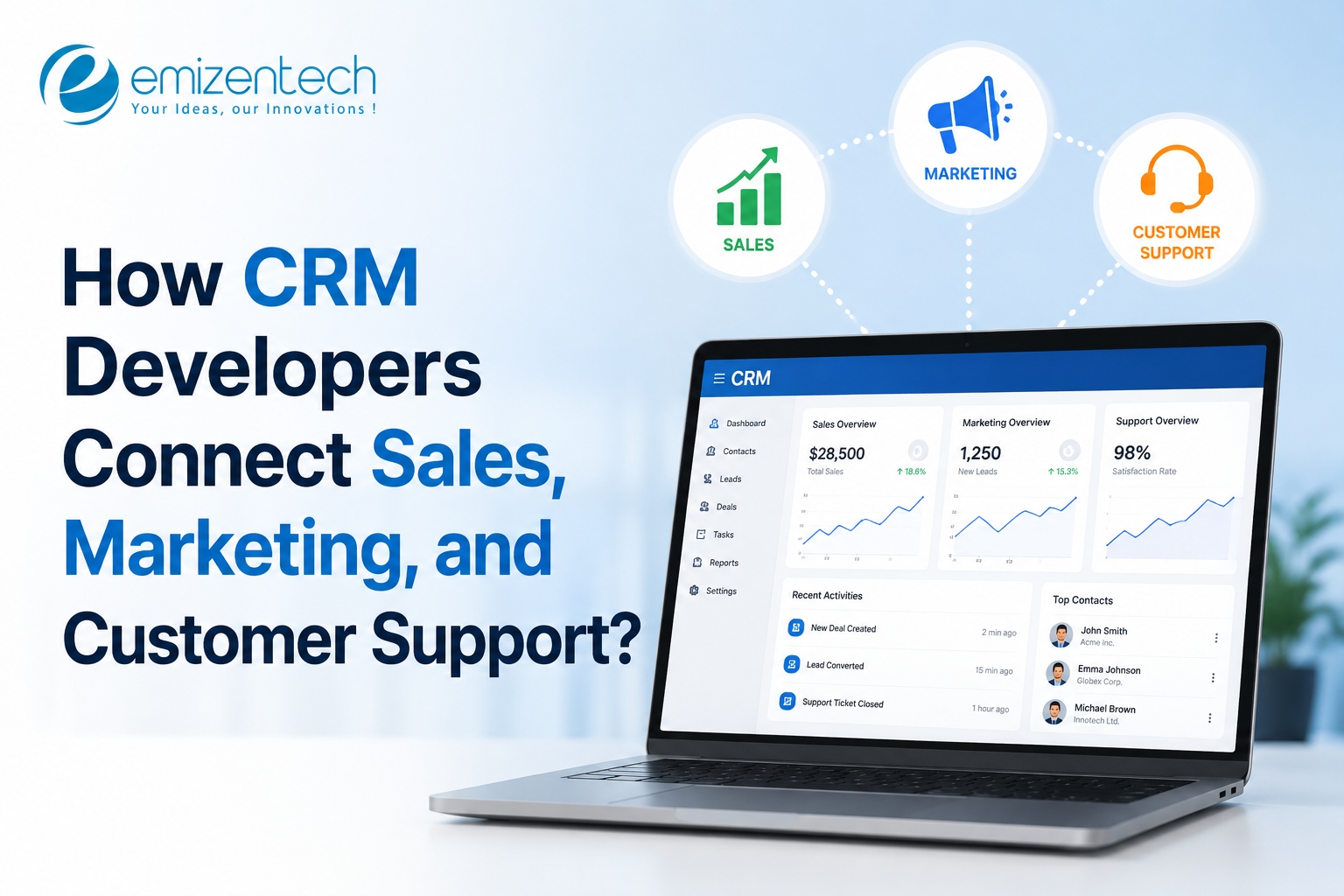
Modern businesses rely on multiple teams to manage customer relationships effectively. Sales teams focus on closing deals, marketing teams generate and nurture leads, while customer support teams handle post-purchase interactions. Although these departments often work toward the same goal, they can easily become disconnected when they use separate tools, processes, or data sources.
This is where CRM systems play an important role. More importantly, CRM developers help transform these platforms into a unified environment where all departments can access relevant customer information. Understanding how CRM developers bridge these gaps can help businesses create smoother customer experiences and improve internal collaboration.
Why Departmental Silos Create Business Challenges?
Many organizations struggle because customer information is spread across multiple systems. Sales may have one set of data, marketing another, and customer support yet another.
When departments work in isolation, several problems can occur:
Inconsistent customer information
Delayed communication between teams
Duplicate efforts
Poor customer experiences
Missed sales opportunities
For example, a customer may submit a support request while simultaneously speaking with a sales representative about an upgrade. Without shared visibility, both teams may operate without knowing the full customer context.
CRM developers help solve these challenges by creating centralized systems that allow information to flow across departments.
How CRM Developers Create a Unified Customer View?
A major responsibility of CRM developers is ensuring that customer data is accessible and meaningful for every department that needs it.
Rather than maintaining separate databases, CRM customization allows organizations to build a single customer profile that includes:
Contact information
Purchase history
Marketing interactions
Customer service records
Sales activities
Imagine a customer who downloads a marketing resource, attends a webinar, requests a product demo, and later submits a support ticket. With proper CRM customization, every interaction becomes part of one complete customer record.
This unified view helps teams make better decisions because everyone works from the same information.
Connecting Sales and Marketing Through CRM Customization
Sales and marketing alignment has become increasingly important as customer journeys grow more complex. Marketing teams generate leads, but sales teams are responsible for converting those leads into customers.
Without proper CRM integration, valuable information can be lost during the handoff process.
Improving Lead Management
CRM developers often create automated workflows that transfer qualified leads directly to sales teams.
Instead of manually sharing spreadsheets or email updates, the CRM can automatically:
Assign leads to the right sales representative
Track lead sources
Record engagement history
Update lead status in real time
For example, if a prospect downloads several resources and attends a webinar, the CRM can automatically increase their lead score and notify a sales representative when they are ready for outreach.
This reduces delays and improves conversion opportunities.
Creating Better Campaign Insights
Marketing teams need visibility into which campaigns generate actual revenue, not just leads.
CRM developers build custom reporting systems that connect marketing activities with sales outcomes. This allows businesses to identify which campaigns contribute most effectively to business growth.
As a result, both departments can make decisions based on measurable results rather than assumptions.
How CRM Developers Support Better Collaboration Between Sales and Customer Support?
The relationship between sales and customer support is often overlooked, yet it has a major impact on customer retention.
Many businesses focus heavily on acquiring customers but fail to create strong communication between sales and support teams after the purchase is complete.
CRM developers help solve this problem by ensuring that important customer information remains accessible throughout the customer lifecycle.
For example, when support representatives can view sales conversations, purchased products, and contract details, they can provide more personalized assistance.
Similarly, sales teams can see open support tickets before reaching out about renewals or upsell opportunities.
This level of visibility helps prevent awkward customer interactions and creates a more consistent experience.
Automating Information Sharing Across Teams
Manual communication between departments often leads to delays and mistakes. CRM developers frequently build automation features that keep teams informed without requiring constant follow-up.
Automation can include:
Notifications for important customer actions
Automatic task assignments
Workflow approvals
Escalation processes
Customer status updates
Consider a situation where a customer submits a complaint about a recently purchased service. The CRM can automatically alert both the support manager and the account representative, ensuring everyone remains informed.
These automated processes help organizations respond more quickly and efficiently.
Improving Customer Experience Through Connected Systems
Customers rarely think about internal departments. They simply expect businesses to understand their needs regardless of who they speak with.
A disconnected customer experience often occurs when teams operate using different information.
For example, customers become frustrated when they must repeatedly explain the same issue to multiple departments. They expect organizations to already have access to their interaction history.
CRM developers help eliminate these frustrations by creating systems that preserve customer context across every touchpoint.
When sales, marketing, and support teams share information effectively, customers experience:
Faster response times
More personalized interactions
Consistent communication
Better issue resolution
Stronger overall satisfaction
These improvements can have a direct impact on customer loyalty and retention.
The Role of CRM Developers in Data Accuracy
Connecting departments is not simply about sharing information. The information itself must be accurate and reliable.
Poor data quality can create significant challenges. Duplicate records, incomplete information, and outdated customer details often lead to confusion across teams.
CRM developers implement processes that help maintain data integrity.
This may include validation rules, duplicate detection systems, automated data updates, and custom workflows designed to reduce manual entry errors.
For example, a developer might create rules that prevent duplicate customer accounts from being created or automatically standardize data formats across departments.
Accurate data improves decision-making and helps every team work more effectively.
Why Businesses Often Hire CRM Developer Professionals for Cross-Department Projects?
As businesses grow, customer interactions become more complex. Multiple departments, software systems, and communication channels must work together seamlessly. What starts as a simple customer management process can quickly evolve into a network of interconnected workflows that require careful planning and coordination.
This is often the stage where companies decide to hire CRM developer talent with experience in customization, integrations, and workflow automation. Cross-department projects involve more than configuring software; they require creating systems that allow sales, marketing, and customer support teams to share information efficiently without disrupting existing operations.
Experienced developers can identify communication gaps between departments and build solutions that improve collaboration. They understand how to connect platforms, automate routine tasks, and create visibility into customer interactions across the entire journey.
Key Skills CRM Developers Use to Connect Teams
Successfully linking sales, marketing, and customer support requires more than coding knowledge.
CRM developers typically rely on a combination of technical and business-focused skills.
Some of the most important capabilities include:
Workflow automation
CRM customization
API integrations
Data management
Reporting and analytics
Business process analysis
These skills allow developers to create systems that support collaboration while remaining scalable for future growth.
When companies hire CRM developer experts with these capabilities, they are often better positioned to create connected customer experiences.
Measuring the Impact of CRM Integration
The benefits of a well-connected CRM system extend beyond operational efficiency. Businesses can often measure improvements across several key areas.
Common outcomes include:
Improved lead conversion rates
Faster support response times
Increased customer retention
Better team productivity
More accurate reporting
For example, a company that previously managed customer information across multiple systems may notice significant reductions in duplicate work after implementing CRM automation.
These measurable improvements demonstrate the value that effective CRM development can bring to an organization.
Future Trends in CRM Collaboration
Customer expectations continue to evolve, and businesses are increasingly focused on creating seamless experiences across all touchpoints.
CRM developers are now building systems that incorporate advanced automation, predictive analytics, and AI-driven insights to improve collaboration further.
However, the core objective remains the same: ensuring that sales, marketing, and customer support teams have access to the information they need when they need it.
Organizations that invest in stronger departmental alignment today will likely be better prepared to meet future customer expectations.
Conclusion
Connecting sales, marketing, and customer support requires more than simply implementing a CRM platform. It involves creating workflows, integrations, and processes that allow information to move freely across departments. CRM developers play a critical role in building these connections, helping organizations create a unified customer experience while improving internal collaboration. As businesses continue to focus on customer-centric strategies, the decision to hire CRM developer professionals with the right mix of technical and business expertise becomes increasingly important. As businesses continue focusing on connected customer experiences, the demand for effective CRM customization and integration is expected to grow. EmizenTech is among the organizations contributing to this evolving technology space, where CRM solutions help improve collaboration between sales, marketing, and customer support teams.
FAQs
How do CRM developers connect different business departments?
CRM developers create integrations, workflows, and shared databases that allow sales, marketing, and customer support teams to access the same customer information.
Why is a unified customer view important?
It helps teams understand customer history, improve communication, and provide more personalized experiences.
How does CRM customization improve collaboration?
Customization enables businesses to create workflows and reporting systems that match their specific operational needs.
When should a business hire CRM developer specialists?
Organizations typically benefit from hiring CRM experts when implementing custom workflows, integrations, automation, or large-scale CRM improvements.
What are the main benefits of connecting sales, marketing, and support through CRM?
Key benefits include better customer experiences, improved efficiency, faster communication, and more accurate business insights.