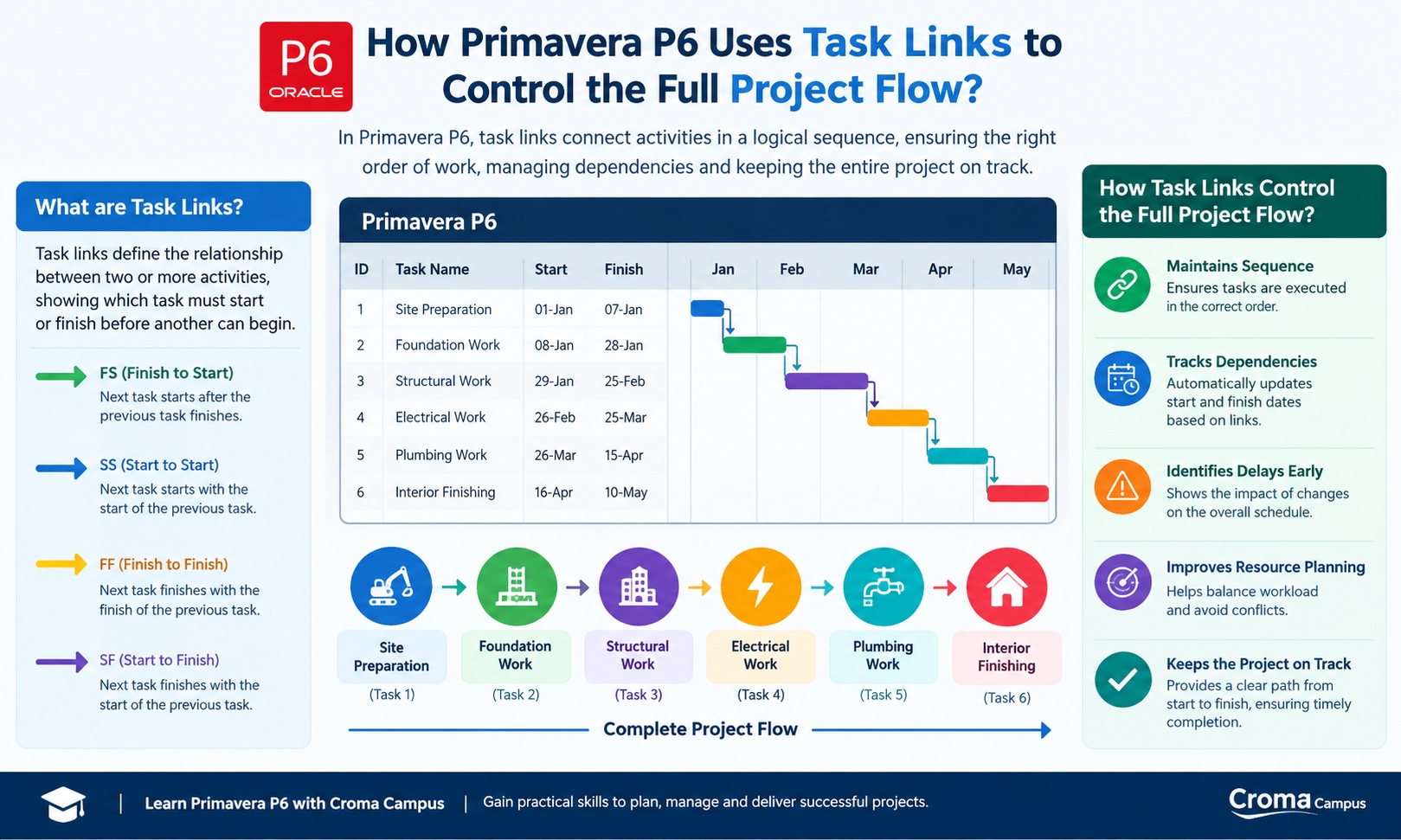
A schedule can look correct on a Gantt chart and still have weak logic. In Primavera P6, task links are rules that tell the scheduler when one activity can move because another has moved. Primavera P6 Training should teach relationship logic as a calculation system.
Key Takeaways
Relationships create project network logic.
Driving links can control successor dates.
FS, SS, FF, and SF have different control points.
Lag changes relationship timing.
Poor links can create false floats.
Progress can change relationship behavior.
Task links control the project flow
In P6, a predecessor controls another activity, while the successor is affected by that link. When the schedule is calculated, P6 follows these links through the network. Oracle says relationships form project logic and work with activity durations to determine dates.
The link controls the flow, not the visual position of the activity bar.
What P6 calculates from the links?
When you run the scheduler, P6 uses the Critical Path Method. It performs forward and backward passes to calculate early dates, late dates, float, and the critical path.
If several predecessors point to one successor, the successor may wait for the relationship that gives the latest controlling date. So, changing one link can change the project finish even when durations stay the same.
Useful checks include early and late dates, total and free float, driving relationships, and critical paths. P6 can also calculate relationship-level float.
Four relationship types
P6 supports Finish-to-Start, Finish-to-Finish, Start-to-Start, and Start-to-Finish relationships.
Link | Technical control | Main use |
FS | Successor starts after predecessor finishes | Real handoff |
SS | Successor starts after predecessor starts | Parallel work |
FF | Successor finishes after predecessor finishes | Linked end points |
SF | Successor finishes after predecessor starts | Rare control |
FS is easiest to trace. Using FS everywhere can hide parallel work. SS can show work starting together, while FF can control a finishing point. SF is uncommon.
Oracle's schedule health guidance recommends a high share of FS relationships, limited SS and FF use, and no SF use.
Driving relationships are the real control points
A successor can have several predecessors. One relationship may be driving while another is not.
If three predecessors feed one activity and one finishes later, that relationship may be the reason the successor cannot move earlier. The planner should inspect that driving link before changing dates.
Primavera P6 Training in Noida can focus on schedule reading. Learners can trace why a date moved and check whether the cause is a relationship, calendar, constraint, or progress.
Lag can change the flow
Lag adds time between related activities. A positive lag can delay a successor, while a negative lag can create overlap. P6 stores lag as part of the relationship. Lag can hide real work. Oracle says lag should not control float or dates when the waiting period represents actual work.
A wait may represent testing, curing, review, or another real process. Modeling it as an activity makes updates clearer.
Progress can change relationship behavior
The network can perform differently once activities have begun. P6 offers Retained Logic, Progress Override, and Actual Dates. Retained Logic maintains remaining work linked to incomplete predecessor logic, whereas Progress Override permits progress without delay.
Planners need to consider their scheduling options following a status update, not just the dates. Primavera P6 Training Institute in Delhi can cover progressed schedules, relationship checks, and date calculations. The skill is understanding why P6 gives a date.
Finding broken project flow
Relationship checks can expose problems that a normal Gantt chart may not show. An activity with no predecessor may start without logical control. One with no successor may not affect completion. Oracle also flags dangling starts, dangling finishes, negative lag, and out-of-sequence progress.
Prior to an update, consider checking the following:
Missing predecessors/successors
Anomalous SF connections
Lags that are too big/are negative
Out-of-order progress
Driving dates
Activities under constraints
External relationships
P6 can connect activities between different projects through external relationships. This matters when one project depends on another project's work or handoff. An external link means a date can depend on another project, so these links need review during updates.
A better way to build task logic
Use this workflow:
Identify the event controlling the next activity.
Select the matching relationship.
Add lag only when it has a clear reason.
Run the scheduler.
Check early and late dates.
Trace driving relationships.
Review float and critical paths.
Check dangling activities and out-of-sequence progress.
Compare the result with actual work.
Fix logic before manually moving dates.
Primavera P6 Training in Noida becomes more useful when learners practice the full cycle.
Advanced use of task links
Relationships are part of the schedule model. Changes to scope, schedule, progress, calendars, or transitions will result in possible need for a network review. Primavera P6 Training should include topics such as relationship analysis, multi-path float, external relationships, lag characteristics, and out-of-sequence progress. This is how one determines the end date from the schedule.
Sum up,
P6 task links do not just define activity sequencing. They help build the network that P6 will use to perform date calculations, floats, driving paths, and the end date of the project. Even the smallest alteration in one relationship may lead to resequencing of activities, since logic runs through the entire network.