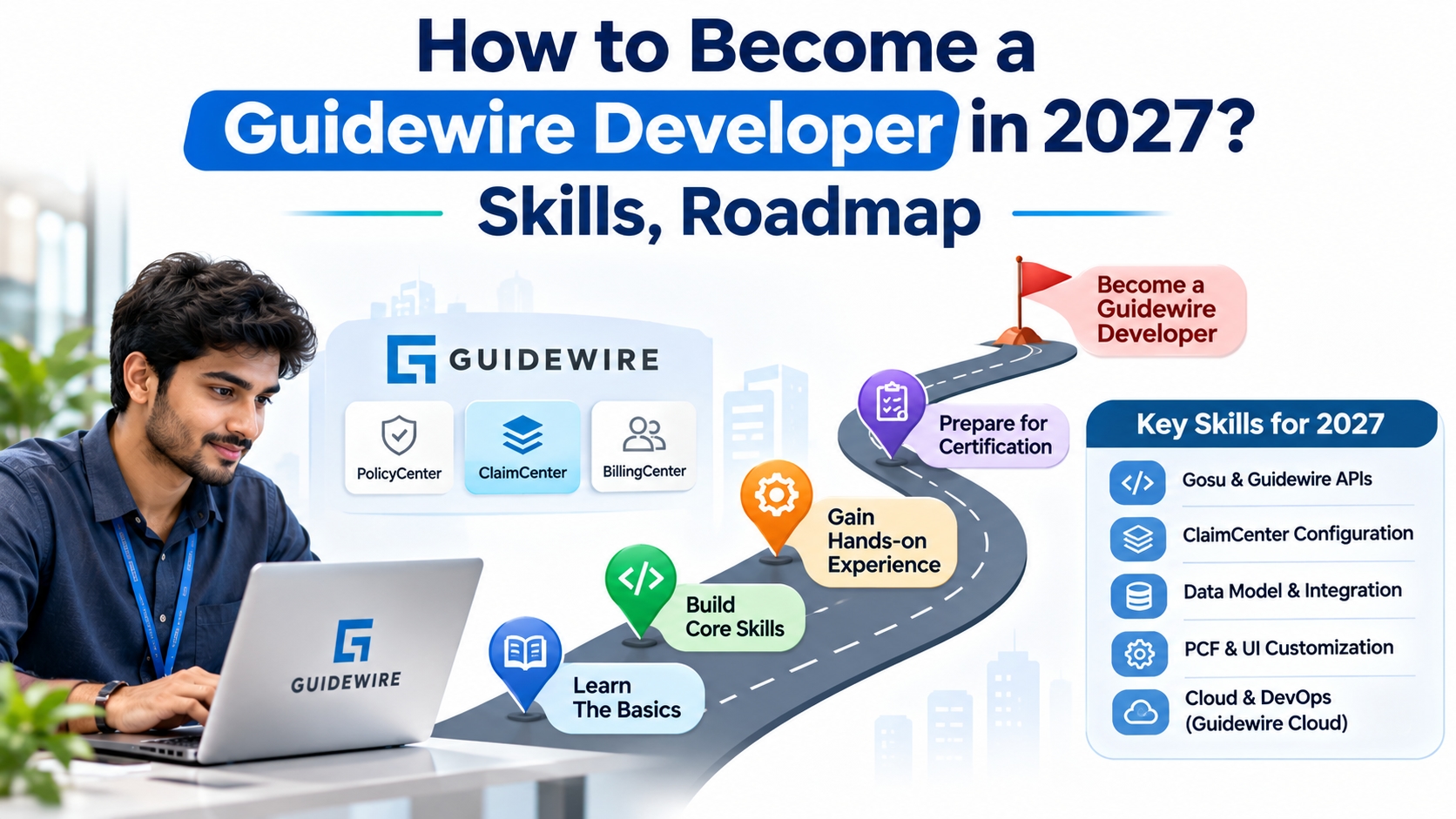
Building a high-growth career in enterprise insurance technology requires mastering platforms that global carriers rely on for mission-critical operations. Guidewire Software dominates the Property and Casualty (P&C) insurance sector, powering policy administration, claims management, and billing workflows across hundreds of top insurers worldwide. As carriers accelerate cloud migrations and adopt AI-assisted underwriting, demand for skilled engineers who understand both insurance business logic and modern cloud architecture continues to climb. Entering this specialized domain offers strong compensation, long-term stability, and global project exposure, provided you approach the ecosystem with a clear, practical engineering plan rather than fragmented tutorials.
Transitioning into this role becomes significantly smoother when you combine core object-oriented programming habits with domain-specific architectural training. Many aspiring engineers struggle early because Guidewire is not a generic web framework; it is a deeply integrated suite built around strict data modeling, transaction bundles, and configurable business rules. Enrolling in structured Guidewire training in Hyderabad or following a mentor-led curriculum gives learners hands-on sandbox access to InsuranceSuite tools, Studio environments, and real-world carrier scenarios. By pairing disciplined technical practice with industry-aligned mentorship, newcomers can bridge the gap between theoretical software knowledge and production-ready implementation skills in 2027.
Mastering InsuranceSuite Fundamentals and P&C Domain Workflows
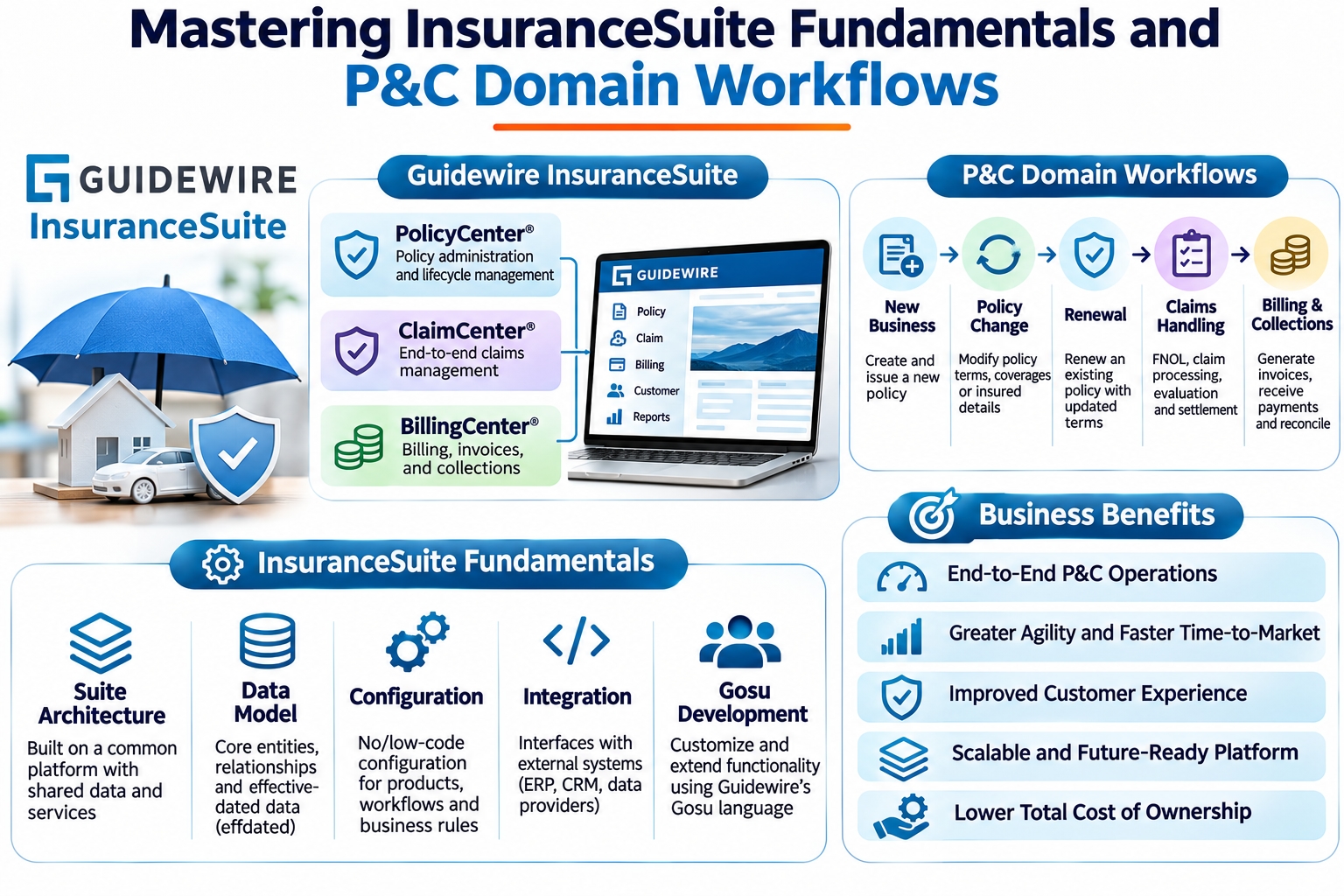
Before writing a single line of custom code, every successful Guidewire developer must understand the operational lifecycle of Property and Casualty insurance. Guidewire InsuranceSuite consists of three core applications: PolicyCenter, ClaimCenter, and BillingCenter. PolicyCenter manages product definitions, quoting, underwriting rules, endorsements, and renewals. ClaimCenter handles First Notice of Loss (FNOL), claim assignment, reserves, adjudication, and financial payouts. BillingCenter orchestrates invoicing, payment plans, delinquency processing, and agency commissions. Developers who grasp how data flows across these three systems make far better architectural decisions when designing extensions or troubleshooting production defects.
In 2027, insurers expect technical professionals to translate complex business requirements directly into clean platform configurations without over-engineering. Instead of immediately building custom screens or heavy scripts, you should learn how out-of-the-box workflows operate inside Guidewire Studio. Spend time exploring Product Model Designer, rating engines, activity patterns, and role-based permissions. Understanding standard P&C terminology—such as exposure, coverage, deductible, subrogation, and policy period—ensures you communicate seamlessly with business analysts, underwriters, and QA teams during agile sprint ceremonies.
Core Technical Stack: Gosu Programming, Data Modeling, and PCF Configuration
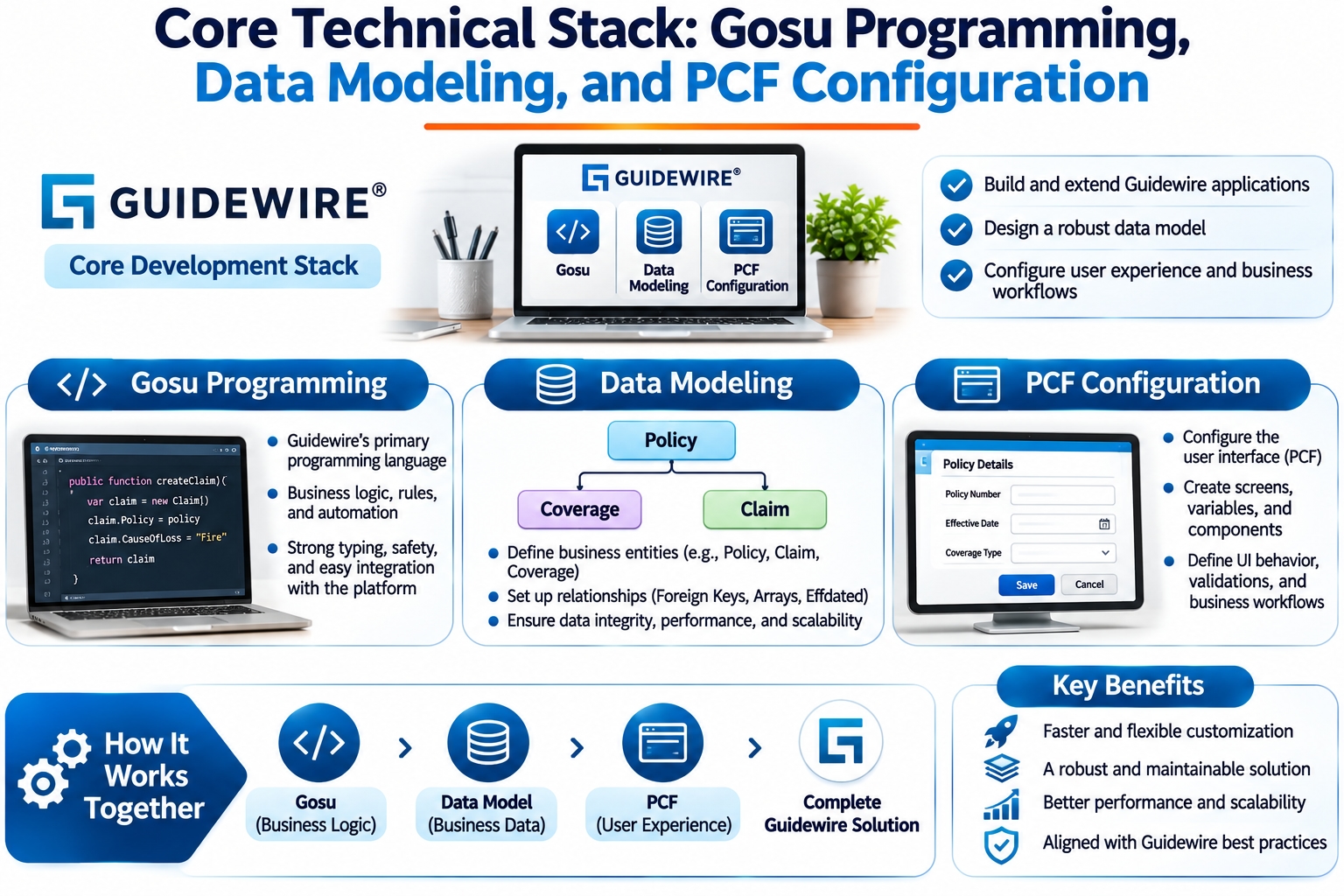
Once you grasp insurance workflows, your next milestone is mastering Guidewire's proprietary technical stack and underlying relational architecture. Gosu, a statically typed JVM language developed by Guidewire, serves as the backbone for business rules, enhancement classes, batch processes, and event-driven logic. Because Gosu shares strong syntactic similarities with Java and TypeScript, developers with object-oriented backgrounds adapt quickly, yet mastering Guidewire-specific constructs like blocks, null-safe operators, and bundle transactions requires dedicated hands-on coding. Alongside Gosu, you must learn Page Configuration Format (PCF) files to build responsive user interfaces, dynamic widgets, validation rules, and popups within Guidewire Studio.
Equally critical is mastering entity extensions, typelists, and database persistence mechanics so your custom features scale cleanly under heavy transaction loads. In Guidewire, data objects are defined through XML metadata files that automatically generate database tables and Gosu entity classes during compilation. Writing reliable queries and preventing performance bottlenecks depends heavily on understanding Guidewire foreign keys, arrays, and effdated relationships, especially when tracking historical policy revisions across multiple effective dates. Practicing how entities link together and how database commits behave inside writable bundles separates junior configurators from dependable senior engineers.
Cloud-Native Engineering: Guidewire Cloud Platform, Jutro, and Extension Layer
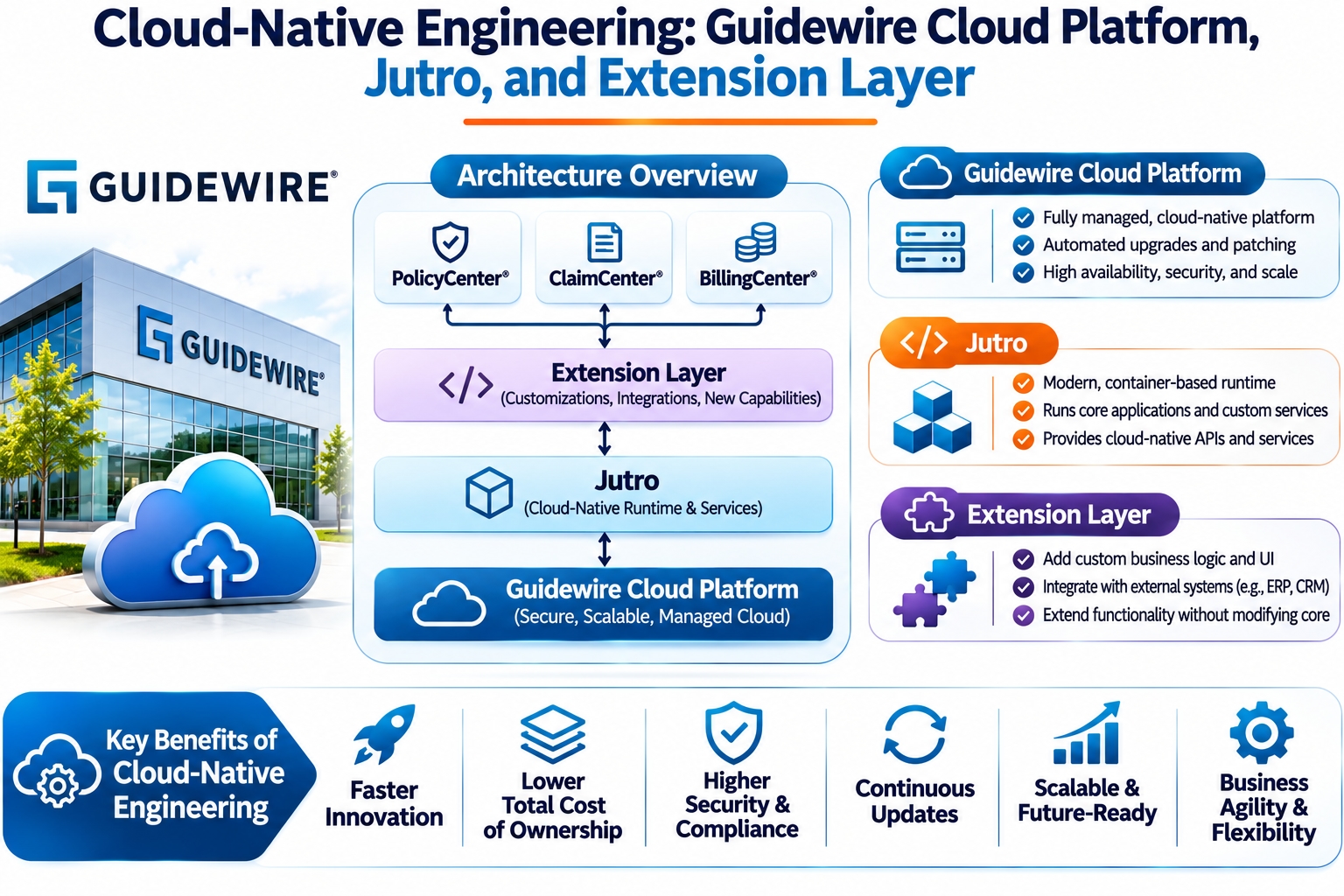
Modern Guidewire implementations in 2027 run predominantly on the Guidewire Cloud Platform (GWCP), shifting developer responsibilities from on-premise server maintenance to cloud-native composition. Carriers now adopt frequent, continuous release cycles—such as the Palisades and Qusar cloud updates—which require developers to follow strict cloud-compatible coding standards. You must familiarize yourself with the Guidewire Extension Layer and Extension Manager, which separate managed carrier extensions from core platform code to eliminate painful three-way merges during upgrades. Learning how CI/CD pipelines, automated quality gates, and cloud deployment tools operate will make you immediately valuable on enterprise modernization teams.
Frontend expectations have also evolved dramatically with the Jutro Digital Platform, Guidewire's React- and TypeScript-based micro-frontend framework. While internal adjusters and underwriters still use PCF screens, customer-facing portals and agent experiences rely heavily on Jutro components connected via Cloud APIs. Developers who combine backend Gosu proficiency with React, TypeScript, and Jutro experience templates unlock higher-tier full-stack roles. Additionally, understanding Guidewire's Agentic AI framework, MCP servers, and embedded developer assistants helps you automate repetitive code generation and integrate intelligent underwriting or claims triage workflows safely into cloud environments.
Enterprise Integrations: Cloud APIs, Messaging, and Event-Driven Architecture
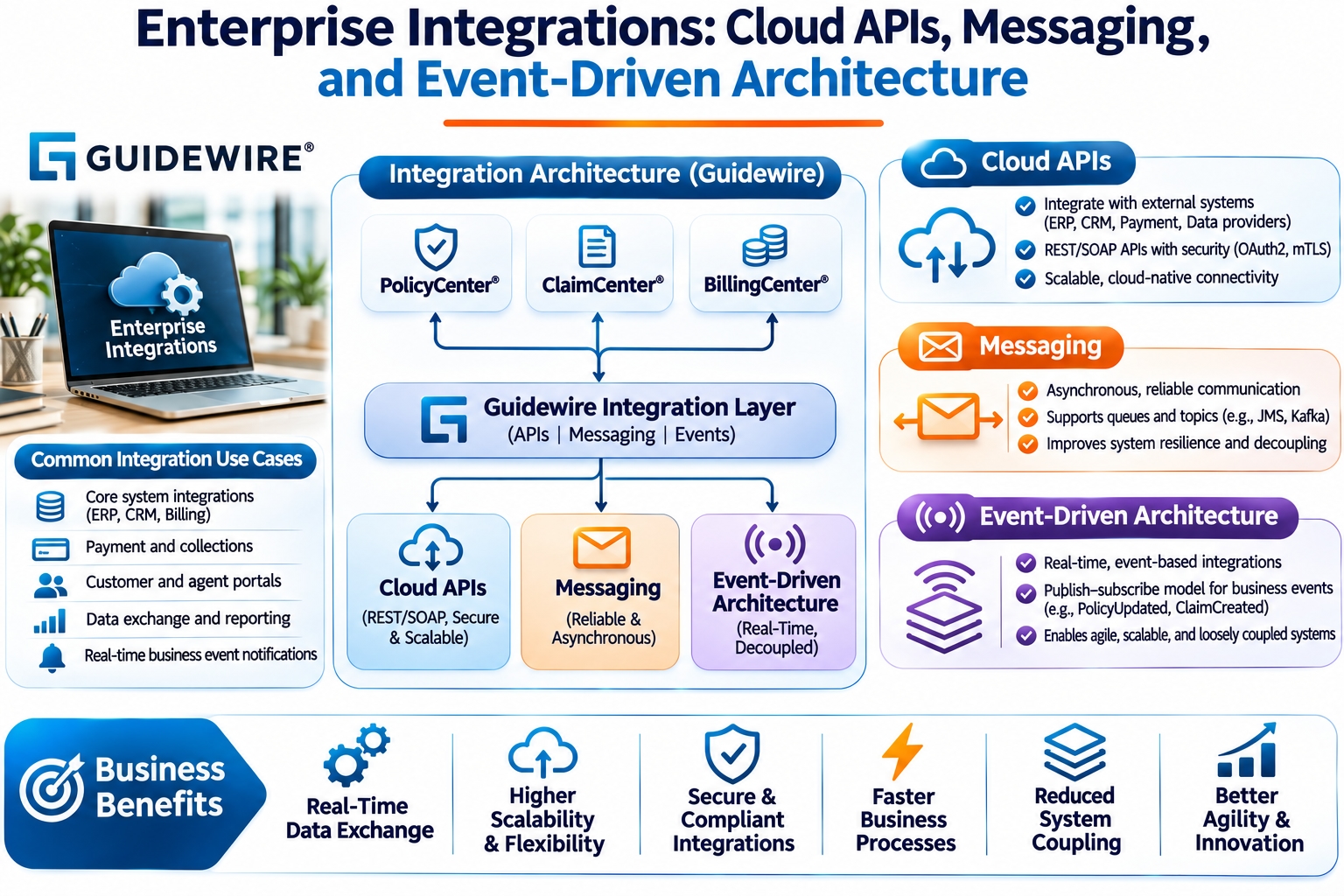
No insurance core system operates in isolation; carriers constantly exchange data with payment gateways, credit bureaus, document management systems, telematics providers, and regulatory reporting agencies. Therefore, integration engineering represents one of the highest-paying specializations within the Guidewire ecosystem. Your roadmap must include deep proficiency in Guidewire Cloud API, which uses RESTful JSON endpoints governed by OpenAPI specifications and Schema Editor extensions. Knowing how to expose custom entity properties through API schemas, configure OAuth2 authentication, and enforce role-based API access controls is mandatory for modern cloud projects.
Beyond synchronous REST calls, reliable insurance platforms depend on asynchronous event-driven messaging to handle high-volume transactions without blocking user screens. You should learn how Guidewire's messaging architecture works, including event fired rules, message transport plugins, request plugins, and reply plugins. Understanding how messages are ordered per primary object, how retries handle downstream outages, and how payloads serialize via XML or JSON guarantees data integrity across external systems. Mastering tools like Postman, Swagger, and Apache Kafka alongside Guidewire Studio equips you to design resilient integrations that withstand peak claim surges during catastrophic weather events.
Step-by-Step 6-Month Learning Roadmap for Aspiring Developers
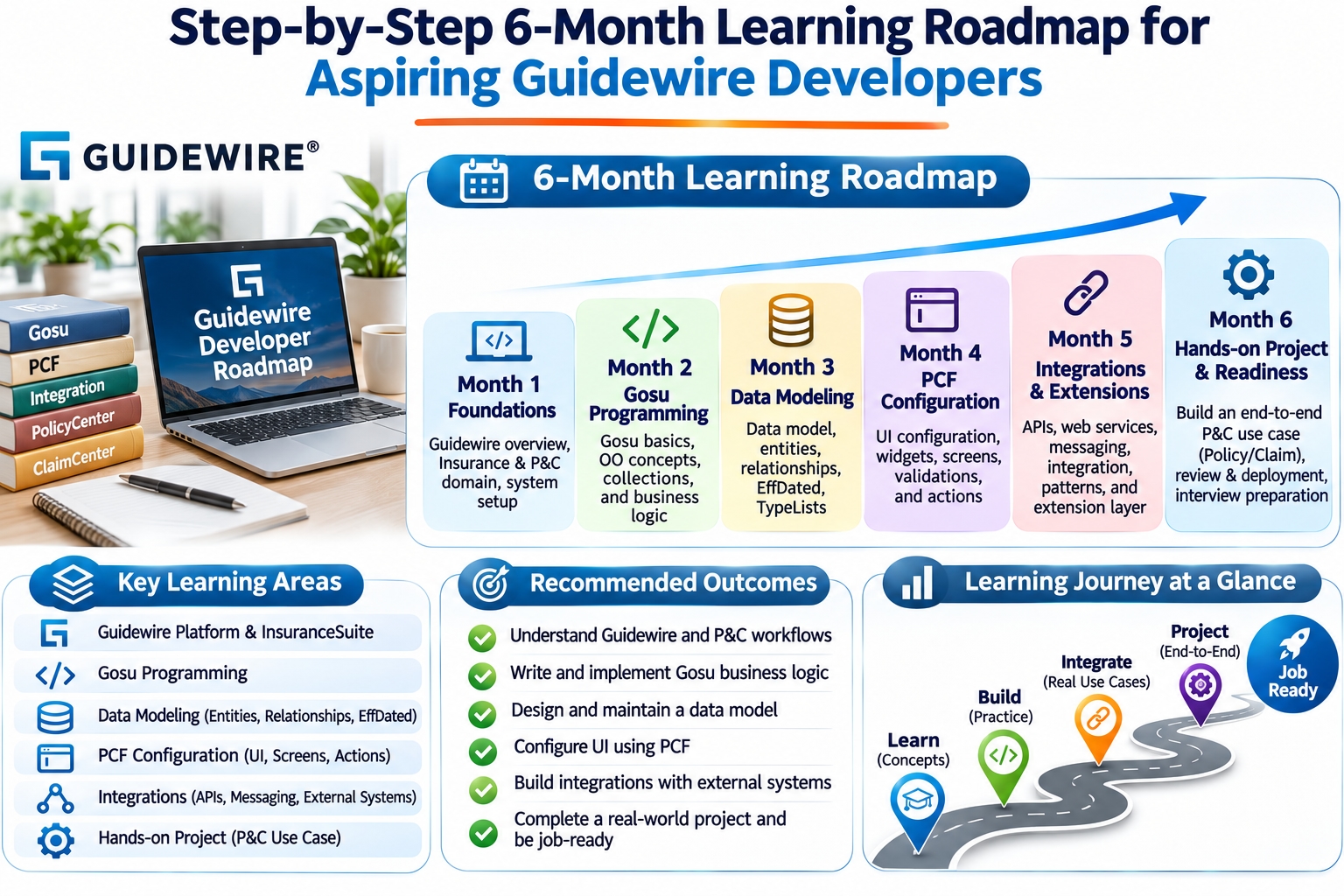
Structuring your preparation into focused monthly milestones prevents burnout and ensures steady, measurable technical progress. During Months 1 and 2, focus exclusively on InsuranceSuite fundamentals, P&C domain concepts, and basic Gosu syntax. Set up a local or cloud training sandbox, build simple enhancements, create custom typelists, and practice writing clean Gosu queries. Avoid jumping straight into complex integrations before you can confidently trace a policy submission or claim payment from the user interface down to the underlying database tables.
In Months 3 and 4, transition into deeper specialization by choosing either PolicyCenter or ClaimCenter as your primary focus track. Build end-to-end mini-projects, such as adding a custom endorsement workflow, configuring assignment rules, or extending an entity with effective-dated fields. During Months 5 and 6, shift your attention toward Cloud APIs, Jutro frontend basics, unit testing with GUnit, and performance profiling. Document every project in a clean technical portfolio detailing business requirements, entity changes, API payloads, and edge-case testing, as hiring managers value demonstrable problem-solving far more than passive course completion certificates.
Guidewire Certifications, Portfolio Building, and Interview Preparation
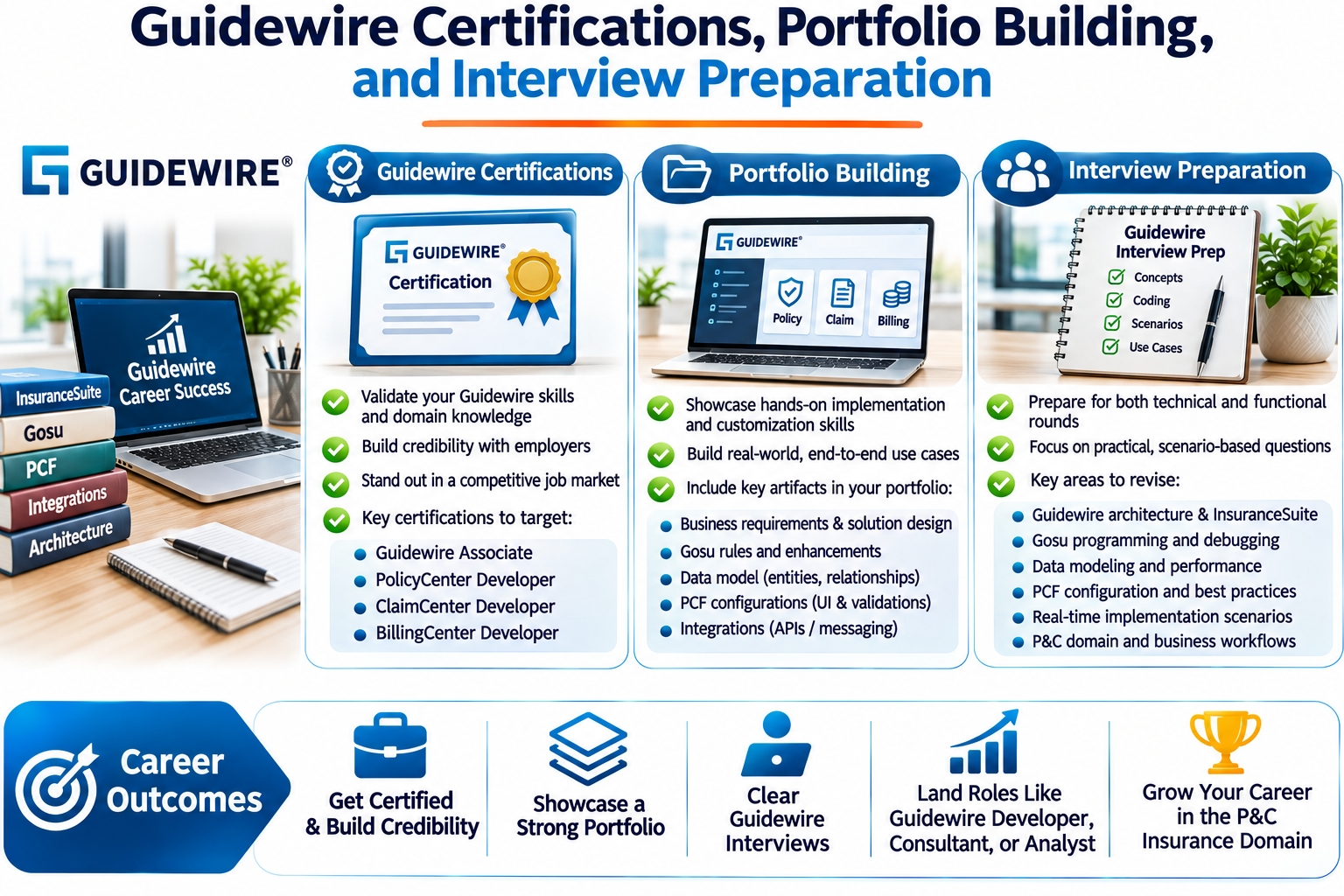
Earning official Guidewire credentials validates your technical rigor to global systems integrators and direct insurance carriers. Guidewire structures its certification pathway into three progressive tiers: Associate, Specialist, and Ace. Starting with the InsuranceSuite Developer Associate exam proves your grasp of core platform architecture, Gosu fundamentals, and basic configuration standards. Once you gain hands-on project experience, advancing to Specialist or Ace certifications in PolicyCenter, ClaimCenter, or Integration demonstrates mastery of complex cloud patterns. Keep in mind that Guidewire enforces an N-3 release currency policy, meaning certified professionals must complete periodic "New Features" knowledge checks to keep credentials active.
To stand out in technical interviews in 2027, pair your certification goals with articulate architectural storytelling. Interviewers rarely ask trivia questions; instead, they present real-world scenarios—such as preventing duplicate claim payments, optimizing slow query bundles, or upgrading legacy code to the Extension Layer—and evaluate your design trade-offs. Practice explaining concepts like effective dating, bundle commits, and REST API schema extensions in plain, structured language. Highlighting concrete troubleshooting scenarios, clean Git workflows, and familiarity with Agile insurance delivery will position you at the top of candidate shortlists.
Conclusion
Becoming a successful Guidewire developer in 2027 requires blending domain literacy in Property and Casualty insurance with disciplined engineering across Gosu, relational data modeling, and cloud-native APIs. Rather than rushing through isolated syntax tutorials, focus on tracing how real business requirements move from user screens and validation rules down to database bundles and external integrations. By following a structured roadmap, building practical sandbox projects, and staying aligned with modern Guidewire Cloud standards like the Extension Layer and Jutro, you can establish a resilient, high-value career in enterprise insurance technology.