
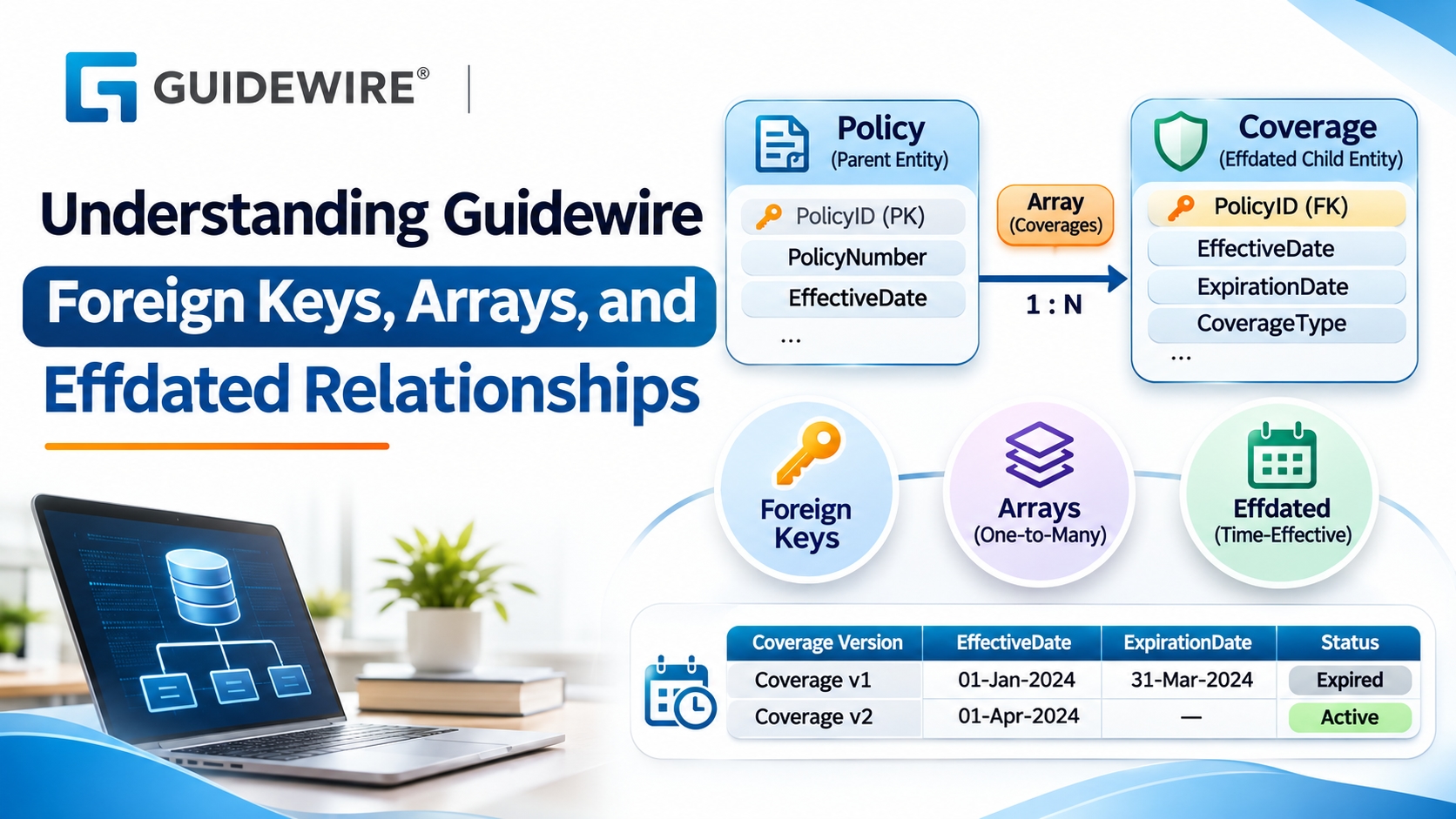
The Guidewire data model provides a robust, metadata-driven architecture designed specifically to manage complex insurance data objects, entities, and transactional lifecycles across InsuranceSuite applications like PolicyCenter, ClaimCenter, and BillingCenter. At its structural core, the platform abstracts traditional relational database management systems into object-oriented entity models written in ETX and ETI metadata definitions. Developers and system architects work with typed entities rather than executing direct SQL queries against underlying physical tables. Understanding how these data objects maintain references, enforce database integrity, and track temporal records across system updates is foundational for any professional configuring Guidewire applications. By mastering the operational boundaries between core data references, technical professionals can build performant, highly scalable enterprise solutions that easily support complex underwriting logic, dynamic UI rendering, and external system integrations without compromising underlying database integrity or transaction bundle stability.
Architecting an enterprise P&C insurance engine requires a firm command over relational pointers, collection structures, and versioning patterns within the application framework. When scaling enterprise platforms, enrolling in a specialized Guidewire training in Hyderabad gives developers and technical leads hands-on exposure to practical data model configuration, Gosu object manipulation, and transaction bundle management. As policy datasets scale to millions of active records, improper relationship modeling can quickly degrade application performance, create circular reference locks, or corrupt historical policy period slices. This comprehensive technical guide breaks down the core structural mechanics of foreign keys, array relationships, and effective-dated (effdated) temporal versioning within the Guidewire ecosystem. We will explore how these relational structures function under the hood, compare their operational traits, and provide best-practice patterns for building robust, upgrade-safe insurance data models across all core modules.
Core Foundations of the Guidewire Data Model
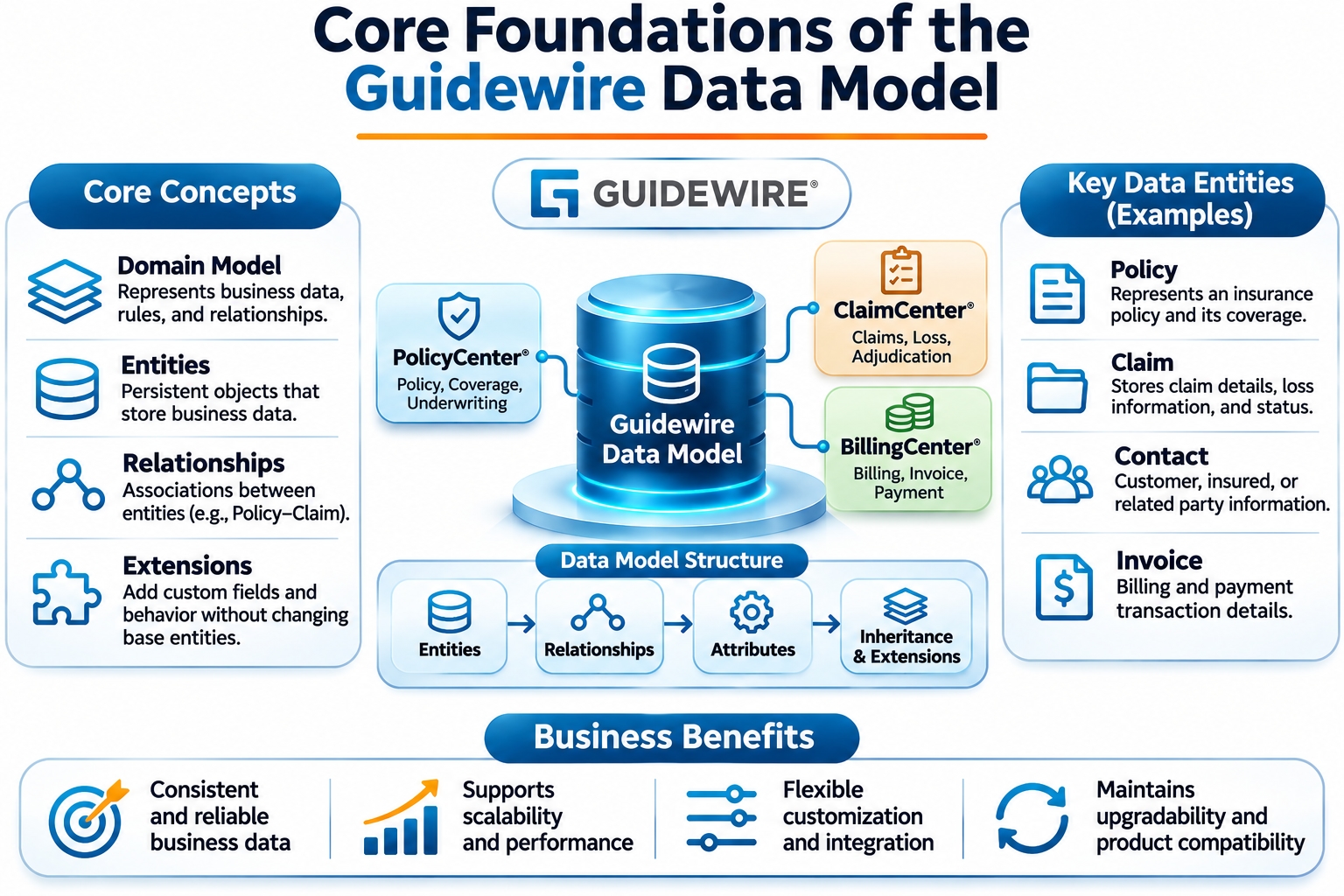
The Guidewire Data Model serves as the structural metadata layer bridging the Gosu programming tier with the persistent relational database underneath. Every business object inside the system—such as an Account, Policy, Claim, or Contact—is formally declared as an entity within .eti (entity definition) or .etx (entity extension) XML files. Instead of altering underlying SQL schemas manually, developers extend base entities using metadata files, allowing the Guidewire engine to generate strongly-typed Java and Gosu classes automatically at build time. This metadata-driven abstraction ensures object-oriented consistency, auto-generates primary key indices, handles optimistic locking via revision columns, and simplifies platform upgrades across major product releases.
Within this object-relational layer, entities maintain data using typed properties, typelists, and explicit structural relationships. Primitive attributes like strings, booleans, and integers store basic data, while typelists manage standardized drop-down enumerations represented as typekeys in the database. However, real-world insurance workflows demand complex connections between distinct entities, such as linking a single account to multiple policy periods or associating a claim with several driver records. By establishing explicit cardinality rules through metadata XML tags, Guidewire controls how data flows into memory bundles and persists into storage. Understanding this foundation is essential for writing efficient Gosu queries and maintaining data stability.
Demystifying Foreign Keys in Guidewire Entities
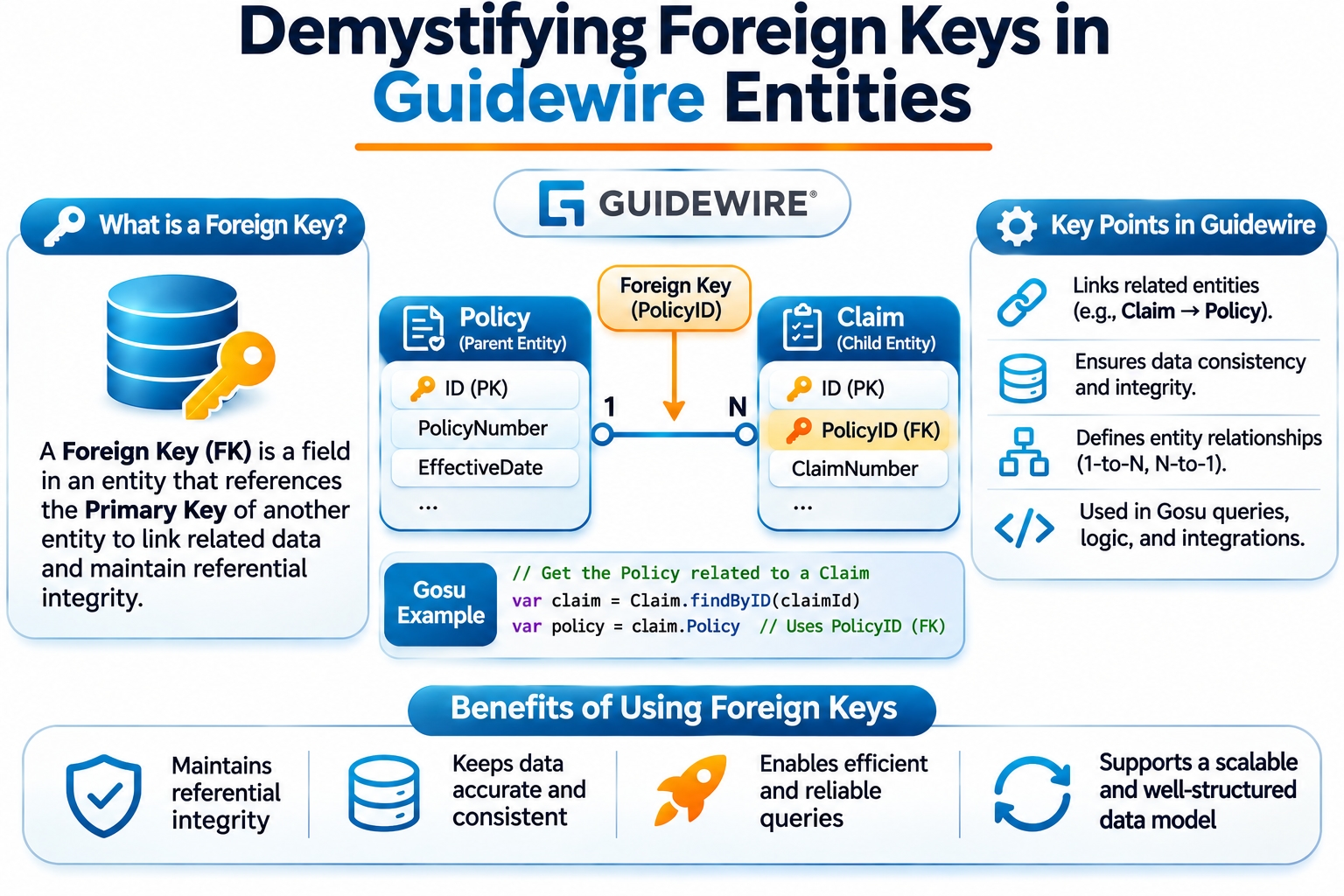
A Foreign Key (FK) in Guidewire defines a single-valued, to-one directional reference from a child entity to a target parent entity. Defined in metadata using the <foreignkey> XML tag, it stores the unique database ID (ID column) of the referenced target object directly inside the host entity's database table. In Gosu code, a foreign key is accessed directly as an object reference via dot-notation, allowing developers to traverse from a child object straight to its parent without writing manual SQL join statements. Foreign keys enforce referential integrity across the database while providing the primary mechanism for establishing parent-child links across business domains.
From an operational standpoint, business analysts and configuration engineers must evaluate how entity pointers map to real-world business requirements. Completing professional Guidewire Business Analyst training helps functional consultants bridge the gap between business rules and underlying data structures, ensuring correct foreign key cardinality during specification design. Whether linking a Vehicle record to its primary driver or mapping a Claim to its primary policy, foreign keys ensure that every child record correctly anchors to its parent entity while maintaining strict memory bundle tracking during transactional updates.
Arrays and One-to-Many Relationship Mechanics
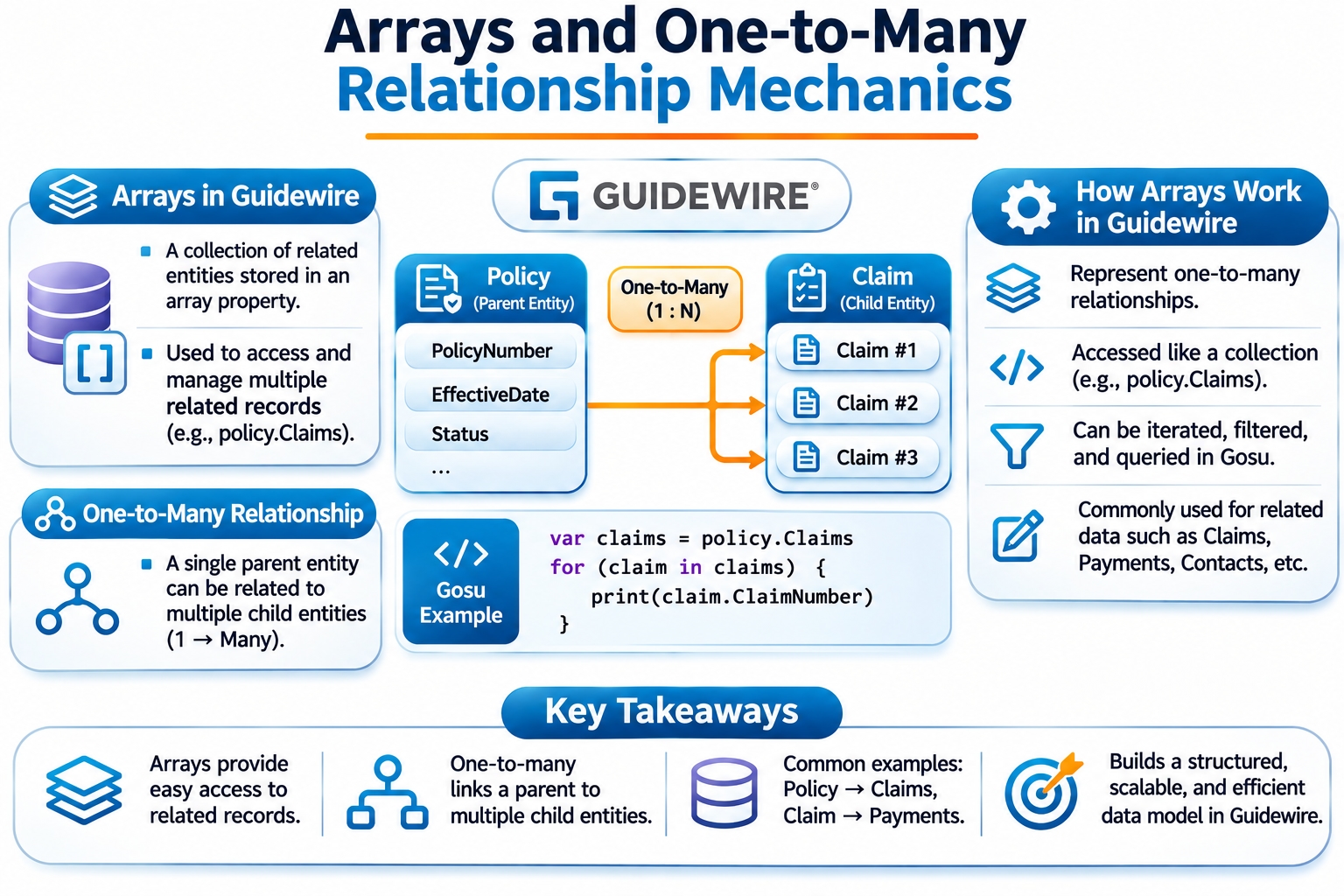
While a foreign key represents a single pointer pointing upward to a parent, an Array tag (<array>) in Guidewire represents the inverse to-many collection pointing downward from a parent entity to its children. Arrays allow a single parent entity to hold, manage, and iterate over a collection of related child records in memory. Crucially, an array definition does not create a new join table or column on the parent table itself; instead, it relies on a corresponding foreign key column sitting on the child entity table that references back to the parent. In Gosu, arrays are exposed as strongly-typed object lists equipped with built-in helper methods.
Building advanced custom entity structures requires mastering both sides of this bidirectional link. Enrolling in a comprehensive Guidewire technical training program equips developers with the Gosu skills needed to query arrays efficiently using built-in methods like where(), hasMatch(), and countWhere(). Developers learn how to configure array ownership flags (arrayentity), cascade deletion parameters, and array element triggers. Mastering array mechanics ensures that adding or removing elements from a collection updates the parent bundle safely without causing orphaned records or memory leaks during database commit phases.
Understanding Effdated (Effective-Dated) Entities
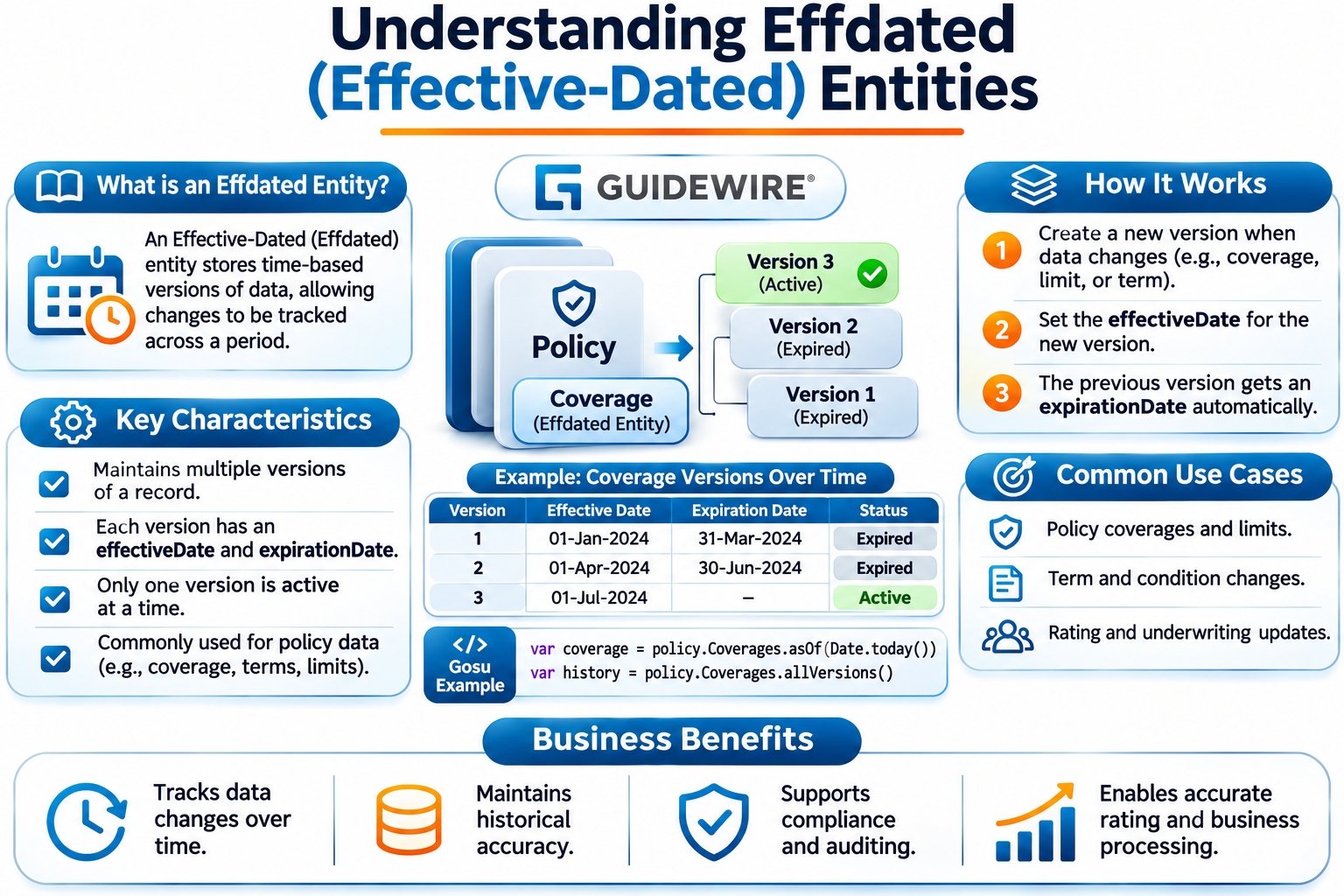
Insurance contracts are inherently temporal; coverage details, premium values, driver assignments, and vehicle limits change constantly over time. Standard relational database models overwrite existing records during updates, losing historical context. Guidewire solves this challenge through Effective-Dated (Effdated) entities—a specialized data model architecture where entities maintain full version history across time boundaries. Effdated entities contain mandatory temporal system fields, including EffectiveDate, ExpirationDate, SliceDate, and ChangeType, allowing PolicyCenter to track mid-term endorsements, policy renewals, and cancellations accurately.
The core power of effdated entities lies in their ability to present a point-in-time "slice" of a policy period. When an underwriter views a policy as of a specific past or future date, the system reconstructs the exact state of that entity version list for that slice date. Instead of overwriting data, mid-term policy changes split existing effdated rows into discrete effective date ranges. This versioning model guarantees complete auditability, precise pro-rata premium calculations, and accurate historical claims evaluation, making effective-dated data structures one of the most critical architectures within the entire Guidewire PolicyCenter platform.
Effdated Foreign Keys and Array Relationships
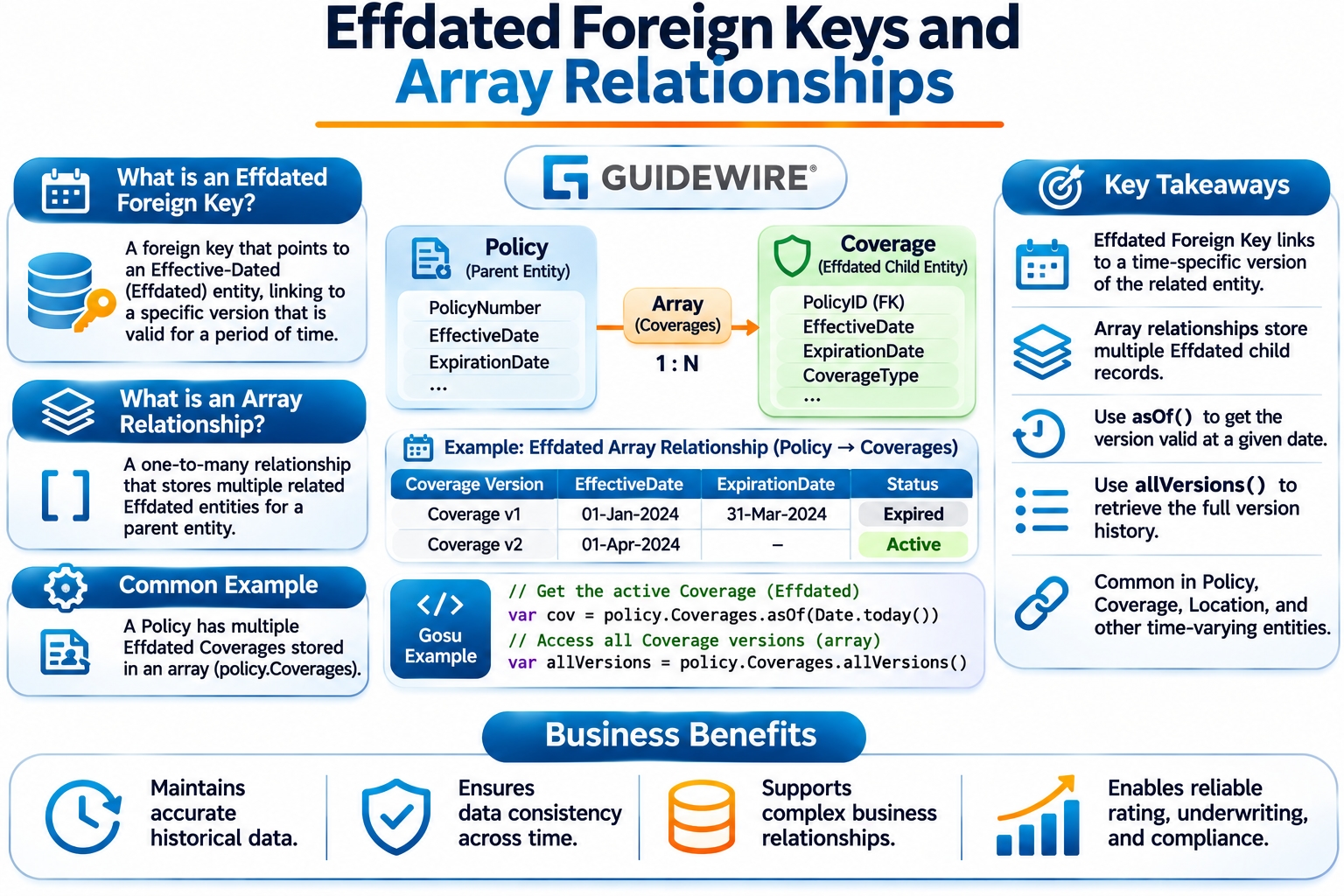
Combining effective-dating with traditional entity relationships introduces unique structural rules that developers must strictly follow. Relationships between effdated entities are governed by temporal boundaries: an effdated child entity can only reference an effdated parent entity within the exact same policy period slice. Guidewire enforces this through foreign keys linked to version lists, ensuring that as a policy period undergoes mid-term endorsements, all child array items—such as coverages, exclusions, and scheduled items—automatically version alongside their parent entity.
When linking an effdated entity to a non-effdated entity (such as a global Contact or Account), developers must use specific non-effdated foreign key patterns (<fk-entity>) to prevent invalid slice references. Understanding these cross-boundary relationships is vital for maintaining data consistency across transactions. If an effdated array is misconfigured, modifying a coverage on a future effective date could inadvertently overwrite past historical versions or cause version-unsliced entity exceptions. Following proper effdated modeling patterns ensures seamless temporal data propagation across all policy terms.
Architectural Best Practices for Data Modeling
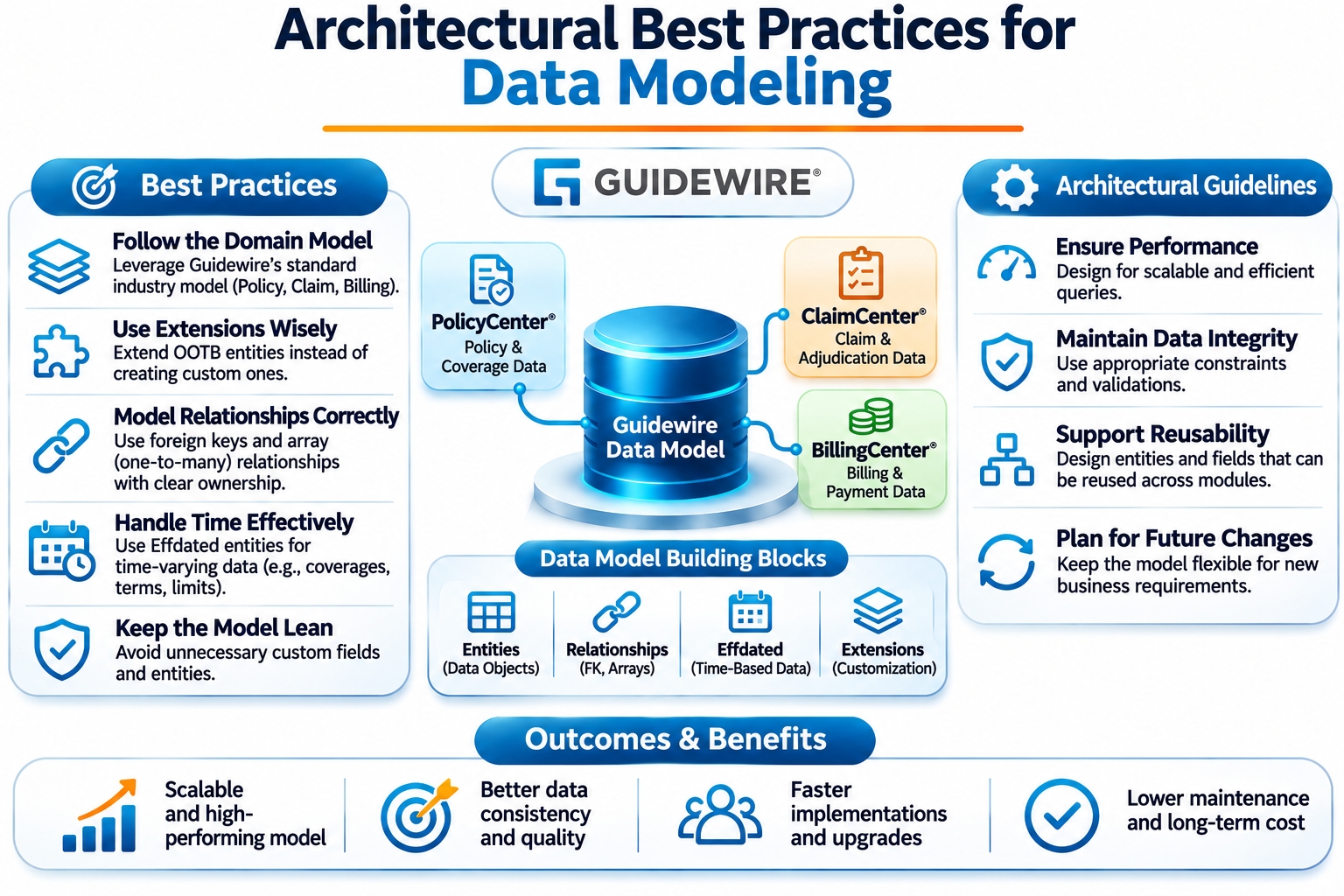
Designing scalable Guidewire data models requires adhering to established platform design patterns and performance guidelines. First, configuration teams should always extend existing out-of-the-box base entities via .etx files rather than creating completely unlinked custom entities whenever standard business objects exist. Over-architecting custom entities increases database join overhead, complicates future platform upgrades, and bypasses built-in InsuranceSuite business logic. Keep entity definitions lean, use typelists for constrained option sets, and maintain clear field naming conventions across all custom extensions.
Second, pay close attention to array loading performance and bundle transaction footprints. Avoid creating deeply nested array hierarchies that force the application server to pull thousands of child records into memory during simple screen loads. Use Gosu query keys and targeted query builders instead of traversing massive array properties directly in code. Finally, always validate effdated relationships within PolicyCenter to ensure proper version list behavior. By enforcing clean data boundaries, leveraging standard foreign key patterns, and respecting temporal versioning rules, software engineers can build high-performance, maintainable Guidewire implementations.
Conclusion
Mastering Guidewire foreign keys, array relationships, and effective-dated entities is essential for designing resilient, high-performance insurance applications. Foreign keys establish referential integrity between objects, arrays provide structured to-many collections, and effdated entities preserve vital historical audit trails across policy lifecycles. By following metadata-driven configuration rules, adhering to temporal slicing principles, and leveraging standard Gosu data patterns, development teams can build scalable, upgrade-safe solutions that align perfectly with complex P&C insurance requirements.



