
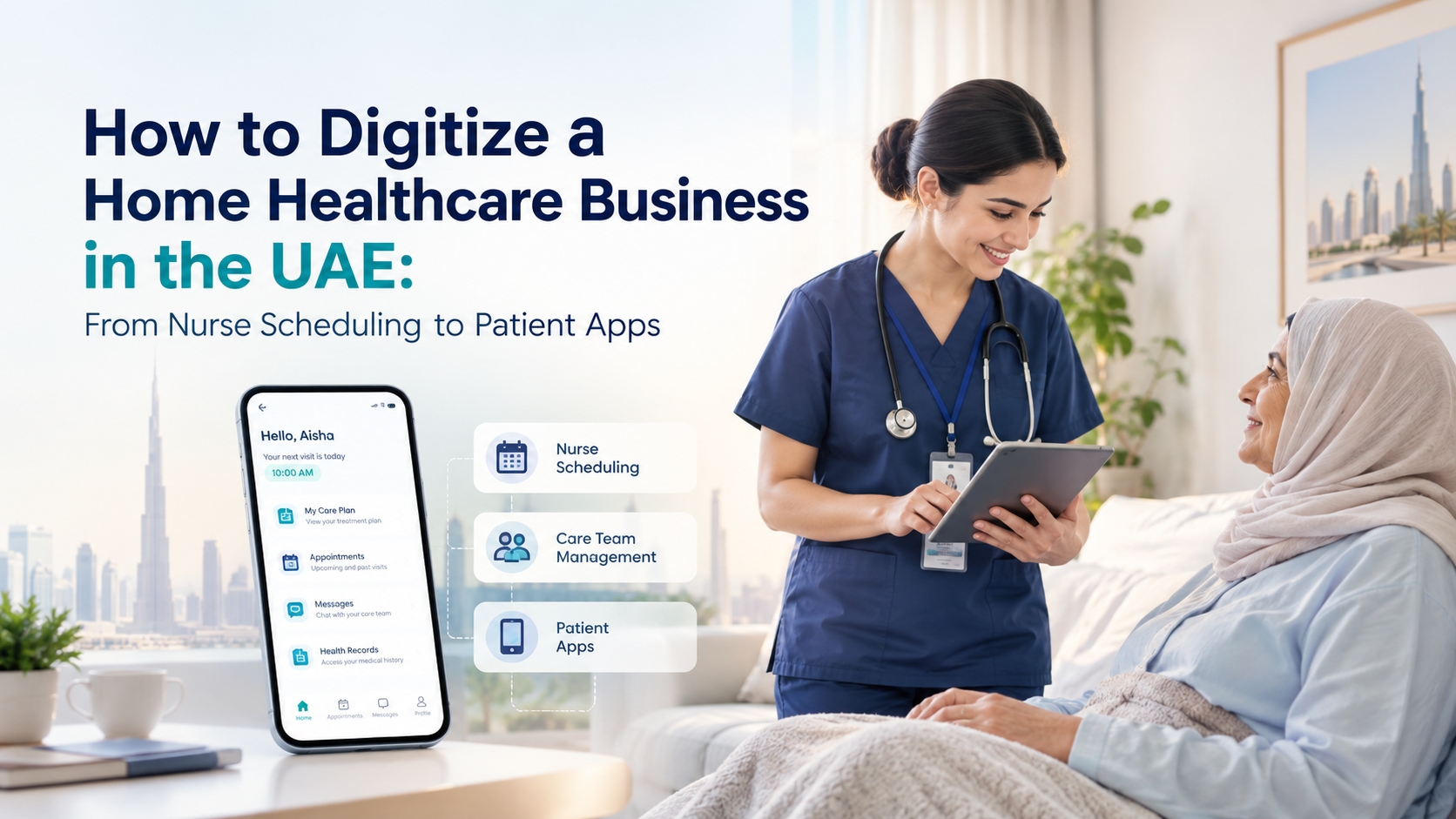
Running a home healthcare business is very different from operating a traditional clinic. Your healthcare professionals have to travel to patients, manage changing schedules, document care remotely, communicate with families and complete administrative work after each visit.
As patient volume grows, managing these activities through phone calls, spreadsheets and disconnected systems becomes difficult.
For UAE home healthcare providers, digital transformation is therefore not simply about launching a mobile app. It is about connecting the complete workflow—from patient intake and nurse scheduling to home visits, clinical documentation, billing, communication and management reporting.
The UAE is already building a connected digital healthcare environment. Digital health initiatives incorporate technologies such as electronic health records, artificial intelligence and connected systems, while emirate-level requirements also address health information exchange and electronic healthcare information.
So, what should a home healthcare business actually digitize first?
What Does Digital Home Healthcare Mean?
A digital home healthcare operation connects the different people and processes involved in delivering care.
A typical workflow could look like:
Patient referral → Digital intake → Assessment → Scheduling → Nurse assignment → Home visit → Clinical documentation → Family communication → Billing → Reporting
Instead of each stage being handled separately, information can move between the relevant teams.
Area | Manual approach | Digital approach |
|---|---|---|
Patient intake | Calls and forms | Digital registration |
Scheduling | Spreadsheets | Centralized scheduling |
Nurse assignment | Manual coordination | Rule-based assignment |
Visit tracking | Phone confirmation | Mobile check-in/check-out |
Documentation | Paper/manual notes | Mobile clinical records |
Family updates | Repeated calls | Automated notifications |
Billing | Separate records | Connected billing workflow |
Reporting | Manual spreadsheets | Management dashboard |
The objective isn't to automate everything immediately. It is to identify the processes that consume the most time or create the most operational problems and digitize those first.
1. Start With Patient Intake
A home healthcare journey can begin through a hospital referral, physician, insurance provider, website enquiry, phone call or family member.
If each referral is handled differently, staff may repeatedly collect the same information.
A digital intake system can centralize:
Patient demographics
Contact details
Referral source
Medical requirements
Service requirements
Location
Insurance information
Preferred visit times
Supporting documents
Once captured, this information can flow into scheduling and care-management workflows instead of being entered repeatedly.
2. Digitize Nurse and Caregiver Scheduling
Scheduling is one of the biggest operational challenges for home healthcare providers.
Coordinators may need to consider:
Nurse availability
Qualifications and skills
Patient requirements
Location
Shift timings
Recurring visits
Leave and absence
Existing assignments
Travel time
A digital scheduling system gives coordinators a centralized view of staff and visits.
More advanced systems can recommend suitable assignments based on availability, location, skills and other business rules.
For a growing provider, this can reduce scheduling conflicts and make it easier to respond to cancellations or last-minute changes.
3. Add Route and Visit Management
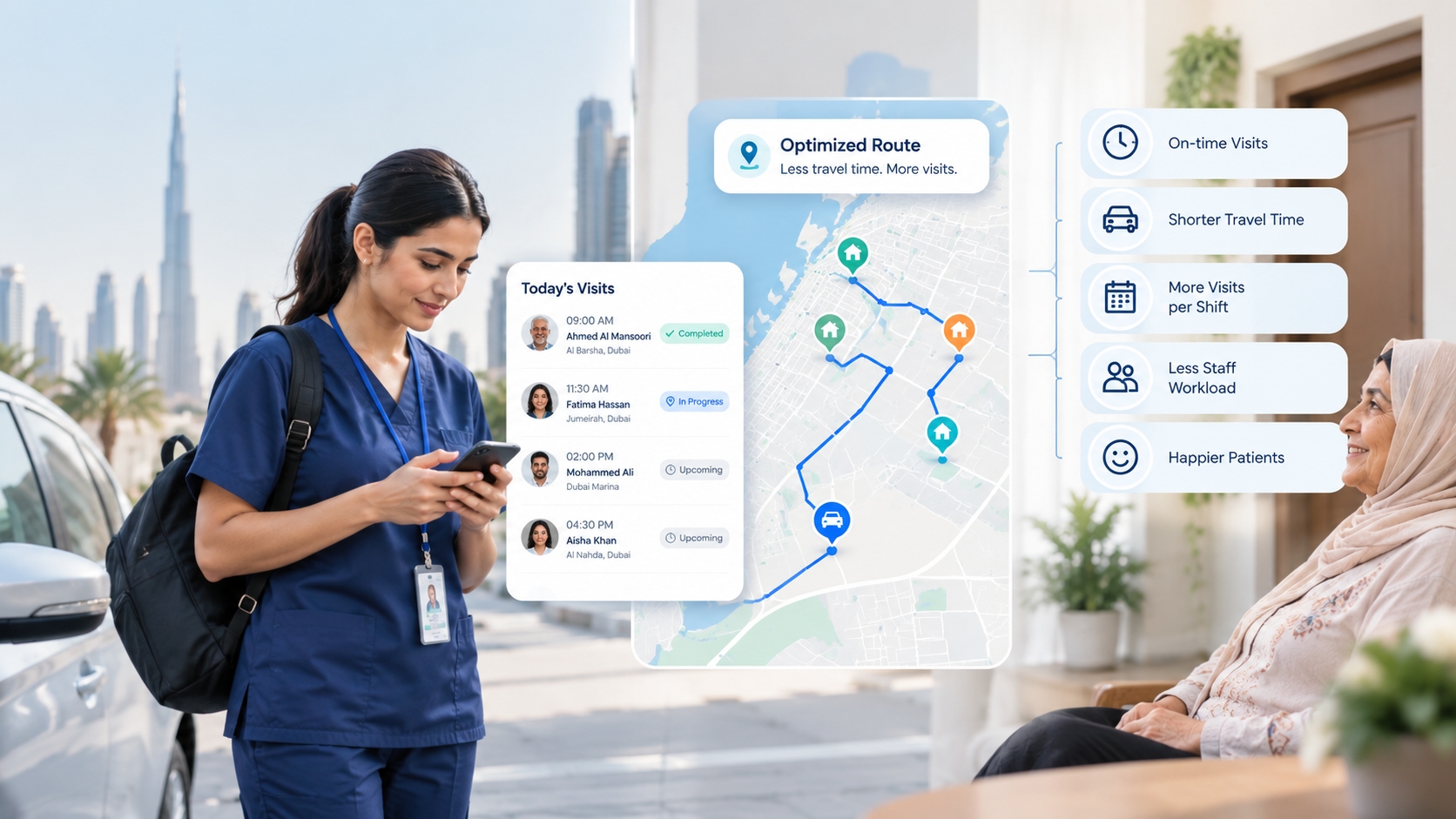
Unlike a clinic, home healthcare requires the healthcare professional to travel to the patient.
Poor route planning can result in:
Late visits
Longer travel times
Fewer visits per shift
Increased staff workload
Patient dissatisfaction
A digital platform can combine scheduling with location information to help coordinators plan visits more efficiently.
The system can consider patient locations, appointment windows, nurse availability and expected visit duration.
This turns scheduling into more than simply finding an available nurse—it becomes an operational planning process.
4. Give Field Staff a Mobile App
A home healthcare platform should work outside the office as well.
A nurse or caregiver may need to access:
Daily visits
Patient information
Care instructions
Care plans
Navigation
Visit check-in/check-out
Clinical documentation
Notifications
Follow-up tasks
A mobile application can put these functions in one place.
The important part is that the staff app should connect to the central healthcare platform. Nurses shouldn't have to update one system while coordinators maintain another spreadsheet.
5. Digitize Clinical Documentation
Documentation is another area where home healthcare businesses can lose time.
Instead of waiting until the end of a shift, authorized staff can document relevant information during or immediately after a visit.
Depending on the service, this may include:
Nursing notes
Vital signs
Patient observations
Care activities
Medication-related documentation
Follow-up requirements
Attachments where appropriate
A mobile-first interface is particularly important because field staff need to enter information quickly while working in patients' homes.
6. Create Digital Care Plans
Home healthcare often involves recurring visits and long-term care.
A digital care plan can connect:
Care requirements → Scheduled visits → Care delivered → Clinical notes → Follow-up
Authorized staff can access relevant care instructions and update progress without relying on separate documents.
This also gives supervisors a clearer view of whether planned care is being delivered consistently.
7. Improve Patient and Family Communication
Families often want visibility into home healthcare services.
They may want to know:
When is the next visit?
Who is coming?
Has the visit started?
What follow-up is required?
Can the appointment be changed?
How can they contact the provider?
A patient or family-facing app can provide features such as appointment management, notifications, secure communication, payment options and access to permitted information.
The UAE's broader healthcare ecosystem is already moving toward patient-facing digital services. Abu Dhabi's Sahatna platform, for example, provides services including appointment booking, teleconsultations and access to health information.
For private home healthcare providers, the opportunity is to build a digital experience specifically around home-based care.
8. Connect Billing and Insurance
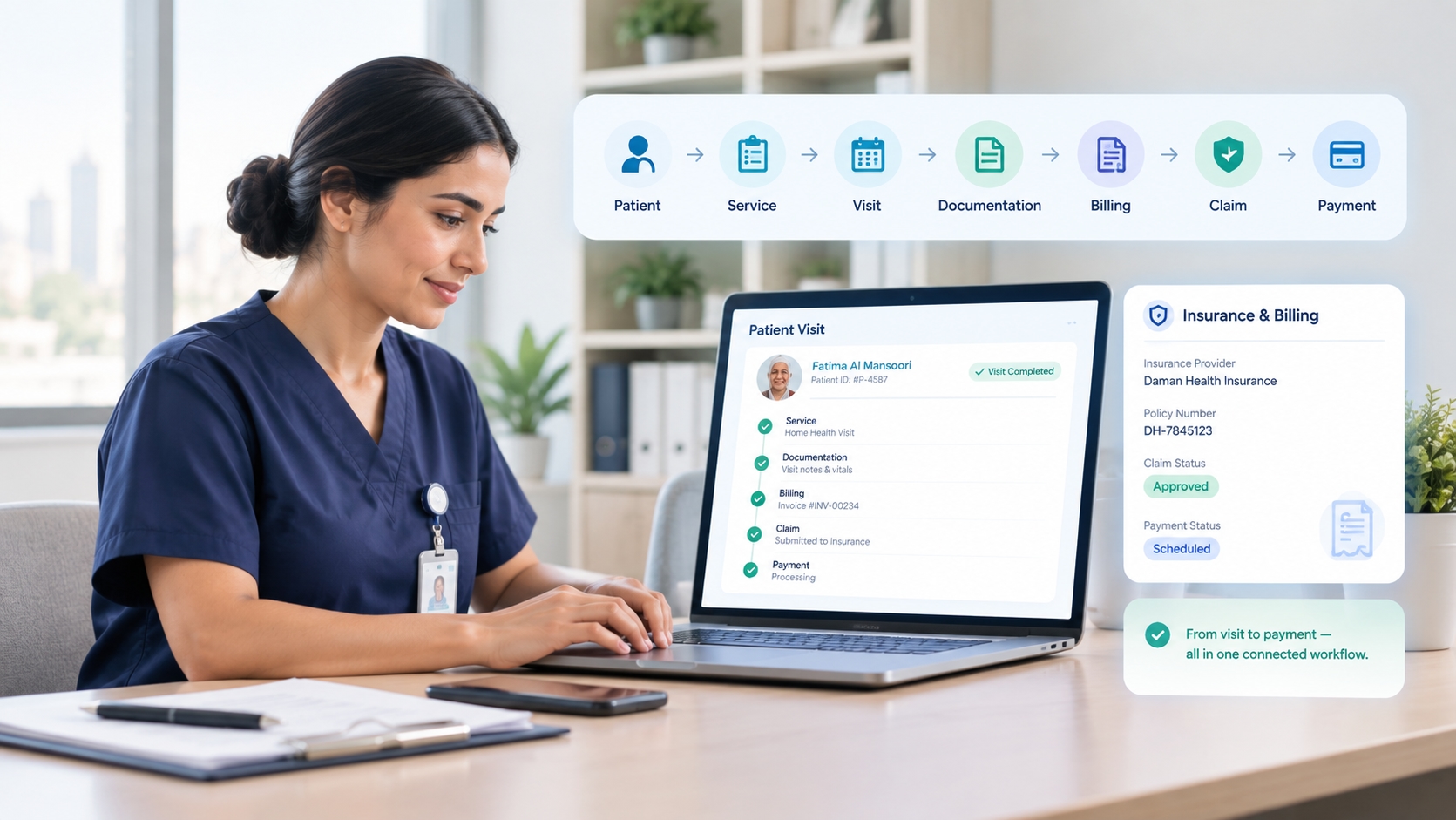
Digitization should continue after the nurse completes a visit.
A connected workflow can link:
Patient → Service → Visit → Documentation → Billing → Claim → Payment
Depending on the provider's model, software can support service capture, invoices, insurance information, claims workflows and payment tracking.
This reduces the risk of completed services becoming disconnected from administrative and financial processes.
9. Build a Management Dashboard
Once operational data is centralized, management can gain visibility into areas such as:
Active patients
Completed visits
Cancelled visits
Missed visits
Nurse utilization
Staff availability
Revenue
Outstanding payments
Referral sources
Patient retention
Branch performance
The purpose of a dashboard isn't simply to display charts. It should help management answer practical questions:
Where is demand increasing?
Which services are growing?
Where are scheduling bottlenecks occurring?
Are particular branches understaffed?
How many visits are being cancelled?
These insights become increasingly important as a home healthcare company expands.
10. Use AI Where It Solves a Real Problem
AI can support home healthcare operations, but it should be introduced for a specific purpose.
Potential applications include:
Nurse scheduling optimization
Route planning
Documentation assistance
Automated patient communication
Demand forecasting
Operational analytics
Identifying unusual patterns
For example, AI could help analyze scheduling constraints and suggest suitable staff assignments.
However, AI should support—not replace—clinical judgment. Healthcare providers also need appropriate security, governance and oversight when introducing AI into patient-facing or clinical workflows.
11. Plan Integrations From the Beginning
Established healthcare businesses often already have an EMR, accounting platform, CRM, payment system or other software.
Digitization does not necessarily mean replacing everything.
A better approach may be to integrate existing systems with a new operational layer, staff application or patient platform.
Depending on the systems involved, integration may use APIs, HL7, FHIR or other supported interfaces.
This is particularly relevant in the UAE, where healthcare information exchange requirements differ by emirate. Abu Dhabi, for example, has specific health information exchange standards and requirements around electronic medical systems and Malaffi integration for applicable healthcare services.
Security, access control, audit trails and data protection should also be considered during architecture and integration planning.
12. Follow a Phased Digital Transformation Roadmap
Trying to digitize everything simultaneously can create unnecessary complexity.
A practical roadmap is:
Phase 1: Map the workflow
Document how patients currently move from referral to care and billing.
Phase 2: Digitize operations
Implement patient management, scheduling, staff assignment and visit management.
Phase 3: Equip field staff
Introduce a mobile application for nurses and caregivers.
Phase 4: Improve the patient experience
Add patient/family applications, notifications and digital communication.
Phase 5: Integrate systems
Connect relevant EMR, insurance, payment and healthcare systems.
Phase 6: Add analytics and AI
Use reliable operational data to introduce advanced reporting, automation and AI.
This approach allows the business to solve its biggest operational problems first rather than spending heavily on features it may not need.
How Much Does Home Healthcare Software Cost in the UAE?
There is no single price for home healthcare software.
The investment depends on factors such as:
Number of applications
Number of users
Scheduling complexity
Mobile development
Healthcare integrations
Patient app requirements
Security architecture
AI functionality
Analytics
Cloud infrastructure
Ongoing support
A basic scheduling system will naturally cost less than a complete platform connecting patients, nurses, EMR, insurance, payments and analytics.
For an established provider, the better question is:
Which digital capabilities will remove our biggest operational bottlenecks and support our next stage of growth?
Frequently Asked Questions
1. What type of software does a UAE home healthcare business need?
A provider may need patient management, scheduling, workforce management, clinical documentation, billing, reporting, staff mobile applications and patient-facing applications. The exact technology stack depends on the provider's size, services, existing systems and expansion plans.
2. Can RowthTech develop custom home healthcare software for UAE providers?
Yes. RowthTech can help healthcare businesses develop customized digital platforms, mobile applications, integrations, dashboards and AI-enabled workflows based on their existing processes and technology requirements.
3. Can RowthTech integrate existing healthcare systems instead of replacing them?
Yes. Where existing systems support suitable integration methods, RowthTech can work on healthcare integrations involving APIs and interoperability technologies such as HL7 or FHIR, depending on the systems and requirements involved.
4. How can AI be used in home healthcare?
AI can potentially support scheduling, route optimization, documentation assistance, patient communication, forecasting and operational analytics. It should be implemented with appropriate clinical oversight and healthcare data governance.
5. What should a home healthcare provider digitize first?
Start with the processes that create the greatest operational friction—usually patient intake, scheduling, staff assignment, visit tracking and clinical documentation. Patient apps, billing integrations, analytics and AI can then be introduced in later phases.
Final Takeaway
Digitizing a home healthcare business in the UAE is not simply about creating a patient app.
The real opportunity is to connect the entire operational journey:
Patient intake → Scheduling → Nurse assignment → Route planning → Home visit → Clinical documentation → Family communication → Billing → Analytics
When these processes work together, a provider gains better operational visibility while creating a smoother experience for patients, families, nurses and administrators.
For an established UAE home healthcare business, the best digital strategy is therefore not to add technology for its own sake. It is to build a connected system around the way care is actually delivered—and then expand that system as the business grows.