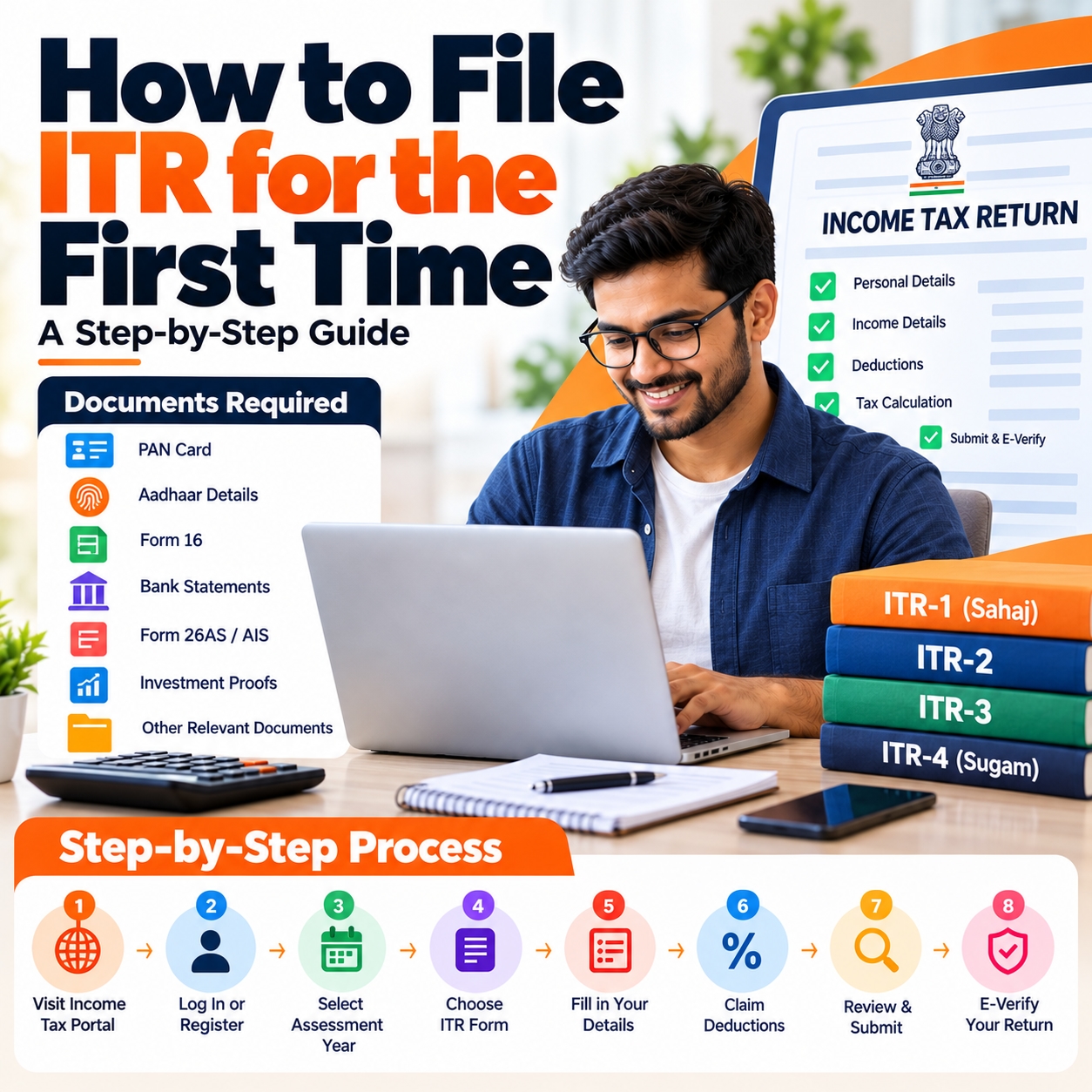
If you are filing an Income Tax Return (ITR) for the first time, it can be quite confusing. This is more so for salaried employees, students, freelancers or new business owners. But with the right documents and a clear understanding of the process, filing your first ITR can be simple and convenient.
An Income Tax Return is a form which is used to report your income, deductions, eligible tax credits and tax liability to the Income Tax Department of India. Even if your tax liability is zero or minimal, filing an ITR is mandatory or beneficial in certain situations based on your individual circumstances.
In this guide, we will walk you through the process of filing your ITR for the first time, the documents required, how to choose the right ITR form and the online filing process.
What is ITR Filing Online?
ITR filing Online is the process of providing details of your income and taxes to the Income Tax Department for a particular financial year. Your return may include income from salary, business, professional services, house property, capital gains, interest or any other applicable sources.
For instance, if you are a salaried employee and your employer has deducted TDS from your salary, filing an ITR will allow you to report your annual income and claim any eligible tax credits or refunds.
Filing an ITR can also be beneficial while applying for a loan, obtaining a visa, keeping a track of your financial history or carrying forward the eligible losses as per the rules that are applicable.
Filing Income Tax Return for the First Time
You may have to file ITR if you:
- You earn more than the basic exemption limit under the applicable tax regime. - You have income from a profession or a business and you have to file a return. - You wish to claim refund of excess TDS or advance tax paid. - You have capital gains or other income that is taxable. - You meet any other condition under the Income-tax Act that requires you to file your return.
There are a few special situations where you may be required to file even if your income is below the basic exemption amount. So don't think filing is only about salary or bank balance.
Documents You Need to File Your First ITR
Before you start filing, have the following documents and information ready, as applicable:
1. PAN card: You usually require your Permanent Account Number to file your income tax.
2. Aadhaar details: for applicable verification and PAN-Aadhaar compliance.
3. Form 16: Generally given by your employer in case of salaried;
4. Bank statements: These may help identify interest income and other relevant transactions.
5. Form 26AS: It includes details about tax credits like TDS.
6. Annual Information Statement (AIS): Reported financial information that is useful for filing taxes.
7. Pay slips These can be useful to look at the elements of salary and the deductions.
8. Investment and deduction proofs: Such as qualified insurance premiums, provident fund contributions, or any other qualified payments.
9. Home loan interest certificate: To claim an eligible deduction/benefit.
10. Capital gains statements - if you sold shares, mutual funds, property or any other capital assets.
11. Business or professional income records: Income statements, expense records and books of account, as appropriate.
12. Bank account details: You may need to provide details of a qualifying, verified account to receive a refund of income tax.
Not all taxpayers need all documents. These documents come from your sources of income , deductions , transactions , and applicable tax rules .
Which ITR Form Should be selected by a First Time Filer?
Choosing the right ITR form is an important step. The right form for you depends on your income sources, residential status, and other eligibility criteria.
– ITR-1 (Sahaj): Generally for eligible resident individuals with relatively simple income, subject to the conditions and exclusions of the form.
- ITR-2: ITR-4 You are generally used by Individuals and Hindu Undivided Families not eligible for ITR-1 and having income from business or profession.
- ITR-3: Normally applicable to individuals and Hindu Undivided Families (HUFs) having income from Business or Profession.
- ITR-4 (Sugam): This ITR form is applicable to the eligible taxpayers who are applying the specified presumptive taxation provisions, subject to the conditions of this form.
There are other ITR forms that may apply to firms, companies and other taxpayers.
Note: Avoid choosing an ITR form simply because it looks simple. Before filing, check the eligibility criteria for the current year on the official Income Tax portal.
Step by Step Process to File ITR Online for the First Time
Step 1: Go to the Official Income Tax Portal
Visit the official website:
[https://www.incometaxindia.gov.in/ If you're a new user, determine whether you need to register. Enter your PAN and other details as per the instructions on the portal.
Step 2. Log In to Your Account
Log in with your registered credentials. Please ensure the accuracy of your personal details, contact details and PAN related information.
If you're unable to access your account, you can use the account recovery options available in the portal.
Step 3: Choose the Correct Assessment Year
Select the Assessment Year (AY) for the financial year for which you are filing the return.
For example, the income earned from 1st April, 2025 to 31st March, 2026 is commonly known as Financial Year 2025-26 and Assessment Year 2026-27.
Always check the relevant financial year and assessment year before proceeding.
Step 4: Begin Filing Your Income Tax Return
Go to the e-File section and click on the option to file an Income Tax Return. Choose the relevant Assessment Year and mode of filing from the options available on the portal.
Select the right taxpayer type and ITR form according to your situation.
Step 5: Check your personal info
Please go through the pre-filled details thoroughly including your name, PAN, address, bank details and other relevant particulars.
Pre-filled information may be incomplete or needs to be corrected. You are still responsible for the accuracy of your return.
6. Fill in your income information
Report all relevant sources of income, for instance:
Salary and allowances. - Interest from savings and fixed deposits. Rental income from owned property. - Business or professional earnings. - Sale of assets, profit. - Other taxable income, if applicable.
Reconcile figures with Form 16, Bank Statements, AIS, Form 26AS, and supporting records.
Step 7: Claim Qualifying Deductions and Tax Credits
You will have to enter eligible deductions and exemptions as per the tax regime chosen and the rules applicable for that Assessment Year.
Details of TDS, Advance Tax & Self Assessment Tax. Do not take deductions or credits unless you know you qualify and have the documentation to back up your claim.
Step 8: Verify Your Tax Calculation
In general, the portal computes the tax based on the details filled. Carefully check the computation to see if you have tax payable, no additional tax payable or a possible refund.
If you owe additional tax, follow the appropriate payment process and ensure the payment is properly recorded on your return.
Step 9: Preview and Send Your Income Tax Return
Check the whole return before you file. Check your income numbers, bank account, deductions, tax credits and the ITR form you have chosen.
If the portal shows validation errors, correct them and then submit the return when the details are correct.
Step 10. E-Verify Your Return
The process does not end with filing your ITR. You have to complete the verification through any of the allowed methods, such as Aadhaar OTP, net banking or any other option provided by the portal.
save the acknowledgment and verify that the return has been successfully verified. An unverified return may not give you the results you expect.
Common Mistakes To Avoid While Filing ITR For The First Time
Here are common mistakes first-time taxpayers should avoid:
- Wrong ITR form: Choose the right form based on your income sources and eligibility.
Disregarding interest income: Savings account and fixed deposit interest may need to be declared.
- Not checking AIS and Form 26AS: Reconcile your tax information before filing your return.
- Claiming deductions you’re not entitled to: Claim only benefits allowed by the relevant tax rules.
- Incorrect bank details submitted: Review your account details to help prevent refund payment failures.
- E-verification: Forget about e-verification. Complete the verification process after submission.
- Failure to file on time: Find the appropriate due date for your taxpayer category and situation.
ITR Filing for the First Time
1. First time filing ITR, can I do it myself?
Yes. Eligible taxpayers can file their returns on the official Income Tax e-Filing portal. If you have complex income sources or are unsure which form to use, consider seeking help from a tax professional.
2. Is PAN required for filing ITR?
Usually, you need a PAN to file an income tax return. Follow the present Income Tax Department requirements applicable to your situation.
3. Can I file ITR without Form-16?
Yes. Form 16 is useful for salaried employees, but it is not the only source of information to file a return. You might have to submit salary slips, bank statements, AIS, Form 26AS and other supporting documents for an accurate report of your income.
4. What’s the cost of filing an ITR?
Generally, there is no government filing fee when filing directly through the official government portal. Service charges may apply if you use a private platform or tax professional depending on the complexity of your return.
5. What if I make a mistake in the first ITR?
If you discover an error after you file, find out if you can file an amended return or use another correction method permitted under the rules and time limits that apply. Take action quickly and check the latest instructions on the official portal.
6. How do I know that my ITR has been successfully filed?
Step 1: Visit the official Income Tax portal and head over to the filed returns section. Check the status of filing and verification of return and retain the acknowledgment for your records.
Preparing your documents, choosing the right form, reporting all applicable income, checking tax credits and doing e-verification makes filing ITR for the first time easy. Take a moment to review your return before submitting, accurate reporting can help minimize avoidable errors and processing delays.
Need help with your first ITR?
TaxCaller India LLP ITR Filing Online provides online income tax return filing help to eligible individuals, salaried employees, freelancers and business owners.
Disclaimer: This article is for general informational purposes only and is not intended as tax or legal advice. ITR eligibility, forms, deductions, and deadlines depend on the relevant Assessment Year and individual circumstances. Always verify the latest official requirements before filing.