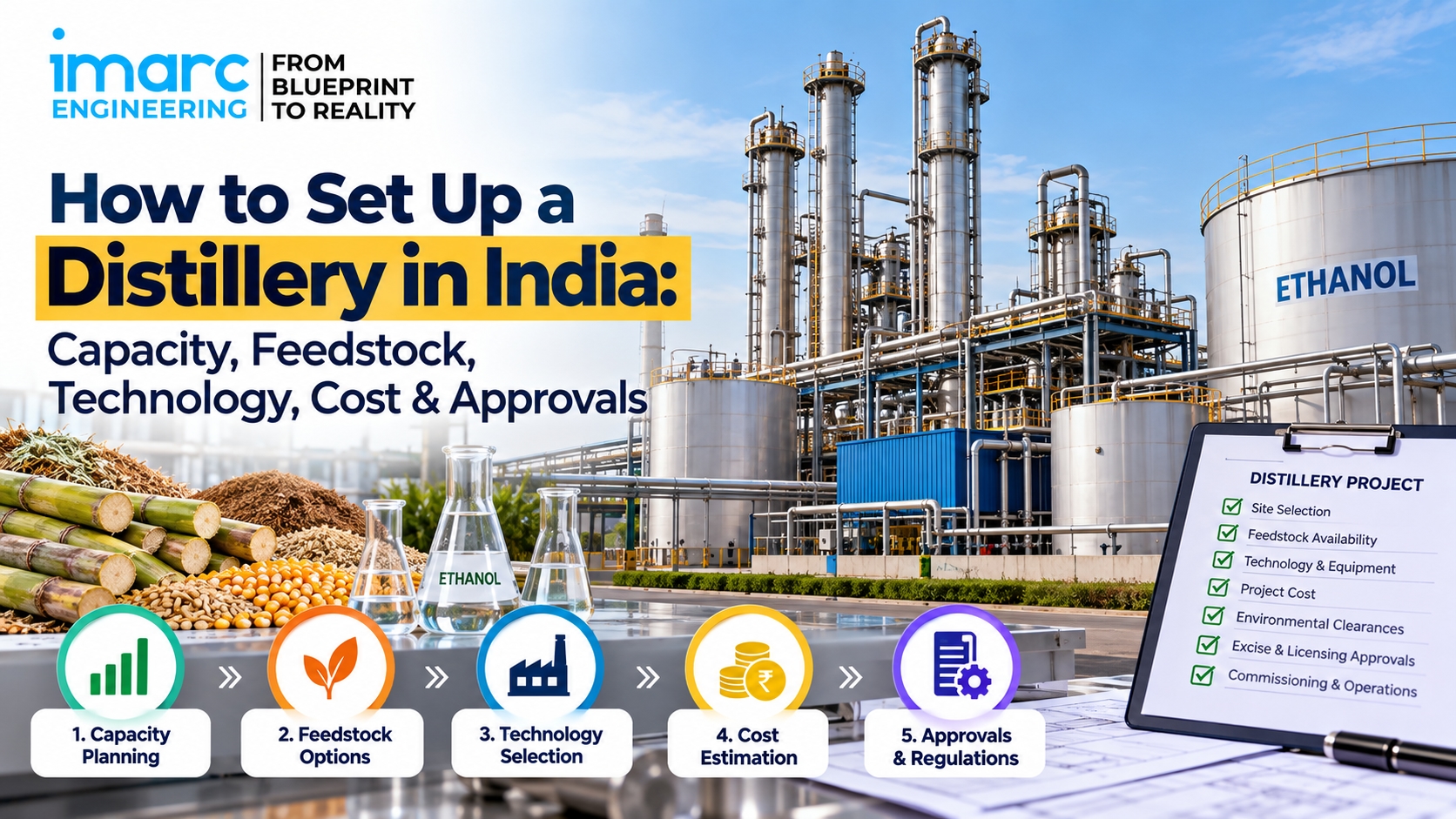
A distillery project is often reduced to a capacity figure and a technology brochure. In practice, project outcomes depend on feedstock security, process selection, utility reliability, effluent management and a complex approval pathway that varies by product type and state. When these are handled late, capital is committed before the operating model is proven.
How to set up a distillery in India therefore requires integrated planning across capacity, feedstock, technology, cost and approvals. The objective is a facility that can run continuously, compliantly and commercially—not only a plant that can be commissioned once. For projects focused on ethanol production, Set Up an Ethanol Manufacturing Plant in India provides a related project-planning reference.
Why Distillery Projects Need Structured Planning
Distilleries are process plants with biological, thermal and regulatory sensitivity. Fermentation performance, water and energy balance, spent wash handling and product quality controls all affect uptime and cost.
Projects typically face pressure from:
Seasonal or price-volatile feedstock
Technology choices that do not match local raw material
Underdesigned utilities and effluent systems
Approval sequencing that delays commissioning
Working-capital strain during ramp-up
India’s manufacturing investment climate remains active:
Manufacturing growth is estimated at around 7% at constant prices in FY 2025-26 (MoSPI First Advance Estimates).
FDI into manufacturing rose 18% in FY 2024-25 to US$19.04 billion (Ministry of Commerce & Industry / DPIIT).
PLI cumulative investment has exceeded ₹2.16 lakh crore, with cumulative production and sales surpassing ₹20.41 lakh crore as of December 2025 (PIB).
Logistics costs have improved to an estimated 7.97% of GDP (DPIIT-NCAER study).
Industrial capacity creation is supported at a macro level. Distillery viability still depends on project-level design and compliance discipline.
Step 1: Define Product and Capacity Clearly
Capacity planning starts with product definition.
Clarify:
Industrial alcohol / ethanol, potable alcohol or other regulated output
Daily and annual capacity basis
Anhydrous or rectified product requirements, where relevant
By-product streams and their disposal or recovery route
Expansion phases versus single-step installation
Capacity should be tied to dependable feedstock and offtake, not only to desired market ambition. Overstated capacity increases capital intensity and under-utilisation risk.
Step 2: Secure Feedstock Before Freezing Capacity
Feedstock is the core operating constraint for most distilleries.
Common routes include:
Molasses-based processes
Grain-based processes
Other approved fermentable substrates depending on project design
For each route, assess:
Annual and seasonal availability
Delivered cost and logistics radius
Quality variability and storage needs
Competing demand from other users
Supply contracts versus spot dependence
A distillery sized on optimistic feedstock assumptions becomes unstable when supply tightens or prices spike. Validate delivered feedstock economics before major equipment commitments.
Step 3: Select Technology Against Feedstock and Operating Reality
Distillery technology is not generic.
A typical process chain includes:
Feedstock handling and preparation
Fermentation
Distillation and rectification
Dehydration where anhydrous product is required
Storage and dispatch
Effluent and spent-stream management
Utilities: steam, power, water and cooling
Technology evaluation should test:
Fit with chosen feedstock
Yield and recovery assumptions under realistic conditions
Energy and water intensity
Spent wash / effluent treatment route
Automation level versus local O&M capability
Reference plant evidence and service support
Lowest EPC price is a weak selection criterion if effluent systems, energy balance or uptime are unstable.
Step 4: Plan Land, Layout and Utilities as One System
Site selection affects both compliance and operating cost.
Evaluate:
Feedstock inbound and product outbound logistics
Reliable power and process-water availability
Space for process blocks, storage, utilities and effluent systems
Environmental sensitivity and buffer requirements
Flood, drainage and soil conditions
Room for phased expansion
Layout should separate process, storage, utilities, effluent treatment and truck movement. Congested layouts raise safety risk and reduce maintainability.
Utility design must support simultaneous process loads. Steam, cooling and power shortfalls often limit capacity more than fermentation or distillation equipment itself.
Step 5: Assess Cost Without False Precision
There is no single setup cost for every distillery in India. Investment varies with capacity, feedstock route, technology package, civil scope, effluent treatment intensity and location.
Build cost from complete packages:
Land and site development
Civil and structural works
Process plant and machinery
Utilities and power systems
Effluent treatment and environmental systems
Storage and material handling
Engineering, approvals and pre-operative expenses
Contingency
Working capital for feedstock, chemicals, spares and ramp-up
Operating cost planning should model feedstock, energy, water, enzymes/chemicals where used, manpower, maintenance, effluent operations and logistics under realistic utilisation. A project that works only at ideal capacity is fragile.
Step 6: Map Approvals Early and Sequence Them
Distillery approvals are multi-layered and vary by product category and state.
A practical approval map usually includes:
Company and tax registrations
Land-use and local establishment permissions
Factory licence and labour compliances
Environmental clearances/consents and pollution-control conditions
State excise and related alcohol regulatory permissions where applicable
Fire and safety approvals
Boiler and pressure-system compliances where applicable
Product and offtake-linked permissions depending on end use
Industrial alcohol and potable liquor pathways are not identical. State-level requirements can differ materially. Treat approval mapping as a project-critical workstream, not a post-ordering formality.
Sequence filings with design freeze, civil execution and commissioning. Installing equipment before critical consents are understood is a common cause of delay.
Step 7: Design Effluent and Environmental Controls Into the Project
Spent wash and process effluents are central to distillery design.
Plan for:
Effluent quantity and characteristics by process route
Treatment technology suited to load and discharge/reuse objectives
Storage, drying, incineration or other approved handling routes where relevant
Monitoring and record systems for consent conditions
Contingency for process variability and shock loads
Environmental systems are not optional add-ons. They affect both compliance and continuous-run capability.
Bankability Checks Before Investment Commitment
Serious promoters and lenders typically look for:
Credible feedstock security and delivered-cost logic
Technology suitability for local conditions
Complete CapEx with limited hidden packages
Robust effluent and utility design
Clear offtake or market pathway
Approval strategy with realistic timelines
Working-capital provision for ramp-up
Sensitivity cases for utilisation, feedstock price and downtime
A strong brochure is not a bankable project. Evidence of operable supply, process and compliance pathways is.
Common Mistakes When Setting Up a Distillery
Freezing capacity before feedstock is secured
Selecting technology only on capital cost
Underdesigning effluent treatment and utilities
Ignoring state-specific regulatory pathways
Treating approvals as end-stage paperwork
Underestimating working capital
No realistic ramp-up plan
Weak integration between process design and layout
These mistakes surface during commissioning, when correction is most expensive.
Practical Setup Checklist
Product type and capacity basis are defined.
Feedstock availability and delivered cost are validated.
Technology matches feedstock and O&M capability.
Land and layout support process, storage and effluent needs.
Utilities are sized for simultaneous operating loads.
CapEx packages are complete beyond equipment cost.
Working capital and utilisation scenarios are modelled.
Approval pathway is mapped by product and state.
Environmental systems are designed into the project.
Offtake or market pathway is clear.
If several items remain open, major capital commitment is premature.
How IMARC Engineering Can Help
IMARC Engineering supports industrial promoters and process-plant sponsors who need stronger project definition before capital is committed. Distillery projects benefit from early alignment of capacity logic, process and utility design, environmental systems and approval readiness.
Support may include:
Project planning and feasibility-oriented inputs
Site, layout and utility readiness support
CapEx-oriented planning advisory for process industries
Experience across industrial process and manufacturing environments where feedstock, utilities and compliance determine operating outcomes
If you are planning to set up a distillery in India and need structured support across capacity, feedstock, technology, cost and approvals, IMARC Engineering can help before major commitments are locked: https://www.imarcengineering.com/contact-us
Conclusion
How to set up a distillery in India is a complete project-design task: define capacity on real feedstock, choose technology that can run under local conditions, build full cost and working-capital logic, and sequence approvals before construction momentum takes over. Equipment selection alone is not a project plan.
Promoters who validate supply, process design, effluent systems and regulatory pathways early reduce commissioning risk. Promoters who begin with machinery quotations alone often rediscover feedstock, utility and consent constraints when the plant is already under construction.
A viable distillery is one that can operate continuously, meet product and environmental requirements and sustain economics under practical conditions—not one that only achieves design capacity on paper.
Explore Our Related Insight: https://www.imarcengineering.com/case-study/grain-based-ethanol-distillery-facility
Contact Us:
IMARC Engineering
Phone: +91-120-433-0800
Email: sales@imarcengineering.com
India: C-130, Sector 2, Noida, Uttar Pradesh 201301
LinkedIn: https://www.linkedin.com/showcase/imarc-engineering/