According to IMARC Group's report titled "India Metallurgical Equipment Market Size, Share, Trends and Forecast by Type, Equipment, Application, and Region, 2026-2034", the report offers a comprehensive analysis of the industry, including market size, its growth, trends, and regional insights.
The India metallurgical equipment market size was valued at USD 5.0 Billion in 2025, expected to reach USD 7.9 Billion by 2034, at a CAGR of 4.99% during the forecast period 2026-2034. Metallurgical equipment sits at the heart of steelmaking and metal processing, from blast furnaces and rolling mills to precision machining tools. Expansion of domestic steel capacity, adoption of Industry 4.0 practices, and a policy push toward indigenisation are shaping equipment demand across ferrous and non-ferrous producers.
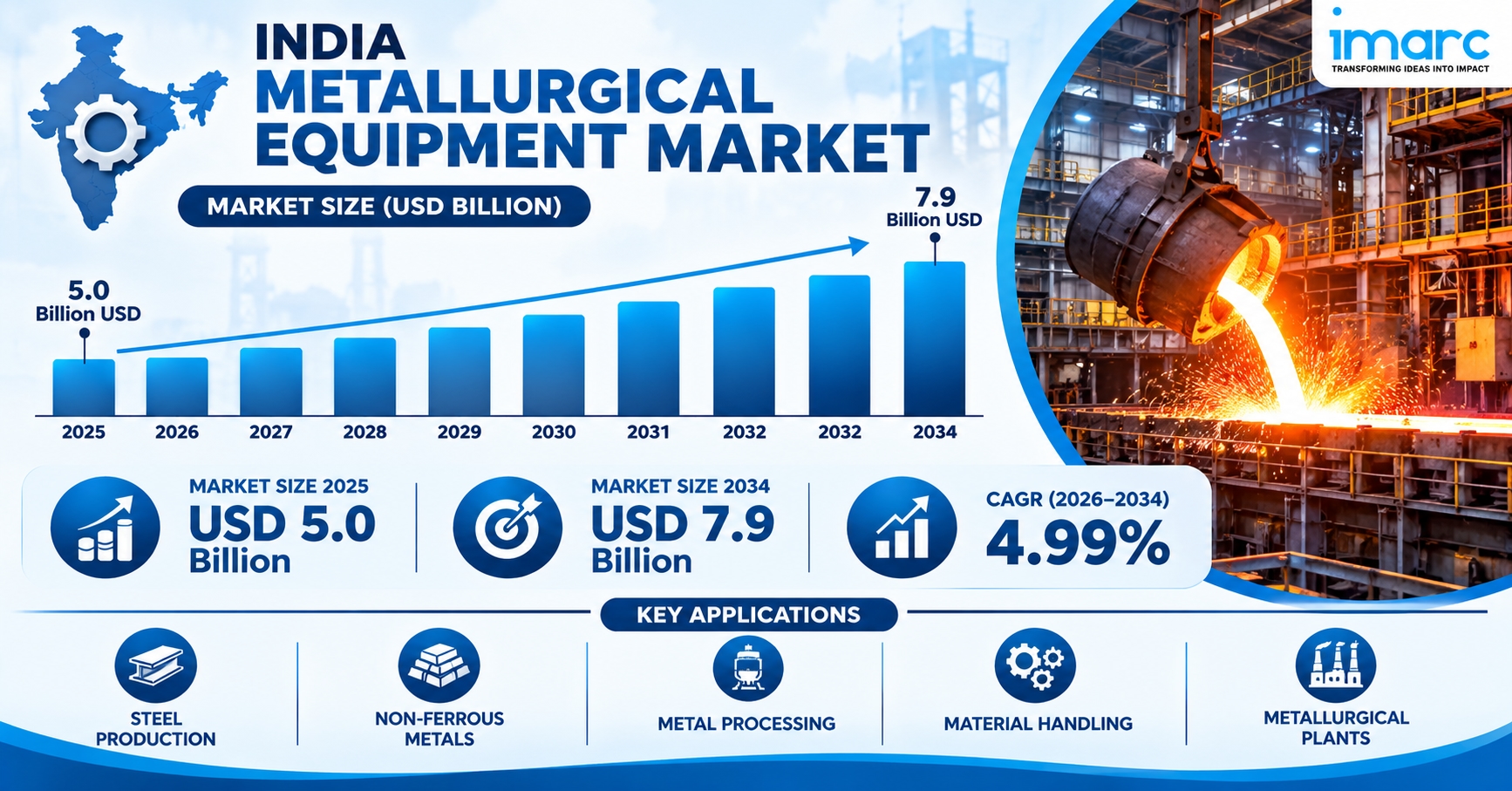
Market Key Statistics:
Current Market Size (2025) : USD 5.0 Billion
Projected Market Size (2034) : USD 7.9 Billion
CAGR : 4.99%
Forecast Period : 2026-2034
Equipment types covered include ironmaking equipment, steelmaking equipment, and metal rolling machines, which form the backbone of primary metal production.
Machine categories include milling machines, broaching machines, grinding machines, and drilling machines used for precision metal working.
Applications span aerospace and defense, automotive, medical and dental, oil and gas, industrial, and others.
Industry 4.0 adoption, including IoT-enabled machinery and predictive maintenance, is improving efficiency and reducing downtime across producers.
Government programmes such as the National Steel Policy and Production Linked Incentive schemes are encouraging upgrades and new integrated plants.
North, South, East, and West India are the regions covered, reflecting steel and metal clusters across the country.
India Metallurgical Equipment Market Trends & Future Outlook
Automation and Smart Manufacturing: IoT-enabled machinery, predictive maintenance, and real-time monitoring are spreading across steel and non-ferrous producers, aiming for better efficiency, less downtime, higher product quality, and lower energy use.
Domestic Steel Capacity Expansion: New integrated plants and brownfield upgrades are increasing demand for blast furnaces, continuous casting machines, sintering equipment, and rolling mills.
Push Toward Indigenisation: Producers and policymakers are encouraging domestic manufacturing of metallurgical equipment to reduce import dependence and build local engineering capability.
Technologies for Lower Emissions and Coke Savings: Producers are adopting technologies such as coke oven gas injection to reduce coke consumption and improve the environmental performance of blast furnaces.
Precision Machining for High-Value Sectors: Demand for milling, grinding, drilling, and broaching machines is supported by aerospace, medical, and automotive applications requiring tight tolerances.
Investment in Specialty Steel: Incentive-backed specialty steel projects are increasing demand for advanced rolling and processing equipment.
Why Invest in the India Metallurgical Equipment Market - Key Growth Drivers
Domestic Steel Expansion Driving Equipment Orders: India's steel producers are adding capacity and modernising plants to meet infrastructure and manufacturing demand, generating sustained orders for ironmaking, steelmaking, and rolling equipment.
Adoption of Industry 4.0 Practices: Sensors, analytics, and predictive maintenance reduce unplanned stoppages and energy use, making smart upgrades attractive for both large integrated producers and mid-sized mills.
Growth of Automotive, Aerospace, and Industrial Manufacturing: These sectors demand high-quality metal components, supporting investment in precision machining equipment such as milling, grinding, and drilling machines.
Policy Push for Indigenisation and Reduced Import Dependence: Encouragement for domestic equipment manufacturing is building local supply chains and creating opportunities for Indian engineering companies.
Energy Efficiency and Decarbonisation Goals: Producers are upgrading to equipment that lowers coke and energy consumption, aligning capital spending with environmental and cost objectives.
Evaluate Market Opportunity with the Business Sample Report
Government Policy Support
National Steel Policy: The policy sets a long-term roadmap for domestic steel capacity and quality, encouraging integrated plant expansion and corresponding demand for blast furnaces, casting, and rolling equipment.
PLI Scheme for Specialty Steel: Incentives for specialty steel production attract investment commitments and upgrades, boosting demand for advanced rolling, heat treatment, and processing equipment.
Steel Scrap Recycling Policy: The policy promotes scrap-based steelmaking, supporting investment in electric furnaces, shredding, and processing equipment while lowering the environmental footprint of the industry.
National Capital Goods Policy: The policy aims to strengthen domestic capital goods manufacturing, encouraging local production of machinery and reducing reliance on imported metallurgical equipment.
Key Market Challenges
High Capital Intensity and Long Gestation: Ironmaking and steelmaking equipment require large upfront investment and long payback periods, making project financing and timing critical.
Raw Material and Energy Cost Volatility: Fluctuating prices of coking coal, iron ore, and energy affect producer margins and can delay equipment purchasing decisions.
Dependence on Imported Technology: Certain advanced technologies and critical components are still sourced from global suppliers, exposing projects to currency swings and long lead times.
Market Segmentation Breakdown
By Type - Ironmaking, Steelmaking, and Metal Rolling
Ironmaking and steelmaking equipment form the upstream base of metal production, while metal rolling machines shape semi-finished products into sheets, bars, and sections for downstream industries.
By Equipment - Four Machine Categories
Milling, broaching, grinding, and drilling machines address different machining tasks, from shaping and cutting to finishing and hole-making, serving precision and general engineering needs.
By Application - Six End-Use Groups
Aerospace and defense, automotive, medical and dental, oil and gas, industrial, and other sectors consume metallurgical equipment, each with distinct quality, precision, and certification requirements.
By Region - Four Regional Markets
North India, South India, East India, and West India represent the regional structure of demand, shaped by the location of steel plants, ore and coal resources, and engineering clusters.
Competitive Landscape & Key Player Positioning
The market research report has also provided a comprehensive analysis of the competitive landscape. Competitive analysis such as market structure, key player positioning, top winning strategies, competitive dashboard, and company evaluation quadrant has been covered in the report. Also, detailed profiles of all major companies have been provided.
Key players include:
Global suppliers of ironmaking and steelmaking technology
Domestic heavy engineering and capital goods manufacturers
Rolling mill and metal processing equipment providers
Machine tool manufacturers for milling, grinding, and drilling
Other organised players active across the metallurgical equipment market
Recent Developments & News
In March 2025, the Competition Commission of India approved Peabody MNG and Peabody SMC's acquisition of a portion of Anglo American's Australian steel-making coal assets.
Request Customized Data Tailored to Your Interest
Note: If you need specific information that is not currently within the scope of the report, we can provide it to you as a part of the customization.
Frequently Asked Questions
Q1. How big is the India metallurgical equipment market?
➤ The India metallurgical equipment market was valued at USD 5.0 Billion in 2025, supported by steel capacity expansion and growing demand for precision metal working equipment.
Q2. What is the projected growth rate?
➤ The market is expected to grow at a CAGR of 4.99% from 2026 to 2034, reaching USD 7.9 Billion by 2034 --- driven by automation, domestic steel expansion, and indigenisation.
Q3. What are the key drivers of the market?
➤ Automation and smart manufacturing, domestic steel expansion supported by the National Steel Policy and PLI schemes, and the push for indigenisation are the primary catalysts of market growth.
Strategic Insight & Verdict
The India metallurgical equipment market is anchored by the country's long-term steel and manufacturing ambitions. Producers are expanding capacity, adopting smart technologies, and seeking lower-emission processes, while policy support is nudging equipment sourcing toward domestic suppliers. Combined with a 4.99% CAGR trajectory, this positions the market as a durable, capital-goods opportunity for equipment makers, technology licensors, and engineering firms over the 2026-2034 forecast period.
Verified Source: IMARC Group