Introduction
India's loan against property market stands as one of the country's fastest-growing secured lending segments, encompassing Self-Occupied Residential Property, Rented Residential Property, Commercial Property, and Self-Owned Plot collateral, across Fixed Rate and Floating Rate structures and tenures from up to 5 years to 25-30 years, spanning North India, South India, East India, and West India. The loan against property market size in India increased from USD 860.33 Billion in 2025 to USD 971.83 Billion in 2026 and is projected to reach USD 2,576.25 Billion by 2034, exhibiting a growth rate (CAGR) of 12.96% during 2026-2034.
The market is growing as borrowers increasingly leverage real estate assets for business expansion, personal requirements, and working capital management. Growing awareness among self-employed professionals and small business owners about property-backed financing has broadened the addressable market, while financial institutions are allocating more resources to non-housing secured loans for their attractive risk-adjusted returns. Technological advancements in property valuation, digital documentation verification, and automated credit assessment have reduced processing timelines, and digital lending platforms are improving accessibility across metropolitan and emerging urban centers, strengthening participation across borrower segments.
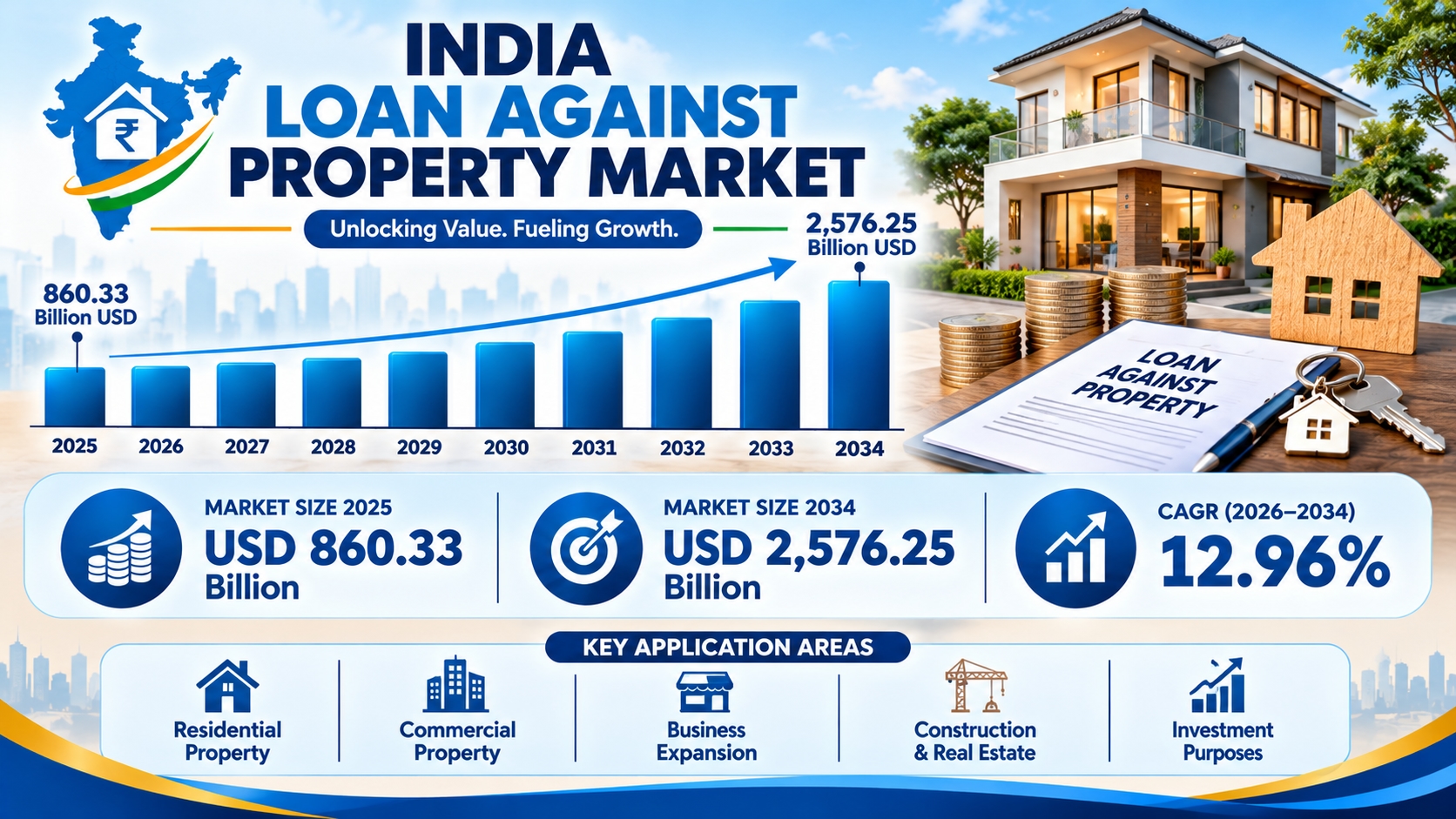
Market Snapshot
Current Market Size (2025): USD 860.33 Billion
Projected Market Size (2034): USD 2,576.25 Billion
CAGR: 12.96%
Self-occupied residential property dominates with a 43% share in 2025, owing to widespread home ownership preferences, established valuation frameworks, and borrower comfort with mortgaging primary residences.
Floating rate leads the interest rate segment at 55%, reflecting borrower preference for flexibility aligned with Reserve Bank of India monetary policy movements.
The 11-24 years tenure is the largest segment at 35%, balancing manageable monthly commitments with reasonable total interest outflows.
North India is the largest region with a 31% share, driven by commercial activity in Delhi-NCR, strong property ownership among business communities, and robust financial infrastructure.
What Growth Factors Are Driving India Loan Against Property Market?
Expanding Credit Demand Among MSMEs in Emerging Urban Centers:
Growing credit needs among MSMEs in tier-two, tier-three, and tier-four cities are substantially driving the loan against property business in India. As these regions see accelerating economic activity, small businesses need accessible financing beyond traditional working capital limits. Traditional banking channels often maintain stringent collateral requirements that exclude smaller enterprises, making loan against property attractive due to its secured nature, relatively lower interest rates than unsecured lending, and higher loan amounts. According to SIDBI's MSME Pulse Report released in May 2025, the commercial credit portfolio in India reached INR 35.2 Lakh Crore as of March 2025, underscoring the scale of credit demand.
Financial Institutions Diversifying into Non-Housing Secured Loan Portfolios:
Housing finance companies and non-banking financial companies are actively expanding non-housing loan portfolios to enhance profitability, diversify income, and reduce overdependence on traditional home loans. Loan against property has emerged as a strategic focus, offering attractive risk-adjusted returns supported by tangible collateral. Many lenders are establishing dedicated verticals and specialized teams to improve underwriting, customer acquisition, and portfolio management, reflecting changing borrower preferences for multipurpose financing that leverages existing assets.
Rising Property Values Enhancing Collateral Capacity:
Sustained appreciation in residential and commercial property values across major Indian cities is enhancing borrower collateral capacity and enabling access to larger loan amounts. According to the Reserve Bank of India, the All-India House Price Index rose 3.1% year-on-year in Q4 2024-25, with Kolkata recording the largest increase at 8.8%. This appreciation lets property owners unlock equity without liquidating holdings, while lenders benefit from improved loan-to-value ratios and stronger collateral coverage.
Government Policy Support:
Udyam Registration and MSME Formalization: Simplified online registration formalizes small businesses, improves their credit visibility and documentation, and expands the pool of MSME borrowers eligible for property-backed financing from banks and NBFCs.
SARFAESI Act, 2002: The law lets secured lenders enforce security interests and recover dues without court intervention, strengthening lender confidence and encouraging wider supply of property-backed loans at competitive terms.
Account Aggregator Framework: The consent-based data-sharing framework lets lenders access verified financial data quickly, speeding underwriting and extending loan against property services to semi-urban and previously underserved borrowers.
RBI Repo Rate Easing: Monetary policy easing, with the repo rate reduced to 5.25% as of December 2025, shapes loan against property rates in India, lowering floating-rate EMIs and improving affordability.
Digital India Land Records Modernization Programme (DILRMP): Digitization of land and property records reduces title verification complexity, shortens legal due diligence timelines, and improves lenders' confidence in collateral documentation across urban and semi-urban markets.
Evaluate Market Opportunity with the Business Sample Report
What Are the Latest Emerging Trends in India Loan Against Property Market?
Digital Transformation Accelerating Loan Origination:
Digital lending platforms are streamlining application submission, document verification, and disbursement workflows, while AI-powered credit assessment tools expedite underwriting decisions without compromising risk management. This evolution lets lenders extend services into previously underserved semi-urban markets, broadening customer accessibility and reducing operational costs, while improving the experience for self-employed borrowers and small businesses that need quick access to funds.
Emergence of Small-Ticket Loan Against Property Products:
Financial institutions are launching specialized small-ticket loan against property schemes for micro and small enterprises needing modest funding. In October 2024, Arka Fincap introduced its 'Uday' Small Ticket Loan Against Property (STLAP) scheme with loan amounts from INR 10 Lakh to INR 30 Lakh, initially across five cities in Tamil Nadu. These products address funding gaps in tier-two and tier-three cities, promoting economic inclusion while expanding lender portfolios.
Hybrid Interest Rate Structures Gaining Borrower Preference:
Hybrid structures offer an initial fixed-rate period that protects borrowers from short-term volatility, followed by a floating rate that benefits from future rate cuts. This combination improves affordability predictability in early repayment years and supports better cash flow planning. As interest rate uncertainty persists, borrowers increasingly view hybrid options as a risk-mitigation tool, encouraging higher adoption among self-employed individuals and small businesses.
How will India Loan Against Property Market Evolve in the Coming Years?
The India loan against property market is poised for robust growth through 2034, driven by expanding MSME credit demand, lender diversification into secured non-housing loans, rising property values, and digital lending adoption. The market is projected to grow from USD 860.33 Billion in 2025 to USD 2,576.25 Billion by 2034 at a CAGR of 12.96%.
Investment is concentrated in digital underwriting, small-ticket products, hybrid rate structures, product customization, and expansion into emerging urban centers. Lenders investing in technology-enabled underwriting, fintech partnerships, and competitive pricing are best positioned to capture India's expanding secured lending opportunity through 2034.
How Is India's Loan Against Property Market Segmented?
➤ By Property Type
Self-Occupied Residential Property
Rented Residential Property
Commercial Property
Self-Owned Plot
➤ By Interest Rate
Fixed Rate
Floating Rate
➤ By Tenure
Up to 5 Years
6-10 Years
11-24 Years
25-30 Years
➤ By Region
North India
South India
East India
West India
Request Customized Data Tailored to Your Interest
Note: If you require any specific information not covered within this report's scope, we will provide it as part of the customization.
Competitive Landscape - By IMARC GROUP
The market research report has also provided a comprehensive analysis of the competitive landscape. Competitive analysis such as market structure, key player positioning, top winning strategies, competitive dashboard, and company evaluation quadrant has been covered in the report. Also, detailed profiles of all major companies have been provided.
The India loan against property market features public sector banks, private sector banks, housing finance companies, and non-banking financial companies offering differentiated product portfolios. Competition centers on interest rate competitiveness, loan-to-value ratios, processing timelines, and geographic coverage, while strategic partnerships between traditional lenders and fintech platforms are expanding distribution reach and improving operational efficiency.
Frequently Asked Questions
How big is the loan against property market in India?
➤ The India loan against property market size increased from USD 860.33 Billion in 2025 to USD 971.83 Billion in 2026, underpinned by rising MSME credit demand, lender diversification into non-housing secured loans, rising property values, and expanding digital lending platforms.
What is the projected growth rate of the India loan against property market?
➤ The market is expected to exhibit a CAGR of 12.96% during 2026-2034 to reach USD 2,576.25 Billion by 2034, driven by small-ticket product innovation, digital underwriting, hybrid interest structures, and continued urbanization and formalization of small businesses.
What are the key factors driving market growth?
➤ Key drivers include expanding MSME credit demand in tier-two to tier-four cities, financial institutions diversifying into non-housing secured loans, rising property values enhancing collateral capacity, and digital lending platforms improving accessibility.
About Us:
IMARC Group is a global management consulting firm that helps ambitious changemakers create a lasting impact. The company offers comprehensive market assessment, feasibility studies, incorporation support, regulatory assistance, branding and strategy services, and procurement research.
IMARC Group
134 N 4th St. Brooklyn, NY 11249, USA
Email: sales@imarcgroup.com
Tel: (D) +91 120 433 0800
United States: +1-201-971-6302