Introduction
Singapore's exterior paint market stands as a specialised segment of the nation's highly urbanised construction and building maintenance ecosystem, encompassing Water-based and Solvent-based product types, across Acrylic, Silicone, Epoxy, Polyurethane, and other resin types, serving Residential, Industrial, and Commercial applications, spanning North-East, Central, West, East, and North regions. The Singapore exterior paint market size reached USD 5.2 Million in 2025 and is projected to reach USD 7.4 Million by 2034, exhibiting a growth rate (CAGR) of 3.91% during 2026-2034.
The market is growing due to rapid urbanisation, consumer demand for durable and weather-resistant paints, innovation in eco-friendly paint technology, and rising construction activity. Singapore's tropical climate, with intense sun, heavy rain, and high humidity, places constant stress on building facades, making protective, long-lasting coatings essential for property owners. The United Nations declared Singapore fully urbanised in 2018, with 100% of its population classified as urban, while continued land reclamation and redevelopment keep construction and repainting activity steady across residential, commercial, and industrial properties.
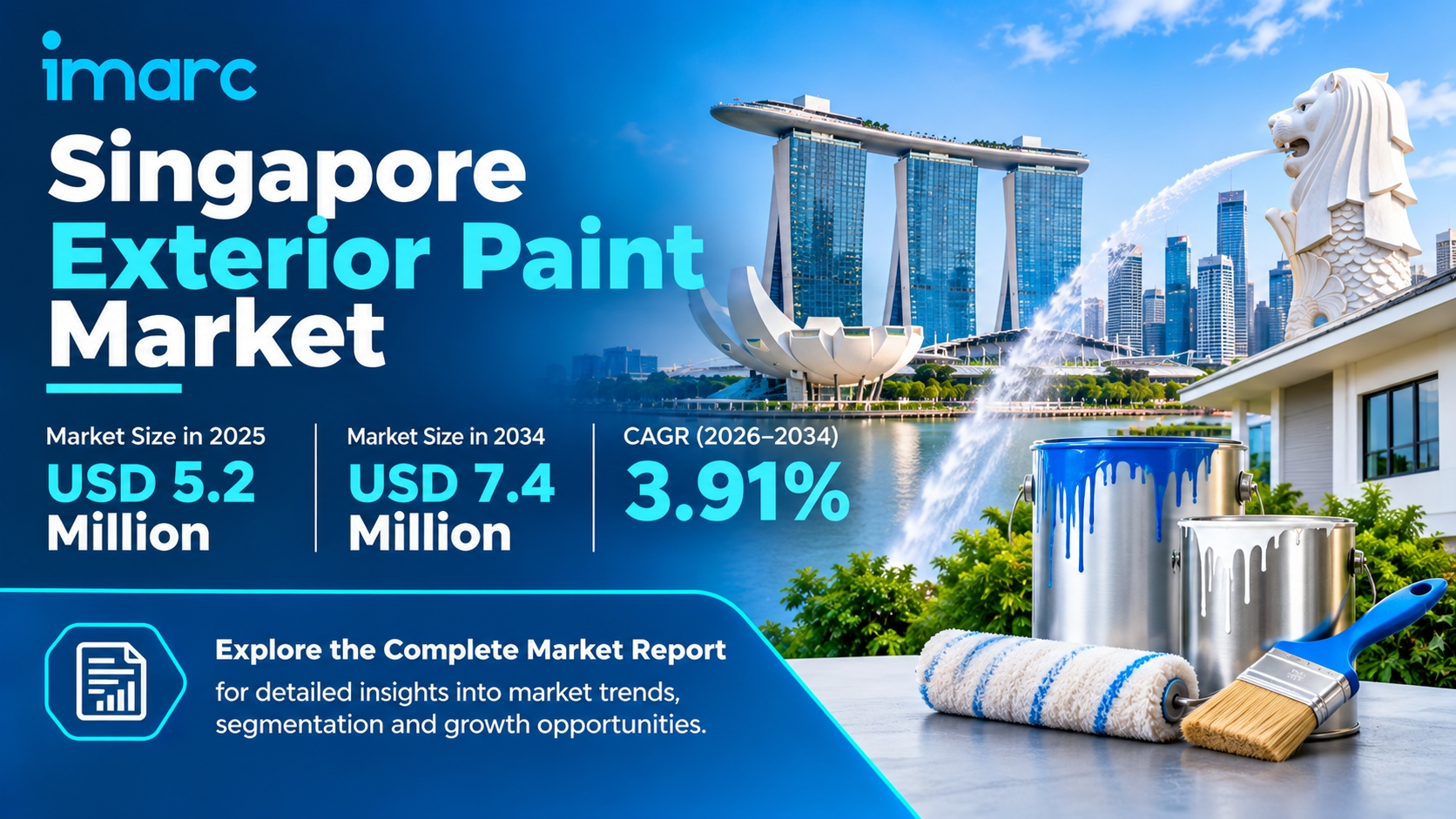
Market Snapshot
Current Market Size (2025): USD 5.2 Million
Projected Market Size (2034): USD 7.4 Million
CAGR: 3.91%
Water-based and solvent-based paints form the product categories, with water-based formulations drawing attention for lower volatile organic compound emissions and alignment with Singapore's green building priorities.
Acrylic, silicone, epoxy, polyurethane, and other resins serve distinct performance needs, from flexible weather resistance on facades to tough protective coatings for industrial structures.
Residential, industrial, and commercial applications drive demand, supported by building upkeep cycles, new developments, and the need to maintain property value in a dense urban environment.
North-East, Central, West, East, and North are the regions covered, reflecting the distribution of housing estates, business districts, and industrial areas across the city-state.
What Growth Factors Are Driving Singapore Exterior Paint Market?
Urbanisation, Land Reclamation, and Construction Activity:
Singapore is a fully urbanised city-state where space is limited and continuous redevelopment is the norm. The country plans to reclaim 56 square kilometres of land from the sea by 2030, creating new sites for housing, infrastructure, and commercial development. Alongside new projects, ageing buildings require regular repainting to preserve appearance and structural protection. This combination of new construction and maintenance work supports consistent paint demand, and the Singapore exterior paint market growth outlook remains tied closely to the pace of building activity and infrastructure investment across the island.
Demand for Durable and Weather-Resistant Coatings:
Singapore's hot, humid, and rainy climate accelerates fading, cracking, algae growth, and peeling on exterior walls. Property owners, town councils, and developers therefore prefer high-performance coatings with strong UV resistance, water repellence, and anti-algal properties. Silicone and acrylic-based formulations are valued for flexibility and durability, helping extend repainting intervals and lowering lifetime maintenance costs. As buildings are expected to maintain their appearance for decades, premium paint systems that offer longer protection are gaining preference over basic coatings, particularly in high-visibility commercial and residential developments.
Eco-Friendly Paint Innovation and Green Building Certification:
Sustainability is a defining theme in Singapore's built environment. Low-VOC and environmentally certified paints are increasingly specified in projects aiming for green building recognition. Alora Paints earned Green Seal GS-11 certification, making projects that use its paints eligible for LEED points, illustrating how eco-credentials are becoming a competitive differentiator. Cool and reflective coatings are also drawing interest: in April 2024, the Singapore government piloted reflective paint using titanium dioxide or barium sulphate pigments to cool urban areas, and an NTU experiment reportedly showed surfaces up to 2°C cooler at peak heat.
Government Policy Support:
Singapore Green Building Masterplan: The plan targets 80% of buildings by gross floor area to be green by 2030, encouraging low-VOC, durable, and energy-efficient coatings in new and existing buildings.
BCA Green Mark Certification: The Building and Construction Authority's scheme rewards sustainable building design and materials, motivating developers to specify certified, environmentally responsible exterior paints for facades and structures.
Singapore Green Labelling Scheme: The Singapore Environment Council's scheme certifies products with lower environmental impact, including paints, helping buyers identify eco-friendly options and encouraging manufacturers to innovate.
HDB Repairs and Redecoration Programme: Periodic repainting and upgrading of public housing estates creates regular, large-scale demand for exterior paint across residential blocks, supporting steady volumes for coatings suppliers.
Evaluate Market Opportunity with the Business Sample Report
What Are the Latest Emerging Trends in Singapore Exterior Paint Market?
Heat-Reflective and Cool Coatings for Urban Heat Mitigation:
Singapore's urban heat island effect is encouraging research into coatings that reflect sunlight and reduce surface temperatures. In April 2024, the government piloted reflective paint with titanium dioxide or barium sulphate pigments, and an experiment by Nanyang Technological University reportedly showed surfaces up to 2°C cooler at peak heat, although the paint costs more than ordinary paint. If costs fall and performance is proven at scale, such coatings could lower cooling demand in buildings and become a distinctive growth area for specialty paint suppliers and research partners.
Green-Certified and Low-VOC Paint Adoption:
Developers and facility managers are increasingly selecting paints that carry recognised green certifications. Alora Paints' Green Seal GS-11 certification in 2022 made projects using its products eligible for LEED points, showing how environmental credentials are influencing specifications. This trend favours manufacturers with strong sustainability credentials and transparent product data, and it is encouraging reformulation toward water-based, low-emission technologies that meet indoor and outdoor air quality expectations while still delivering the weather resistance that Singapore's climate demands.
Regional Participation and Strategic Investments by Paint Majors:
International paint companies continue to use Singapore as a base for regional strategy. In May 2024, Asian Paints' Singapore subsidiary, Asian Paints International (APIPL), agreed to buy a 24.3% stake in SCIB Chemicals S.A.E., Egypt, from minority shareholders. While the transaction is outside Singapore, it demonstrates how the city-state functions as a financial and strategic hub for global coatings players, supporting investment in innovation, distribution, and technical expertise that also benefits the local market.
How will Singapore Exterior Paint Market Evolve in the Coming Years?
The Singapore exterior paint market is poised for steady growth through 2034, driven by sustained urban redevelopment, demand for durable and weather-resistant finishes, and rapid progress in eco-friendly paint technology. The market is projected to grow from USD 5.2 Million in 2025 to USD 7.4 Million by 2034 at a CAGR of 3.91%.
Investment is concentrated in low-VOC and water-based formulations, heat-reflective coatings, silicone and acrylic resin performance, and certification-led product positioning. Suppliers investing in sustainability credentials, long-life protection, and strong relationships with developers and facility managers are best positioned to capture Singapore's evolving exterior coatings opportunity through 2034.
How Is Singapore's Exterior Paint Market Segmented?
➤ By Product Type
Water-based
Solvent-based
➤ By Resin Type
Acrylic
Silicone
Epoxy
Polyurethane
Others
➤ By Application
Residential
Industrial
Commercial
➤ By Region
North-East
Central
West
East
North
Request Customized Data Tailored to Your Interest
Note: If you require any specific information not covered within this report's scope, we will provide it as part of the customization.
Competitive Landscape - By IMARC GROUP
The market research report has also provided a comprehensive analysis of the competitive landscape. Competitive analysis such as market structure, key player positioning, top winning strategies, competitive dashboard, and company evaluation quadrant has been covered in the report. Also, detailed profiles of all major companies have been provided.
The Singapore exterior paint market features a mix of global paint majors, regional manufacturers, and specialist eco-friendly coating brands. Performance, certification credentials, technical support, and relationships with developers shape exterior paint market share in Singapore, with companies such as Asian Paints and Alora Paints highlighting the importance of sustainability and regional strategy.
Frequently Asked Questions
How big is the exterior paint market in Singapore?
➤ The market reached USD 5.2 Million in 2025, underpinned by rapid urbanisation, consumer demand for durable and weather-resistant paints, innovation in eco-friendly paint technology, and steady construction and redevelopment activity across the city-state.
What is the projected growth rate of the Singapore exterior paint market?
➤ The market is expected to exhibit a CAGR of 3.91% during 2026-2034 to reach USD 7.4 Million by 2034, driven by continued urban development, low-VOC regulation, eco-certification, and the emergence of heat-reflective coatings designed to cool buildings.
What are the key factors driving market growth?
➤ Key drivers include Singapore's full urbanisation and ongoing land reclamation, demand for durable paints that withstand a tropical climate, adoption of green-certified and low-VOC coatings, rising construction activity across residential, commercial, and industrial segments, and innovation in reflective paint technology.
About Us:
IMARC Group is a global management consulting firm that helps ambitious changemakers create a lasting impact. The company offers comprehensive market assessment, feasibility studies, incorporation support, regulatory assistance, branding and strategy services, and procurement research.
IMARC Group
134 N 4th St. Brooklyn, NY 11249, USA
Email: sales@imarcgroup.com
Tel: (D) +91 120 433 0800
United States: +1-201-971-6302