
India Welding Equipment Market Outlook
The market is advancing as the country scales up infrastructure spending and industrialization. Demand from automotive, construction, energy, and defense manufacturing is reinforcing adoption of modern joining technologies, while automation and digital controls are reshaping how welding work is done.
Understanding the market requires separating machines and equipment from the wider welding industry. IMARC’s figures focus on equipment, so welding industry market size in India estimates that also include consumables, services, or labor follow different definitions and should not be compared directly with the equipment figures below.
Market-At-A-Glance
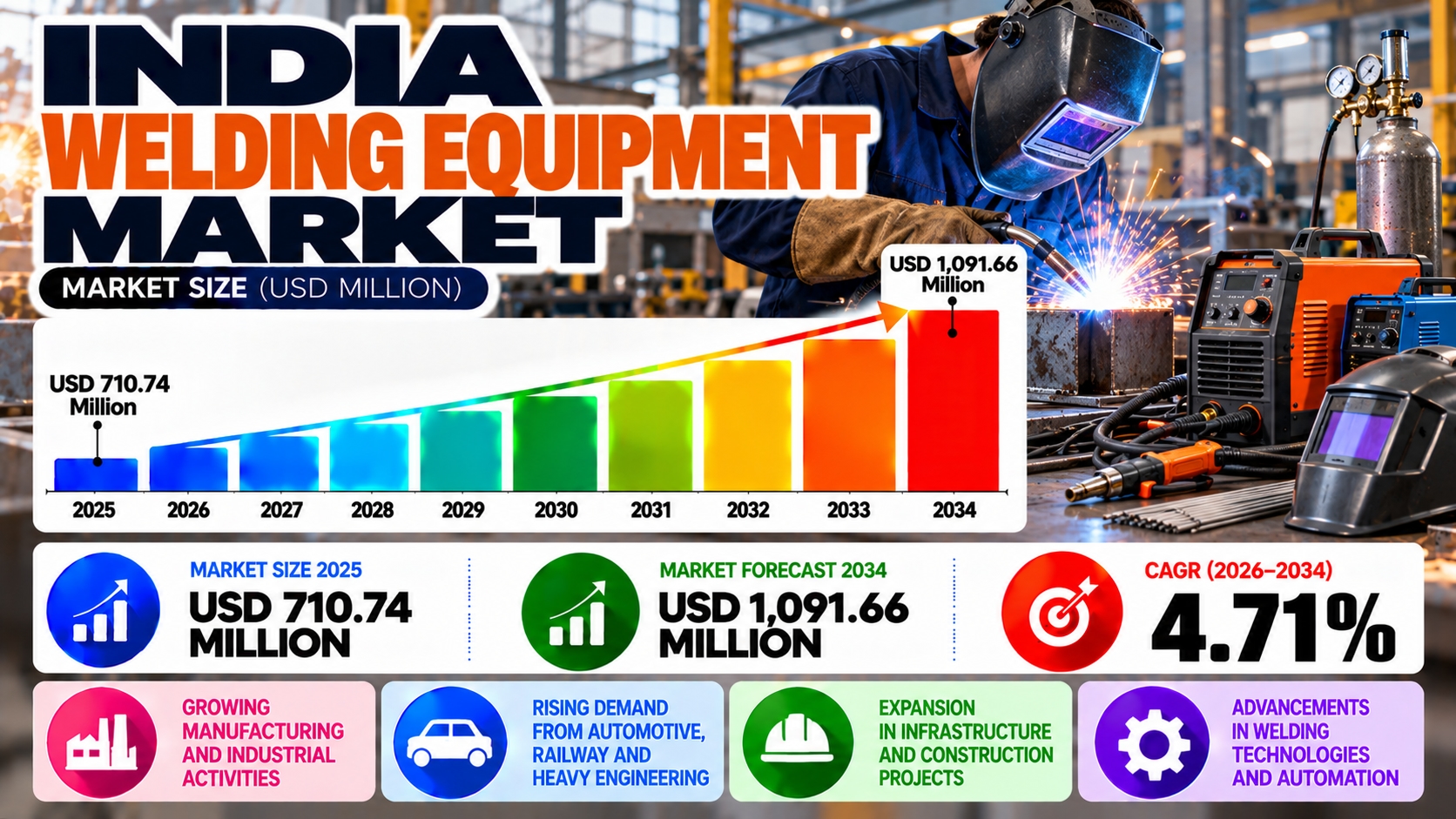
Market Size (2025): USD 710.74 Million
Forecast Market Size (2034): USD 1,091.66 Million
CAGR (2026-2034): 4.71%
Leading Technology: Arc Welding, 76.2% share
Leading Type: Manual, 42.5% share
Leading End Use: Automotive, 27.5% share
Leading Region: West India, 30.5% share
Why the India Welding Equipment Market Is Growing?
Government-Led Infrastructure Development:
Highway construction under the Bharatmala Pariyojana, metro rail expansion across over 15 cities, industrial corridors, and the Smart Cities Mission are driving demand for structural, pipeline, and heavy engineering welding. The Second Asset Monetization Plan for 2025–30 aims to reinvest INR 10 lakh crore in new projects, creating growth opportunities for the welding equipment market in India.
Expanding Automotive and Defense Manufacturing:
India is the third-largest automobile market globally, and welding is central to body-in-white assembly, chassis fabrication, and exhaust systems. Defense production under Atmanirbhar Bharat requires precision techniques such as friction stir welding and electron beam welding. These applications are strengthening demand across the welding industry market size in India.
Adoption of Automation and Advanced Technologies:
Industries are moving from manual processes to automated and semi-automated systems, supported by Industry 4.0 principles, IoT monitoring, and AI-driven quality control. A shortage of skilled manual welders accelerates this shift.
Renewable Energy and Shipbuilding Investments:
Growth in renewable energy infrastructure and shipbuilding broadens the application scope of advanced welding solutions.
Evaluate Market Opportunity with the Business Sample Report
What Are the Key Trends Shaping the India Welding Equipment Market?
Rising Adoption of Automated and Robotic Welding:
Automotive, heavy engineering, and construction companies are integrating robotic arms and collaborative robots. In February 2025, Delta debuted its D-Bot series of collaborative robots at ELECRAMA 2025, with payload ratings of up to 30 kg and speeds of 200 degrees per second.
AI-Driven Smart Welding:
IoT sensors and AI enable real-time monitoring of temperature, voltage, and seam position, supporting predictive maintenance and automatic parameter optimization.
Energy-Efficient and Sustainable Solutions:
Manufacturers are developing battery-powered welders, inverter-based machines, and low-emission processes aligned with national sustainability goals.
Government Support Driving Market Expansion
Make in India and Production Linked Incentives:
Encourage investment in advanced manufacturing equipment
Support domestic production of welding machines and automation systems
Strengthen the supply base for automotive, defense, and capital goods
National Infrastructure Pipeline and Bharatmala Pariyojana:
Bharatmala covers over 34,800 kilometers of highways
Metro rail, railway modernization, and industrial corridors add steady equipment demand
PM Gati Shakti coordinates multi-modal infrastructure planning
Defense Manufacturing under Atmanirbhar Bharat:
Expands production of aircraft, submarines, warships, and missile systems
Raises demand for precision and specialized welding technologies
Skill India and Welder Training:
Skill development programs help build a trained welding workforce
Welding skill development centers with modern equipment are improving workforce capability
Explore the Full Report with Charts, Table of Contents, and List of Figures
Segment Insights
Technology Insights:
Arc Welding (Shielded Metal/Stick, MIG, TIG, Plasma Arc, Others)
Resistance Welding
Laser Beam Welding
Oxy-Fuel Welding
Others
Arc welding dominates with a market share of 76.2% of the total India welding equipment market in 2025.
Type Insights:
Automatic
Semi-Automatic
Manual
Manual represents the largest segment with a 42.5% share of the total India welding equipment market in 2025.
End Use Insights:
Aerospace
Automotive
Building and Construction
Energy
Oil and Gas
Marine
Others
Automotive holds the largest share at 27.5% of the total India welding equipment market in 2025.
Regional Insights:
North India
South India
East India
West India
West India leads with a 30.5% share in 2025, and Maharashtra alone contributes a share of 18% to the total market.
Competitive Landscape
The India welding equipment market includes established local players and international technology leaders competing across manual, semi-automatic, and automatic product segments. Companies are building nationwide distribution, investing in robotic welding, green technology, and AI-based monitoring, and partnering with educational institutions.
Differentiation increasingly comes from after-sales service and from designing equipment for local operating conditions, particularly in the industrial segment.
Key Opportunities for Businesses and Investors
High-Growth Areas:
Robotic and collaborative-robot welding cells for automotive and heavy engineering
Inverter-based and energy-efficient arc welding machines
Smart welding systems with remote diagnostics and analytics
Equipment for renewable energy, railway, defense, and shipbuilding projects
Strategic Opportunities:
Financing and leasing models that lower the barrier to automation for small and medium enterprises
Welder training partnerships that pair equipment sales with skill development
Service networks and spare parts support that build recurring revenue among both organized and unorganized customers
Discuss Your Requirements With an Analyst and Get Your Customized Market Report
Frequently Asked Questions (FAQ)
How big is the India welding equipment market?
The market was valued at USD 710.74 Million in 2025.
What is the projected growth rate?
The market is expected to grow at a CAGR of 4.71% during 2026-2034, reaching USD 1,091.66 Million by 2034.
Which technology holds the largest share?
Arc welding dominates with a 76.2% share in 2025, due to its versatility, cost-effectiveness, and wide applicability.
What are the major challenges?
High costs of advanced equipment, a shortage of skilled welders, dominance of the unorganized sector, price-sensitive competition, and limited affordable financing for small manufacturers.
What are the key growth drivers?
Government infrastructure spending, automotive production, defense manufacturing modernization, robotic and automated welding adoption, and renewable energy projects.
Conclusion
India’s welding equipment market is on a measured, stable growth path, supported by infrastructure programs, vehicle production, and the gradual shift toward automation. Manual welding will remain important, while automation and smart technologies gain share in organized manufacturing.
Organizations that invest in inverter, robotic, and smart welding technologies, along with training and service networks, will be best positioned to capture the approximately USD 380.92 Million of incremental market value through 2034.
Source: IMARC Group