
How Is India’s Access Control Market Performing?
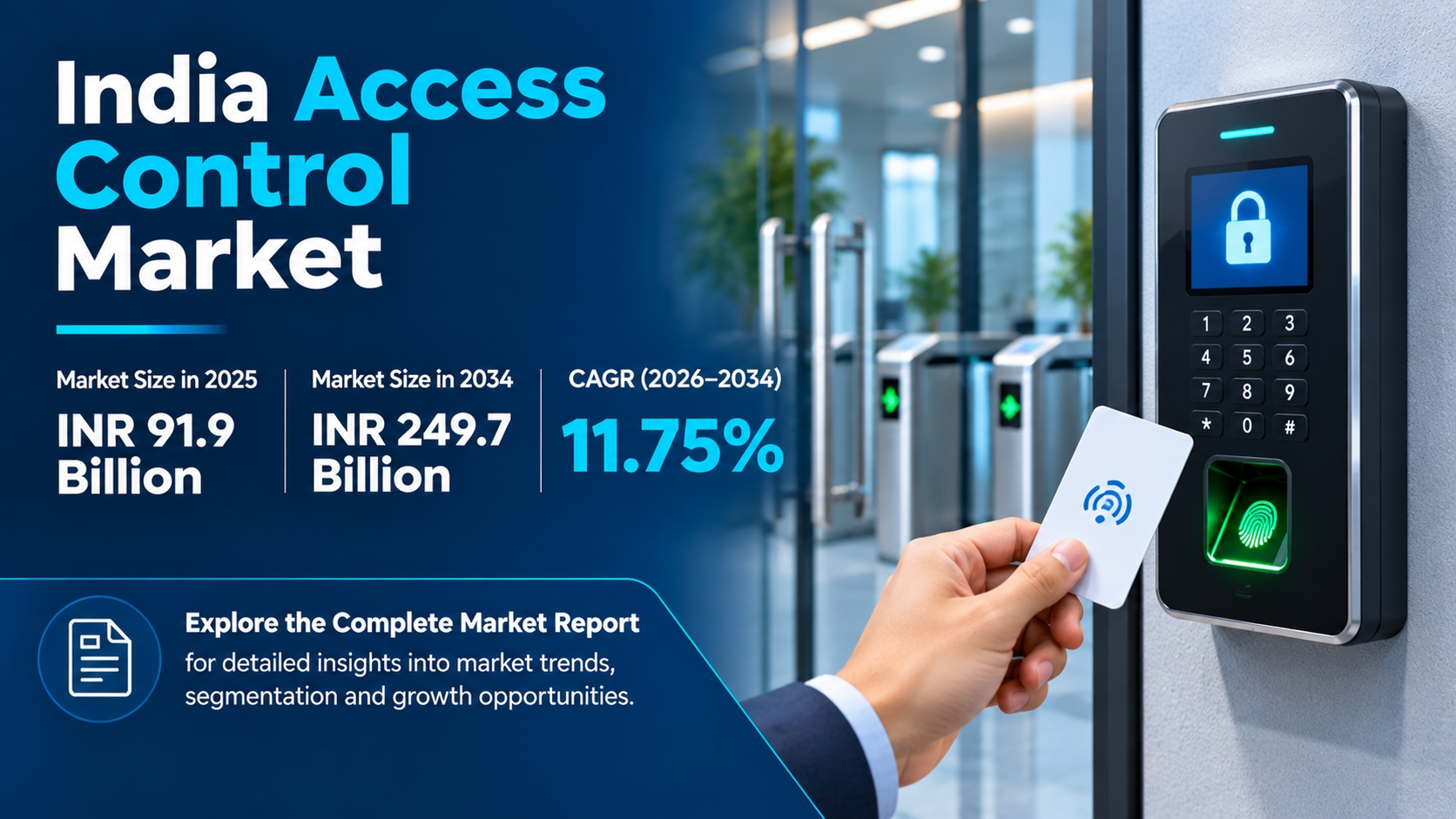
The access control market size in India reached INR 91.9 Billion in 2025. Looking forward, IMARC Group expects the market to reach INR 249.7 Billion by 2034, exhibiting a growth rate (CAGR) of 11.75% during 2026-2034. The market is driven by escalating security requirements across commercial, government, and industrial sectors, rapid digital transformation, and smart city development. Biometric authentication, cloud platforms, and mobile credentials are reshaping the security landscape, while government digitization programs strengthen adoption across end-user segments.
Indian Access Control Market Dynamics
Driver: Government-Led Digital Infrastructure and Rising Biometric Adoption:
Programs such as the Smart Cities Mission, Digital India, and Atmanirbhar Bharat are creating institutional demand for advanced access control. By May 2025, the Smart Cities Mission had completed 94% of its 8,067 projects across 100 cities, valued at approximately INR 1.64 lakh crore, including more than 84,000 CCTV cameras and integrated security systems. The government has also assigned more than ₹28,602 crores for 12 smart city initiatives under NICDC, driving procurement of hardware, software, and integration services across municipal and state-level infrastructure.
Biometric technologies are the second engine. Organizations across commercial, government, healthcare, and industrial sectors are moving from keys and cards to fingerprint, facial, and iris recognition that eliminate credential sharing and enable contactless entry. India’s Aadhaar infrastructure, managing over 1.4 billion biometric identities, has built strong public acceptance. In October 2025, Mantra Softech received the Certificate of Recognition for Outstanding Contribution to Innovation in Biometric Authentication Solutions from the Unique Identification Authority of India. Commercial real estate growth in IT parks, business process outsourcing centers, and retail complexes adds further demand for integrated platforms combining access control, video surveillance, and visitor management. In June 2025, Honeywell launched its 50 Series CCTV portfolio, designed and manufactured at its Bengaluru R&D center with VVDN Technologies.
Opportunity: AI, Cloud, and Contactless Authentication:
The Indian access control market outlook is increasingly shaped by AI and machine learning, which enable facial recognition, anomaly detection, and adaptive authentication. In 2025, Razorpay and YES BANK introduced RBI-approved biometric card verification for online transactions, signaling the move toward touchless, intelligent verification. Cloud-based platforms and mobile credentials let organizations manage multiple sites remotely and lower infrastructure costs. In July 2024, Suprema launched CLUe, a cloud integration platform for biometric access control, pointing to software-defined security architectures.
Transportation hubs offer a large deployment canvas. By February 2025, India’s DigiYatra biometric boarding system had exceeded 10 million app downloads and facilitated over 45 million passenger journeys across 24 airports. Contactless facial recognition and touchless fingerprint technologies are replacing manual verification at airports, metro systems, and railway stations. The convergence of physical and logical access control through unified identity management platforms is also creating room for new partnerships among technology providers.
Restraint: Cost, Data Privacy, and Interoperability:
High upfront costs for hardware, software licensing, installation, and maintenance remain a barrier for small and medium enterprises and budget-constrained institutions, particularly in tier-2 and tier-3 cities. Even where long-term benefits are recognized, initial capital expenditure often delays adoption.
The growing collection of fingerprints, facial images, and iris scans also raises privacy and cybersecurity concerns, and evolving rules such as the Digital Personal Data Protection Act create compliance challenges. Lack of universal interoperability standards and proprietary protocols further complicate multi-vendor deployments and raise total cost of ownership for large installations.
Evaluate Market Opportunity with the Business Sample Report
How Is India’s Access Control Market Segmented?
By Component:
Controller: leading segment at 28% share in 2025; the central unit that manages authentication decisions and coordinates readers, locks, and software
Reader: credential capture devices for cards and biometrics
Locks: electronic locking hardware for doors and gates
Software: centralized policy, monitoring, and reporting platforms
By Type:
Card Based: leading at 55% share in 2025; contact and contactless cards, with RFID and NFC credentials widely used across corporate, government, and residential settings
Biometric Based: fingerprint, face recognition, face recognition and fingerprint, iris recognition, and others
By End User:
Commercial: leading at 26% share in 2025; offices, IT parks, retail, hospitality, and banking
Government, Healthcare, Manufacturing and Industrial, Transport, Education, Residential, and Others
Regional Insights:
North India: Leads with a 30% share in 2025; concentration of government institutions, corporate headquarters, and IT corridors in Delhi-NCR, Chandigarh, Lucknow, and Jaipur, with 1,000 new CCTV cameras installed in Gurugram as part of smart city retrofitting by 2025
South India: Part of the regional analysis covered in the report
West and Central India: Part of the regional analysis covered in the report
East India: Part of the regional analysis covered in the report
Explore the Full Report with Charts, Table of Contents, and List of Figures
Competitive Landscape
The Indian access control market report offers an in-depth look at a market shaped by established multinationals and emerging domestic manufacturers. Companies are investing in R&D, strategic partnerships, and localized manufacturing, and Make in India is helping domestic players strengthen their position. Major players include ESSL, Gemalto (3M Cognet), HID India Pvt. Ltd., Honeywell International India Pvt. Ltd, IDEMIA Ltd., Mantra Softech (India) Pvt. Ltd, Matrix Comsec Pvt. Ltd., Realtime Biometric Co. Ltd, Tyco Security Products, and ZKTeco Biometrics India Pvt Ltd.
In November 2025, Mantra Softech raised USD 14 million in its first institutional round, led by India SME Fund II with participation from Motilal Oswal Principal Investments, to accelerate biometric and access control innovation. In 2025, Matrix Comsec joined the Security Industry Association to widen its global reach.
Government Initiatives Supporting the Market
Smart Cities Mission: integrated command-and-control centers, surveillance networks, and intelligent security systems across 100 designated cities
Digital India: digitization of public services and infrastructure, creating demand for secure identity and entry management
Atmanirbhar Bharat and Make in India: promotion of indigenous security technology and localized manufacturing
NICDC Industrial Smart Cities: ₹28,602 crores assigned for 12 initiatives to create future-ready industrial environments
DigiYatra: biometric boarding that has normalized contactless authentication at airports
Digital Personal Data Protection Act: a compliance framework that pushes buyers toward audit-ready, secure systems
Investment Opportunities
Biometric and AI-Enabled Platforms: Facial recognition, anomaly detection, and multi-factor authentication solutions benefit from smart city demand and growing trust in Aadhaar-based identity.
Cloud and Mobile Credentialing: Subscription-based, remotely managed platforms suit co-working spaces, multi-tenant buildings, and distributed enterprises.
Integrated Security Ecosystems: Solutions that connect access control with video analytics, intrusion detection, and building management meet rising commercial and government requirements.
Discuss Your Requirements With an Analyst and Get Your Customized Market Report
Frequently Asked Questions (FAQ)
How big is the access control market in India?
The access control market size in India was valued at INR 91.9 Billion in 2025.
What is the forecast size by 2034?
The market is projected to reach INR 249.7 Billion by 2034, exhibiting a CAGR of 11.75% during 2026-2034.
What are the key growth drivers?
Smart city and Digital India programs, rising biometric adoption, expanding commercial real estate, higher corporate security budgets, and growing demand for cloud-based and mobile access solutions.
Which segments lead the market?
Controllers lead by component at 28%, card-based systems lead by type at 55%, the commercial segment leads by end user at 26%, and North India leads by region at 30%.
What are the major challenges?
High implementation and maintenance costs, data privacy and cybersecurity concerns, and interoperability gaps across multi-vendor environments.
Conclusion
India’s access control market offers a multi-year growth opportunity, underpinned by smart city investment, biometric adoption, and a fast-expanding commercial real estate base. AI, cloud, and contactless technologies are redefining how organizations manage entry and identity, while government programs provide a supportive policy environment.
Organizations that invest in integrated, cloud-ready, and biometric-enabled platforms, and address privacy and interoperability early, will be best placed to capture the largest share of growth through 2034.
Source: IMARC Group


