
Indian Toys Market Outlook
The Indian toy industry is entering a transformative phase, driven by a large young population, rising disposable incomes, and growing parental awareness of child development through play. The industry spans plush toys, electronic toys, learning games, construction toys, and outdoor play equipment, and it is steadily moving from price-led purchases toward quality, safety, and learning value.
Supportive government policy, rapid e-commerce expansion, and a clear shift toward educational and STEM-based products are reshaping how toys are designed, made, and sold. As domestic manufacturers invest in innovation and global brands deepen their presence, the market is evolving into a more organized, compliance-driven, and export-oriented ecosystem.
Market Snapshot
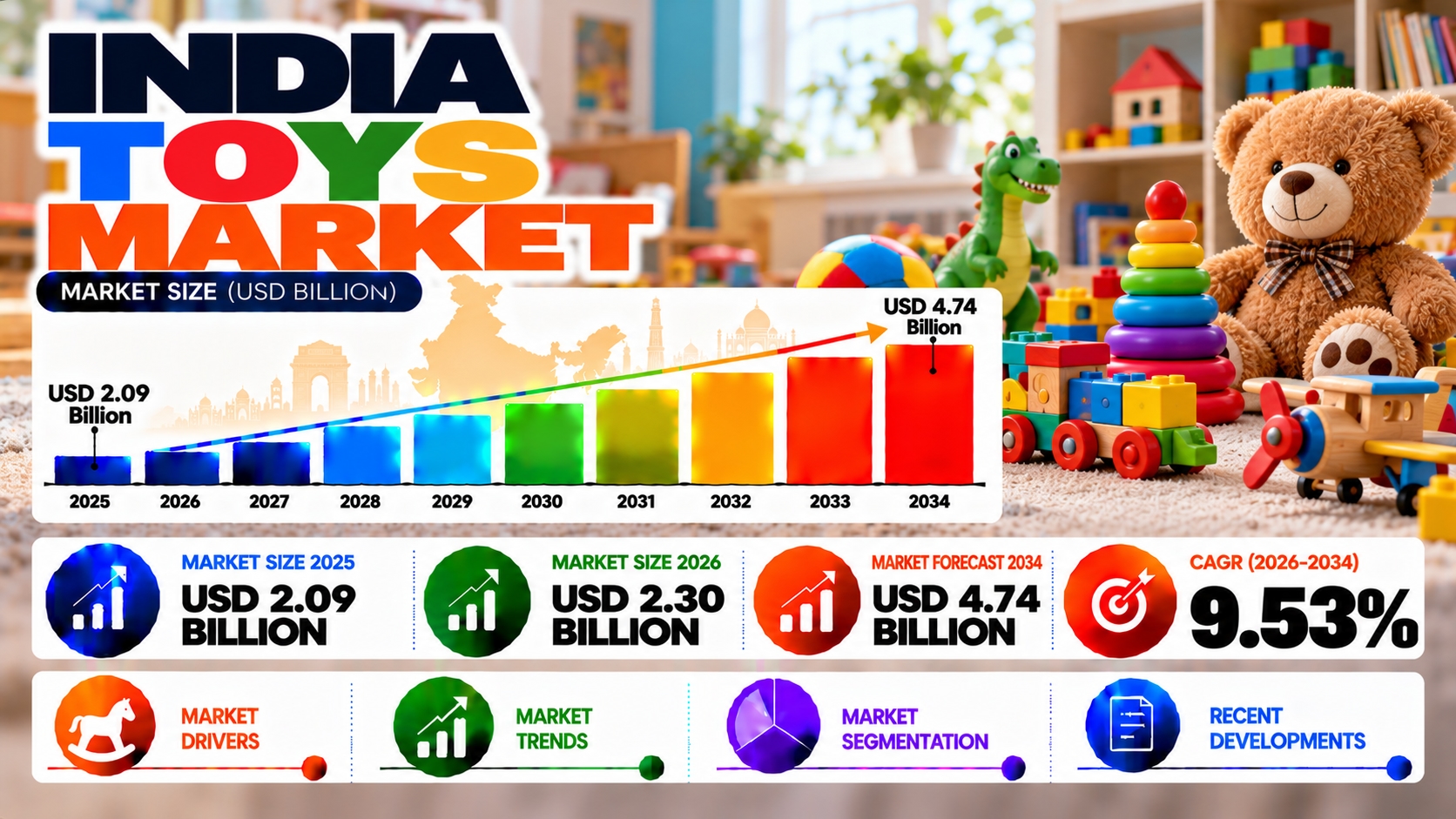
Market Size (2025): USD 2.09 Billion
Market Size (2026): USD 2.30 Billion
Forecast Market Size (2034): USD 4.74 Billion
CAGR (2026-2034): 9.53%
Leading Toy Type: Plush Toys, 16% share (2025)
Leading Gender Segment: Unisex Toys, 58% share (2025)
Leading Distribution Channel: Online, 38% share (2025)
Leading State: Maharashtra, 20% share (2025)
Key Growth Drivers: Favorable demographics, domestic manufacturing initiatives, e-commerce expansion, demand for educational toys
Executive Summary
The Indian toys market grew from USD 2.09 Billion in 2025 to USD 2.30 Billion in 2026 and is projected to reach USD 4.74 Billion by 2034, expanding at a CAGR of 9.53% during 2026-2034. Plush toys lead by toy type, which is relevant to anyone assessing the soft toys market size in India. Their 16% share is a portion of the total toys market and should not be read as a separate valuation for soft toys. Unisex toys account for 58% of the market, reflecting a clear parental preference for inclusive play.
Competition is moderately fragmented, with Funskool India, Hamleys India, Hasbro, Mattel, and The LEGO Group operating alongside Micro Plastics, Plastech International, Simba Toys India, Toyzone, and Tripple Ess Toys. Quality control regulations and domestic manufacturing initiatives are raising entry barriers and encouraging consolidation among compliant organized players.
Indian Toys Market Key Drivers
Favorable Demographics and Rising Disposable Incomes:
Approximately 24% of India’s estimated 1.44 billion people are aged 0-14, creating a deep and durable base of toy consumers. Rising incomes among the expanding middle class are lifting spending on educational and recreational toys, while urbanization exposes families to global trends and fuels a preference for branded, safety-certified products.
Government Initiatives Supporting Domestic Manufacturing:
Policy support under Make in India and Atmanirbhar Bharat is strengthening local production. Increased customs duties on imported toys, mandatory Bureau of Indian Standards certification, and dedicated toy manufacturing clusters have reduced import dependency. In July 2025, Union Commerce Minister Piyush Goyal noted that India’s toy exports now reach 153 countries.
A Dedicated National Toy Strategy:
The National Action Plan for Toys, coordinated by the Department for Promotion of Industry and Internal Trade, promotes Indian design, quality monitoring, and indigenous toy clusters. Schemes such as SFURTI support traditional toy clusters, while design and tooling assistance from the Ministry of Textiles and export incentives under RoDTEP help local makers compete globally.
E-Commerce Expansion and Digital Accessibility:
Online platforms are bringing diverse toy assortments to smaller towns and villages, supported by digital payments and improving logistics. Initiatives such as the Open Network for Digital Commerce are enabling small and indigenous sellers to reach buyers beyond metro markets.
Evaluate Market Opportunity with the Business Sample Report
Indian Toys Market Emerging Trends
Rising Demand for Educational and STEM-Based Toys:
Parents are investing in STEM kits, coding robots, and interactive puzzles that blend entertainment with learning. In 2025, AI-powered educational toys that adapt to a child’s learning pace gained popularity, reflecting stronger awareness of early cognitive development.
E-Commerce and Digital Retail Transformation:
India’s e-commerce market was valued at USD 129.72 billion in 2025 and is projected to reach USD 651.10 billion by 2034 at a 19.63% CAGR. Together with safety regulation, this is strengthening consumer trust in buying toys online.
Sustainable and Eco-Friendly Product Innovation:
Manufacturers are adopting recycled materials, sustainable wood, and non-toxic components. Prime Minister Narendra Modi has urged toy makers to use less plastic and adopt recyclable materials, signaling a national push toward responsible production.
Character Licensing and Premiumization:
Media franchises and licensed characters are strengthening engagement and supporting premium pricing for branded toys, especially in plush and collectible categories.
Indian Toys Market Challenges
Despite strong momentum, the Indian toys market faces several structural headwinds:
Unorganized manufacturers offering low-cost toys create pricing pressure on organized players, and price-sensitive consumers may choose cheaper options despite safety and quality risks
Many domestic manufacturers still rely on outdated machinery and technology, which limits design innovation and makes it hard to build capability in electronic and technologically advanced toys
Growing screen time on smartphones, tablets, and gaming devices is shifting children’s attention and spending away from traditional toys, forcing continuous product innovation
Explore the Full Report with Charts, Table of Contents, and List of Figures
Indian Toys Market Segment Insights
By Toy Type
Plush Toys (leading segment, 16% share in 2025)
Electronic Toys
Games and Puzzles
Construction and Building Toys
Dolls
Ride-Ons
Sports and Outdoor Play Toys
Infant/Pre-school Toys
Activity Toys
Other Toys
By Gender
Unisex Toys (leading segment, 58% share in 2025)
Toys for Boys
Toys for Girls
By Distribution Channel
Specialty Stores
Supermarkets and Hypermarkets
Online (leading channel, 38% share in 2025)
Others
Regional Insights
Maharashtra: Share (2025): 20%, supported by toy manufacturing units, strong retail infrastructure, and a large metropolitan consumer base in Mumbai and Pune
Tamil Nadu
Karnataka
Gujarat
Delhi
Other States
Competitive Landscape
The Indian toys market is moderately fragmented, with established domestic manufacturers, international brands, and numerous regional players competing across price segments. Leading companies differentiate through product innovation, quality certifications, brand building, and distribution expansion. Strategic partnerships between domestic manufacturers and international brands for technology transfer and licensing are becoming more common.
Funskool India: Domestic manufacturer that entered the electronic toys segment in 2025
Hasbro, Mattel, and The LEGO Group: Global brand recognition and licensing partnerships
Hamleys India: Specialty toy retail and premium brand presence
Micro Plastics, Plastech International, Simba Toys India, Toyzone, and Tripple Ess Toys: Domestic and regional manufacturing and distribution depth across price segments
Recent Developments
December 2025: Funskool India officially entered the electronic toys segment, showing how domestic manufacturers are expanding into tech-driven play
July 2025: Startup WOL3D launched Vinglits, India’s first line of 3D-printed flexible toys made with biodegradable materials
July 2025: Ultra Soft Toys introduced its “Cuddle & Calm” weighted plush range for emotional wellness and sensory comfort, alongside cultural and festive lines
2024-25 fiscal year: FirstCry reported 18% growth in online gross merchandise value, ahead of its offline growth
Investment Opportunities
High-Growth Segments: Educational, STEM, and electronic toys are gaining ground as parents prioritize cognitive development. Weighted and wellness-oriented plush ranges and character-licensed products offer premium margins within the leading toy type.
Geographic Expansion: Tier-two and tier-three cities offer room for online-first brands, as improving connectivity and digital payments offset limited physical retail.
Manufacturing and Technology Upgrades: Investment in modern machinery, design capability, and sustainable materials can help domestic players move up the value chain and benefit from cluster-based government support.
Discuss Your Requirements With an Analyst and Get Your Customized Market Report
Frequently Asked Questions (FAQ)
How big is the Indian toys market?
The Indian toys market size increased from USD 2.09 Billion in 2025 to USD 2.30 Billion in 2026.
What is the projected growth rate of the Indian toys market?
The market is expected to grow at a CAGR of 9.53% during 2026-2034, reaching USD 4.74 Billion by 2034.
Which toy type holds the largest share?
Plush toys lead with a 16% share in 2025, driven by consumer preference for soft, cuddly toys that offer comfort and companionship across age groups.
What factors are driving growth?
Key drivers include a large young population, rising disposable incomes, government initiatives supporting domestic manufacturing, demand for educational and STEM-based toys, and expanding e-commerce penetration.
What challenges does the market face?
Major challenges include competition from the unorganized sector, limited domestic technology and design capabilities, and rising digital entertainment alternatives.
Conclusion
The toy industry in India offers one of the more compelling consumer growth stories in the region, supported by a young population, rising incomes, and sustained policy backing for local manufacturing and exports. Quality regulations and cluster-based support are building a more trusted and competitive domestic ecosystem.
Three forces will shape the market through 2034: the rise of educational and tech-enabled play, deeper online reach into smaller cities, and a growing preference for sustainable, certified products. Businesses that invest in innovation, compliance, and omnichannel distribution will be best placed to capture value as the market expands toward USD 4.74 Billion.
Source: IMARC Group