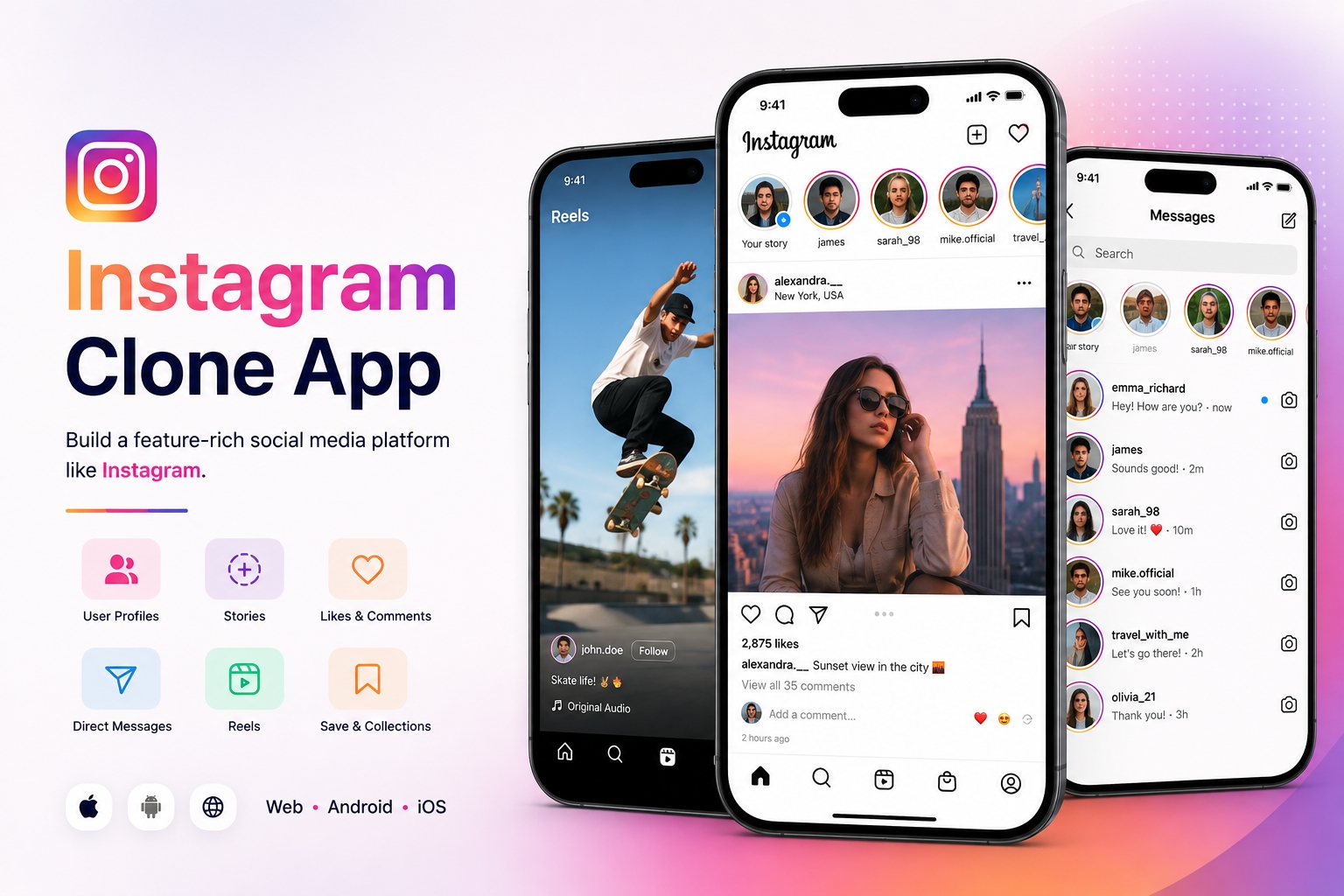
Building an Instagram clone is relatively straightforward at small scale. The real engineering challenge begins when thousands of users start uploading images, watching reels, sending messages, refreshing feeds, joining live streams, and generating notifications at the same time.
A scalable Instagram clone needs more than powerful servers. Developers must design the database, media pipeline, caching strategy, real-time services, background processing, security model, and observability systems so individual components can grow without slowing the entire platform.
The Miracuves Instagram Clone provides posts, reels, stories, messaging, live streaming, creator monetization, commerce, and administration across web, Android, and iOS from a shared TypeScript-based application architecture.
Start With a Modular Architecture
Scalability begins with separation of responsibilities.
Instead of building one tightly connected application where every feature depends on every other feature, developers should organize the platform around clear domains such as:
Authentication
Profiles
Social graph
Content publishing
Feed generation
Media processing
Messaging
Notifications
Live streaming
Commerce
Payments
Moderation
This does not mean developers need microservices from day one. A well-structured modular application can scale effectively during early and mid-stage growth while remaining easier to maintain.
Services can later be separated when a particular workload becomes large enough to justify independent infrastructure.
Design the Database for Growth
Social platforms generate huge numbers of relationships.
A single user may create posts, follow accounts, receive followers, like reels, save content, send messages, purchase products, and interact with creators.
Database design therefore has a direct impact on performance.
Developers should create appropriate indexes around frequently queried fields such as:
User IDs
Creator IDs
Publication dates
Follow relationships
Conversation participants
Content status
Notification recipients
The Miracuves Instagram Clone currently uses PostgreSQL 14 with 53 tables, ordered migrations, database functions, and Row-Level Security policies.
PostgreSQL provides a strong foundation, but developers should continuously analyze slow queries as usage grows rather than assuming the original database configuration will scale indefinitely.
Optimize Feed Generation
The home feed can become one of the most frequently requested endpoints.
At low traffic, the application might generate a feed by querying recent posts from accounts a user follows.
This becomes increasingly expensive when users follow hundreds or thousands of accounts.
Developers can progressively introduce:
Pagination
Database indexes
Cached feed results
Precomputed timelines
Ranking services
Recommendation layers
Background feed generation
The correct approach depends on traffic patterns.
There is little value in creating an extremely complex distributed feed system before the platform has enough activity to require it. Optimization should follow measured bottlenecks.
Separate Media From Application Data
Images and videos should not be handled like ordinary database records.
Large media files require dedicated storage and delivery infrastructure.
A scalable architecture should store metadata such as captions, ownership, visibility, and content type in the database while placing media files in object storage.
The Miracuves platform uses five policy-controlled storage buckets, with access policies connected to its broader privacy model. Private assets can be delivered through signed URLs instead of permanent public links.
As traffic grows, developers can introduce CDN delivery so images, thumbnails, reels, and other static assets are served closer to users.
Move Video Processing to Background Jobs
Video is significantly more expensive to process than text or standard database operations.
When someone uploads a reel, the platform may need to perform several tasks:
upload → validate → compress → transcode → create thumbnail → store → publish.
These operations should not keep the normal HTTP request waiting.
Background workers can process media asynchronously while the API quickly confirms that the upload was received.
Developers can use queues for video processing, notifications, scheduled posts, analytics aggregation, email delivery, and other tasks that do not need immediate synchronous completion.
Miracuves already includes edge functions for operations such as scheduled publishing, administrative tasks, and account bootstrap processes.
Cache Frequently Requested Data
Caching can significantly reduce repeated database work.
Good candidates include:
Popular creator profiles
Trending content
Public reels
Hashtag results
Discovery pages
Frequently viewed product data
Configuration values
The Miracuves application uses TanStack Query for server-state handling, including client-side caching and invalidation linked to PostgreSQL change events.
Server-side caching can be added separately as traffic increases.
However, developers should avoid caching everything. Data that changes constantly or requires strict user-specific privacy checks needs careful invalidation.
Scale Messaging Independently
Direct messaging introduces a different traffic pattern from ordinary feed requests.
Users expect conversations, typing indicators, presence updates, and message delivery to feel immediate.
The Miracuves Instagram Clone supports one-to-one and small-group messaging with presence, typing indicators, and real-time communication while applying the same Row-Level Security model used across the broader platform.
As messaging usage increases, developers should monitor concurrent connections, event fan-out, unread-message calculations, and notification workloads.
Messaging can eventually be separated into dedicated infrastructure if it becomes one of the platform's largest workloads.
Prepare Live Streaming for Separate Scaling
Live video has different infrastructure requirements from normal reels.
Miracuves uses WebRTC-based live broadcasting with real-time chat, stream moderation, gifting, featured products, and private replay delivery.
At larger scale, developers should treat live streaming as its own capacity-planning problem.
Important metrics include concurrent viewers, active broadcasts, bandwidth consumption, chat activity, replay storage, and connection failures.
A spike caused by one popular creator should not slow down profiles, feeds, messaging, or checkout functionality.
Keep Security Intact While Scaling
Performance optimizations should never bypass authorization.
Caching, replicas, CDN delivery, and background workers can accidentally expose private information if they ignore visibility rules.
The Miracuves Instagram Clone uses default-deny Row-Level Security across its PostgreSQL tables. Its visibility logic covers public profiles, private profiles, follow relationships, blocks, and storage access.
Developers introducing new infrastructure should preserve these authorization rules across every additional service.
Monitor Before Scaling
Developers cannot optimize what they cannot observe.
Production monitoring should track metrics such as:
API response time
Database query latency
Error rates
CPU and memory usage
Media-processing time
Storage growth
Queue depth
Concurrent WebSocket connections
Video delivery failures
Notification delays
Alerts should identify abnormal behavior before it becomes a major outage.
Tracing and structured logs can also help engineers understand whether a slow request originates from the database, application code, third-party service, storage layer, or real-time infrastructure.
Scale Gradually Instead of Overengineering
A startup does not need infrastructure designed for hundreds of millions of users on launch day.
A better scaling path is progressive.
Start with a well-structured application and reliable relational database. Add indexes and caching when queries increase. Introduce queues when background workloads grow. Separate media infrastructure when video consumption becomes significant. Add replicas or isolated services when measurements show that specific components have become bottlenecks.
This approach prevents unnecessary infrastructure complexity while still leaving room for growth.
Why Source Code Ownership Matters for Scaling
Scaling requirements change as the business grows.
A development team may eventually need to replace storage providers, introduce new caching layers, separate services, modify database queries, redesign feeds, or deploy to different cloud infrastructure.
Miracuves states that its Instagram Clone includes the complete React 18, TypeScript 5, Vite 5 application, PostgreSQL schema, migrations, edge functions, and storage policies, with the code available for modification and redeployment.
For technical teams, this provides more flexibility than a closed platform where infrastructure decisions remain controlled by the vendor.
Conclusion
Instagram Clone scalability should be treated as an architectural process rather than a single infrastructure upgrade.
Developers need to optimize databases, feeds, media delivery, video processing, caching, messaging, live streaming, background jobs, monitoring, and security as traffic increases.
The Miracuves Instagram Clone provides an existing technical foundation with PostgreSQL, Row-Level Security, policy-controlled storage, real-time communication, WebRTC live streaming, cross-platform delivery, and full source-code ownership.
From there, development teams can scale individual components according to real usage instead of rebuilding the entire platform. The strongest strategy is to start with clean architecture, measure actual bottlenecks, and introduce complexity only where growth genuinely requires it.