
When someone needs legal help, their search often begins on Google. They might look for a family lawyer in Melbourne, a conveyancing solicitor in Sydney or a criminal defence lawyer in Brisbane. If your law firm does not appear in relevant search results, potential clients may contact another practice instead.
Law firm SEO helps your practice become more visible to people searching for legal services online. By improving your website, publishing useful legal information and strengthening your local search presence, you can make it easier for potential clients to find your firm and understand how you can help.
For Australian law firms, an effective SEO strategy combines relevant content, technical website improvements, local visibility and a clear path for visitors to make an enquiry.
1. Understand What Potential Clients Are Searching For
The first step in SEO for lawyers is understanding how people search for legal assistance. Potential clients rarely use the same language as legal professionals. They may search for a specific legal problem, a type of service or a lawyer in their local area.
For example, someone looking for help with a separation might search for:
Family lawyer in Melbourne
How does property settlement work in Australia?
Divorce lawyer near me
Cost of hiring a family lawyer
These searches reveal different intentions. Some people are researching their legal situation, while others are ready to contact a lawyer.
Your website should address both types of visitors. Service pages can target people actively looking for legal assistance, while informative articles can answer common questions and introduce your firm to people who are still researching.
Choose keywords that match your legal services
Create a keyword list for each practice area. Include the service, location and common questions relevant to your clients.
For example, a law firm offering family law services could target phrases such as "family lawyer Melbourne", "family law services" and "property settlement lawyer".
Avoid targeting every keyword on one page. Each important service should have a dedicated page that explains what the firm offers, who it helps and how prospective clients can get in touch.
The goal is not simply to attract more website visitors. It is to attract people whose needs match your legal services.
2. Build a Website That Supports SEO
Your website is the foundation of your online visibility. Even if your firm publishes useful content and earns links from other websites, a poorly structured or difficult-to-use website can limit the value of those efforts.
Effective website design for Australian law firms should make it easy for both search engines and potential clients to understand the practice.
A well-organised website typically includes:
A clear homepage explaining the firm's legal services and location.
Individual service pages for each major practice area.
Lawyer profiles that introduce the people behind the firm.
Useful legal resources that answer common client questions.
Contact details, enquiry forms and clear calls to action.
Why law firm website design matters for SEO
Law firm website design and SEO work together. A website that is easy to navigate helps visitors find relevant information, while a logical page structure helps search engines understand how the firm's services relate to one another.
For example, a family law service page can link to relevant articles about divorce, parenting arrangements and property settlements. These internal links help visitors explore related information and make it easier for search engines to discover important pages.
A strong design also supports mobile usability, page speed, accessibility and trust. These are important considerations when potential clients are choosing a law firm.
A visually attractive website is useful, but it should also communicate clearly, load reliably and make contacting the firm straightforward.
3. Improve Your Google Business Profile
Local SEO is particularly important for law firms that serve clients in specific cities, suburbs or regions.
When someone searches for a lawyer nearby, Google may display local business listings alongside ordinary search results. A complete and accurate Google Business Profile can help your practice appear in relevant local searches.
To improve your local presence:
Claim and verify your firm's profile.
Use your correct business name, address and phone number.
Select the most relevant business categories.
Add accurate opening hours and a link to your website.
Describe your legal services clearly.
Keep your profile updated and respond appropriately to client reviews.
Your website and business profile should provide consistent information about your firm's location and services.
Create useful location pages
If your practice serves multiple areas, consider creating location-specific pages where they provide genuinely useful information.
For example, a firm serving Melbourne and Geelong could explain which services it offers in each location and how clients can arrange an appointment.
Avoid creating dozens of nearly identical pages that simply replace one suburb name with another. Each page should have a clear purpose and offer information relevant to people in that area.
4. Publish Helpful Legal Content
Potential clients often search online before deciding whether to speak with a lawyer. They may want to understand their rights, learn about a legal process or find out what information they need before an appointment.
Publishing useful content allows your firm to answer these questions and demonstrate its knowledge.
Consider creating articles around questions such as:
What happens during a property settlement?
How much does it cost to hire a lawyer in Australia?
What documents should I bring to a legal consultation?
How does the conveyancing process work?
When should I seek legal advice about a workplace dispute?
Each article should provide a clear, helpful answer rather than simply repeating keywords.
Demonstrate legal experience and trust
Legal content can influence important decisions, so accuracy and credibility matter. Make sure articles are reviewed by an appropriately qualified legal professional, where relevant, and include clear authorship and review information.
Useful trust signals include lawyer biographies, relevant qualifications, professional experience, accurate contact details and links to authoritative legal resources.
Australian law firms should also ensure that their content reflects the relevant state or territory where laws and procedures differ.
Avoid presenting general information as personalised legal advice or promising particular legal outcomes.
5. Make Your Website Fast and Mobile-Friendly
Many potential clients use their phones to search for legal services. If your website is difficult to read or navigate on a small screen, visitors may leave before contacting your firm.
A mobile-friendly website should have readable text, clear navigation, accessible buttons and enquiry forms that are easy to complete.
Page speed is another important consideration. Large images, unnecessary scripts and poorly configured hosting can make pages slow to load.
Useful technical SEO improvements include:
Compressing images and using suitable image formats.
Reducing unnecessary plugins and scripts.
Ensuring HTTPS is enabled.
Fixing broken links and redirect errors.
Creating an XML sitemap.
Making sure important pages can be crawled and indexed.
Use Google Search Console to monitor indexing, search performance and technical issues. Google's PageSpeed Insights can help identify performance problems and suggest improvements.
Technical SEO is not a one-time task. Review your website regularly, particularly after redesigns, migrations or significant content changes.
6. Strengthen Your Website's Internal Links
Internal links connect related pages within your website. They help visitors discover additional information and provide search engines with useful context about your content.
For example, a blog post explaining local SEO for solicitors could link to your SEO service page. An article about website accessibility could link to a relevant website design service.
Use descriptive anchor text that explains what the linked page is about. Avoid relying entirely on generic phrases such as "click here".
A well-planned internal linking structure might look like this:
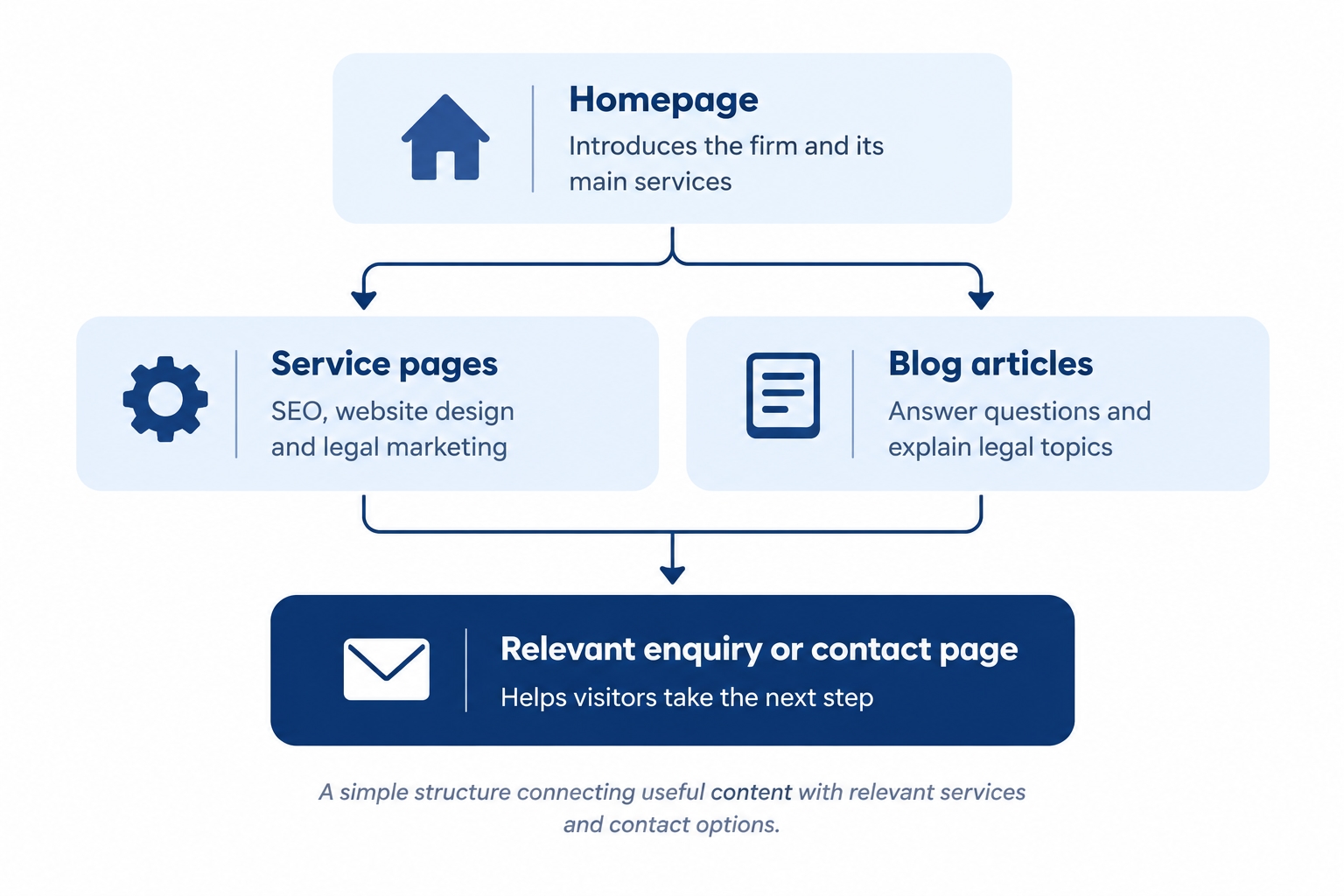
The structure should feel natural to visitors. Do not add links simply to increase the number of internal links on a page.
7. Earn Relevant Backlinks and Build Authority
Backlinks are links from other websites to your firm's website. Search engines can use links as one signal when assessing the relevance and authority of pages.
For law firms, relevant and trustworthy links can be more valuable than a large number of unrelated links.
Consider opportunities such as:
Contributing useful articles to reputable legal or business publications.
Participating in relevant professional associations and directories.
Publishing original research or practical legal resources that others may reference.
Building genuine relationships with complementary businesses and professional organisations.
Keep your business information accurate across reputable directories, and avoid buying large volumes of low-quality links or participating in link schemes.
The purpose of off-page SEO should be to build genuine credibility and help the right audience discover your firm, rather than to collect as many backlinks as possible.
8. Measure Your SEO Results
SEO takes time, so it is important to monitor progress and understand which activities are helping your firm become more visible online.
Use Google Search Console and website analytics to track meaningful performance indicators.
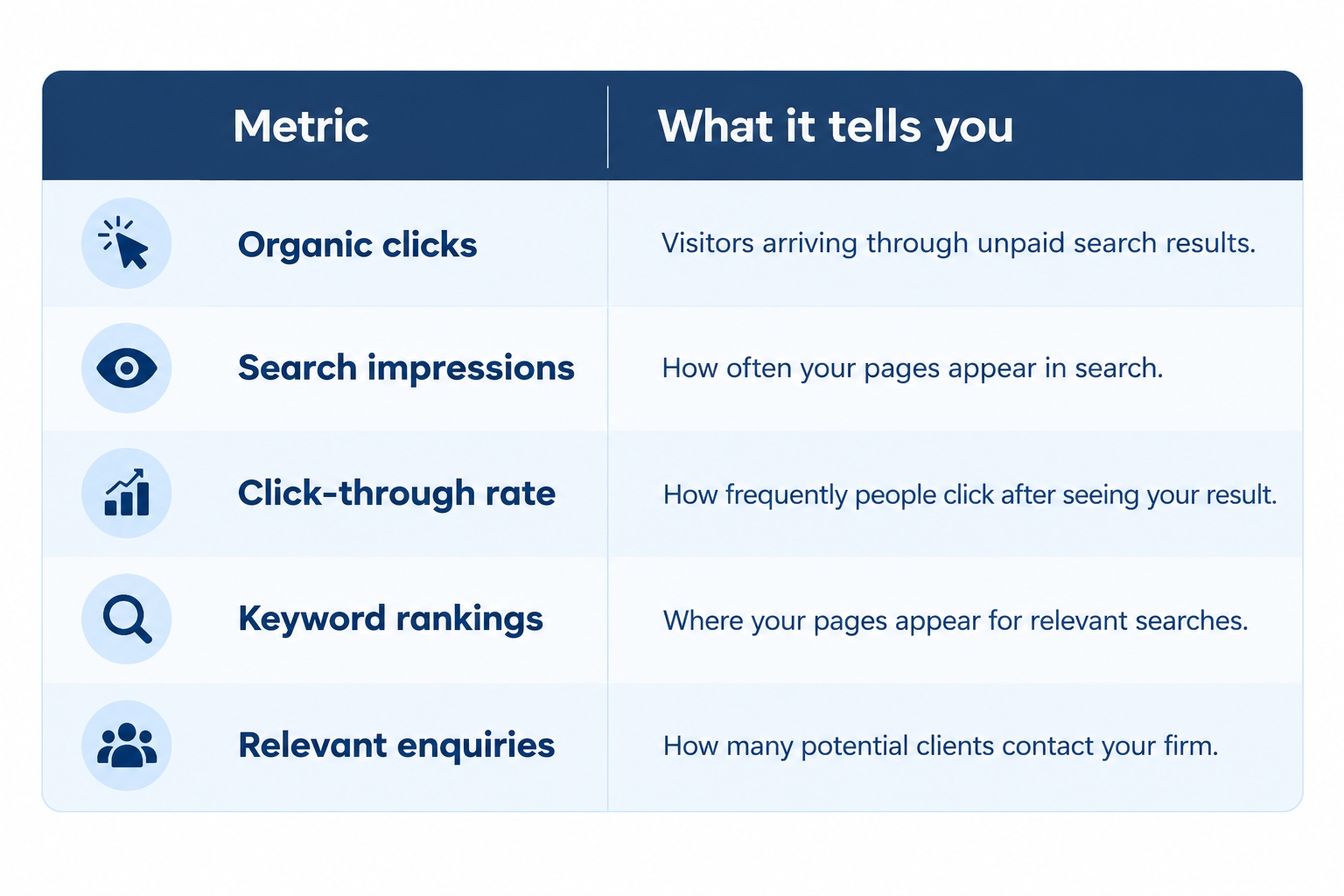
Review performance regularly, identify pages that need improvement and update your strategy based on what you learn.
9. Prepare Your Law Firm for AI Search
People are increasingly using AI-powered search experiences to research businesses, compare services and find answers to questions.
For law firms, the fundamentals of effective SEO remain important: accurate information, useful content, accessible website pages and clear evidence of experience.
To improve your website's readiness for AI-powered search:
Answer common legal questions clearly and directly.
Use descriptive headings and logical page structures.
Keep lawyer profiles, practice areas and business information accurate.
Support important claims with trustworthy sources.
Make sure your website content can be accessed and indexed by search engines.
There is no guaranteed method to make a law firm appear in AI-generated answers. However, creating helpful, reliable content gives your website a stronger foundation for both traditional search and emerging search experiences.
Conclusion
Law firm SEO is about making it easier for potential clients to find your practice, understand your services and decide whether to contact you.
For Australian law firms, the strongest approach combines relevant keywords, effective website design, local search optimisation, helpful legal content, technical improvements and trustworthy online authority.
SEO for lawyers works best when visibility and the client experience are treated as part of the same strategy. A well-designed website supported by useful content and consistent optimisation can help your firm build a stronger online presence and attract more relevant enquiries over time.