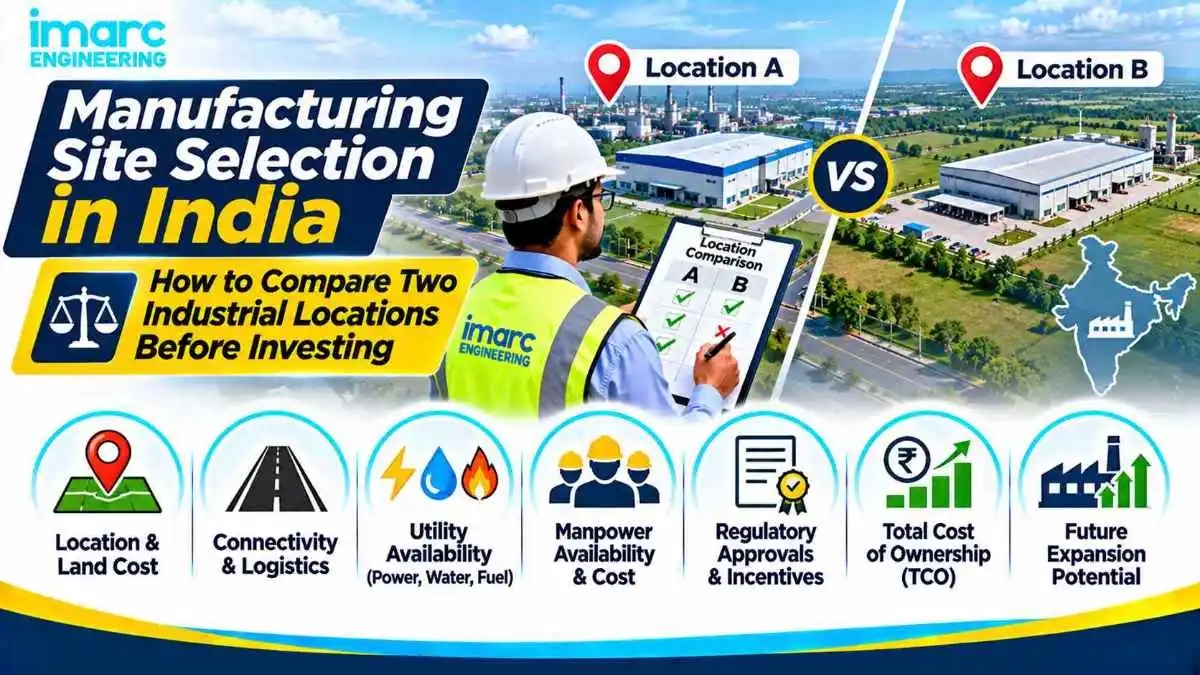
Two plots can look similar on paper — similar size, similar asking price, both marked “industrial.” One may support a smooth project. The other can add months of delay, higher connection costs and permanently higher logistics or power costs. Manufacturing site selection fails most often when the comparison stops at land price or state incentives and does not examine how each location will actually support the plant over its operating life.
Two plots can look similar on paper — similar size, similar asking price, both marked “industrial.” One may support a smooth project. The other can add months of delay, higher connection costs and permanently higher logistics or power costs. Effective site evaluation requires more than comparing land prices and state incentives. A structured Manufacturing Site Selection in India assessment helps manufacturers evaluate infrastructure, utility availability, logistics connectivity, labour access and regulatory requirements before committing capital. Manufacturing site selection fails most often when the comparison stops at land price or state incentives and does not examine how each location will actually support the plant over its operating life.
This article outlines a practical way to compare two candidate industrial locations in India before capital is committed.
Why Side-by-Side Comparison Matters
Land cost is only one component of total project and operating cost. Power connection charges, external infrastructure, logistics distance, labour catchment, approval complexity and expansion potential can outweigh a lower land price. A structured comparison forces these factors into the open so the decision is based on total impact rather than the most visible number.
1. Define What the Plant Actually Needs
Before comparing sites, clarify the non-negotiable requirements:
Approximate capacity and process type
Connected electrical load and preferred voltage level
Process water demand and effluent characteristics
Inbound raw-material sources and outbound market or port destinations
Labour skill profile and approximate headcount
Need for future expansion space
Without this baseline, every site looks workable and none can be ranked objectively.
2. Compare Logistics and Market Access
Measure practical distances and reliability, not just map distance:
Road quality and congestion to primary highways or freight corridors
Distance and transit time to the nearest suitable port (for export-oriented plants)
Proximity to key suppliers or customer clusters
Availability of container handling, ICD or warehousing support nearby
A site that saves on land but adds significant recurring freight cost or unreliable transit times often loses the advantage within a few years of operation.
3. Test Utility Readiness, Not Just Presence
Ask the same questions for both locations:
Is the required power capacity available at the nearest substation, and what is the indicative connection timeline and cost?
What is the reliable water source and its quality/quantity limits?
How will process effluent be handled — common treatment facility, own ETP with discharge consent, or other route?
Is natural gas or other process fuel available if needed?
A developed industrial estate may offer lower external connection cost and shorter timelines. A cheaper greenfield plot may require substantial investment in power lines, water infrastructure and effluent pathways. These differences should be quantified, not assumed.
4. Examine Land Status, Zoning and Approval Pathway
For each site check:
Clear title and absence of major encumbrances
Current land-use / zoning status and any conversion requirements
Whether the proposed industry category is permitted
Indicative environmental clearance or Consent to Establish pathway and typical timelines in that jurisdiction
Setback, green-belt and ground-coverage implications that affect usable area
A plot that requires lengthy conversion or sits in a more complex approval category can shift the entire project schedule even if the land price is attractive.
5. Assess Labour Catchment and Industrial Ecosystem
Compare the realistic ability to attract and retain the required workforce. Established manufacturing clusters usually offer deeper skilled-labour pools and supporting services (maintenance contractors, fabricators, logistics providers). Emerging locations may offer lower wage costs but higher recruitment and training effort. The right balance depends on the process complexity and the company’s operating model.
6. Evaluate Total Cost, Not Just Land Price
Build a simple comparative cost view that includes:
Land or lease cost
Site development (levelling, roads, drainage, boundary)
External utility connections
Expected differences in logistics cost
Differences in power tariff or reliability that affect operating cost
Holding cost during longer approval or connection periods
This comparison often reverses the ranking that appears when only land price is considered.
7. Check Future Flexibility
Ask which site leaves more room for a second line, additional storage, or utility upgrades without major disruption. A tightly constrained plot may force expensive workarounds later. Expansion potential is part of the long-term value of the location.
A Simple Comparison Framework
For any two shortlisted locations, score or rank them on:
Logistics fit to markets and suppliers
Power and water readiness and connection cost
Land title, zoning and approval complexity
Labour and ecosystem support
Total project and early operating cost
Expansion headroom
Weight the factors according to the specific process. A power-intensive plant will prioritise electrical infrastructure differently from a logistics-heavy distribution-oriented unit.
When the Comparison Should Be Completed
The structured comparison should be finished before land is purchased or a long-term lease is signed, and before detailed engineering and major equipment commitments begin. Changing location after these steps is rarely practical.
How IMARC Engineering Can Help
IMARC Engineering supports manufacturers with location analysis and site selection studies that compare candidate industrial locations against process, utility, logistics and approval requirements. The work focuses on producing a clear, decision-ready comparison rather than a generic ranking of states or cities.
If you are evaluating two or more industrial locations and need a structured technical and commercial comparison before investing, a focused location analysis is the practical next step: https://www.imarcengineering.com/contact?service=location-analysis-and-site-selection
Conclusion
Manufacturing site selection in India is a comparison exercise, not a search for the cheapest plot. The better location is the one that supports reliable utilities, workable logistics, a realistic approval path, adequate labour and acceptable total cost over the life of the plant. Land price is only one input. Projects that treat it as the main decision criterion frequently discover the true cost of the location only after construction has started and options have narrowed.
Contact Us:
IMARC Engineering
Phone: +917827860593
Email: sales@imarcengineering.com
India: C-130, Sector 2, Noida, Uttar Pradesh 201301
LinkedIn: https://www.linkedin.com/showcase/imarc-engineering/