
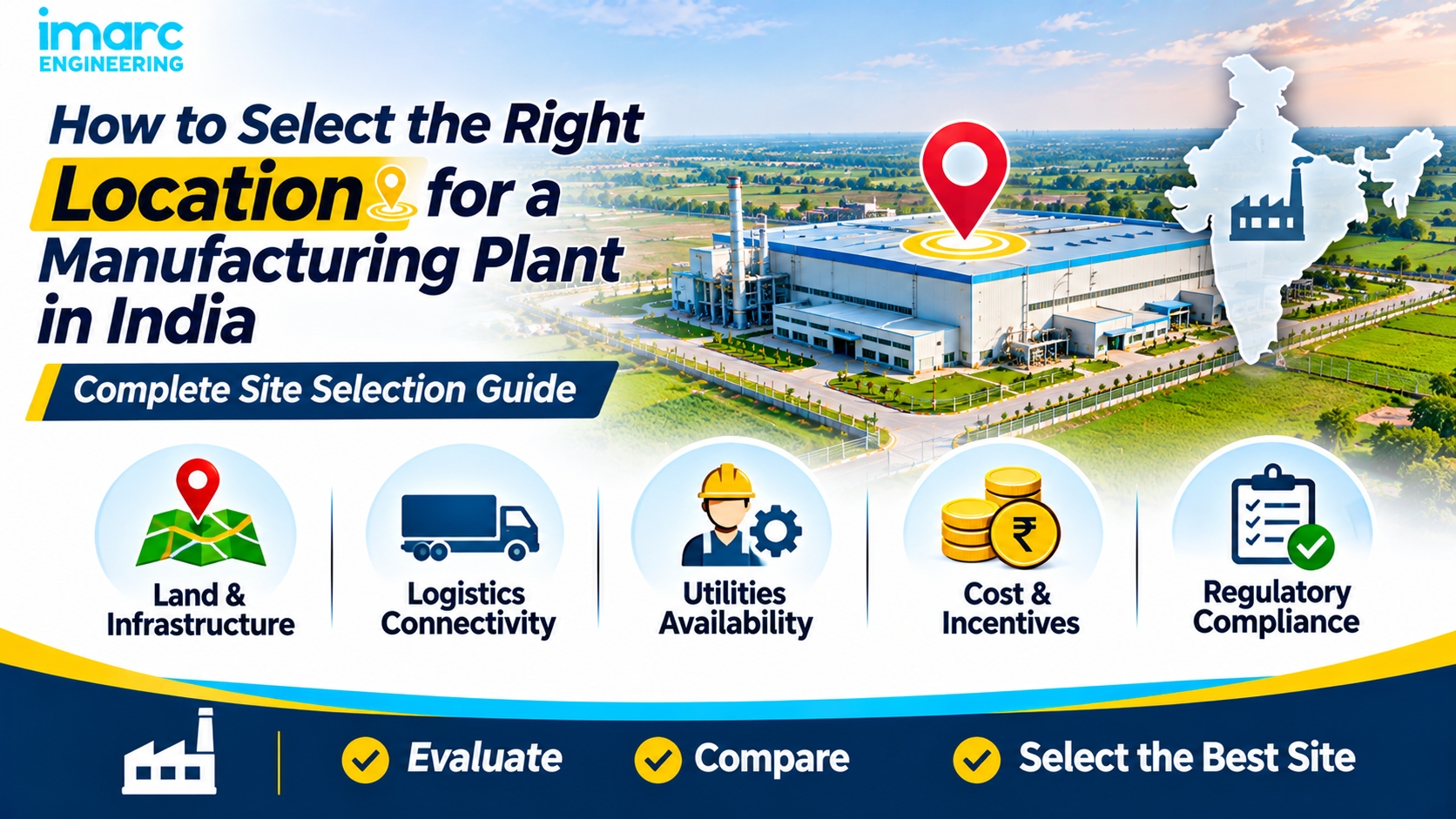
Choosing land for a manufacturing plant often feels like a land-cost decision. In practice, the wrong location creates longer delays, higher capital cost, and permanent operating disadvantages than almost any other early project choice. Many promoters discover the real constraints only after purchase — power connection timelines measured in years, water scarcity, zoning mismatches, or logistics that quietly erode margins every single day.
Manufacturing plant location selection requires a detailed evaluation of infrastructure, logistics, utilities, regulatory requirements and long-term operational costs. A structured Location Analysis and Site Selection in India approach helps manufacturers and investors identify suitable industrial locations, assess site feasibility, compare potential locations and minimise project risks before committing capital to land and infrastructure.
Why Location Decisions Go Wrong
The most common pattern is optimising for one or two visible factors — low land price or state incentives — while under-weighting utilities readiness, approval pathways, and total lifecycle cost. Cheap land outside established industrial areas frequently requires expensive external infrastructure. Sites that look attractive on a map can fail geotechnical, environmental, or labour tests later.
Once capital is committed and civil work begins, correcting a poor location is extremely expensive. The better approach is structured evaluation before any commitment.
Critical Factors That Must Be Evaluated Together
A practical site selection process examines several dimensions in parallel rather than in sequence.
1. Market and Logistics Access
Proximity to raw materials, suppliers, customers, ports, and major highways or Dedicated Freight Corridors reduces both inbound and outbound costs. For many sectors the logistics cost over ten years exceeds the difference in land price between two candidate sites. Port proximity matters for export-oriented units; domestic market access matters more for high-volume consumer or intermediate goods.
2. Land Title, Zoning and Legal Suitability
Clear title, conversion status (if agricultural), and confirmation that the proposed industrial activity is permitted under local zoning and development plans are non-negotiable. Industrial estate plots generally carry lower legal risk than private land. Unclear ownership or pending conversion can freeze a project for months or years.
3. Utilities Readiness
Reliable power at the required voltage, industrial water, effluent disposal routes, and (where relevant) natural gas are often the largest hidden cost and schedule drivers. Distance to a suitable substation, feeder loading, groundwater category, and existing effluent infrastructure should be verified early. Bringing utilities to an isolated site can add 15–25% to project capital cost and months to the timeline.
4. Environmental and Geotechnical Conditions
Flood risk, seismic zone, soil bearing capacity, and proximity to sensitive receptors (water bodies, habitations, protected areas) affect both design cost and consent timelines. Pollution Control Board siting guidelines and green-belt requirements further constrain usable area.
5. Labour Catchment and Ecosystem
Availability of skilled and semi-skilled workers, existing industrial clusters that support ancillary services, and living conditions that retain talent influence ramp-up speed and operating stability. Remote low-cost land can create persistent hiring and attrition problems.
6. Regulatory Pathway and Incentives
State industrial policy incentives, ease of obtaining Consent to Establish, and the track record of incentive disbursement should be assessed realistically. Headline subsidy rates matter less than eligibility conditions, documentation burden, and actual receipt timelines.
7. Expansion Potential and Total Lifecycle Cost
A site that meets today’s capacity but leaves no practical room for additional lines, storage, or utilities forces expensive workarounds later. Total cost of ownership — land, development, external connections, logistics, compliance, and holding cost — must be compared, not land price alone.
Typical Decision Scenarios
A promoter selects a low-cost private plot far from industrial areas and later faces multi-year power and water delays.
Another chooses an established industrial estate with higher land cost but ready utilities and faster clearances, achieving earlier production and lower total investment.
A third prioritises incentives in a new industrial corridor without verifying labour density or logistics density and struggles with operating costs for years.
These outcomes are predictable when the evaluation is incomplete.
Practical Site Selection Sequence
Define capacity, process requirements, utility loads, and target markets clearly.
Shortlist regions or industrial corridors on logistics, ecosystem, and policy fit.
Identify candidate plots or estate options.
Conduct parallel technical due diligence: title, zoning, utilities, environment, geotech, and access.
Model total project and operating cost for the shortlisted options.
Confirm approval timelines and residual risks before commitment.
Skipping steps or treating any single factor as decisive increases the probability of expensive corrections.
Timing and Risk Control
Site work should begin at the pre-feasibility stage and run in parallel with technology and capacity definition. Final land commitment should occur only after key technical and regulatory risks have been quantified. Projects that buy land first and then discover constraints almost always pay more and take longer.
How IMARC Engineering Can Help
IMARC Engineering supports manufacturers and investors with structured industrial site selection and project development. This includes location analysis against process and market requirements, technical due diligence on utilities, environment and access, layout integration, and realistic cost and schedule modelling so that the chosen site supports reliable production rather than becoming a long-term constraint.
The focus remains on reducing avoidable location risk before capital is locked in.
Conclusion
Selecting the right location for a manufacturing plant in India is a multi-factor engineering and commercial decision, not a land-price exercise. Sites that score well across logistics, utilities readiness, legal suitability, labour, environment, and expansion potential consistently outperform those optimised on any single variable. When evaluation is structured and completed early, the plant starts with fewer hidden constraints and a clearer path to stable operations.
Contact Us:
IMARC Engineering
Phone: +917827860593
Email: sales@imarcengineering.com
India: C-130, Sector 2, Noida, Uttar Pradesh 201301
LinkedIn: https://www.linkedin.com/showcase/imarc-engineering/





