Most green ammonia projects in India look attractive on a slide deck and then stall between concept and financial close. The gap is rarely the chemistry. It is the practical mismatch between assumed renewable power cost, electrolyser utilisation, offtake certainty under SIGHT Mode 2A, water and land constraints, and the actual capital required once captive generation, storage and certification are included.
Setting up a viable plant therefore starts with answering one question clearly: can this location deliver round-the-clock renewable electricity at a cost that supports a bankable offtake price while still meeting India’s green ammonia standard? Proper Green Ammonia Plant Setup in India requires careful planning of site selection, engineering design, machinery procurement, renewable energy integration and project execution to ensure long-term project viability.
What “Setting Up a Green Ammonia Plant” Actually Requires
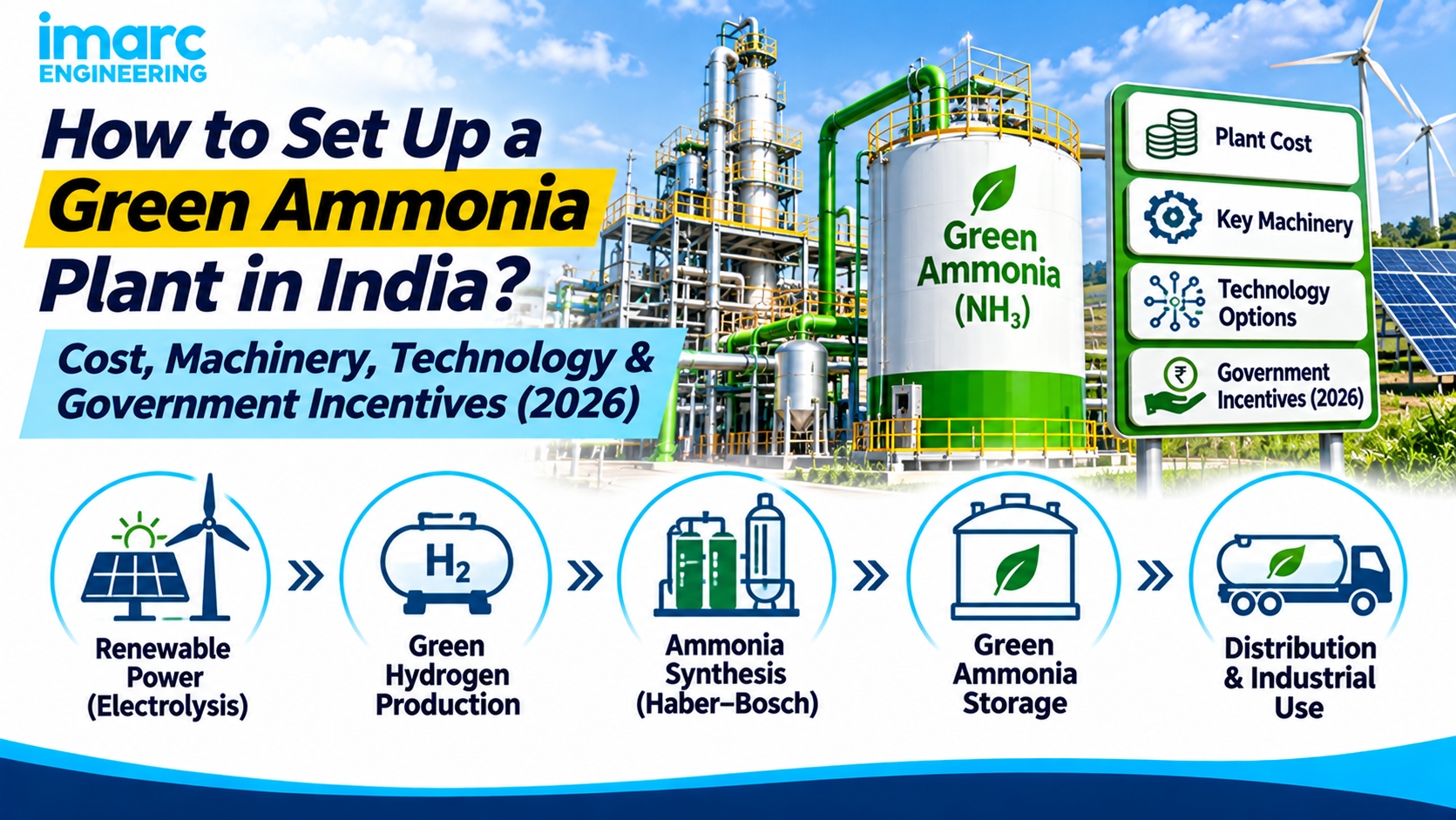
Green ammonia is produced by electrolysing water with renewable electricity to generate hydrogen, separating nitrogen from air, and combining the two in a Haber-Bosch synthesis loop. In India the commercial pathway is now defined by the National Green Hydrogen Mission and the SECI auctions under SIGHT Mode 2A.
A functional plant therefore needs four integrated systems:
Dedicated or contracted renewable power (solar, wind or hybrid) sized for high electrolyser utilisation.
Electrolyser train (typically alkaline for large scale) plus hydrogen purification and compression.
Air separation unit and Haber-Bosch synthesis loop.
Ammonia refrigeration/storage, loading infrastructure and certification under the Indian green ammonia standard.
The project is only bankable when these systems are sized together and matched to a credible offtake.
Why Projects Stall Between Concept and FID
Several recurring constraints explain the high attrition rate:
Electricity dominates both CapEx and OpEx. Intermittent solar or wind without sufficient storage or hybridisation leaves electrolysers under-utilised and raises the levelised cost of ammonia above competitive offtake prices.
Offtake is concentrated. Domestic demand is currently anchored by SECI-mediated 10-year agreements for fertiliser plants at discovered prices in the ₹49.75–64.74 per kg range. Export offtake requires additional certification and logistics that many early concepts under-estimate.
Water quality and volume are frequently overlooked. Large electrolyser trains need consistent demineralised water; coastal desalination or inland water allocation can become critical-path items.
Regulatory sequencing is underestimated. Environmental Clearance, SPCB Consent to Establish/Operate, factory licensing and PESO approvals for ammonia storage run in parallel with technology selection and financing, yet late changes in plant capacity or location force rework.
Technology choice locked too early. Selecting PEM versus alkaline, or a particular Haber-Bosch pressure level, without first fixing the power profile and offtake specification creates irreversible cost or performance gaps.
How to Structure the Project Decision Correctly
A practical sequence that reduces the chance of later redesign is:
Fix the offtake pathway first. Determine whether the plant will supply domestic fertiliser units under SIGHT Mode 2A, target export markets, or pursue a hybrid offtake. This sets the required purity, certification standard and logistics envelope.
Establish the renewable power model. Model the levelised cost of electricity under captive hybrid generation versus wheeled power, including the impact of the 25-year ISTS charge waiver for plants commissioned by 31 December 2030. High capacity-factor hybrids are usually essential for competitive ammonia cost.
Size the electrolyser and synthesis train to the power profile, not the other way around. Alkaline technology currently offers the best CapEx and scale characteristics for multi-hundred-MW plants; PEM may suit smaller or more dynamic applications.
Confirm site constraints early. Coastal or near-port locations simplify ammonia logistics and often improve renewable resources, but land, water allocation and environmental sensitivity must be validated before land acquisition.
Map the full regulatory and incentive pathway. Register under the National Green Hydrogen Mission, confirm eligibility for production incentives (approximately ₹8.82/kg, ₹7.06/kg and ₹5.30/kg of green ammonia in the first three years of production under Mode 2A), and sequence EC, CTE/CTO and PESO applications so they do not become critical-path delays after technology freeze.
Only after these five points are documented should detailed equipment packages be tendered.
Realistic Cost Ranges and What Drives Them
Indicative total project investment in 2026 terms (including captive renewables where required) runs roughly:
Pilot or demonstration scale (1,500–10,000 TPA, largely grid or third-party renewable power): INR 40–300 crore.
Commercial domestic-oriented plant (~100,000 TPA with dedicated renewable generation and storage): INR 3,500–5,000 crore.
Export-scale complexes (approaching 1 MTPA): well above INR 30,000 crore.
The dominant cost blocks are renewable generation plus storage, electrolysers and hydrogen handling, and the synthesis loop. Civil works, land and conventional utilities form a much smaller share. Electricity cost remains the single largest determinant of long-term competitiveness.
Technology Choices That Affect Bankability
Alkaline electrolysers remain the default for large Indian projects because of lower capital cost per MW, proven large-stack availability and acceptable efficiency at high utilisation. Air separation and Haber-Bosch technology are mature; the differentiation lies in integration efficiency, heat recovery and the ability of the synthesis loop to ride through renewable power variability. Storage can be refrigerated or pressurised depending on offtake logistics. Certification under India’s green ammonia standard (aligned with the ≤0.38 kg CO₂e/kg NH₃ threshold) is now a prerequisite for both domestic SIGHT offtake and credible export contracts.
Key Decision: Captive Power or Wheeled Power?
Projects that rely solely on wheeled renewable power without sufficient firming capacity often discover that electrolyser load factors fall short of the assumptions used in early financial models. Captive or hybrid captive-plus-wheeled configurations with battery or other storage usually provide more predictable utilisation and better alignment with offtake pricing. The decision should be tested against the specific offtake price and the ISTS waiver eligibility before the power-purchase strategy is frozen.
Practical Pre-Investment Checklist
Offtake pathway (SIGHT Mode 2A domestic, export, or mixed) defined and, where possible, term-sheeted.
Renewable power LCOE and capacity-factor model completed for the chosen site, including storage.
Water source, quality and allocation confirmed.
Preliminary land parcel identified with environmental and connectivity screening.
Electrolyser technology shortlist aligned with power profile and target ammonia cost.
Mission registration and incentive eligibility pathway mapped.
High-level CapEx and OpEx model stress-tested against discovered SECI price bands.
Regulatory critical path (EC, CTE/CTO, PESO, factory licence) outlined with realistic timelines.
When These Checks Must Be Completed
All of the above should be substantially complete before land is acquired or long-lead equipment is ordered. Once electrolyser and synthesis packages are placed, changes in power strategy or offtake specification become expensive. Early engagement also improves the quality of applications for SIGHT incentives and state-level support.
How IMARC Engineering Can Help
IMARC Engineering supports green ammonia developers through techno-economic feasibility assessment, renewable power and water resource evaluation, technology selection, site suitability analysis, regulatory pathway mapping and bankable project structuring. The work is designed to close the gap between concept and investment decision by grounding the project in realistic power, offtake and cost assumptions.
For promoters preparing a green ammonia project in India, a structured feasibility and site assessment is the most effective way to test whether the numbers will survive detailed engineering. Explore IMARC Engineering’s greenfield project management and feasibility services to align technical, regulatory and commercial parameters early.
Looking to develop a green ammonia project in India? Connect with IMARC Engineering to discuss your project requirements and take the next step towards successful project execution: https://www.imarcengineering.com/contact-us
Conclusion
A green ammonia plant in India succeeds when renewable power cost, electrolyser utilisation, offtake security and regulatory sequencing are solved together rather than sequentially. The SECI auctions and National Green Hydrogen Mission incentives have created a clearer commercial pathway than existed two years ago, yet the projects that reach financial close are those that treat electricity cost and offtake as the primary design drivers. Completing a rigorous pre-investment assessment against these realities remains the single most effective step before capital is committed.
Contact Us:
IMARC Engineering
Phone: +91-120-433-0800
Email: sales@imarcengineering.com
India: C-130, Sector 2, Noida, Uttar Pradesh 201301
LinkedIn: https://www.linkedin.com/showcase/imarc-engineering/