
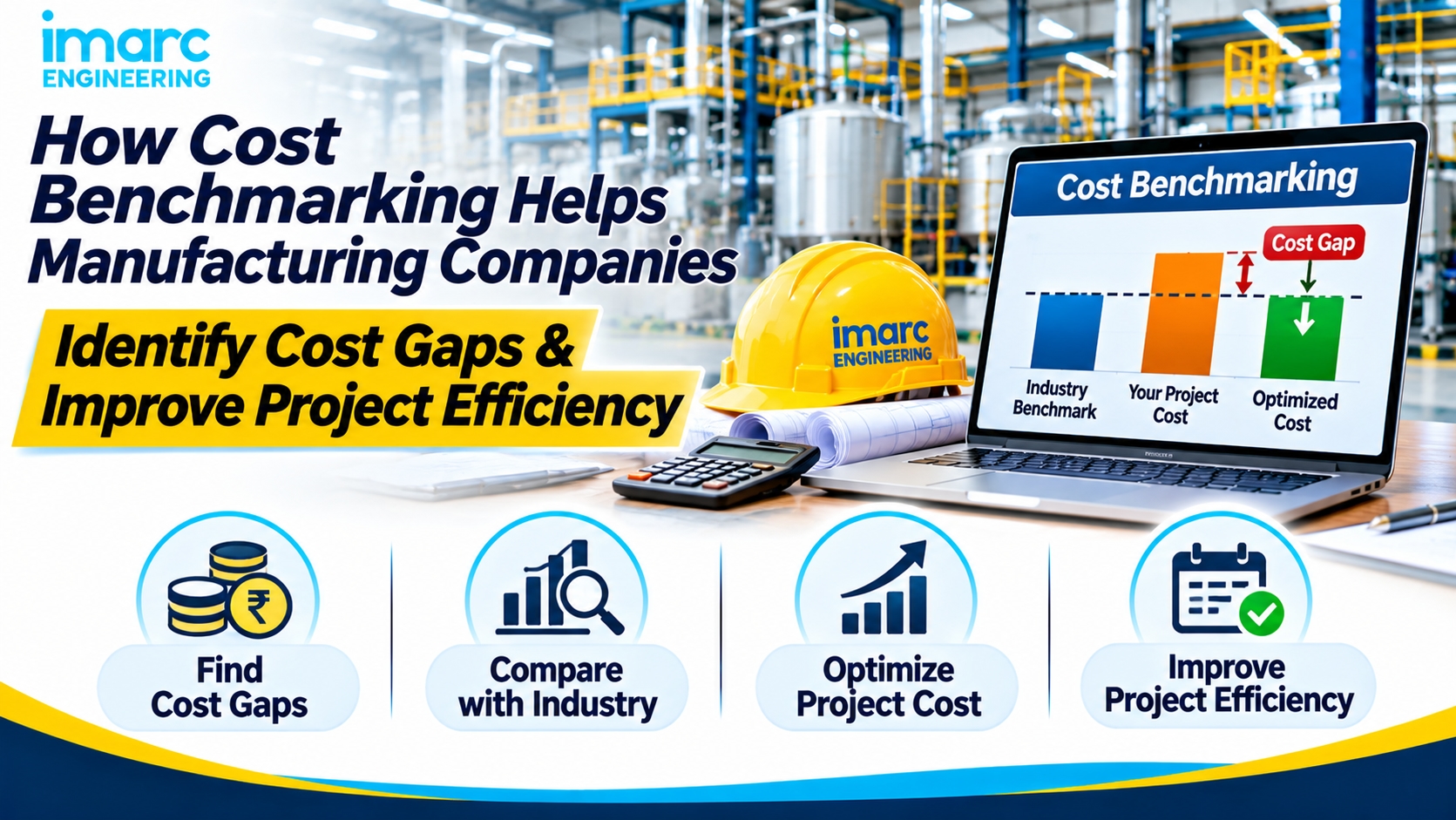
When a manufacturing project’s final cost comes in 15–30% higher than the approved budget, the usual explanations are “scope change,” “market fluctuation,” or “unexpected site conditions.” In many cases the real issue is simpler: the original estimate never had a reliable external reference. Without cost benchmarking, teams cannot tell whether a package is genuinely competitive or simply the best quote received that day.
Effective cost benchmarking helps manufacturing companies evaluate project estimates against relevant market data and comparable industrial projects. By identifying cost gaps, inefficient spending and potential savings at an early stage, Cost Benchmarking Services in India can help businesses improve budget accuracy, optimise project costs and make more informed investment decisions before committing capital.
Why Cost Gaps Stay Hidden in Most Project Estimates
Most Indian manufacturing projects are estimated using a mix of vendor quotations, internal historical costs and percentage contingencies. This approach has three structural weaknesses:
Vendor quotes rarely reflect total installed cost (foundations, piping, instrumentation, installation, commissioning).
Internal historical data is rarely adjusted for current market rates, location differences or scope completeness.
Contingency is often applied as a flat percentage rather than being informed by where past projects actually overran.
The result is a budget that looks controlled on paper but contains invisible gaps. These gaps surface later as variations, claims or forced compromises on specification and schedule.
What Effective Cost Benchmarking Actually Compares
Useful benchmarking works at package level, not just total-project level. Typical comparisons include:
Civil and structural costs against recent projects of similar scale and specification in the same or comparable industrial region
Equipment packages on a total-installed-cost basis rather than purchase price alone
Utility systems (power, water, steam, compressed air, HVAC, ETP) against current market rates and typical ratios for the process technology
Indirect costs (engineering, project management, temporary works, interest during construction) relative to project complexity and duration
On the operating side — energy intensity, manpower norms, maintenance cost per unit of capacity
Each comparison is normalised for capacity, location, technology, scope inclusions and price date. Without this normalisation, the benchmark itself becomes misleading.
How Benchmarking Turns Gaps into Actionable Efficiency Gains
Once a package sits materially above the benchmark range, the next step is diagnosis rather than automatic acceptance. The gap may come from:
Over-specification relative to functional need
Incomplete scope definition in the original estimate
Temporary market conditions
Inefficient design or construction methodology
Each root cause points to a different corrective action — specification review, re-tendering, design optimisation, or targeted contingency. When this process is applied early (feasibility and pre-tender stages), the impact on final project efficiency is significantly higher than when it is used only as a post-facto audit.
Over successive projects, a maintained internal benchmark database also improves the organisation’s own estimating accuracy, creating a continuous improvement loop instead of repeating the same estimation errors.
When Benchmarking Creates the Highest Value
The return is greatest at these decision points:
Before freezing capacity, technology and project basis
During feasibility and conceptual cost estimation
Before issuing major equipment and package tenders
When evaluating alternative locations or technology options
During brownfield expansion planning (where interface and production-disruption costs are frequently underestimated)
After project completion, to capture actual costs for future reference
Applying benchmarking only after budgets are already approved limits its usefulness. The highest leverage comes when it shapes the estimate rather than merely checking it.
Practical Sequence for Using Cost Benchmarking
Freeze a clear project basis (capacity, technology route, location, inclusions/exclusions).
Select comparable reference data that matches the basis as closely as possible.
Normalise for capacity, currency, price date and scope differences.
Compare at package level.
Investigate material variances instead of accepting them.
Convert findings into specific actions — specification change, re-sourcing, design optimisation or contingency adjustment.
Record actual final costs to strengthen the internal database.
How IMARC Engineering Can Help
IMARC Engineering supports manufacturing companies with structured cost estimation and benchmarking for both greenfield and brownfield projects. This includes package-level CAPEX build-ups using current market-verified rates, comparison against relevant project and market data, identification of cost gaps, and practical recommendations that improve estimate quality and overall project efficiency.
If your current or upcoming project needs clearer visibility into where costs stand relative to the market — and how those insights can tighten the budget and improve delivery — a focused cost benchmarking review is a practical next step: https://www.imarcengineering.com/contact?service=procurement-strategy-and-cost-benchmarking
Conclusion
Cost overruns rarely begin during construction. They begin in the estimate, when packages are accepted without a reliable external reference. Systematic cost benchmarking makes those gaps visible early enough to correct them. When applied at the right stage and at the right level of detail, it improves estimate quality, strengthens procurement leverage, focuses design effort and raises overall project efficiency. For manufacturing companies operating under tight capital and delivery pressure, this is no longer optional analysis — it is a core discipline of responsible project planning.
Contact Us:
IMARC Engineering
Phone: +917827860593
Email: sales@imarcengineering.com
India: C-130, Sector 2, Noida, Uttar Pradesh 201301
LinkedIn: https://www.linkedin.com/showcase/imarc-engineering/




