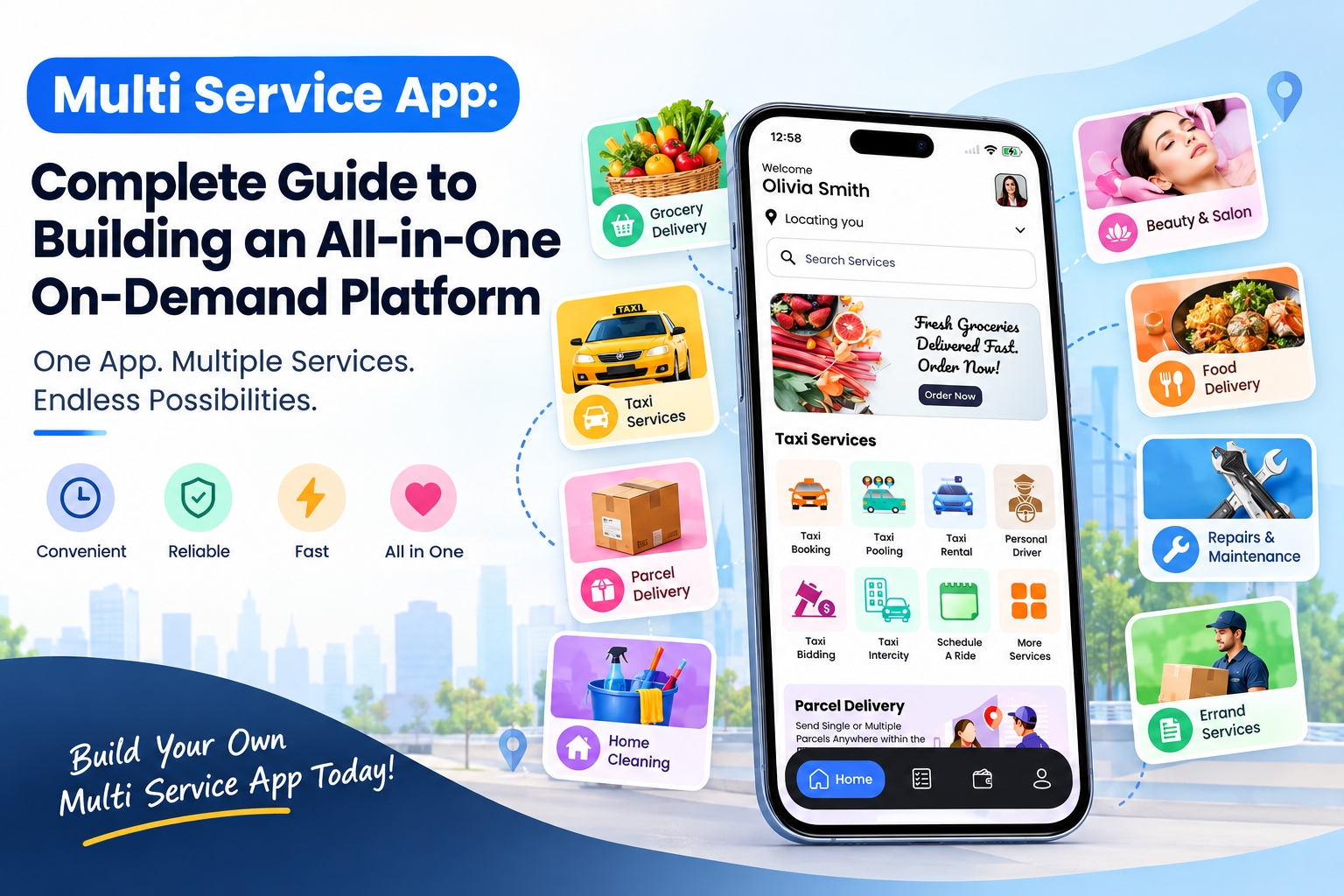
The way people access everyday services has changed significantly with the growth of mobile technology. Instead of downloading a separate application for transportation, food delivery, grocery shopping, courier services, and home services, customers increasingly prefer convenient platforms that bring multiple services together.
This is where a Multi Service App comes into play.
A multi-service application combines different on-demand services into one digital platform. Users can book a taxi, order food, purchase groceries, send parcels, hire professionals, or request other services through a single application.
For startups and entrepreneurs, this model creates opportunities to serve multiple customer needs while developing several revenue channels within one ecosystem.
What Is a Multi Service App?
A Multi Service App is an all-in-one mobile platform that provides access to several on-demand services from a single application.
Instead of operating separate apps for every business category, entrepreneurs can integrate multiple services into one platform.
Depending on the business model, a multi-service app can include:
Taxi and ride-hailing
Food delivery
Grocery delivery
Courier and parcel delivery
Pharmacy delivery
Beauty services
Cleaning services
Plumbing services
Electrical services
Laundry services
Car wash
Handyman services
Personal shopping
Moving services
The platform normally includes separate interfaces or modules for customers, service providers, delivery partners, drivers, merchants, and administrators.
Why Are Multi Service Apps Becoming Popular?
Customers value convenience. Managing multiple applications for different everyday requirements can be time-consuming.
A multi-service platform simplifies the experience by allowing customers to access multiple services through one account.
For example, a customer could:
Book a ride → Order lunch → Buy groceries → Send a parcel → Book home cleaning
All of these activities can be managed through the same platform.
For businesses, this approach can also create cross-selling opportunities. A customer who initially uses the application for taxi booking can later discover food delivery or home services.
How Does a Multi Service App Work?
A typical multi-service platform connects customers with businesses, drivers, merchants, and independent service providers.
Step 1: Customer Opens the App
The customer signs in and views the available service categories.
Step 2: Customer Selects a Service
For example, the user chooses:
Ride
Food
Grocery
Courier
Home services
Step 3: Service Request Is Created
The customer enters the required information, such as pickup location, delivery address, service type, or booking time.
Step 4: Provider Receives the Request
The request is sent to an appropriate driver, merchant, delivery partner, or service professional.
Step 5: Service Is Completed
The provider completes the booking or order.
Step 6: Payment Is Processed
The customer pays using an available payment method.
Step 7: Rating and Feedback
The customer can rate the service provider and provide feedback.
This process creates a connected ecosystem between customers and service providers.
Main Components of a Multi Service App
A successful multi-service platform usually requires multiple applications or interfaces.
1. Customer App
The customer application allows users to:
Register and log in
Browse services
Place orders
Book rides
Track services
Make payments
Apply promo codes
View order history
Manage profiles
Rate providers
Contact support
The interface should remain simple even when the platform offers many services.
2. Driver App
For transportation and delivery services, drivers can use a dedicated application to:
Accept or reject requests
View booking details
Navigate to locations
Update availability
Track earnings
View trip history
Receive notifications
Manage profiles
3. Service Provider App
Professionals such as cleaners, electricians, beauticians, and plumbers can receive and manage service requests through their own interface.
4. Merchant Panel
Restaurants, grocery stores, pharmacies, and retailers can manage:
Products
Menus
Prices
Orders
Promotions
Availability
Sales reports
5. Admin Panel
The administrator manages the overall ecosystem.
Important functions can include:
User management
Provider management
Merchant management
Driver management
Service management
Commission settings
Payment management
Promotions
Reports
Reviews
Dispute management
Popular Services to Include in a Multi Service App
The service mix depends on the target market and business strategy.
Ride-Hailing
Users can book cars, taxis, motorbikes, or other eligible transportation options.
Food Delivery
Customers can discover restaurants, browse menus, place orders, and track deliveries.
Grocery Delivery
Users can purchase groceries and household products from participating stores.
Courier Delivery
Customers and businesses can send documents, packages, and other permitted items.
Home Services
The platform can connect users with professionals for:
Cleaning
Plumbing
Electrical work
Appliance repair
Painting
Handyman services
Beauty Services
Customers can book:
Hairdressers
Makeup artists
Beauticians
Massage professionals where legally permitted
Laundry Services
Users can schedule laundry pickup and delivery.
Car Wash
Customers can request mobile or location-based car washing services.
The platform can start with a few high-demand categories and gradually expand.
Essential Features of a Multi Service App
Multiple Service Categories
Users should be able to discover all available services from the home screen.
Real-Time Tracking
Transportation and delivery services can provide live status or location tracking where technically and legally appropriate.
Multiple Payment Options
The platform can integrate suitable payment methods based on the target market.
Push Notifications
Notifications can inform users about:
Booking confirmations
Order updates
Driver arrivals
Promotions
Payment updates
Service completion
Search and Filters
Search and filtering make it easier for customers to find restaurants, stores, professionals, and services.
Ratings and Reviews
Customer feedback can help maintain service quality and provide useful information to other users.
Promo Codes
Businesses can create discounts and promotional campaigns to attract customers.
Wallet
A digital wallet can support eligible balances, promotional credits, refunds, and transactions depending on the platform's payment architecture.
Order and Booking History
Customers should be able to view previous orders and bookings.
Customer Support
In-app support can help users resolve booking, payment, delivery, and service-related issues.
Benefits of Building a Multi Service App
One Platform, Multiple Services
The biggest advantage is convenience. Customers can access multiple services through one application.
Multiple Revenue Opportunities
Businesses can monetize different service categories through commissions, delivery fees, subscriptions, advertising, and other models.
Cross-Selling
A customer using one service can discover other categories.
For example:
Taxi User → Food Customer → Grocery Customer → Home-Service Customer
Increased Customer Engagement
More service categories can create additional reasons for users to return to the application.
Scalable Business Model
Entrepreneurs can start with a limited number of services and add new categories as the business grows.
Multi Service App Revenue Models
A multi-service platform can use several monetization strategies.
Commission
The platform can charge a commission from participating drivers, merchants, or service providers based on applicable agreements.
Delivery Fees
Customers can pay delivery charges for food, grocery, courier, and other delivery services.
Service Fees
The platform can apply service fees to eligible bookings or transactions.
Subscription Plans
Users can purchase memberships that provide selected benefits, such as discounts or reduced delivery charges.
Advertising
Merchants can pay for sponsored listings, featured placements, or promotional campaigns.
Premium Services
Premium transportation, express delivery, or other enhanced services can provide additional monetization opportunities.
Corporate Accounts
Businesses can use the platform for employee transportation, food orders, logistics, or other commercial requirements.
A diversified revenue strategy can reduce dependence on one service category.
How to Build a Multi Service App
Building a multi-service platform requires both technical planning and business research.
1. Select Your Target Market
First, identify the city, country, or customer segment you want to serve.
Research:
Customer demand
Existing competitors
Service-provider availability
Pricing
Regulations
Payment preferences
2. Choose Your Initial Services
Avoid adding too many services without validating demand.
Start with services that have a clear customer need and manageable operations.
3. Design the User Experience
The application should make service discovery easy.
A clean home screen can display service categories without overwhelming users.
4. Develop the Platform
The development process can include:
Customer application
Provider application
Driver application
Merchant panel
Admin dashboard
Backend infrastructure
APIs
Payment integrations
Maps and location services
5. Integrate Payments
Choose appropriate payment providers and payment methods for your target market.
6. Test the Application
Testing should cover:
Registration
Booking
Ordering
Payments
Notifications
Tracking
Provider workflows
Admin controls
7. Launch Gradually
A controlled launch allows businesses to collect customer feedback and identify operational problems before expanding.
Multi Service App vs Single-Service App
A single-service application focuses on one category, such as taxi booking or food delivery.
A multi-service app combines several categories.
Feature | Single-Service App | Multi Service App |
|---|---|---|
Service categories | One | Multiple |
Customer use cases | Limited | Broader |
Cross-selling | Limited | Higher potential |
Revenue sources | Usually fewer | Multiple |
Operational complexity | Lower | Higher |
Expansion opportunities | Category-specific | Multiple categories |
A multi-service platform offers broader functionality, but it also requires more complex operations, partner management, technology, and customer support.
Challenges of Running a Multi Service App
Despite its potential, a multi-service business comes with challenges.
Managing Multiple Providers
Each category may require different provider onboarding and quality-control processes.
Maintaining Service Quality
Customers expect consistent experiences across different categories.
Operational Complexity
Managing rides, food orders, deliveries, and home services requires different workflows.
Customer Support
The support team must handle different types of issues.
Technology Scalability
The backend should be capable of handling increasing users, transactions, service providers, and real-time activities.
Local Regulations
Different services may have different licensing, transportation, consumer-protection, payment, tax, employment, and data-protection requirements.
Businesses should obtain appropriate professional and local legal advice before launching regulated services.
How to Make a Multi Service App Successful
Focus on Customer Experience
A complicated service ecosystem should still feel simple to customers.
Build a Reliable Provider Network
Service availability and quality depend heavily on drivers, merchants, and service professionals.
Start Small
Launch a focused set of services and expand based on demand.
Use Data Analytics
Monitor:
Orders
Bookings
Revenue
Customer retention
Provider activity
Cancellation rates
Service demand
Offer Relevant Promotions
Promotions can be targeted toward customer behavior and service categories rather than offering discounts indiscriminately.
Keep Improving
Regularly update the platform based on customer feedback, provider feedback, and business performance.
Future of Multi Service Apps
The multi-service model is likely to remain relevant as consumers look for greater convenience and businesses search for ways to connect multiple services within a single ecosystem.
Future platforms may increasingly focus on:
Personalized service discovery
Automated customer support
Smarter recommendations
Integrated loyalty programs
Digital wallets
Business accounts
Advanced analytics
Connected delivery networks
More localized services
However, technology alone does not guarantee success. Strong operations, reliable service providers, competitive offerings, customer trust, and sustainable economics remain important.
Conclusion
A Multi Service App can transform several individual on-demand services into one connected digital ecosystem. By combining transportation, food delivery, grocery, courier, home services, and other categories, businesses can create more customer touchpoints and develop multiple revenue opportunities.
For startups, the best approach is usually to begin with carefully selected services, validate demand, build a reliable provider network, and expand gradually.
A scalable technology platform, intuitive customer experience, effective monetization strategy, and strong operational management can provide the foundation for building a sustainable multi-service business.
Frequently Asked Questions
1. What is a Multi Service App?
A Multi Service App is a platform that provides several on-demand services through one application, such as ride-hailing, food delivery, grocery delivery, courier services, and home services.
2. How does a Multi Service App make money?
It can generate revenue through commissions, delivery fees, service fees, subscriptions, advertising, premium services, and corporate accounts.
3. What services can be included in a Multi Service App?
Common categories include taxi booking, food delivery, grocery delivery, courier services, pharmacy delivery, home services, beauty services, laundry, and car wash.
4. How much does it cost to build a Multi Service App?
The cost depends on the number of services, platforms, features, integrations, design requirements, technology architecture, and development location. A basic platform costs less than a large-scale multi-service ecosystem.
5. Can startups launch a Multi Service App?
Yes. Startups can begin with a limited number of services and gradually add new categories after validating customer demand.
6. Do I need separate apps for customers and service providers?
For many business models, separate interfaces for customers, drivers, merchants, and service providers can simplify workflows. The exact architecture depends on the services being offered.
7. What are the most important features?
Important features can include service management, booking and ordering, payments, tracking, notifications, ratings, promotions, provider management, analytics, and customer support.
8. Is a Multi Service App better than a single-service app?
They serve different business models. A multi-service platform can support more customer use cases and revenue channels, while a single-service application can be simpler to operate and focus on one market category.
9. Can I add new services after launching?
Yes. A scalable architecture can allow businesses to introduce additional service categories as their operations and customer base grow.
10. What should I consider before launching a Multi Service App?
Research your target market, customer demand, competitors, provider availability, pricing, technology requirements, payment infrastructure, operating costs, and applicable legal and regulatory requirements before launching.