
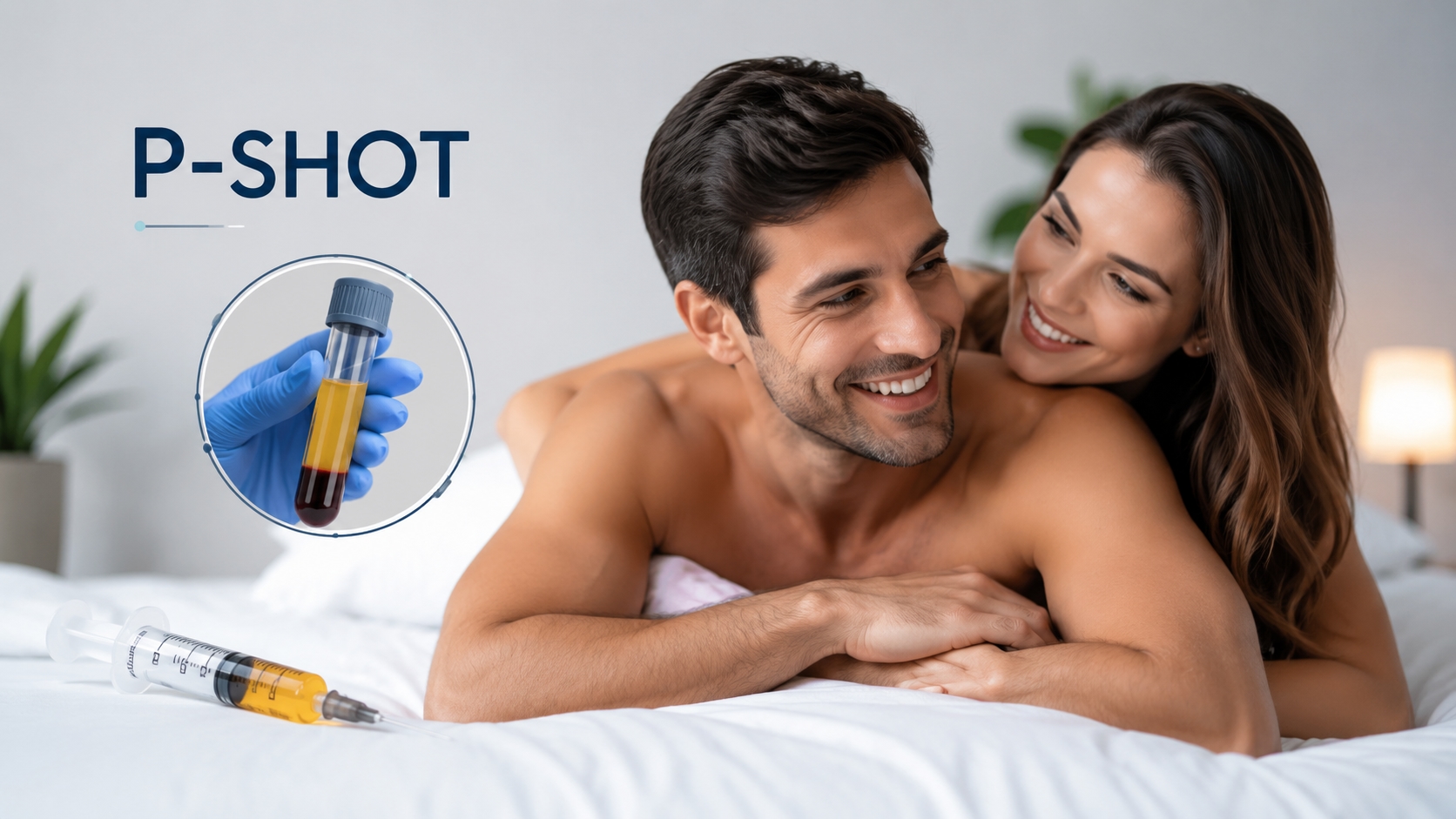
The P-Shot, also known as the Priapus Shot, is a regenerative treatment that uses platelet-rich plasma (PRP) prepared from a patient's own blood. It is promoted as a minimally invasive option for men experiencing concerns such as erectile dysfunction, reduced penile sensitivity, or changes in sexual performance.
Unlike conventional medications that are designed primarily to improve blood flow temporarily, the P-Shot is intended to use the body's own platelets and growth factors to support tissue repair and regeneration. Interest in PRP-based treatments has increased in men's sexual health, although research is still developing and results can vary from one patient to another.
This guide explains what the P-Shot is, how it works, its potential benefits, the procedure, recovery, possible side effects, expected results, candidacy, and commonly asked questions.
What Is the P-Shot?
The P-Shot (Priapus Shot) is a platelet-rich plasma treatment involving the injection of concentrated platelets derived from the patient's own blood into specific areas of the penis.
Platelets contain numerous biological substances, including growth factors, that are involved in tissue repair, inflammation regulation, and blood-vessel formation. Researchers are investigating whether these properties can help improve erectile tissue function.
The procedure generally involves three basic steps:
A small amount of blood is collected.
The blood is processed to concentrate the platelets and produce PRP.
The PRP is injected into selected areas of the penis using a fine needle.
Because the PRP is prepared from the patient's own blood, the treatment is considered an autologous therapy.
It is important to understand that the P-Shot is not a guaranteed cure for erectile dysfunction, and PRP protocols are not yet standardized across clinics or studies.
How Does the P-Shot Work?
The principle behind the P-Shot is based on the regenerative properties of platelet-rich plasma.
After blood is collected, it is processed to separate and concentrate platelets. These platelets contain growth factors and other signaling proteins involved in processes such as tissue repair and angiogenesis.
When PRP is injected into erectile tissue, the goal is to support the body's natural healing processes and potentially improve the health and function of penile tissue.
Researchers have proposed several possible mechanisms, including:
Supporting tissue repair
Promoting blood-vessel formation
Improving local blood circulation
Supporting the health of erectile tissue
Potentially improving penile sensitivity
Supporting recovery from certain types of tissue injury
However, these proposed mechanisms should not be confused with proven clinical outcomes. Although laboratory and clinical research has produced encouraging findings, the evidence for meaningful improvement in erectile function remains inconsistent.
P-Shot for Erectile Dysfunction
One of the main reasons men seek the P-Shot is erectile dysfunction (ED).
Erectile dysfunction refers to difficulty achieving or maintaining an erection that is firm enough for satisfactory sexual activity. ED can have many causes, including cardiovascular disease, diabetes, high blood pressure, obesity, certain medications, psychological factors, hormonal problems, nerve damage, and age-related changes.
PRP has been studied as a potential treatment for ED. Several systematic reviews and meta-analyses have reported improvements in erectile-function scores following PRP treatment. For example, a 2024 systematic review and meta-analysis reported improvements in International Index of Erectile Function (IIEF-EF) scores following PRP treatment, while also noting that much of the available evidence came from studies with methodological limitations.
Other 2024 analyses also reported favorable results for PRP compared with control groups.
However, newer evidence provides a more cautious perspective. A 2026 meta-analysis of seven randomized controlled trials involving 479 patients found no significant differences between platelet-rich therapies and placebo in combined IIEF scores at 1, 3, and 6 months. The authors concluded that current evidence provides low-to-moderate certainty that PRP does not consistently outperform placebo for improving sexual function.
Another 2026 meta-analysis of seven randomized controlled trials similarly concluded that current evidence does not establish a consistent, clinically meaningful improvement with PRP monotherapy compared with placebo.
Therefore, the P-Shot may be considered an emerging or investigational option for ED, rather than a proven replacement for established treatments.
Potential Benefits of the P-Shot
Depending on the individual patient and the underlying cause of the problem, potential benefits may include:
1. Uses the Patient's Own Blood
PRP is prepared from the patient's own blood. This means the treatment does not rely on donor tissue.
2. Minimally Invasive
The P-Shot is performed through injections rather than surgery. There is generally no need for a surgical incision or prolonged hospital stay.
3. Short Procedure Time
PRP preparation and injections can generally be completed during an outpatient visit, although the exact duration varies according to the clinic's protocol.
4. Potential Support for Erectile Function
Research suggests PRP may improve certain measures of erectile function in some men, although clinical evidence remains mixed.
5. Potential Tissue-Regenerative Effects
PRP contains growth factors involved in tissue healing and vascular processes. This is one of the primary reasons researchers are investigating its use in sexual medicine.
6. Generally Well Tolerated in Studies
Published studies have generally reported relatively mild adverse events. However, the safety profile can depend on injection technique, preparation method, patient factors, and the expertise of the treating clinician.
Who May Be a Candidate for the P-Shot?
The P-Shot may be discussed with men who have erectile difficulties and are interested in regenerative approaches.
A doctor may consider factors such as:
The severity and duration of erectile dysfunction
The patient's age
Cardiovascular health
Diabetes or metabolic conditions
Blood pressure
Current medications
Hormonal status
Previous ED treatments
Penile or pelvic injury
Smoking and alcohol use
Psychological or relationship factors
Overall sexual health
A proper medical assessment is important before treatment because erectile dysfunction can sometimes be an early sign of an underlying cardiovascular or metabolic problem.
The P-Shot should not be viewed simply as a cosmetic procedure. Men experiencing persistent ED should receive an appropriate medical evaluation.
Who May Not Be Suitable for the P-Shot?
Not every patient is an appropriate candidate.
Treatment may need to be postponed, avoided, or carefully evaluated in people with certain medical or blood-related conditions. Examples may include active infection at the injection site, significant bleeding disorders, certain blood diseases, or situations in which the clinician determines that PRP is unlikely to be appropriate.
Patients taking blood-thinning medication should also tell their doctor before treatment. Medication should never be stopped without medical advice.
A qualified healthcare professional should determine whether PRP is appropriate for an individual patient.
How Is the P-Shot Procedure Performed?
Although techniques differ between providers, a typical P-Shot procedure may involve the following stages.
Step 1: Consultation
The process begins with a medical consultation. The clinician discusses the patient's symptoms, medical history, medications, sexual health, and treatment goals.
For men with ED, identifying possible underlying causes is particularly important.
Step 2: Blood Collection
A small amount of blood is drawn from the patient's arm.
The quantity varies depending on the PRP preparation system and the clinic's protocol.
Step 3: PRP Preparation
The collected blood is placed into a specialized processing system, commonly involving centrifugation.
The objective is to separate and concentrate the platelets from other components of the blood.
Step 4: Preparation of the Injection Area
The penile area is cleaned and prepared. A local anesthetic or other pain-control method may be used depending on the clinician's technique.
Step 5: PRP Injection
The prepared PRP is injected into selected areas of penile tissue using a fine needle.
The exact injection locations, number of injections, PRP concentration, and treatment volume vary between providers.
Step 6: Observation and Aftercare
After the injections, the patient is generally observed briefly before being allowed to leave.
Because protocols differ, the treating clinician should provide specific instructions regarding sexual activity, exercise, medications, and follow-up.
Does the P-Shot Hurt?
Most patients describe the procedure as involving some pressure, pinching, or mild discomfort rather than severe pain.
A numbing medication may be used to make the injection more comfortable.
Temporary tenderness, swelling, bruising, or sensitivity can occur after injections.
If severe or worsening pain develops after treatment, the patient should contact the treating healthcare provider promptly.
P-Shot Recovery
One of the attractions of PRP treatment is that it is minimally invasive and generally does not require a lengthy recovery period.
Patients may experience temporary:
Swelling
Bruising
Tenderness
Mild discomfort
Sensitivity at injection sites
The recovery period can vary according to the patient's health and the technique used.
Patients should follow the specific post-treatment instructions given by their clinician rather than relying on generalized timelines found online.
When Do P-Shot Results Appear?
P-Shot results are not necessarily immediate.
Because PRP is intended to stimulate biological processes rather than provide an instant pharmacological effect, any potential improvement may develop gradually.
Some clinical studies have assessed outcomes at one, three, and six months following treatment. Research has reported improvements in erectile-function scores in some study populations, but the magnitude and reliability of these improvements vary.
Patients should therefore avoid expecting an immediate or guaranteed result.
How Long Do P-Shot Results Last?
The duration of potential benefits is not yet clearly established.
Different studies use different PRP preparation methods, injection protocols, treatment schedules, and follow-up periods. This makes it difficult to provide a reliable universal answer regarding how long the effects last.
Research has included follow-up periods of several months, but long-term evidence remains limited.
A 2024 systematic review specifically highlighted the need for better-quality research, longer follow-up, and standardized PRP preparation protocols.
How Many P-Shot Sessions Are Needed?
There is no universally accepted P-Shot treatment schedule.
Some research protocols have used one or multiple injections, while other clinical providers may recommend a series of treatments.
A 2026 meta-analysis reported that included RCTs used varying PRP volumes and treatment schedules, illustrating the lack of standardization.
The appropriate number of sessions should therefore be determined after an individual assessment rather than using a fixed schedule for every patient.
P-Shot Side Effects and Risks
Although PRP uses the patient's own blood, this does not mean that the procedure is completely risk-free.
Possible side effects can include:
Temporary pain
Bruising
Swelling
Tenderness
Minor bleeding
Infection
Temporary changes in sensation
Discomfort at injection sites
Rare complications may occur depending on the patient's health and the injection technique.
Clinical research has generally reported relatively few serious adverse events, but researchers continue to emphasize the need for better-designed studies and standardized treatment protocols.
Patients should seek medical attention if they experience severe pain, significant swelling, fever, signs of infection, prolonged bleeding, or other unusual symptoms after treatment.
P-Shot vs. Traditional ED Treatments
Traditional erectile dysfunction treatments include several established approaches.
Oral ED Medications
PDE5 inhibitors are commonly used for erectile dysfunction. They work primarily by enhancing the nitric oxide pathway and increasing blood flow to the penis during sexual stimulation.
Vacuum Erection Devices
These devices use negative pressure to help draw blood into the penis and produce an erection.
Intracavernosal Medications
Certain medications can be injected into the penis to produce an erection.
Penile Implants
For selected patients with severe or treatment-resistant ED, penile prostheses can provide a surgical treatment option.
Lifestyle and Medical Management
Managing diabetes, high blood pressure, obesity, smoking, cardiovascular disease, and other contributing factors can be an important part of ED treatment.
The P-Shot differs because it is intended as a regenerative PRP approach rather than a conventional medication or mechanical treatment.
Importantly, current evidence does not establish the P-Shot as a replacement for established first-line ED treatments. The 2026 randomized-trial evidence remains inconclusive regarding whether PRP provides clinically meaningful benefits over placebo.
P-Shot and Penile Sensitivity
Some clinics promote the P-Shot for improving penile sensitivity.
The biological rationale is related to PRP's potential effects on tissue repair and vascular or nerve-related processes. However, evidence specifically demonstrating reliable improvements in penile sensitivity is much less established than the marketing claims sometimes suggest.
Patients should discuss their particular symptoms with a qualified clinician before assuming that PRP will improve sensitivity.
P-Shot and Peyronie's Disease
PRP has also been investigated in men with Peyronie's disease, a condition characterized by scar tissue within the penis that can cause curvature, pain, or erectile difficulties.
A systematic review of PRP research identified studies examining both erectile dysfunction and Peyronie's disease, but the authors emphasized that evidence remains insufficient to establish standardized PRP treatment protocols.
Therefore, men with penile curvature or suspected Peyronie's disease should undergo evaluation by an appropriate specialist.
Is the P-Shot FDA Approved for Erectile Dysfunction?
Patients should be cautious about claims that present the P-Shot as an FDA-approved cure for erectile dysfunction.
The term "P-Shot" refers to a branded approach to PRP treatment, while PRP itself has many medical applications and preparation methods.
For erectile dysfunction specifically, clinical research is still evolving. Current randomized evidence has not established a consistent, clinically meaningful advantage over placebo.
For this reason, clinics should avoid guaranteeing results or describing the P-Shot as a universally proven cure.
P-Shot Cost
The cost of a P-Shot varies considerably depending on several factors, including:
Location of the clinic
Doctor's expertise
PRP preparation system
Number of treatment sessions
Diagnostic evaluation
Additional treatments
Clinic facilities
Follow-up requirements
Patients should ask for a complete treatment estimate during consultation rather than relying on a generic online price.
If you are considering treatment in Pakistan, it is particularly important to compare the qualifications of the treating clinician, the clinic's standards, the PRP preparation technique, and what is included in the quoted price.
How to Choose a P-Shot Provider
Choosing the right provider is important because PRP quality and injection technique can vary.
Before treatment, consider asking:
Is the procedure performed by a qualified medical professional?
What type of PRP preparation system is used?
How is the PRP prepared?
How many treatments are recommended and why?
What medical evaluation is performed before treatment?
What are the potential risks?
What results can realistically be expected?
What happens if the treatment does not work?
Are there established ED treatments that may be more appropriate?
What follow-up care is included?
A reputable provider should be willing to discuss both the potential benefits and the limitations of the evidence.
P-Shot: What Does the Research Say?
Scientific evidence surrounding PRP for erectile dysfunction has evolved rapidly.
Several reviews published in 2024 reported encouraging improvements in erectile-function measurements. For example, one meta-analysis found improvements in IIEF-EF scores and other outcomes after PRP treatment.
Another meta-analysis involving controlled and single-arm studies also reported improved IIEF outcomes among patients receiving PRP.
However, more recent analyses focusing on randomized controlled trials have been more cautious. A 2026 systematic review and meta-analysis of seven RCTs found no significant difference between platelet-rich therapies and placebo in IIEF scores at 1, 3, and 6 months.
A separate 2026 meta-analysis of seven RCTs involving 512 participants similarly concluded that current evidence does not demonstrate consistent, clinically meaningful improvement compared with placebo and highlighted substantial variation between studies.
This difference between studies is important. It means that while the P-Shot is scientifically interesting and may help some patients, more high-quality research is needed before its effectiveness can be considered firmly established.
P-Shot: Pros and Cons
Potential Advantages
Uses the patient's own blood
Minimally invasive
Usually performed as an outpatient procedure
Does not involve major surgery
PRP contains biologically active growth factors
Has shown promising results in some clinical studies
Potential Limitations
Evidence remains inconclusive
Treatment protocols are not standardized
Results can vary between patients
It may not treat the underlying cause of ED
It may not work for every patient
Long-term effectiveness remains uncertain
It can be expensive
It should not replace appropriate medical evaluation or established ED treatments without professional guidance
Frequently Asked Questions About the P-Shot
What is the P-Shot?
The P-Shot, or Priapus Shot, is a PRP-based injection treatment that uses platelet-rich plasma prepared from the patient's own blood. It is promoted primarily for men's sexual health concerns, particularly erectile dysfunction.
Is the P-Shot a permanent treatment?
There is currently insufficient evidence to say that P-Shot results are permanent. Research has generally involved relatively short follow-up periods.
How quickly does the P-Shot work?
Results, if they occur, may develop gradually rather than immediately. Studies have evaluated outcomes at different time points, including one, three, and six months.
Is the P-Shot painful?
Some temporary discomfort, pressure, tenderness, bruising, or swelling may occur. A clinician may use a local anesthetic to improve comfort.
Is PRP made from my own blood?
Yes. PRP is prepared from a sample of the patient's own blood.
Can the P-Shot cure erectile dysfunction?
It should not be marketed as a guaranteed cure. Current evidence is promising in some studies but remains inconsistent, particularly in recent placebo-controlled randomized trials.
How many P-Shot treatments are required?
There is no universally accepted number of treatments. Treatment schedules vary among studies and providers.
Can every man with ED receive the P-Shot?
No. Suitability depends on the cause of ED, overall health, medications, medical history, and clinical assessment.
Are there risks associated with the P-Shot?
Potential risks include pain, bruising, swelling, bleeding, infection, and temporary changes in sensation. Your clinician should explain the risks before treatment.
Final Thoughts
The P-Shot (Priapus Shot) is an emerging PRP-based treatment that has attracted significant interest in men's sexual medicine. It uses concentrated platelets from the patient's own blood and is intended to support tissue healing and regeneration.
Research published in recent years has produced encouraging findings, with some studies reporting improvements in erectile-function scores. However, newer randomized controlled evidence has been less conclusive, and researchers continue to call for larger, better-designed studies and standardized PRP protocols.
For men experiencing erectile dysfunction, the most appropriate approach is to first identify possible underlying causes and discuss established treatment options with a qualified healthcare professional. The P-Shot may be worth discussing as a potential option for selected patients, but realistic expectations are essential.
A medical consultation can help determine whether PRP treatment is appropriate and whether another evidence-based treatment may be more suitable for the individual's condition.
Medical disclaimer: This article is intended for general educational purposes and should not be considered a substitute for professional medical advice, diagnosis, or treatment. Anyone experiencing persistent erectile dysfunction or other sexual-health symptoms should consult a qualified healthcare professional.