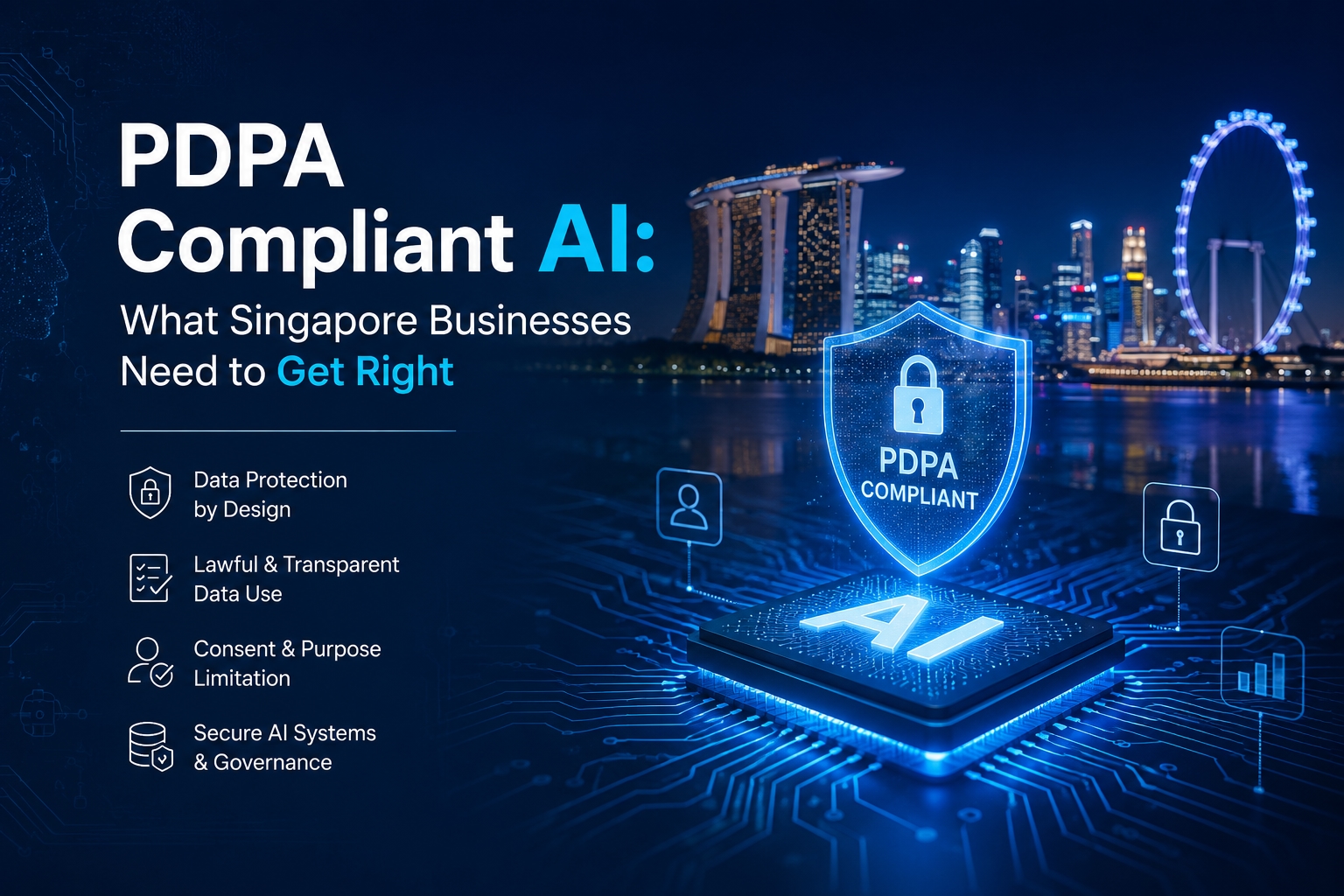
Talk to any AI development company in Singapore about a new AI project, and the Personal Data Protection Act comes up before the tech stack does, and that order is correct. A model that performs brilliantly but was trained or deployed without proper regard for how personal data flows through it is not a project that survives its first compliance review. Getting PDPA right is not a legal afterthought bolted onto a finished system, it is an architectural decision that shapes what the system can do from the very first design meeting.
Why PDPA Changes How You Build, Not Just What You Document
A lot of teams treat data protection compliance as a documentation exercise, something the legal team handles after engineering ships the product. With AI systems, that sequencing does not work, because the model itself often needs to be trained differently, hosted differently, and monitored differently depending on what personal data it touches and how. Retrofitting compliance into an AI system that was not designed with PDPA in mind usually means rebuilding core parts of the data pipeline, which costs far more time and money than getting the architecture right the first time.
The Personal Data Protection Act sets clear expectations around consent, purpose limitation, and data minimization, and each of these has a direct engineering consequence for AI systems. Consent means your system needs to know, at a technical level, what a given piece of data is allowed to be used for. Purpose limitation means a model trained on customer support transcripts for one purpose cannot casually be repurposed to power a marketing tool without revisiting that consent. Data minimization means an AI agent should only have access to the specific fields it needs for its task, not a broad database connection that happens to be convenient during development.
Data Residency and Where Your Model Actually Runs
One of the more concrete PDPA related decisions in any Singapore AI project is where the model and its underlying data actually live. Some organizations, particularly in financial services and healthcare, need local hosting or private cloud deployment to satisfy data residency expectations, rather than routing sensitive customer data through a foreign cloud region by default. This decision needs to be made early, because switching hosting environments after a system is built and tested is a meaningfully larger project than choosing correctly at the architecture stage.
This is also where model choice interacts with compliance in ways that are easy to overlook. A model-agnostic approach, where the underlying foundation model can be swapped without rearchitecting the whole system, gives Singapore businesses flexibility to meet data sovereignty requirements as they evolve, rather than being locked into a single provider whose data handling practices may not fit a specific regulatory requirement down the line.
Building Governance Into the System, Not Around It
This is where the broader discipline of AI governance and PDPA compliance overlap almost completely. A well built AI governance framework already asks the questions PDPA compliance requires answers to: who owns the system, what data can it access, how are decisions logged, and who is accountable when something goes wrong. Organizations that build governance and compliance as one connected discipline, rather than two separate workstreams handled by different teams, end up with systems that are both more defensible to regulators and genuinely easier to operate day to day.
This connects to a pattern we have written about before, that AI transformation is a problem of governance rather than a problem of finding better models. In the Singapore context, that governance problem has a very specific regulatory shape, defined by PDPA on the data protection side and, for financial institutions, by MAS expectations around risk management and auditability. Companies that treat these as parallel checklists to satisfy separately tend to build clunkier systems than those who recognize the underlying discipline is the same.
Consent Management for AI Systems in Practice
Consent under PDPA is not a one time checkbox during account creation. It needs to travel with the data as that data moves through an AI pipeline. A practical approach involves tagging data at the point of collection with its permitted use cases, then enforcing those tags at the retrieval and processing layer of any AI system that touches it. This sounds like a lot of engineering overhead, and it is, but it is dramatically cheaper to build this tagging system once, early, than to try to reconstruct consent history after a regulator asks which customers' data was used to train a specific model feature.
Generative AI systems complicate this further, since training data and retrieval sources both need consent tracking, and a RAG system pulling from internal documents needs the same rigor around what it is allowed to surface as a fine tuned model needs around what it was allowed to learn from.
What Happens When You Get This Wrong
The cost of a PDPA compliance gap in an AI system is rarely a single dramatic incident. More often it is a slow accumulation of risk that surfaces during an audit, a data subject access request, or an incident investigation, at which point the business discovers it cannot cleanly answer what data a system used, why, or under what consent basis. Rebuilding that answer after the fact, without proper logging built in from the start, is one of the more expensive and reputation damaging exercises a Singapore business can go through, and it is almost entirely avoidable with the right architecture decisions made early.
Practical Steps for Getting Started
Start by mapping every place personal data enters an AI system, whether through training, retrieval, or live user interaction, and documenting the consent basis for each. Build access controls at the system level so agents and models only see what they need for their specific task, rather than broad database access that seems convenient during development but creates risk later. Choose hosting and infrastructure decisions with data residency requirements in mind from the beginning, particularly for financial services or healthcare use cases. Finally, treat audit logging as a first class requirement, not a feature to add after launch, since the ability to reconstruct exactly what a system did with what data is the single most important capability for surviving a compliance review intact.
Frequently Asked Questions
Does PDPA apply to internal AI tools that never touch customer facing data?
Yes, if internal tools process employee or other personal data, PDPA obligations still apply, though the risk profile and required controls may differ from customer facing systems.
Can a business use customer support transcripts to train an AI model under PDPA?
Only if the original consent basis covers that specific use, which is why purpose limitation needs to be tracked at the data level rather than assumed to cover any future use case.
Is local hosting in Singapore always required for PDPA compliance?
Not always, but certain sectors and use cases, particularly financial services, often require it or strongly prefer it, and this should be evaluated early rather than assumed either way.
How does PDPA compliance differ for generative AI versus traditional software? Generative AI introduces training data provenance and retrieval source questions that traditional software rarely faces, requiring more granular tracking of what data influenced a given output.
What is the first step a Singapore business should take toward PDPA compliant AI?
Map where personal data enters any AI system and document its consent basis before building further, since retrofitting this after deployment is significantly more costly than designing for it from the start.