
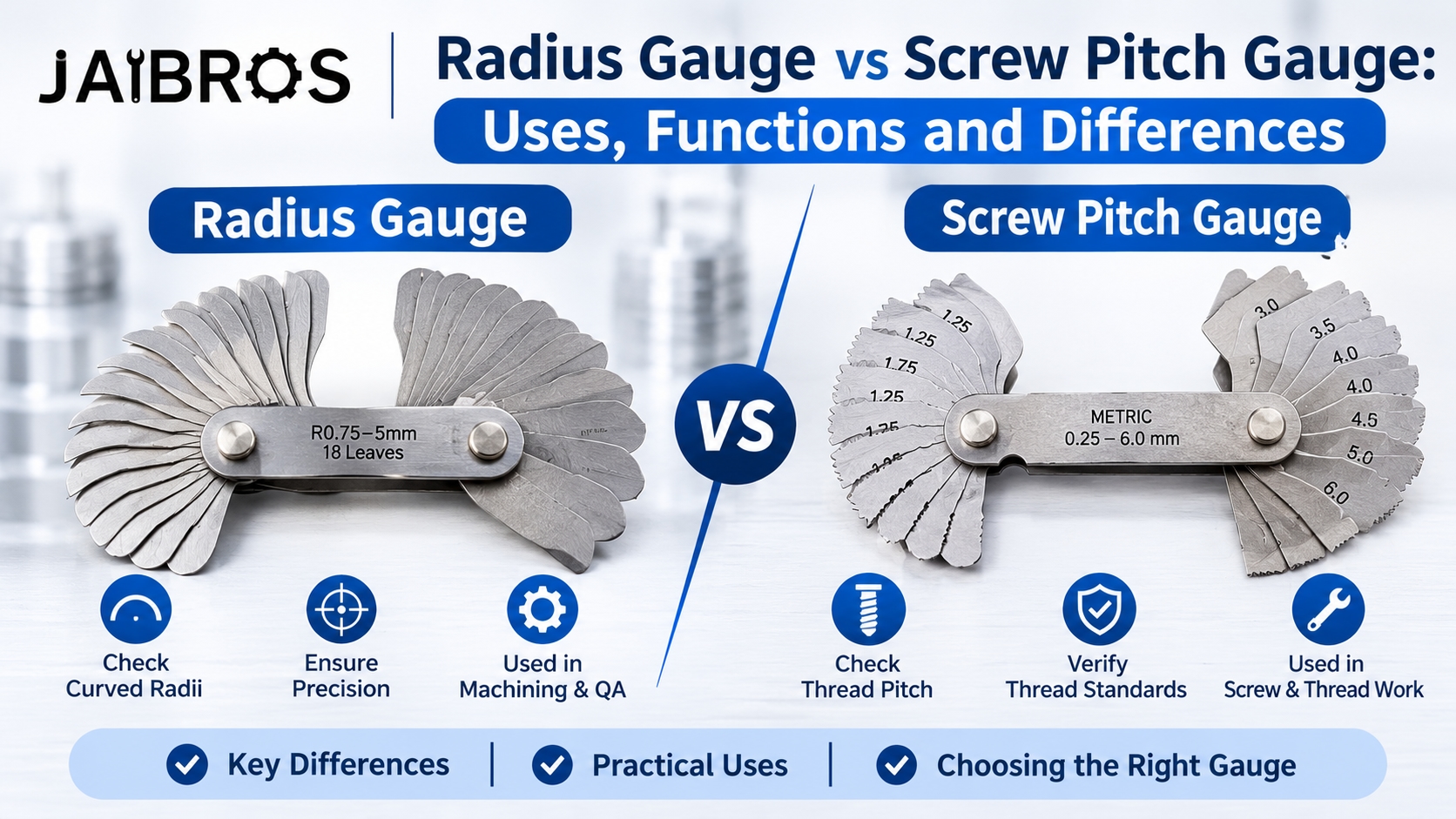
Anyone who works in a machine shop or inspection room knows that small details decide whether a part fits. Two simple hand tools help with this: the radius gauge and the screw pitch gauge. Both are thin steel leaves held in a handle, so they look alike, but they check very different features. This guide explains how each one works, where it is used, and how they differ.
What Is a Radius Gauge?
A radius gauge, also called a fillet gauge, checks the curve on an edge or corner. Each steel leaf has a precise curved shape marked with its size in millimetres or inches. Convex leaves check outside corners, and concave leaves check inside fillets.
To use it, pick a leaf you think matches and press it against the corner. Then hold the part up to a light source. If no light shows between the leaf and the part, the radius matches. If light leaks through, try another leaf.
Common uses include machined shoulders, turned parts, sheet metal bends, mould and die work, and checking the nose radius of cutting tools. It is a quick comparison tool and does not give a digital reading.
What Is a Screw Pitch Gauge?
A screw pitch gauge, also known as a thread pitch gauge, identifies the pitch of a thread. Pitch is the distance between two neighbouring thread crests. Metric threads give pitch in millimetres, so M10 x 1.5 means a 1.5 mm pitch. Unified threads count threads per inch (TPI).
Each blade has teeth cut to a thread form. Most sets use a 60° angle for metric and unified threads, while Whitworth sets use 55°. To use it, press the teeth of a blade into the thread. The correct blade sits fully in the thread with no gaps and no rocking.
You will see it used on bolts, nuts, tapped holes, lathe threading jobs, and repair work where the thread type is unknown.
How to Choose Between Them
The choice is simple. If your question is “How round is this corner?”, you need a radius tool. If your question is “What thread is this?”, you need a screw pitch gauge. Many workshops keep both close to the bench, since drawings often call for both fillet sizes and thread specifications.
Buying Tips for Accurate Results
Check the range. A good radius gauge set covers small and large sizes in both convex and concave forms. A pitch gauge set should cover the common metric and inch pitches you work with.
Look at the material. Hardened stainless or carbon steel blades resist wear and keep their shape.
Read the markings. Clear, deeply etched or stamped numbers stay readable after years of use.
Inspect the edges. Blades should be smooth and free of burrs, so they sit flat against the part.
Match the thread angle. Make sure the pitch gauge suits the thread type you use, such as 60° or 55°.
Care and Accuracy Tips
Wipe the blades clean after each use to remove oil, chips and dust. Apply a thin film of light oil to prevent rust. Never force a blade into a damaged thread or onto a sharp burr, because this can bend it. After use, fold the blades back into the handle and store the tool in a dry place.
Remember that both tools are comparison aids. For very tight tolerances, use precision instruments such as an optical comparator, a micrometer, or go/no-go thread gauges.
Frequently Asked Questions
1. What does a radius gauge measure?
A radius gauge checks the size of a curved edge, either an outside corner or an inside fillet. You press a leaf of known radius against the part and look for light gaps. When no light passes through, the radius matches the marked value. It is a quick visual comparison, so it suits workshop checks rather than very tight tolerance inspection.
2. What is a screw pitch gau–ge used for?
A screw pitch gauge identifies the pitch of a thread, meaning the distance between neighbouring crests. You fit different blades into the thread until one sits snugly with no gaps. It helps you identify unknown bolts, check tapped holes, and confirm that a threading operation produced the correct pitch before the part is assembled.
3. Is a screw pitch gauge the same as a thread pitch gauge?
Yes. Both names describe the same tool. Some regions and catalogues say screw pitch gauge, while others say thread pitch gauge or thread gauge. It has a set of toothed blades, each marked with a pitch in millimetres or threads per inch. Just make sure the blade angle suits your thread type, such as 60° or 55°.
4. Can these gauges measure thread diameter or tolerance?
No. A pitch gauge only tells you the spacing of the threads, and a radius leaf only tells you the curve size. For diameter, use a caliper or micrometer. To confirm thread class and tolerance, use go/no-go plug or ring gauges. Think of pitch and radius tools as quick identification and comparison aids, not full inspection instruments.
5. How should I care for these gauges to keep readings reliable?
Wipe the blades clean after use to remove oil, chips and dust, then apply a thin film of light oil to prevent rust. Never force a blade into a damaged thread or onto a sharp burr, as this bends the leaf. Fold the blades back into the handle and store the tool in a dry place away from heavy tools.
Conclusion
A radius gauge checks curves and fillets, while a screw pitch gauge identifies thread pitch. Each is simple to use, and together they cover many everyday checks in machining, fitting and repair. Choose the right one for the feature you are checking, handle the blades with care, and use precision instruments when tolerances are tight.
If you are looking for dependable measuring tools and gauges, you can explore the range at Jaibros, a trusted online store for industrial and workshop tools..



