AI is changing how software gets built. Developers are no longer writing every line of code from scratch - tools powered by LLMs are generating functions, APIs, and even entire workflows in seconds.
But while code generation has accelerated, quality assurance hasn’t kept pace.
This is where regression testing is facing a new kind of pressure.
The Shift: From Human-Written Code to AI-Generated Systems
Traditionally, developers had a deep understanding of the code they wrote. This made it easier to predict what could break, where edge cases might exist, and how changes might impact existing functionality.
With AI-generated code, that clarity is fading.
Developers are now reviewing instead of writing, integrating instead of designing, and shipping faster than ever.
The result is more code, less context, and significantly higher risk of regressions.
Why Regression Testing Is Getting Harder
Increased Code Volume
AI tools can generate significantly more code in the same time. More code means more surface area for bugs and more scenarios to validate.
Regression testing suites that worked before often become too slow, miss critical paths, and fail to scale.
Lack of Deep Code Ownership
When code is AI-generated, developers may not fully understand hidden dependencies, edge-case behaviors, or implicit assumptions.
This makes it harder to predict what needs to be covered in regression testing.
Frequent and Rapid Changes
AI accelerates iteration cycles. Teams now push updates multiple times a day, across multiple services, with minimal manual validation.
Without strong regression testing, this speed leads to fragile systems.
Traditional Test Strategies Don’t Scale
Older approaches rely heavily on static test cases, predefined scenarios, and controlled staging environments.
But AI-generated systems are dynamic, evolving, and less predictable.
This creates gaps that traditional regression testing simply can’t cover.
Regression Testing vs Unit Testing in AI-Driven Development
It’s important to understand the evolving relationship between unit testing vs regression testing in this new landscape.
Unit tests validate small pieces of logic in isolation, while regression testing ensures that system-wide behavior remains stable after changes.
With AI-generated code, unit tests can be auto-generated but may lack meaningful coverage, while regression testing becomes the last line of defense against unexpected breakages.
In other words, unit tests check correctness, while regression testing checks real-world stability.
What Modern Regression Testing Needs to Look Like
Shift Toward Production-Like Testing
Testing in isolated environments is no longer enough.
Modern regression testing should reflect real user behavior, use realistic data, and simulate production conditions.
Most critical bugs don’t appear in staging - they appear in production.
Focus on Critical User Flows
Instead of trying to test everything, teams should prioritize high-impact workflows, revenue-critical paths, and frequently used features.
This ensures regression testing remains fast and effective, even as systems grow.
Automate Test Generation Intelligently
AI can generate code, but it can also help generate tests.
The key is not just automation, but relevance. Tests should reflect real usage, not just theoretical scenarios or code coverage metrics.
Move Beyond Static Test Suites
Static regression suites quickly become outdated.
Modern teams are shifting toward dynamic test generation, continuous validation, and feedback loops from real usage.
This keeps regression testing aligned with how the system actually behaves.
Integrate Testing into the Development Workflow
Regression testing can’t be an afterthought.
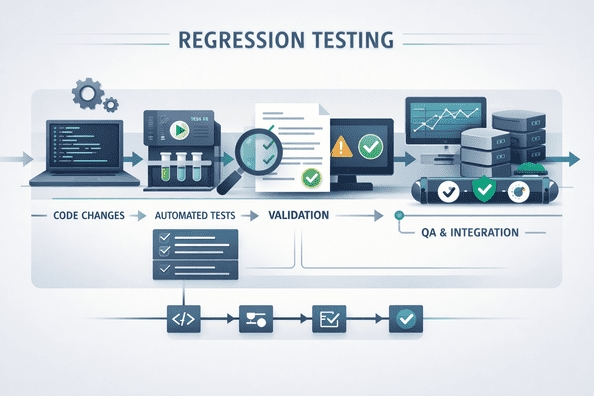
It needs to be embedded in CI/CD pipelines, triggered automatically on changes, and fast enough to not block releases.
The goal is to catch regressions before users do, without slowing developers down.
The Future of Regression Testing
As AI continues to reshape software development, regression testing will become less about predefined scripts and more about adaptive validation.
It will move away from coverage metrics and toward real-world reliability.
Teams that rely on outdated testing approaches will struggle with flaky systems, frequent production issues, and slower debugging cycles.
Teams that evolve their regression testing strategy will gain faster releases, higher confidence, and a better user experience.
Final Thoughts
AI is making it easier than ever to build software, but also easier to break it.
In this new era, regression testing is no longer optional- it’s foundational.
It ensures that as systems grow faster and more complex, they remain stable.
Because in the age of AI-generated code, you’re not just testing what you wrote - you’re testing what you don’t fully understand.
And that is exactly why regression testing matters more than ever.