
Quick Summary
SAP S/4HANA Service becomes easier to study when each syllabus topic is tied to an actual business process. The four main areas are organizational and master data, general configuration, on-site service processing, and in-house service processing. This guide walks through them using a fictional equipment company, with study checkpoints for each topic.
Introduction
Memorizing terms rarely shows whether you understand how a service organization works. A stronger method is to picture the business first and then ask which data, settings, and transactions it needs.
This SAP S/4HANA Cloud Private Edition, Service Study Guide follows that method. Each topic comes with a study map: what to learn, where it appears in a real workflow, and how to test your own understanding.
Start with the certification scope
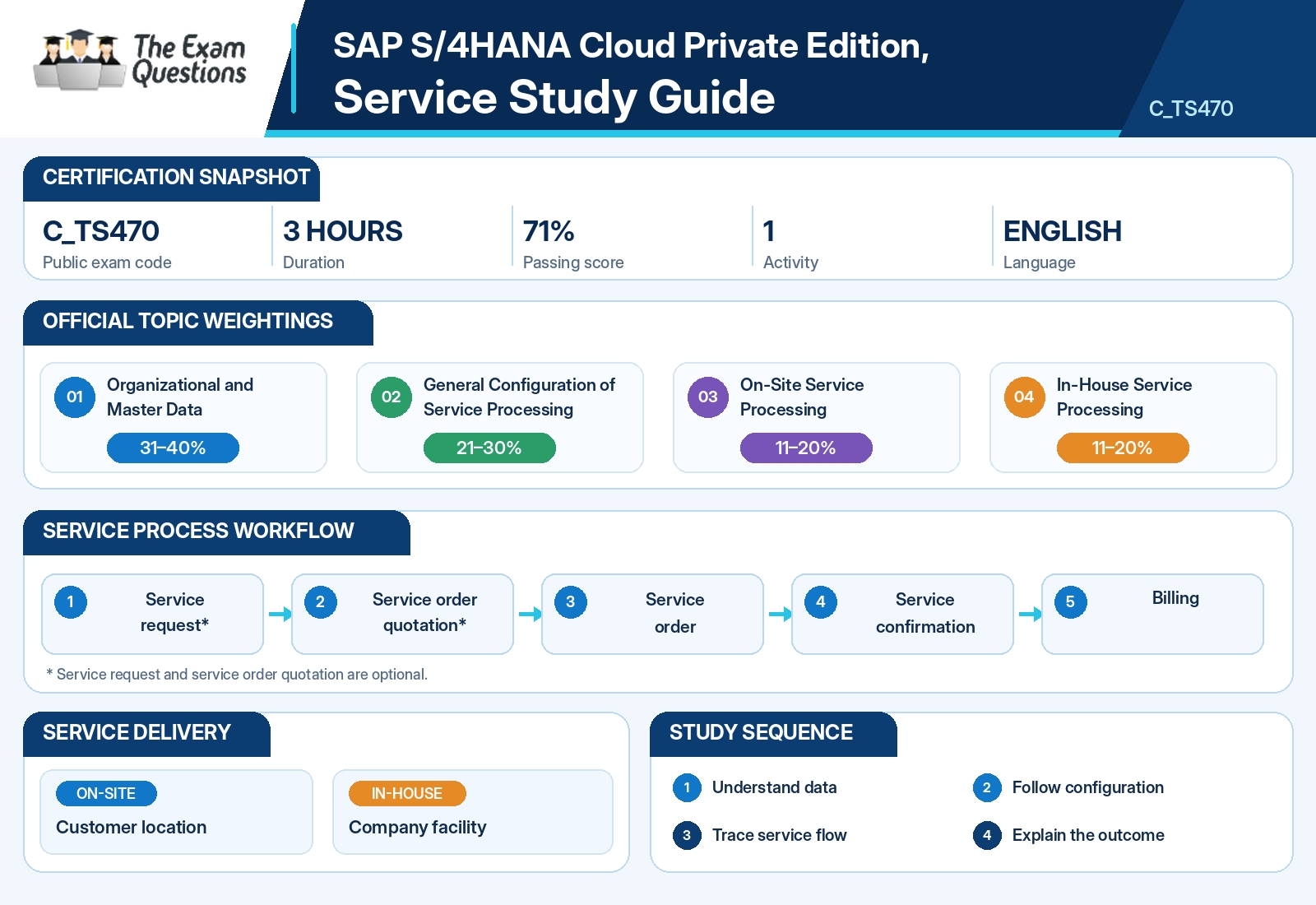
SAP's current listing shows the code C_TS470 with these assessment details:
Certification: SAP Certified - SAP S/4HANA Cloud Private Edition, Service
Assessment type: system-based assessment
Duration: 3 hours
Passing score: 71%
Number of activities: 1
Language: English
SAP also publishes four knowledge areas with percentage ranges:
Organizational and Master Data: 31 to 40%
General Configuration of Service Processing: 21 to 30%
On-Site Service Processing: 11 to 20%
In-House Service Processing: 11 to 20%
Use the ranges to divide revision time. Organizational and master data carries the largest range, and the other three areas count as well. The public page shows the base code, so confirm the exact version in your SAP account before booking, and treat version-specific codes in older material as pointers to check. The official SAP certification page lists the latest requirements.
Understand the service business before the SAP terms
Consider a fictional company called Northstar Equipment. It sells industrial machines and provides maintenance and repair services. One customer reports that a machine is working incorrectly, and Northstar identifies the equipment, understands the requirement, and decides how to deliver the service.
Two situations are possible. A technician can visit the customer's location, or the customer can send the equipment to Northstar's facility for inspection or repair. Both involve service processing, and each has its own operational needs. Whenever a new SAP concept appears, ask where it fits in Northstar's operation. That question makes the need for particular data, transactions, and settings clear.
Study map 1: organizational and master data
Official weighting: 31 to 40%.
This area is the foundation. Before Northstar can process the requirement, it needs the right organizational information and details about the equipment. Five study areas make up the topic:
Organizational data: how organizational structures support service responsibilities and how elements are assigned.
Master data for organizational elements: which information service operations need and how business transactions use it.
Products and product bundles: how product information represents the items involved in service activities.
Technical assets: how equipment and other serviceable objects are represented.
Measuring points and counters: how measurement information supports equipment monitoring and maintenance needs.
SAP covers these in its course Configuring Organizational and Master Data in SAP S/4HANA Service.
Checkpoint: explain which organizational information supports service operations, how product data relates to service transactions, why technical assets matter when equipment needs service, and what measuring points and counters represent. Try each explanation without your notes, since recognizing a term falls short of explaining it.
Study map 2: general configuration of service processing
Official weighting: 21 to 30%.
Configuration determines how service processing works in SAP. For Northstar, it must support how the team handles customer requests, plans work, and records completed activities. The main concepts are:
Service processing steps: the stages for handling service requirements.
Service quotations: how a quotation fits when work is proposed before it proceeds.
Service orders: how service activities are organized and managed.
Service confirmations: how completed work is recorded.
Service contracts: how ongoing agreements are supported.
Integration and user interface configuration: how service connects with other business areas and how settings shape the user experience.
The key distinction lies between knowing what a transaction is and understanding how it works in the process. A service order, for example, earns its place through the information it carries, the reasons the team needs it, and the work it supports. SAP's course Performing Basic Customizing for Service covers general configuration, on-site service, in-house service, and service contracts.
Checkpoint: choose one service requirement, explain how a quotation, order, and confirmation may be used, and name the configuration concepts that support the process.
Study map 3: on-site service processing
Official weighting: 11 to 20%.
On-site service takes place at the customer's location, for inspections, maintenance, or fixes without moving the equipment. At Northstar, the customer wants a technician to visit. SAP describes a typical flow of service request, service order quotation, service order, service confirmation, and billing. The request and quotation are optional, depending on the business process.
Each step has a purpose. The request records the customer's requirement, the quotation proposes the work and related commercial details, the order organizes the activity, the confirmation records what was done, and billing supports financial settlement. Think about the information that moves through these stages: which customer and equipment are involved, what work is planned, and what was completed. SAP's lesson Executing a Service Management Process explains the typical steps.
Checkpoint: describe the process from the customer's first requirement to billing, name the optional steps, and identify which activities record the completed service.
Study map 4: in-house service processing
Official weighting: 11 to 20%.
In-house service covers work at the company's own facility, such as a workshop or repair center. Back at Northstar, the customer sends the defective machine to the facility. The learning focus shifts to how the company manages the service object at its own location, organizes the repair, and handles the related transactions.
Pay attention to the difference between on-site and in-house requirements, how the service object is handled, how quotations and orders support the work, how logistics relate to moving equipment, and how completed activities are recorded. In-house service differs from an on-site process at another address, since the location and handling of the equipment shape the operational process.
Checkpoint: explain when a company would choose in-house over on-site service, and which parts of the process need extra care when equipment is handled at the company's facility.
Connect the four topics in one scenario
The four areas fit together in one flow. The company receives a service need and identifies the requirement and the equipment, which draws on organizational and master data. It then prepares the process with the right service transactions and settings, which is general configuration. Next it selects a method, working at the customer site or at its own facility, which is on-site or in-house service. It records the completed work, and it reviews related logistics, controlling, and service information.
Treat this as a learning frame, and rely on SAP's detailed process instructions for specifics. SAP's course path also covers Interaction Center, Service Order Management, Advanced Execution, service contracts, recurring services, and analytics, which add context to the wider solution.
Build your own revision sheet
A revision sheet shows what you understand and what needs work. For every topic, record six fields: the concept, its purpose, the information it requires, its connection to the steps before and after it, a practical example from the Northstar scenario, and any knowledge gap. A note on technical assets, for instance, can explain how equipment information supports service activities, which related data needs maintaining, and where the asset appears in a scenario.
Keep notes short enough to review quickly. The aim is explaining concepts in your own words, and copying course chapters adds little.
Official SAP course material
SAP's course path, Implementing SAP S/4HANA Cloud, Private Edition for Service, is the recommended starting point. It covers the main functional areas of SAP Service for business users and implementation consultants, and SAP lists open prerequisites for beginning it. Four courses build your knowledge:
Discovering SAP S/4HANA Service introduces the main service solutions, organizational structures, and business processes.
Identifying Business Processes in SAP S/4HANA Service covers service order management, advanced execution, in-house service, service contracts, recurring services, and analytics.
Configuring Organizational and Master Data in SAP S/4HANA Service focuses on organizational data, products, technical assets, measuring points, and counters.
Performing Basic Customizing for Service covers configuration of service processing, on-site service, in-house service, and service contracts.
Follow the prerequisites on SAP's course pages, where the business process course comes before the two intermediate configuration courses. Use the practice system and exercises where available, since working through examples shows whether you can link concepts to real SAP activities.
Frequently asked questions
Which topic deserves the most study time?
Organizational and master data has the largest official weighting range, at 31 to 40%. Give it extra revision time while covering every other topic.
What should I understand about service orders?
Focus on their purpose in organizing service work, the information they hold, and their relationship with quotations, confirmations, and later activities.
How are the two service-processing methods different?
On-site service happens at the customer's location, and in-house service happens at the company's facility. Study how location and equipment handling shape each process.
Can I begin without previous project experience?
Yes. SAP lists open prerequisites for the main course path, and project experience is optional for the assessment.
Where should I check for updated assessment information?
SAP's official certification page and its linked course path. Check them again before booking, since certification information can change.
Conclusion
A strong grasp of SAP S/4HANA Service comes from connecting business requirements with the data, configuration, and processes that support them.
Study organizational and master data first, then move through general configuration, on-site service, and in-house service. Use the Northstar example to link the concepts, and keep a revision sheet that shows what is solid and what needs another look. For more SAP certification guides, visit The Exam Questions.