
Quick Summary
This SAP SuccessFactors Variable Pay Exam Guide explains the key concepts, configuration areas, and business processes behind the C_THR87_2605 certification. It covers exam topics, bonus calculation methods, employee data requirements, and preparation techniques.
Introduction: Understanding SAP SuccessFactors Variable Pay
Employee compensation often extends beyond a fixed monthly salary. Many organizations run incentive programs that reward individual achievements, team performance, and overall business results. SAP SuccessFactors Variable Pay manages these short term incentives through structured configuration and calculation processes.
Imagine a company that offers an annual bonus based on revenue targets, department performance, and individual achievements. Its compensation team needs a system that manages eligibility, bonus plans, performance information, and final payouts. This SAP SuccessFactors Variable Pay Exam Guide covers the technical and functional concepts behind that process, and the C_THR87_2605 certification targets the configuration and administration knowledge the module requires.
What SAP SuccessFactors Variable Pay does
Variable Pay standardizes the calculation of short term employee incentives. Bonus amounts shift with predefined company metrics and performance results, while regular salary stays fixed. The module supports these connected activities: establishing incentive programs, defining eligibility, creating and assigning bonus plans, managing business goals and weights, calculating bonuses, reviewing compensation through manager forms, and generating reports and reward statements.
These functions depend on each other. Employee information influences eligibility, plan assignments determine the applicable incentives, and configured rules shape the final payout. Studying the relationships works better than studying each feature alone.
Major technical areas
The SAP SuccessFactors Variable Pay Academy has seven units, and they give a useful structure for the main technical areas.
Introduction and customer analysis
Every implementation starts with business requirements. A consultant identifies how the organization calculates incentives, which employees participate, and which performance measures drive payments. A company with separate bonus arrangements for sales employees and department managers needs those differences settled before configuration begins.
Program setup and employee data
Program configuration sets the structure of a compensation cycle. Study program properties, employee history data, background elements, employee records, and data imports. Changes in employment status, job position, or salary affect calculations, and an employee who joins midway through a period may receive a prorated incentive under the program rules.
Bonus plans and form management
Bonus plans define the incentive arrangements, and organizations may create several plans by employee category or policy. Forms help managers review and approve compensation. Study plan assignments, target incentives, worksheet configuration, field visibility, manager review, and reward statements.
Advanced features and calculations
Advanced configuration covers custom formulas, calculation methods, business goal weights, guidelines, budgets, bonus caps, and proration. A bonus might depend on three objectives with different weights, and the calculation method decides how each result contributes to the payment. Changing one input shifts the overall payout, so understand the logic behind each calculation.
Employee Central integration
Employee Central supplies employee and employment information for Variable Pay administration. Study how employee records, job details, and employment changes connect with the compensation process. When an employee transfers departments during a bonus period, review the employee history and bonus plan assignment before checking the payout.
Total Compensation Plan Template
The template presents several compensation components together, such as fixed pay and variable incentive amounts. Understand its purpose and how Variable Pay configuration fits into the wider compensation view.
Consultant skills
The final unit applies technical knowledge to consulting situations. A consultant interprets customer requirements, selects suitable configuration options, investigates unexpected results, validates the implementation, and explains technical decisions clearly.
A practical example: how a bonus program works
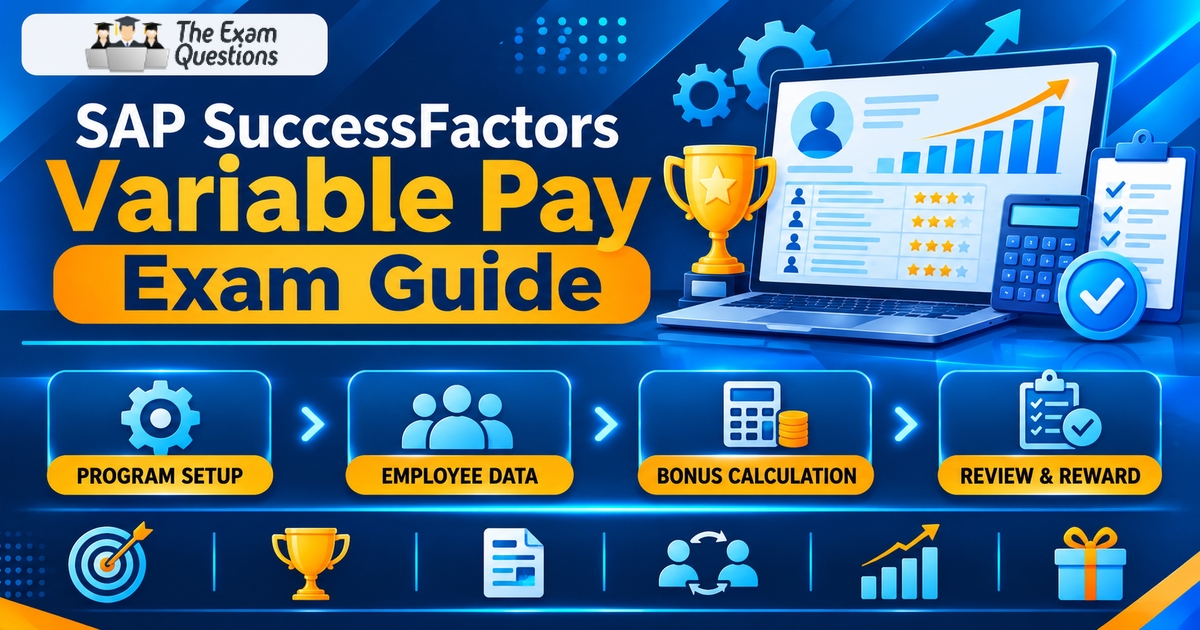
Consider a fictional company, Apex Technologies, that introduces an annual incentive program based on business performance and individual achievements. The implementation follows these steps:
Define the program: the compensation team identifies eligible employees, bonus targets, performance objectives, and program dates.
Prepare employee information: records and history are reviewed so the correct people participate.
Configure bonus plans: suitable incentive arrangements go to the relevant employee groups.
Establish calculation rules: business goals, weights, individual ratings, and formulas are set.
Review compensation: managers examine calculated amounts through Variable Pay forms.
Complete the process: administrators validate results and generate reward statements.
This sequence shows why program configuration, employee data, and calculation logic work as one system.
How to prepare for C_THR87_2605
Open the SAP official certification page to confirm the current exam version and details. Then start with the purpose of Variable Pay and how incentive compensation differs from regular salary. Move to program setup, employee history, and bonus plan assignments, which form the foundation for later topics. Spend extra time on calculation methods, custom formulas, goal weights, and proration, and work through hypothetical situations where employee information or performance results change.
Finish with Employee Central integration, the Total Compensation Plan Template, and consultant skills. The online THR87 Academy lists THR80 (SAP SuccessFactors Platform Introduction Academy) as a prerequisite, and the instructor led course adds THR86 (SAP SuccessFactors Compensation Academy). Check each course page before registering.
Common mistakes to avoid
Checking employee history data late, even though it affects calculations.
Mixing up bonus plan assignments with employee eligibility.
Memorizing formulas instead of understanding their inputs.
Skipping form configuration and Employee Central integration.
Assuming every organization uses the same calculation method.
Using outdated exam information instead of SAP's current certification page.
Frequently asked questions
What is the C_THR87_2605 certification?
It is the version specific certification code for SAP SuccessFactors Variable Pay, focused on configuring and managing short term incentive compensation.
What are the main topics in the exam?
Customer analysis, program setup, employee data, bonus plans, form management, advanced features, Employee Central integration, Total Compensation Plan Templates, and consultant skills.
Is practical configuration knowledge important?
Yes. Understanding how program settings, employee records, bonus assignments, and calculation rules work together helps apply technical concepts to business situations.
How does Variable Pay differ from regular compensation?
Variable Pay covers short term incentives that depend on performance and predefined business metrics, while regular salary follows fixed amounts through separate compensation functionality.
Final thoughts
The certification covers more than bonus calculations. It connects business requirements, employee records, incentive structures, program settings, and performance results. Linking each technical concept to a realistic compensation scenario makes complex configuration topics easier to interpret.
Practise for the C_THR87_2605 exam
Review the core configuration areas, rehearse business scenarios, and note the concepts that need more attention. Visit The Exam Questions for C_THR87 practice questions that test your grasp of SAP SuccessFactors Variable Pay.