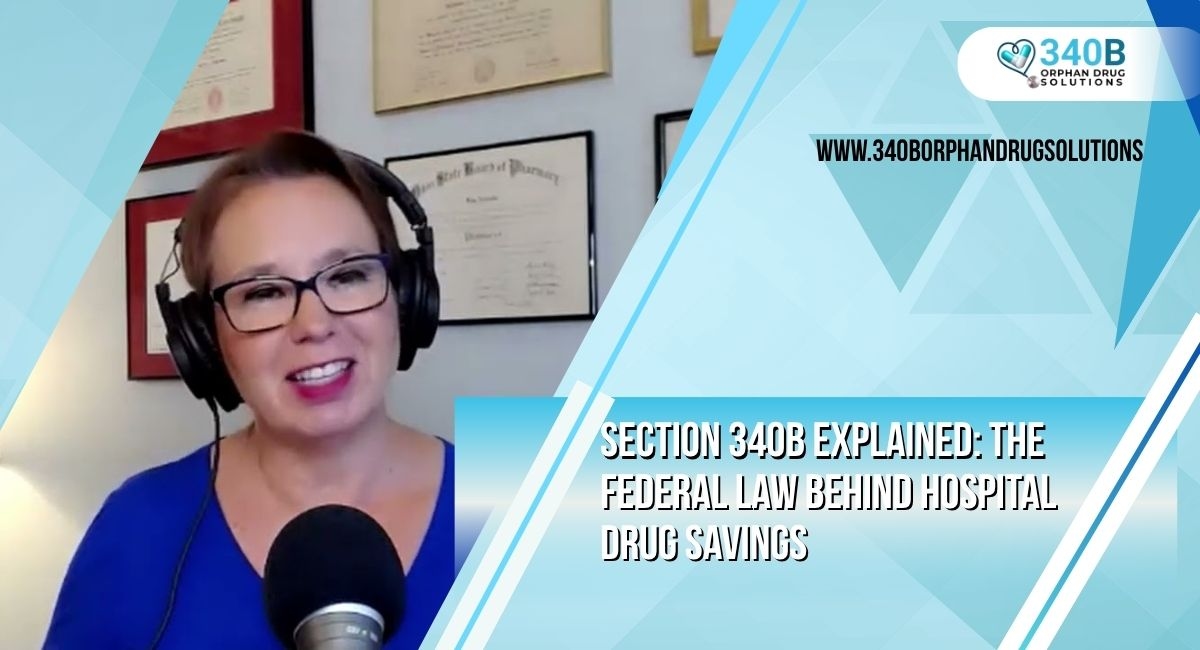
Most hospital staff use the phrase Section 340B every day without ever reading the actual law behind it.
Section 340B of the Public Health Service Act (PHSA) shapes how billions of dollars in drug pricing move through the American healthcare system every year. Thus, understanding the 340B Drug Pricing Program is essential to increase savings for your hospital.
What Section 340B Requires
Section 340B was enacted through the Veterans Health Care Act of 1992. This is according to the Congressional Research Service. The law ties two federal programs together in a specific way.
As per the section, drug manufacturers that seek coverage for their outpatient drugs in Medicaid and Medicare Part B need to enter into a Pharmaceutical Pricing Agreement. This agreement binds them to sell covered outpatient drugs at or below the statutory ceiling price to eligible providers.
To put it simply, involvement in the Medicaid program is accompanied by a certain condition. This implies that the manufacturers agree to sell their products at reduced prices to a selected group of safety net providers in return for being allowed into the market.
Section 340B Compliance Requirements
Participation in the Section 340B program carries with it certain responsibilities, and HRSA is vigilant about enforcing them. Some of the key 340B compliance requirements include:
Registering and annually recertifying eligibility
Avoiding the diversion of 340B drugs to ineligible patients
Ensuring that no duplicate discount is received through the 340B Drug Pricing Program and Medicaid Rebate Program
Complying with group purchasing organization restrictions where applicable
Keeping track of all 340B drug acquisition and dispensation with auditable documentation
Non-compliant hospitals may have repayment liabilities to drug manufacturers or be removed from the program altogether, thus making regular internal audits a requirement.
Section 340B Covered Entities
Eligibility for the Section 340B program is confined to certain groups of providers specified explicitly within the law. 340B covered entities include
Disproportionate share hospitals
Children's hospitals
Critical access hospitals
Sole community hospitals
Rural referral centers
Free-standing cancer hospitals
Federally qualified health centers and certain other federal grantees
Expansion within this group has been substantial. The Government Accountability Office (GAO) found that registered 340B covered entities more than doubled between January 2013 and January 2023. The registered entities rose from 20,183 to 55,339, with hospital sites climbing from 7,806 to 33,532 over the same period.
Section 340B Ceiling Price Calculation
According to the 340B Drug Pricing Program, the 340B ceiling price follows a formula tied to two other federal pricing figures. The formula is based on:
Average Manufacturer Price (AMP): It is the average price wholesalers pay manufacturers for a drug.
Unit Rebate Amount (URA): This refers to the rebate manufacturers already owe to hospitals under Medicaid.
340B ceiling price is usually based on AMP minus URA. For example, when the Medicaid rebate of any particular drug is high, the 340B ceiling price could end up being very high too. This can go as much as a penny per unit.
This is another reason why 340B drug savings can be quite variable across drugs and quarters. The ceiling price follows Medicaid pricing data rather than the negotiation capabilities of the hospital in question.
It is important to recognize this, as it will influence the way in which hospitals approach the forecasting of 340B drug savings. If a drug had a high Medicaid rebate one quarter, it will most likely move the next, meaning that any savings forecasted for a particular drug and never updated will become inaccurate.
What Section 340B Does Not Say
There is a misconception about Section 340B on one point only. The point of contention is that the statute does not restrict how covered entities must spend their 340B hospital savings.
There is no federal mandate to dedicate cost savings to a particular service line or to monitor expenditure by drug. Covered entities have much freedom when using margins created due to 340B pricing because this is a part of why this program has turned into an important way to expand access to care for underserved communities.
That flexibility, combined with growing drug costs, is a major reason 340B hospital savings now represent a meaningful share of total pharmacy budgets at many eligible hospitals.
Why Section 340B Still Matters in a Changing Landscape
The core statute has not changed much since 1992, but the environment around it has. Drug costs have grown, the list of eligible entities has expanded, and HRSA continues to refine how it enforces existing rules.
Hospitals that treat Section 340B purely as a purchasing mechanism often miss opportunities the statute actually allows for, particularly around lesser-known provisions like the treatment of orphan-designated drugs for certain hospital types.
Understanding the statute itself, not just the day-to-day purchasing process, is what separates hospitals that capture full program value from those leaving savings on the table.
Frequently Asked Questions
Q1. Does 340B program require hospitals to spend savings on charity care specifically?
Ans: No. There is no mention in the statute that the 340B covered entities have to compulsorily use the 340B hospital savings for any particular type of care.
Q2. What is the difference between Section 340B and the 340B Drug Pricing Program?
Ans: While Section 340B is a law made under the Public Health Service Act, the 340B Drug Pricing Program is a system built by HRSA to implement the law.
Q3. How often does the 340B ceiling price change?
Ans: The ceiling price is recalculated quarterly, since it depends on Average Manufacturer Price and Unit Rebate Amount figures that are themselves updated every quarter.
Put Section 340B to Work for Your Hospital
Section 340B was written to help safety net hospitals stretch limited resources further, but capturing its full value takes more than basic registration.
340B Orphan Drug Solutions helps hospitals understand exactly what the statute allows, close compliance gaps, and capture savings that often go unclaimed.
Contact 340B Orphan Drug Solutions today to see how your hospital's 340B drug pricing program measures up.