Introduction
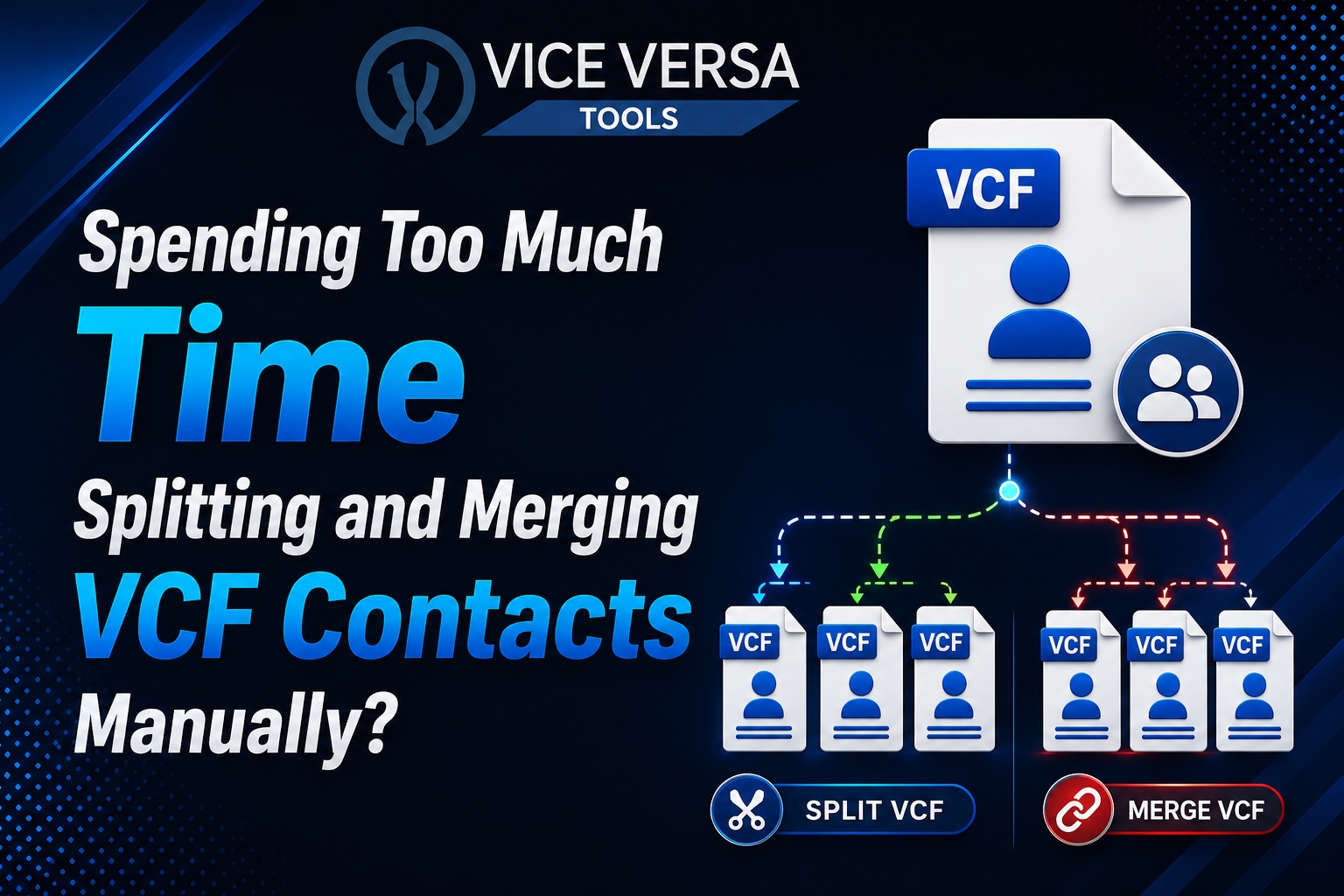
Managing digital contacts should make communication easier, but it often turns into a time-consuming chore for many users. After exporting data from Outlook, Gmail, Android phones, iPhones, iCloud, and other email applications, people usually have hundreds or thousands of contacts in VCF (vCard) files. Initially, it appears convenient to have everything in one place. But you run into problems when you want to separate, merge, or share contacts for different purposes. Many users still use manual methods for splitting or ViceVersa Split and merge VCard software. Such methods may work for a few contacts, but managing large contact databases manually requires a lot of time and increases the probability of errors. If you are an individual user managing personal contacts or a business managing customer data, hours of repetitive contact management reduce productivity.
In this case study, we will go over the reasons for this problem, the difficulties users are facing, its impact on everyday work, and some practical ways to better manage VCF files.
The Problem of the User
A growing marketing agency kept contact lists of customers, employees, and vendors in separate VCF files. Over time many team members have created multiple backups so there are hundreds of VCF files in different folders. Whenever there was a new employee in the company, the administration team had to combine all these contact files into one master list. Likewise, if the sales department only needed contacts from the clients, someone had to manually take the combined VCF file and split it into smaller files. At first this process appeared to be manageable. But as the number of contacts grew, employees began spending several hours each week organizing contact files. Some contacts were duplicated, some were deleted accidentally, and some were placed in the wrong file.
Valuable working hours were spent managing contact files instead of communicating with customers.
What is causing this problem?
There are plenty of reasons why users end up splitting and merging VCF files manually.
Contacts are collected from various sources.
Contacts are imported from Outlook, Gmail, Android phones, iPhones, CRM systems, and cloud services. Each export will create a separate VCF file.
Business Data Continues to Grow
As companies grow, so does the number of customers, vendors, and employees. All this work is becoming increasingly difficult to do manually.
Different Teams Require Different Contact Lists
Sales, HR, finance, and support departments most often need separate contact databases rather than a single combined file.
Regular Data Backup
If you do this task regularly, you will have lots of VCF files over time, and it will be harder to organize them later.
Contact Misorganization
If you do not have a system, your contacts are everywhere in different files, and it becomes confusing when you try to migrate or import them later.
Common Problems Users Face
Manual contact management causes a range of common problems.
It takes a long time to split a big VCF file into smaller files.
The process of merging multiple contact files involves a lot of repetitive manual work.
Duplicate contacts are difficult to identify.
It’s really frustrating to try and find certain contacts.
Contact files may become unsorted.
Repeating this process every month will lower overall productivity.
For businesses that have thousands of customer records, even minor errors can impact communication and workflow.
What are the dangers of manual split and merge?
There are some manual methods, but they have many limitations.
Unintentional data loss
Editing VCF files manually can remove important contact information if you change the formatting incorrectly.
Duplicate Contacts
When you merge multiple files manually, you often end up with duplicate entries, which you then have to clean up.
Formatting Mistakes
A small mistake while editing can even influence the structure of the VCF file, and it becomes difficult to import the VCF file into another application.
Duration
Dealing with hundreds of contact files manually can consume several hours of your week.
Decreased Productivity
Employees spend more time sorting contacts than doing what they are responsible for.
Practical tips for reducing manual effort
Before choosing any method, users should first decide the size of their contact database.
If you only have a few contacts to manage occasionally, manual methods might be sufficient. Users can import contacts in a contact application, sort them out carefully, and then export the files they need. But with hundreds or thousands of contacts, repeating the same manual tasks becomes impractical. In this case, many users prefer to use a dedicated VCF split and merge utility to simplify repetitive tasks and keep contacts organized.
The goal is not only to save time but also to cut human errors and keep contact records accurate.
Benefits of improved contact management
Well-organized VCF files have several long-term advantages.
Time Saver
No more hours spent over and over again splitting or merging contact files.
Improved organisation
It’s easier to locate customers, employees, vendors, or personal contacts when you have separate contact files.
Better Data Accuracy
There is less need for manual editing; therefore, there are fewer formatting errors and omissions.
Easier sharing of contacts
Instead of sharing the whole contact database, users can share only necessary contact files.
Increased Productivity
Employees can focus on business rather than repetitive file handling.
What if this problem goes unaddressed?
The disregard of manual contact management can lead to several practical issues.
Workers are still losing precious working hours.
The contact databases are getting harder and harder to keep up.
Over time, contact duplication occurs.
Import and export operations become more complicated.
Outdated or misplaced contact information may impact customer communications.
Messy contact records make it difficult to support business growth.
Small problems today become much bigger as the number of contacts continues to grow.
Conclusion
Manually splitting and merging VCF contacts may appear to be an uncomplicated task at first, but it becomes increasingly more and more difficult as contact databases grow. Repetitive editing, duplicate records, formatting errors, and wasted time can all negatively impact personal productivity and business operations. To choose a more organized approach, examine now the reasons for these problems. From personal contacts to business databases, well-structured VCF files can help reduce confusion, increase efficiency, and protect important contact data.
The aim is not just to split or merge files but to make contact management easier, more accurate, and less time-consuming in the long run.
Frequently Asked Questions
1. Why does manually splitting and merging VCF files take so much time?
The process requires users to edit, organize, and verify contacts manually one by one. This is difficult when there are large contact databases.
2. Is it safe to manually edit a VCF file?
Yes. Some contacts may not import correctly into other applications or may be unreadable due to incorrect formatting or accidental deletion during editing.
3. When to split a large VCF file?
Splitting is useful when different departments, devices, or users need their contact lists, or when large VCF files are difficult to manage.
4. Why duplicate contacts after merging VCF files?
Duplicates often result from the same contact existing in more than one VCF file before the files are merged.