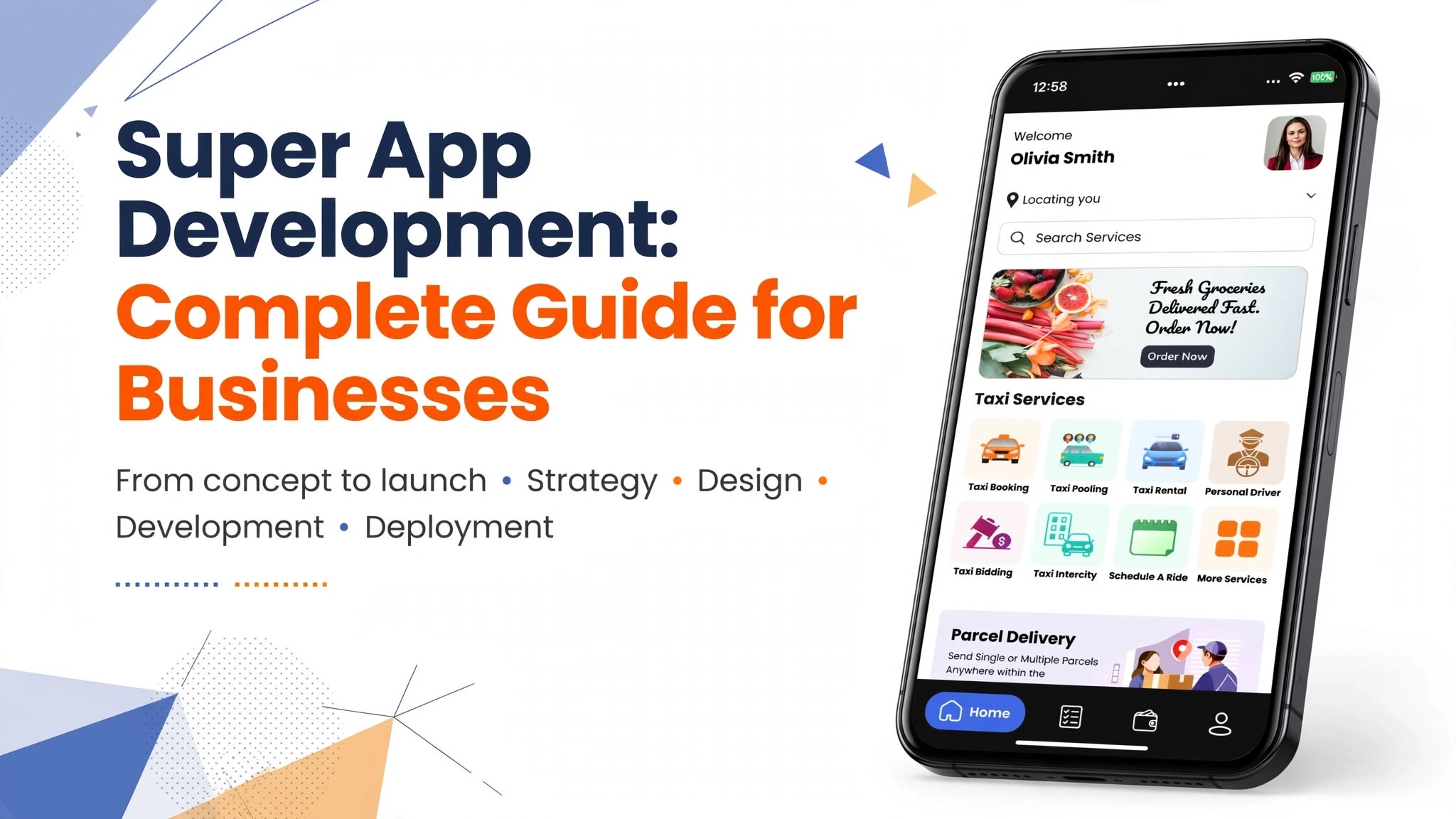
The way people use mobile applications is changing rapidly. Instead of installing separate apps for transportation, food delivery, grocery shopping, payments, home services, and other everyday needs, many users prefer platforms that bring multiple services together.
This is where Super App Development comes into the picture.
A super app combines several services within one digital ecosystem. Users can access different products and services from a single application, while businesses can create multiple revenue streams and build stronger relationships with customers.
For startups, entrepreneurs, and established businesses, developing a super app can provide an opportunity to create a centralized platform that serves multiple customer needs. However, building a successful super app requires more than combining several services into one application. It requires careful planning, scalable technology, a convenient user experience, secure payments, and an effective business model.
This guide explains the key aspects of super app development, including features, development stages, costs, revenue models, benefits, and frequently asked questions.
What Is a Super App?
A super app is a mobile platform that provides access to multiple services through a single application.
Instead of requiring users to download separate applications, a super app can bring different services together under one account.
Depending on the target market, a super app may include services such as:
Taxi and ride booking
Food delivery
Grocery delivery
Courier and parcel delivery
E-commerce
Beauty services
Home services
Doctor appointments
Event booking
Travel services
Digital payments
Financial services
The exact combination depends on the business model and the needs of the target audience.
For example, a company could initially launch with taxi booking and food delivery and later introduce grocery delivery, courier services, and home services.
Why Are Businesses Investing in Super App Development?
Consumers increasingly value convenience. Managing multiple applications can require separate registrations, payment methods, passwords, and interfaces.
A super app can simplify this experience by allowing users to access several services from one platform.
For businesses, the model provides additional opportunities to engage existing customers.
For example, someone who initially downloads an application to book a taxi may later use the same platform to order food or book a home service.
This creates opportunities for cross-selling, customer retention, and multiple revenue streams.
Key Features of a Super App
A successful super app needs a combination of customer-facing features, service-provider functionality, and administrative tools.
1. User Registration and Login
Users should be able to create accounts quickly using options such as:
Mobile number
Email address
Social login
OTP verification
A unified account allows users to access multiple services without creating separate accounts for each service.
2. Multi-Service Dashboard
The home screen should clearly display the available services.
For example:
Transportation
Taxi booking
Bike booking
Car rental
Delivery
Food delivery
Grocery delivery
Courier delivery
Services
Home cleaning
Beauty services
Repair services
A well-organized dashboard helps users discover services without making the application confusing.
3. Search and Location Services
Location-based functionality is essential for many super app services.
Users may need to:
Select pickup locations
Enter delivery addresses
Find nearby stores
Locate service providers
Track orders
View available transportation
Integration with mapping and geolocation services can support these functions.
4. Multiple Payment Options
A super app should provide convenient and secure payment options.
Depending on the target market, businesses may support:
Credit cards
Debit cards
Digital wallets
Online payment gateways
Cash payments
In-app wallet balances
A unified payment experience can make transactions easier across different services.
5. Real-Time Tracking
Real-time tracking is particularly important for transportation and delivery services.
Customers can potentially track:
Drivers
Delivery partners
Orders
Service providers
Tracking can improve transparency and help users understand the status of their requests.
6. Ratings and Reviews
Ratings and reviews allow customers to provide feedback about drivers, restaurants, stores, and service providers.
Businesses can use this information to monitor service quality and identify recurring problems.
7. Notifications
Push notifications can keep users informed about:
Booking confirmations
Order updates
Driver arrival
Promotions
Payment status
Delivery status
New services
Notifications should be relevant and appropriately managed to avoid overwhelming users.
8. Loyalty and Promotional Programs
Businesses can encourage repeat usage through:
Coupons
Discount codes
Loyalty points
Referral programs
Membership plans
Personalized offers
These features can be configured across individual services or the entire platform.
Admin Panel for Super Apps
The admin panel is the central management system behind the super app.
Administrators may need to manage:
Customers
Drivers
Delivery partners
Restaurants
Stores
Service providers
Bookings
Orders
Payments
Promotions
Commissions
Reports
Complaints
Content
A multi-service platform requires flexible administration because different services may have different operational rules.
For example, a taxi driver may receive ride requests, while a restaurant receives food orders and a home-service professional receives service bookings.
The admin system should allow each business vertical to be managed independently while maintaining centralized platform control.
Service Provider Features
A super app often requires different interfaces for different service providers.
For example, a transportation provider may need:
Availability management
Ride requests
Navigation
Earnings
Trip history
A restaurant may need:
Menu management
Order management
Preparation status
Delivery coordination
Revenue reports
A home-service provider may need:
Service catalog
Booking management
Availability scheduling
Customer details
Earnings information
Therefore, the provider-side architecture should be flexible enough to accommodate different service categories.
How to Build a Super App
Super app development usually involves several stages.
Step 1: Define the Business Concept
Start by identifying the problem your super app will solve.
Determine:
Target audience
Target location
Initial services
Competitors
Pricing strategy
Revenue model
Expansion plan
Launching with too many services at once can increase complexity. Many businesses may prefer starting with a smaller number of high-demand services and expanding gradually.
Step 2: Select the Core Services
Choose the services that will form the foundation of the application.
For example, a business could begin with:
Taxi booking
Food delivery
Grocery delivery
Later, it could add courier delivery, home services, shopping, and other categories.
The initial service selection should be based on customer demand and operational capabilities.
Step 3: Design the User Experience
The interface should make multiple services easy to discover and use.
Important UX considerations include:
Simple navigation
Clear service categories
Fast booking
Easy checkout
Consistent design
Accessible account management
Personalized recommendations
The challenge is to provide many services without making the application complicated.
Step 4: Develop the Platform
Development can include:
Customer application
Provider applications
Admin panel
Backend infrastructure
APIs
Payment integration
Location services
Notification systems
Analytics
Businesses can choose between custom development and a ready-made or white-label super app solution.
Step 5: Integrate Third-Party Services
Super apps often require integrations with external services.
Potential integrations include:
Payment gateways
Maps
SMS providers
Email services
Push notification platforms
Analytics tools
Customer support systems
The integrations required depend on the services offered by the platform.
Step 6: Test the Application
Testing should cover both individual services and the complete platform.
Important testing areas include:
Registration
Login
Booking
Ordering
Payments
Notifications
GPS tracking
Provider workflows
Admin functionality
Security
Application performance
Testing should also cover different devices, operating systems, network conditions, and user scenarios.
Step 7: Launch and Monitor
After testing, the application can be deployed to the relevant app stores and infrastructure.
After launch, businesses should monitor:
Downloads
Registrations
Active users
Service bookings
Order volume
Conversion rates
Customer retention
Revenue
Cancellations
Customer complaints
These metrics can help identify which services are performing well and where improvements are needed.
Super App Development Cost
The cost of super app development varies significantly depending on the application's complexity.
Factors affecting the cost include:
Number of services
Number of applications
Design requirements
Custom features
Payment integrations
Map integrations
Backend architecture
Third-party APIs
Security requirements
Development team
Testing
Cloud infrastructure
Maintenance and upgrades
A basic multi-service platform will generally require fewer resources than a large ecosystem containing transportation, delivery, e-commerce, financial services, and other verticals.
Businesses should therefore define their minimum viable product before estimating the total development budget.
Super App Revenue Models
A super app can generate revenue through several models.
Commission
The platform can charge service providers a percentage of each completed transaction.
This model can be used for transportation, food delivery, home services, and other transactional categories.
Delivery Fees
Delivery services can generate revenue through customer delivery charges.
Booking Fees
Businesses can apply booking or convenience fees to selected services.
Subscription Plans
A membership program can provide users with benefits such as discounts, free deliveries, or premium services in exchange for a recurring fee.
Advertising
Restaurants, stores, and service providers may pay to promote their businesses within the platform.
Featured Listings
Businesses can pay for greater visibility in search results or service categories.
A super app can combine several revenue models depending on its target audience and service structure.
Benefits of Super App Development
One Platform for Multiple Services
Customers can access several services through a single application.
Multiple Revenue Streams
Businesses are not dependent on one service category.
Cross-Selling Opportunities
Customers using one service can discover other services available on the platform.
Stronger Customer Engagement
Frequent interactions across different services can increase platform engagement.
Centralized Account
Users can maintain one profile, wallet, and account across multiple services.
Scalable Business Model
Businesses can gradually introduce new services as their customer base grows.
Challenges of Building a Super App
Super app development also presents several challenges.
Technical Complexity
Supporting multiple service categories requires a flexible and scalable architecture.
User Experience
Adding more services can make navigation complicated if the interface is not carefully designed.
Operational Management
Different services have different providers, workflows, pricing structures, and support requirements.
Data Security
A platform managing customer accounts and transactions needs strong security practices.
Service Quality
A poor experience in one service can influence how customers perceive the overall platform.
Scalability
The infrastructure needs to handle increasing users, transactions, providers, and data.
Businesses should address these challenges during the planning and architecture stages rather than waiting until after launch.
Ready-Made vs Custom Super App Development
Businesses generally have two broad approaches.
Custom Development
A custom super app is developed specifically according to the company's requirements.
It can provide extensive flexibility but may require more development time, resources, and ongoing technical investment.
Ready-Made Super App
A ready-made solution provides pre-developed functionality that can be customized for the business.
This approach can reduce the initial development effort and allow businesses to focus more on branding, operations, marketing, and market expansion.
The appropriate approach depends on the company's budget, timeline, required functionality, customization needs, and long-term technology strategy.
Future of Super App Development
Super apps are continuing to evolve as businesses look for ways to combine digital services into unified ecosystems.
Future super app development may increasingly focus on:
AI-powered personalization
Voice-based interactions
Automated customer support
Digital wallets
Predictive recommendations
Smarter search
Personalized promotions
Advanced analytics
Automation
Connected service ecosystems
AI can help businesses analyze customer behavior and automate selected processes, but successful super apps will still depend on reliable core services and a simple user experience.
Conclusion
Super App Development offers businesses an opportunity to bring multiple services together within one digital platform.
From transportation and food delivery to grocery shopping, courier services, home services, and payments, a super app can create a connected ecosystem that serves different customer needs.
However, building a successful super app requires careful planning. Businesses need to define their target market, select the right initial services, create a simple user experience, develop scalable technology, integrate secure payment solutions, and establish an effective revenue model.
Whether a company chooses custom development or a ready-made solution, the focus should remain on solving real customer problems and creating a platform that can expand as demand grows.
Frequently Asked Questions
1. What is super app development?
Super app development is the process of creating a mobile platform that combines multiple services, such as transportation, food delivery, grocery delivery, shopping, and home services, within one application.
2. What services can be included in a super app?
A super app can include taxi booking, food delivery, grocery delivery, courier services, e-commerce, home services, travel, healthcare, payments, and many other service categories.
3. How much does super app development cost?
The cost depends on the number of services, features, applications, integrations, customization, technology stack, and development requirements. A clearly defined MVP can help businesses estimate the initial investment more accurately.
4. How long does it take to develop a super app?
The development timeline depends on the application's scope and complexity. A platform with a few core services will generally require less development effort than an ecosystem containing many independent service categories.
5. Can I launch a super app with multiple services?
Yes. A super app can combine multiple services under one application. Businesses can also start with a smaller number of services and add additional categories over time.
6. What are the main components of a super app?
A typical super app can include a customer application, service-provider applications, an admin panel, backend infrastructure, payment systems, location services, notifications, and analytics.
7. How does a super app make money?
Common revenue models include commissions, booking fees, delivery charges, subscriptions, advertising, featured listings, and premium services.
8. Can I customize a ready-made super app?
Yes. Depending on the solution, businesses can customize branding, services, workflows, pricing, payment methods, and other features according to their requirements.
9. Is a super app suitable for startups?
A super app can be suitable for startups when the business has a clearly defined target market and service strategy. Starting with an MVP can help control initial complexity and validate the business concept.
10. Can AI be integrated into a super app?
Yes. AI can be used for recommendations, customer support automation, demand forecasting, fraud detection, personalization, analytics, and other use cases depending on the platform's architecture.
11. What is the difference between a super app and a multi-service app?
The terms are often used interchangeably. A multi-service app provides several services through one platform, while the term “super app” generally describes a broader digital ecosystem that may combine services, payments, commerce, and other functionality.
12. Can a super app scale to different countries?
A properly designed platform can be adapted for different markets. Expansion may require changes to languages, currencies, payment gateways, regulations, service availability, and local business operations.