
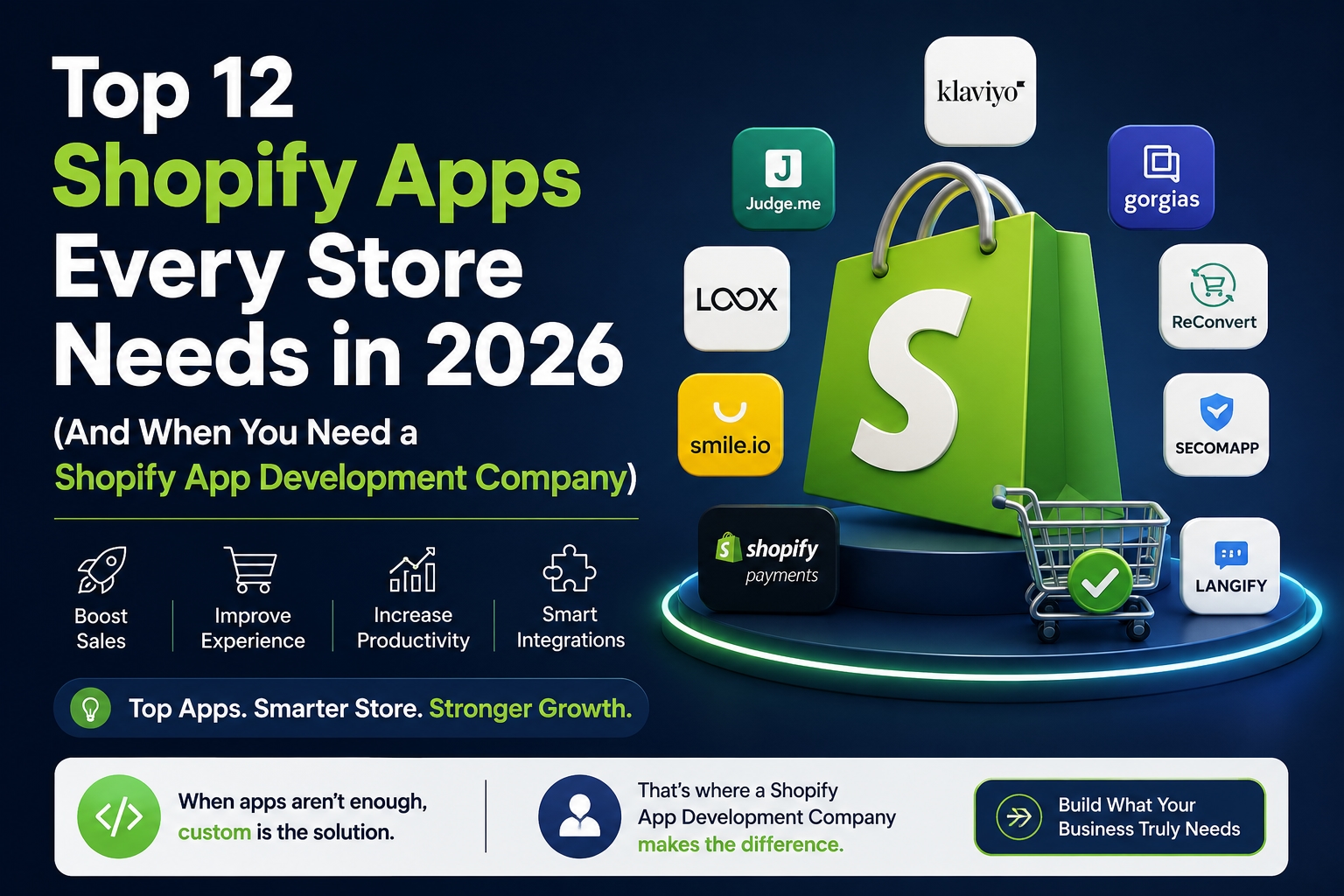
The Shopify App Store now lists more than 13,000 apps, promising to fix everything from abandoned carts to slow shipping. But more apps don't automatically mean a better store. Install the wrong mix, and you end up with a slower storefront, a longer list of monthly subscriptions, and checkout errors nobody has time to debug.
That's the problem this guide solves. Instead of listing apps just because they're popular, we cover the tools that genuinely move the needle for most Shopify stores in 2026 — and just as importantly, when those apps stop being enough.
In this guide, you'll find:
The best Shopify apps for 2026, category by category
Which type of business each app suits best
Free vs paid options, and where the real value is
When a custom-built feature beats a marketplace app
When it's time to hire a Shopify App Development Company
If you're already noticing app conflicts, rising subscription costs, or workflows your current app stack can't handle, you may be past the point where public apps can help. In that case, it's worth exploring what our Shopify App Development Services can build for you instead.
Quick Summary Table
App | Category | Best For | Pricing | Rating |
|---|---|---|---|---|
Klaviyo | Email & SMS | Repeat purchase flows | Free–$$$ | 4.6/5 |
Judge.me | Reviews | Budget-friendly review collection | Free–$15/mo | 4.9/5 |
PageFly | Page Builder | Custom landing pages | Free–$24/mo | 4.8/5 |
ReConvert | Post-Purchase Upsell | Thank-you page upsells | Free–$7.99/mo | 4.9/5 |
Recharge | Subscriptions | Consumable/repeat products | $99+/mo | 4.5/5 |
Smile.io | Loyalty & Rewards | Repeat customers & referrals | Free–$49/mo | 4.7/5 |
Loox | Photo Reviews | Visual product stores | $9.99+/mo | 4.8/5 |
Tidio | Live Chat & AI | Fast support without a big team | Free–$29/mo | 4.7/5 |
AfterShip | Order Tracking | International shipping | Free–$11/mo | 4.6/5 |
Vitals | All-in-One Suite | Lean teams, early-stage stores | $29.99/mo | 4.7/5 |
Bold Upsell | Upsell & Cross-Sell | Multi-point funnel upsells | $9.99+/mo | 4.5/5 |
Plug in SEO | SEO Monitoring | Ongoing technical SEO checks | Free–$29.99/mo | 4.6/5 |
How We Selected These Shopify Apps
Every app on this list was evaluated against the same criteria — not ranked by affiliate payouts or popularity alone. Here's what we looked at:
Ratings — sustained review scores across the Shopify App Store, not just launch-week hype
Performance — actual impact on page load and Core Web Vitals
Support — response time and quality of merchant support
Integrations — how well the app connects with Shopify and other tools in a typical stack
Security — data-handling practices and compliance history
Scalability — whether the app holds up as order volume and catalog size grow
Merchant Reviews — recurring feedback patterns from real store owners, not just star ratings
Top 12 Shopify Apps Every Store Needs in 2026
Each app below follows the same breakdown — what it's best for, its core features, the trade-offs, pricing, and where it starts to hit its limits. Here’s a detailed breakdown of the Top 12 Shopify Apps every store needs in 2026.
1. Klaviyo — Email & SMS Marketing
Best For: Stores that want to turn one-time buyers into repeat customers through automated flows.
Key Features:
Pre-built abandoned cart and win-back flows
Email and SMS managed from one dashboard
Predictive analytics for customer lifetime value
Deep native sync with Shopify customer and order data
Pros: Powerful segmentation, strong deliverability, and scales well as your catalog grows.
Cons: Costs rise quickly once your contact list crosses a few thousand profiles; steep learning curve for beginners.
Pricing: Free up to 250 profiles; paid plans scale with list size.
Why We Recommend It: Email and SMS remain among the highest-ROI channels for Shopify stores, and Klaviyo's native sync removes the need for manual data exports.
Expert Tip: If your flows need custom logic Klaviyo can't handle — like syncing loyalty points or ERP inventory in real time — that's usually where a custom integration from a Shopify app development company pays for itself.
2. Judge.me — Product Reviews
Best For: Stores that need review collection without a steep monthly cost.
Key Features:
Photo and video review requests
Automated review request emails
Google Shopping and rich snippet markup
Multi-language review widgets
Pros: Generous free plan, fast-loading widgets, and solid SEO markup out of the box.
Cons: Advanced customization needs the paid tier; the interface feels dated compared to newer apps.
Pricing: Free plan available; paid plans from roughly $15/month.
Why We Recommend It: Reviews are one of the strongest trust signals for conversion, and Judge.me delivers this without hurting page speed.
Expert Tip: For catalogs with 10,000+ SKUs, review sync can slow down at scale — a custom review pipeline avoids the batch-processing delays some merchants report.
3. PageFly — Advanced Page Builder
Best For: Stores that want landing pages and product pages beyond what their theme allows.
Key Features:
Drag-and-drop page builder
Built-in A/B testing
Mobile-responsive templates
Works independently of your theme code
Pros: No coding required, flexible layouts, and compatible with most Shopify themes.
Cons: Can add page bloat if sections aren't optimized; the free plan is limited to a handful of pages.
Pricing: Free plan available; paid plans from roughly $24/month.
Why We Recommend It: Custom landing pages consistently outconvert generic theme templates, especially for paid traffic campaigns.
Expert Tip: If you're running dozens of campaign landing pages, a custom-built page framework can load faster and be easier to maintain than stacking app-built pages.
4. ReConvert — Post-Purchase Upsell
Best For: Stores that want to increase average order value after checkout, not before it.
Key Features:
Customizable thank-you page
Post-purchase, one-click upsell offers
Order status page upsells
Visual, no-code funnel builder
Pros: Doesn't interrupt the main checkout flow, has an easy visual editor, and works cleanly with Shopify's native checkout.
Cons: More advanced upsell logic sits behind paid plans; limited personalization on the free tier.
Pricing: Free plan available; paid plans from roughly $7.99/month.
Why We Recommend It: Post-purchase upsells convert at a much higher rate than pre-purchase pop-ups, since the customer has already committed to buying.
Expert Tip: Stores with complex bundle pricing or dynamic discount rules often outgrow ReConvert's rule builder — that's a common custom-app request we see.
5. Recharge — Subscriptions
Best For: Stores selling consumable or repeat-purchase products.
Key Features:
Flexible subscription billing cycles
Customer self-service portal
Churn and retention analytics
Native Shopify Checkout integration
Pros: A mature, well-supported platform that handles complex billing logic and offers solid churn-reduction tools.
Cons: Pricing scales with subscription order volume; setup can get technical for non-developer teams.
Pricing: Plans typically start around $99/month plus transaction fees.
Why We Recommend It: Subscription revenue is more predictable than one-time sales, and Recharge remains the most established option in this category.
Expert Tip: Once subscription logic needs to tie into inventory forecasting or custom loyalty tiers, most merchants move to a subscription engine built directly into their store.
6. Smile.io — Loyalty & Rewards
Best For: Stores focused on repeat purchases and referral-driven growth.
Key Features:
Points-based rewards program
VIP customer tiers
Built-in referral program
Redeemable rewards at checkout
Pros: Easy setup, a solid free plan, and integrations with most major email and SMS tools.
Cons: Deeper customization requires higher-priced plans; reward logic is fairly rigid.
Pricing: Free plan available; paid plans from roughly $49/month.
Why We Recommend It: Loyalty programs are one of the most cost-effective ways to lift repeat purchase rate without spending more on ads.
Expert Tip: Multi-brand stores, or those wanting loyalty tied to a custom CRM, usually need a purpose-built loyalty engine instead of a one-size-fits-all app.
👉 Talk to our Shopify App Development Company
7. Loox — Photo & Video Reviews
Best For: Visual, product-heavy stores such as fashion, beauty, and home goods.
Key Features:
Photo and video review requests
Built-in referral program
Review carousel widgets
Upsell offers inside review request emails
Pros: Clean, visual widget design and strong social-proof presentation with a simple setup.
Cons: Pricier than some review competitors; entry plan is fairly limited.
Pricing: Plans typically start around $9.99/month.
Why We Recommend It: Visual reviews consistently outperform text-only reviews for conversion on image-driven product categories.
Expert Tip: If you're syncing reviews across a multi-storefront setup, a custom API-based sync avoids the duplicate-review issues some Loox users report.
8. Tidio — Live Chat & AI Support
Best For: Stores that want to reduce response time without hiring a full support team.
Key Features:
Live chat widget
AI chatbot flows
Built-in ticketing system
Order lookup directly inside chat
Pros: Free plan covers basic chat, AI responses cut down repetitive tickets, and installation is simple.
Cons: Chatbot accuracy depends on how well it's configured; higher-volume stores need paid tiers.
Pricing: Free plan available; paid plans from roughly $29/month.
Why We Recommend It: Faster response times directly reduce cart abandonment, and Tidio's AI layer handles common questions without added staffing.
Expert Tip: Stores wanting the chatbot to pull real-time inventory, order status, or ERP data usually need a custom AI integration beyond Tidio's standard connectors.
9. AfterShip — Order Tracking
Best For: Stores that ship internationally or field frequent "where's my order" tickets.
Key Features:
Branded order tracking page
Automated shipment status notifications
Delivery date predictions
Multi-carrier support
Pros: Meaningfully reduces support tickets, offers a clean tracking page, and covers most major carriers.
Cons: Free plan has shipment limits; full branding control needs a premium plan.
Pricing: Free plan available; paid plans from roughly $11/month.
Why We Recommend It: A branded tracking experience keeps customers on your site instead of a carrier's generic page, cutting support volume.
Expert Tip: High-volume stores with multiple warehouses often need custom logic to route tracking data correctly — a common gap public tracking apps don't cover.
10. Vitals — All-in-One App Suite
Best For: New or lean teams wanting to replace 10+ separate apps with one.
Key Features:
Reviews, upsells, and trust badges bundled together
Built-in currency converter
40+ marketing and conversion tools
Single unified dashboard
Pros: Reduces both app count and combined subscription cost, all managed from one place.
Cons: Individual tools are less powerful than dedicated apps; enabling every module can still add page weight.
Pricing: Single flat plan, typically around $29.99/month.
Why We Recommend It: For stores just getting started, Vitals is a fast way to cover multiple needs without stacking a dozen separate subscriptions.
Expert Tip: As you scale, you'll likely outgrow Vitals' individual modules one at a time — that's usually when dedicated, purpose-built tools make more sense.
11. Bold Upsell & Cross-Sell
Best For: Stores wanting rule-based upsells and cross-sells at multiple points in the funnel.
Key Features:
Pre- and post-purchase upsell offers
Cart-level cross-sells
Advanced audience targeting rules
Works across product, cart, and checkout pages
Pros: A flexible rule builder, funnel-wide coverage, and an established app with strong support.
Cons: Pricing scales with revenue, and it can conflict with other checkout-related apps if not configured carefully.
Pricing: Plans typically start around $9.99/month, scaling with order volume.
Why We Recommend It: Upselling at multiple funnel stages, rather than just one, consistently lifts average order value.
Expert Tip: Running Bold alongside other upsell or checkout apps is one of the most common causes of checkout conflicts we get asked to debug.
12. Plug in SEO
Best For: Stores that want ongoing technical SEO monitoring without hiring an agency.
Key Features:
Automated SEO audits
Broken link detection
Meta tag and alt text suggestions
Google Search Console integration
Pros: Explains SEO issues in plain language, useful for non-technical merchants, with regular audit scans.
Cons: Doesn't fix everything automatically — many issues still need manual or developer intervention.
Pricing: Free plan available; paid plans from roughly $29.99/month.
Why We Recommend It: Ongoing monitoring catches issues like broken links, missing alt text, and duplicate titles before they hurt rankings.
Expert Tip: Apps like this can flag JavaScript-rendering or crawlability issues, but they can't fix them — that typically needs a developer to rebuild the affected templates, which is exactly what a Shopify app development agency handles.
Common Problems with Installing Too Many Shopify Apps
This is the part most competitor guides skip — but it's usually where store owners feel the most pain.
Speed: Every app adds its own JavaScript and CSS. Stack enough of them, and your Core Web Vitals — and your conversion rate — start slipping, often without an obvious single cause.
Conflicts: Two apps editing the same theme file or checkout element can silently override each other, breaking a feature with no error message to point to.
Monthly Costs: Most apps look cheap individually. Ten apps at $20–$50 each adds up to a real operating expense that rarely gets audited once it's set up.
Duplicate Functionality: It's common to find three apps quietly doing the same job — an upsell tool, an all-in-one suite, and a dedicated app all trying to control the same cart step.
Security: Every app is a new access point into your store's data. More apps means a wider surface area for something to go wrong, especially with apps that request broad permissions.
Code Bloat: Uninstalled apps don't always clean up after themselves. Leftover code snippets and unused liquid files accumulate and quietly slow the theme down over time.
Checkout Issues: Upsell, currency, and payment-related apps are the most common source of checkout errors — exactly the part of your store where errors cost you the most revenue.
How to Choose the Right Shopify App Development Company
Choosing the best Shopify App Development Company isn’t an easy task like it sounds. You need to check a lot of things before you finally choose one that ensures the correct pick.
Experience: Ask how many Shopify projects they've shipped, and in what category — a team that's built subscription logic before will move faster on yours.
Portfolio: Look for real, working examples close to what you need, not just design mockups.
Shopify Partner Status: Official Shopify Partners have direct access to Shopify's technical resources and API updates.
Maintenance: Ask what happens after launch — bug fixes, Shopify API updates, and ongoing support should be part of the conversation upfront.
Security: Custom apps touch customer and order data, so ask how they handle authentication, data storage, and Shopify's app security requirements.
API Expertise: Confirm hands-on experience with Shopify's Admin API, Storefront API, and webhooks — not just theme customization.
Support: Understand response times and whether support is included or billed separately after launch.
Communication: A team that explains trade-offs clearly, in plain language, is usually easier to work with long-term than one that only talks in technical jargon.
Conclusion
The apps on this list cover what most Shopify stores genuinely need in 2026 — reviews, email and SMS, upsells, subscriptions, loyalty, support, tracking, and SEO monitoring. Used well, they're a fast, low-cost way to get real functionality live.
But apps aren't a permanent solution. As your store grows, don't install apps just because they're popular — audit what you're running regularly, and retire what's redundant. When your workflow starts asking for something no public app quite delivers, that's the point to build custom instead of adding one more subscription to the stack.
If that point sounds familiar, our Shopify App Development Company can scope exactly what a custom build would look like for your store.