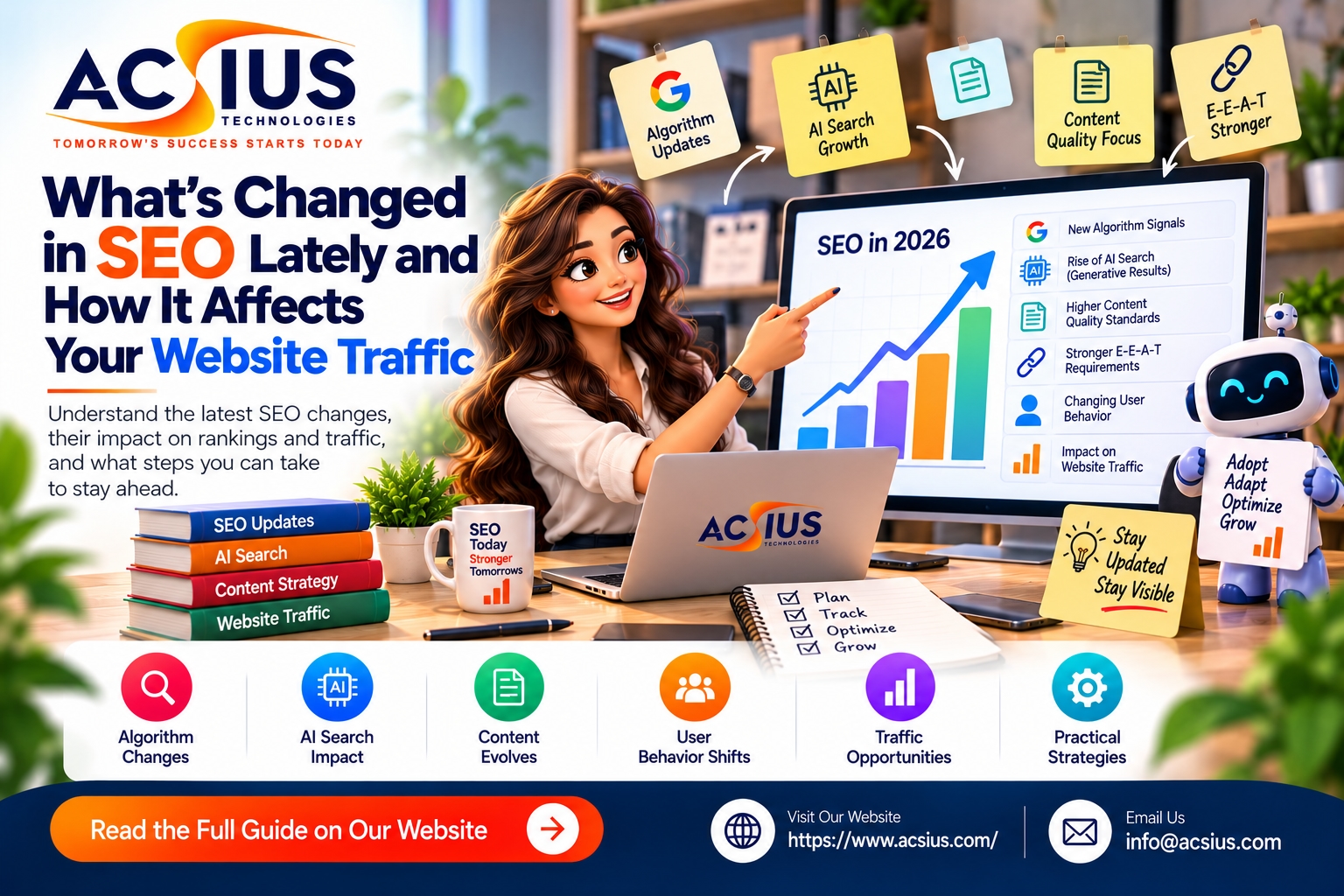
If your website traffic has gone up and down this year without an obvious reason, you are in good company. Search has changed more in recent months than in many previous years. Google has pushed out a rapid series of ranking updates, AI-generated answers now sit at the top of many results pages, and people are searching in longer, more conversational ways than ever before.
The good news is that these changes are manageable once you understand them. In this guide, we explain what has changed in SEO lately, how each change can affect your traffic, and what practical steps you can take to protect and grow your visibility. Whether you run a blog, a service business, or an online store, the same core ideas apply.
Google Is Updating Rankings More Often
The first big change is speed. In 2026, Google confirmed a Discover-focused core update in February, a very short spam update in March, the March core update (March 27 to April 8), and the May core update (May 21 to June 2). A further spam update began in late September. Google has also said that smaller core updates happen continuously between the larger announced ones.
How it affects your traffic. Rankings now move more frequently, so you may see more ups and downs than before. A traffic drop after an update does not mean your site was penalized. It usually means Google reassessed which pages best satisfy a search. Google recommends waiting at least a week after a rollout finishes, then comparing your Search Console data with the period before the update. Avoid rewriting everything in a panic; look for patterns across groups of pages first.
AI Answers Now Appear Before Many Results
The second major change is the rise of AI in search. At Google I/O in May, Google announced a redesigned search box, smoother movement between AI Overviews and AI Mode, and a new default model for AI Mode. Google also reported that AI Mode has passed one billion monthly users, and that queries there tend to be much longer than traditional searches. These are Google's own figures, so treat them as directional rather than independently verified.
How it affects your traffic. When an AI answer fully satisfies a simple question, fewer people click through to a website. Pages that only give basic definitions or quick facts are the most exposed. Pages that offer depth, original insight, tools, or real-world experience still give people a reason to visit. In other words, you may see fewer clicks on simple informational queries while seeing stronger engagement on high-intent pages.
This is also why many businesses are now working with a trusted AI SEO Company India to track how their brand appears in AI-driven results, structure content so it is easier to cite, and build strategies that go beyond traditional rankings. The goal is no longer only to rank; it is to be understood, trusted, and recommended by both search engines and AI systems.
Search Queries Are Getting Longer and More Conversational
People no longer type only short phrases like "best running shoes." They ask full questions: "Which running shoes are best for flat feet and long-distance training under a moderate budget?" They also ask follow-up questions, refine their requests, and expect the search tool to remember context.
How it affects your traffic. Pages optimized for a single short keyword can miss a large share of modern searches. To keep traffic steady, cover the full set of related questions around each topic. Use clear headings written as questions, give direct answers early in each section, and then add depth, examples, and comparisons. This helps your content match how people actually search and makes it easier for AI systems to extract the right answer.
Content Quality and Originality Matter More
Google describes its recent core updates as regular updates meant to surface relevant, satisfying content from all types of sites. It did not publish specific recovery steps, but its long-standing advice remains consistent: create helpful, people-first content and demonstrate real expertise.
With AI tools making it easy to produce large volumes of generic text, originality has become a competitive advantage. Pages that copy common advice, repeat what competitors already say, or exist only to catch search traffic tend to lose ground over time.
How it affects your traffic. If your site relies on thin, repetitive, or mass-produced pages, expect volatility. If you publish original research, case studies, expert commentary, clear examples, and updated information, you give Google and AI systems a reason to prefer your pages. Add author names, credentials, and sources so readers can see who is behind the content and why it can be trusted.
Topical Authority Beats Isolated Pages
Another clear shift is that search engines increasingly reward sites that cover a subject thoroughly, not just a single keyword. A website with one article about a topic is easier to replace than a website with a strong main guide, supporting articles, and clear internal links connecting them all.
How it affects your traffic. Sites with deep topic coverage tend to be more stable through updates, because their value does not depend on one fragile ranking. To build this strength, group your content into topic clusters, merge overlapping posts, update weak pages, and link related articles together. This also helps visitors move naturally from one page to the next, which improves engagement and conversions.
If you want expert help with audits, content planning, technical fixes, and authority building, working with reliable SEO Services India providers can give you a structured plan rather than scattered, short-term fixes. A good partner will focus on the foundations that support every other channel, including AI-driven discovery.
Technical SEO Still Decides Who Gets Seen
With all the attention on AI, it is easy to forget that technical health remains essential. Google has said that pages must be indexed and eligible to appear with a snippet to be linked in its AI features. If a page cannot be crawled, loads slowly, or is blocked by mistake, it is unlikely to earn traffic from any source.
How it affects your traffic. Technical problems quietly drain visibility. Check these basics regularly:
Important pages are indexed and not marked noindex by accident.
Pages load quickly and stay stable on mobile devices.
Your site has a clean structure with logical categories and internal links.
Canonical tags, sitemaps, and redirects are set up correctly.
Structured data is added where it helps explain your content.
Fixing these issues does not always create dramatic jumps, but it prevents unnecessary losses and helps every new page perform better.
Local Search Is Becoming More AI-Driven
Local searches are also changing. People now ask for things like "a dentist near me open on Sunday" or "a restaurant for a family of six," and they expect precise, immediate answers. Google has been expanding agent-style features that can help with tasks such as bookings, which means being chosen by an AI system may become as important as being listed.
How it affects your traffic. A basic Google Business Profile is no longer enough. Keep your hours, services, photos, and categories accurate. Collect fresh reviews and respond to them. Publish unique location pages with real details, rather than copying the same text for each city. Make your pricing, policies, and contact information clear and consistent across your website and directories.
Businesses that serve several cities can benefit from a dedicated local seo company India to manage profiles, citations, reviews, and location pages at scale. That support helps you stay visible in map results and conversational local searches while your website content builds trust with nearby customers.
Brand Mentions and Trust Signals Carry More Weight
As AI answers pull information from many sources, trust has become a deciding factor. Search systems look for signs that a brand is real, consistent, and respected: clear authorship, transparent business details, positive reviews, and mentions across reputable websites.
How it affects your traffic. If people recognize your brand and search for it by name, you gain a more stable source of traffic that is less affected by ranking changes. Invest in digital PR, original studies, partnerships, and genuinely useful tools. Participate in relevant communities and industry publications. Over time, these efforts increase branded searches and make it more likely that AI tools will mention you.
How to Measure Traffic in the New Search Landscape
Watching clicks alone no longer tells the full story. A page may lose clicks but gain impressions, brand awareness, or assisted conversions. Update your reporting to include:
Organic clicks and impressions in Search Console.
Branded search growth, which shows whether your reputation is building.
Conversions and leads, not just sessions.
Engagement, such as time on page and return visits.
AI mentions and citations, using available visibility tools.
Performance by topic, so you can see which subject areas are growing.
Because AI Mode data is not fully reported in public tools yet, combine several sources and look at trends over months rather than days.
A Simple Action Plan to Protect Your Traffic
Here is a practical plan you can start this month:
Audit your top pages. Identify which ones gained or lost traffic over the last six months and look for common causes.
Improve answer quality. Add direct answers, question-based headings, examples, and updated facts to your key pages.
Strengthen topic clusters. Merge duplicate posts, fill content gaps, and improve internal linking.
Fix technical issues. Check indexing, speed, mobile usability, and structured data.
Build trust. Add author details, sources, reviews, and case studies.
Expand reporting. Track branded searches, conversions, and AI visibility alongside clicks.
Review monthly. Avoid reacting to daily changes; make decisions from consistent trends.
Common Mistakes to Avoid
Overreacting to every update. Constant rewriting can create more instability than it solves.
Publishing generic AI-written content. Unedited, repetitive pages add little value and increase quality risks.
Ignoring zero-click behavior. If your pages only repeat simple facts, plan for lower traffic and create more useful content.
Chasing shortcuts. There is no trick to being cited by AI; quality and authority remain the reliable path.
Neglecting local and technical basics. Good content cannot perform if it is hard to find, slow, or poorly structured.
Final Thoughts: Adapt, Don't Panic
SEO has changed, but its purpose has not: helping the right people find the most useful answer. Updates are faster, AI answers are more visible, and searches are more conversational, yet websites that publish original, trustworthy, well-organized content continue to earn visibility. Focus on depth, clarity, technical health, and reputation, measure your results with a broader scorecard, and your traffic will be far more resilient than it would be if you chased every trend.
If you would like expert guidance on adapting to these changes, ACSIUS can help you build a clear, results-focused search strategy that strengthens your foundations, improves visibility across traditional and AI-driven results, and supports sustainable traffic growth. Contact ACSIUS today to turn the latest SEO changes into a lasting advantage for your website.