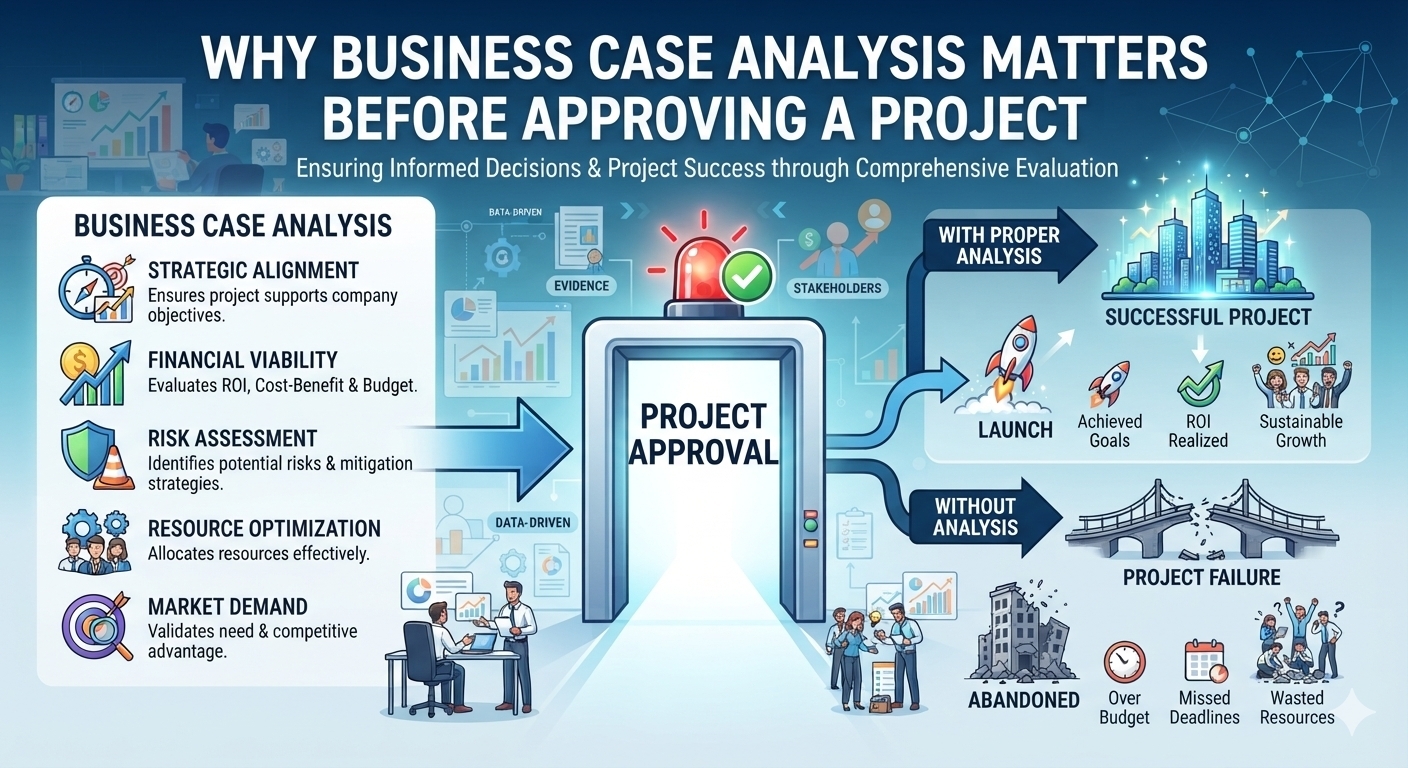
There are cases where a great majority of failing projects were good ideas which have never tested. When the project is approved on the basis of excitement alone, resources are wasted without even being noticed. This is the very reason why I have always advocated the point that all the learners who are doing the Business Analyst Training course should first discuss the facts and then discuss the enthusiasm.
It turns a great idea into a decision that you can defend. In today’s post, we are going to discuss what the business case includes and why it is needed. You are also going to see a real-life example illustrating the entire process.
What a Business Case Reveals About a Project
A business case makes a collection of opinions into one document that everyone in the room can see.
The problem or opportunity behind the idea
Expected benefits, in numbers where possible
Costs, including the boring ones people forget
Risks, and the assumptions hiding under them
Alternatives
Resources and strategic fit
Not only does the data provide the decision maker with a notion of the project, but it provides him with a rationale for pursuing it.
Why Projects Should Be Evaluated Before Approval
Once, I witnessed a team approve a new tool due to an impressive demo and strong sponsorship. No one asked who was going to maintain it, which resulted in the budget being increased by twice in six months and almost half the team not using it.
Approvals without analyses lead to the same issues time after time in any industry.
Objectives nobody can state in one sentence
Costs that someone guessed instead of calculating
Benefits that sound nice but have no owner
Two projects fighting over the same people
A poor match with where the company is heading
A business case prevents such situations from occurring, as it provides executives with a framework to analyse the project prior to approval.
How Business Case Analysis Supports Better Project Approval Decisions
Analysis can be defined as a set of questions that are posed in a systematic manner, which is learned by learners in a Business Analyst Certification Course.
It starts with the definition of a problem or an opportunity, since it is not possible to evaluate a project without any purpose.
The decision-makers determine if there is any business value in the project through comparison of the benefits and costs.
The risks, assumptions, and dependencies are determined from the very beginning in order to ensure that the approval considers risks and not only opportunities.
Problem solving does not guarantee project approval, as the team assesses various alternatives, including doing nothing.
Furthermore, the project is assessed on the basis of the organisation’s business objectives to ensure that it is appropriate, despite being feasible.
Finally, the team makes sure that the organisation has adequate capacity to execute the project, based on its strengths.
Main Factors Considered Before Decision Making
These can be viewed as factors in a sequence: need, cost, benefit, risk, alternative, resource, and strategy.
Factor | Question to ask |
|---|---|
Costs | What are the real costs, including maintenance? |
Benefits | What are the actual benefits, and who will be responsible for them? |
Risks | What could go wrong and what will be the consequences? |
Resources | Do we have the right personnel and expertise? |
Strategic fit | Does it help us meet our long-term goals? |
The considerations listed above need to be examined together because any large benefit can mean nothing in case of high risks or insufficient resources. An inexpensive project with poor strategic fit is still a waste of effort, no matter how inexpensive.
A Simple Example of Business Case Analysis Before Project Approval
Often in courses like Business Analytics Online Training, learners analyse a business case in the form of an example. Now, let’s do a simple one. Let’s assume that there is an average-sized retail firm that needs to develop a new customer service platform due to increased complaints of delayed responses.
Step | Finding |
|---|---|
Business problem | In the last 2 days, complaints increased by 30% this year |
Solution | A single platform for tickets, chats, and emails |
Expected benefits | Replies within four hours, fewer repeat complaints |
Cost | Setup at Rs. 60,000 and annual support of Rs. 12,000 |
Risks | Staff resistance, data migration errors, vendor delays |
Alternatives | Hire two agents, upgrade the old tool, or do nothing |
Decision | Approve in phases, starting with a pilot team |
Hiring agents proved to be more costly and inefficient than constructing the platform. No action only meant losing more customers. Consequently, the management was forced to kick-start the project by carrying out a three-month trial period, which had specific goals.
What Happens if a Team Approves a Project Without a Business Case
Simply ignoring the analysis just delays the process to an even more expensive time frame.
Scope keeps growing because nobody agreed on a finish line
Costs surprise everyone, usually at the worst time
Staff avoid the new system, so adoption stays low
Key people leave other work to rescue the project
Promised benefits never show up, and nobody knows why
Aspect | With a business case | Without one |
|---|---|---|
Goals | Clear and agreed | Vague and shifting |
Costs | Estimated early | Found late |
Benefits | Tracked | Assumed |
The cost of remedying these issues after project approval is far greater than raising difficult questions prior to spending any money.
Conclusion
It is essential to conduct a business case study, as this proves the value, feasibility, affordability, and relevance of the project in question at the start. Otherwise, we put the resources of others at stake without any factual evidence. If done in a proper manner, gaining approval will be easier, as it will be a well-informed and justifiable decision made by all.