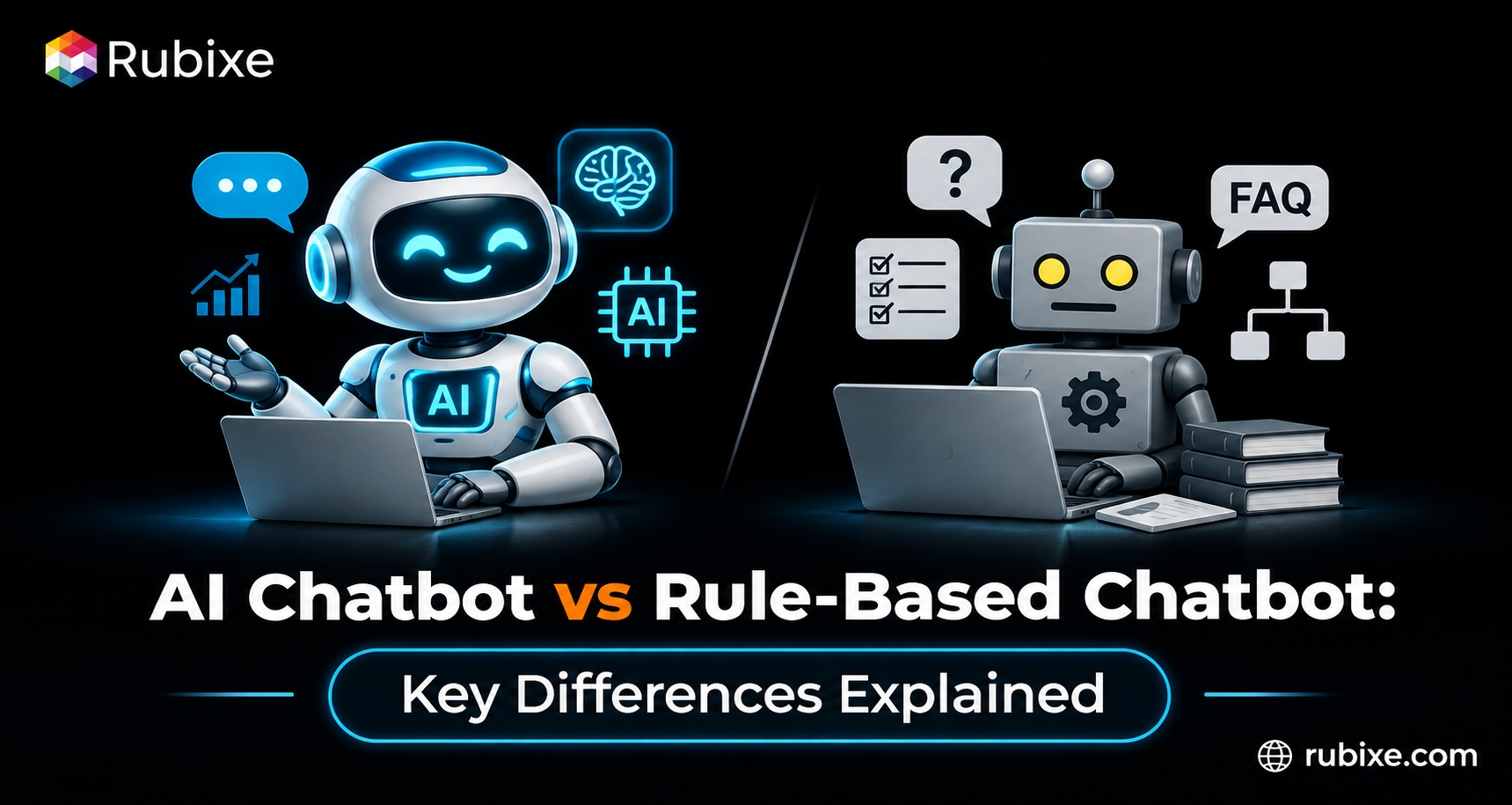
Almost every business with a website eventually faces the same decision: set up a simple scripted bot, or invest in something that can genuinely understand customers? Both promise faster replies, lower support costs and happier visitors, yet they work in very different ways. Understanding the difference between a rule-based chatbot and an AI chatbot helps you choose the right tool, avoid wasted budget, and stop customers from getting stuck in endless loops. This guide explains how each type works, where each one shines, and how to decide which fits your business.
What Is a Rule-Based Chatbot?
A rule-based chatbot follows a script written in advance. Developers map specific keywords or button clicks to fixed replies and build a decision tree that guides the user step by step. If a visitor types "opening hours," the bot returns the hours. If they ask "when can I drop by on Sunday?", the bot may not recognise the question at all.
This predictability is both its strength and its weakness. The bot never says anything unexpected, and every answer can be approved in advance. But it also can't handle anything its creators didn't plan for. Every new product, policy or question means someone has to edit the script by hand.
What Is an AI Chatbot?
An AI chatbot uses natural language processing (NLP) and machine learning to work out what a person means, not just which words they typed. It recognises intent, picks out details such as dates, names or order numbers, remembers earlier parts of the conversation, and produces a fitting reply.
Because it interprets language instead of matching patterns, it can handle spelling mistakes, slang, incomplete sentences and questions phrased in dozens of different ways. Many modern versions also use generative AI, which lets them respond in natural, flowing language rather than canned sentences. The result feels much closer to talking with a helpful human agent.
The Technology Powering Intelligent Chatbots
Several building blocks work together behind a smart bot:
Natural language understanding (NLU): Identifies the user's intent, such as "track my order" or "change my plan."
Entity extraction: Pulls out key details like product names, locations and dates.
Dialogue management: Keeps track of context so the conversation stays coherent across multiple turns.
Machine learning models: Learn from past conversations and corrections to improve accuracy.
Knowledge base integration: Lets the bot retrieve answers from help articles, product catalogues and policy documents.
Sentiment analysis: Detects frustration and can trigger a handover to a human agent.
A rule-based bot has none of these layers. It simply checks whether the input matches a trigger.
How Each Type Works Behind the Scenes
Rule-based flow
The user clicks a button or types a keyword.
The bot matches it against a list of triggers.
A fixed reply is returned.
The conversation moves to the next step in the decision tree.
AI-powered flow
The message is analysed with NLP to identify intent and key details.
Conversation history and customer data add context.
The model generates or selects the most relevant answer.
Feedback and new data are used to improve future responses.
The first model only matches patterns, while the second interprets meaning. That gap shapes everything else, from customer experience to maintenance effort.
Key Differences Between an AI Chatbot and a Rule-Based Chatbot
Aspect | Rule-Based Chatbot | AI-Powered Chatbot |
Logic | Predefined rules and decision trees | NLP and machine learning models |
Language understanding | Exact keywords or buttons | Natural, free-form language |
Context memory | None; each step is isolated | Remembers earlier messages |
Learning | Static until manually updated | Improves with data and feedback |
Personalisation | Generic replies | Tailored to user history and behaviour |
Setup effort | Quick and inexpensive | Needs training data and integration |
Maintenance | Constant rule updates | Monitoring and retraining |
Scalability | Limited by script size | Handles more topics and higher volume |
Beyond the table, three differences matter most in daily use.
Flexibility. A scripted bot works only on the paths it was given. An intelligent bot can handle a question it has never seen by understanding the intent behind it.
Experience. Rule-based bots often force users through menus. Smart bots let people simply ask, which cuts effort and shortens resolution time.
Growth. Adding new topics to a scripted bot means more branches, and large trees become hard to manage. AI-powered systems scale more gracefully because they generalise from examples instead of relying on hand-written paths.
Benefits of Using an AI Chatbot
Natural conversation: Customers can type the way they speak and still get useful answers.
Round-the-clock customer support automation: Common queries are resolved instantly at any hour, so human agents can focus on complex cases.
Personalised experiences: Replies adapt to purchase history, preferences and past interactions.
Stronger lead generation: The bot can qualify visitors, answer product questions and book demos without delay.
Multilingual reach: One virtual assistant can serve customers in several languages.
Useful insights: Conversation analytics reveal frequent questions, pain points and content gaps on your website.
Cost efficiency at scale: Handling thousands of simultaneous chats does not require a matching increase in headcount.
Smooth integration: It can connect with your CRM, helpdesk and e-commerce tools to pull and update live data, such as order status or account details.
Where a Rule-Based Chatbot Still Makes Sense
Smarter is not always necessary. A rule-based chatbot works well when interactions are simple and predictable, such as:
Answering FAQs about pricing, timings or delivery policies
Collecting contact details through a short form
Booking appointments with fixed time slots
Handling internal requests like password resets or leave balance checks
Guiding users through a menu of services
It deploys quickly, costs little, and gives consistent answers, which suits small businesses and first-time automation projects. It is also a safe choice where every response must be exact, such as legal disclaimers or regulated wording.
Limitations to Keep in Mind
Rule-based bots break down when users go off-script. They can't learn from past chats, they need manual updates whenever your offerings change, and repeated "Sorry, I didn't get that" replies quickly frustrate customers. They also struggle with messages that contain more than one question.
AI-powered bots need more upfront effort. They depend on quality training data, careful integration, and ongoing monitoring to catch inaccurate or off-brand answers. Businesses also need strong data privacy practices, clear escalation paths to humans, and guardrails so the bot stays within approved topics.
Industry Use Cases
Industry | Typical task | Better fit |
Retail | Store hours, return policy FAQs | Rule-based |
E-commerce | Product recommendations, order help | AI-powered |
Healthcare | Appointment booking | Rule-based |
Healthcare | Symptom-related queries, patient support | AI-powered |
Banking and insurance | Balance checks, policy questions, claims guidance | AI-powered |
HR | Leave policy lookups | Rule-based |
HR | Candidate screening, employee helpdesk | AI-powered |
Education | Admission FAQs | Rule-based |
Education | Student support and course guidance | AI-powered |
As a rule of thumb, the more varied and open-ended the questions, the more value an intelligent system adds.
Why Many Businesses Choose a Hybrid Approach
You don't always have to choose one. A hybrid chatbot uses scripted flows for simple, high-volume tasks like order tracking or appointment booking, then passes complicated questions to an AI chatbot, and finally to a human agent when empathy or judgement is needed. This layered setup keeps costs sensible, delivers consistent answers where accuracy matters, and protects the customer experience when conversations get complicated.
How to Choose the Right Chatbot
Define your goal. Decide whether the bot is for support, sales, engagement or internal use.
Study your customer queries. Review chat logs, emails and support tickets. If your customers ask varied, unpredictable questions, an AI chatbot is usually the better fit.
Check integration needs. Make sure it can connect with your CRM, ticketing and payment systems.
Match budget and timeline. Simple scripts launch in days, while intelligent systems take longer to train and tune.
Review security and compliance. Customer conversations often contain sensitive data, so check encryption, access controls and data storage rules.
Plan for human handover. Whatever you choose, customers should always have a way to reach a person.
Pilot before scaling. Test with a limited audience, gather feedback, then expand.
Metrics to Track After Launch
Choosing the bot is only the beginning. Measure results regularly to see whether it is paying off:
Resolution rate: The share of conversations solved without human help.
Customer satisfaction (CSAT): Ratings collected at the end of a chat.
Fallback rate: How often the bot fails to understand a question.
Handover rate: How often chats are escalated to agents.
Response time: Average time to first and final reply.
Conversion rate: Leads captured or purchases completed through the bot.
A high fallback rate on a scripted bot is a sign that your customers' questions have outgrown it. A rising handover rate on a smarter bot usually points to gaps in training data or knowledge content.
Frequently Asked Question
1. What is the main difference between an AI chatbot and a rule-based chatbot?
A rule-based chatbot follows a fixed script and responds only to specific keywords or button clicks. An AI chatbot uses natural language processing and machine learning to understand the meaning behind a message, so it can handle free-form questions it was never explicitly programmed for.
2. Which is better for my business: an AI chatbot or a rule-based chatbot?
It depends on your customer queries. If most questions are simple and predictable, such as store hours or appointment slots, a rule-based bot is enough. If customers ask varied, open-ended questions, an AI chatbot is usually the better long-term investment.
3. What is a hybrid chatbot?
A hybrid chatbot combines both approaches. Scripted flows handle simple, high-volume tasks like order tracking or bookings, an AI layer takes on more complex questions, and a human agent steps in when empathy or judgement is needed.
4. Can an AI chatbot replace human support agents?
Not entirely. It can resolve common queries instantly at any hour, but complex or sensitive issues still need a human. Every chatbot setup should include a clear handover path to a live agent.
Final Thoughts
The real question is not which technology is newer, but which one solves your customers' problems. A rule-based chatbot is a reliable starting point for simple, predictable queries. An AI chatbot is the stronger long-term investment when you want natural conversations, personalised service, and support that scales with your business. Start with your goals, test with real conversations, track the right metrics, and refine as you grow.