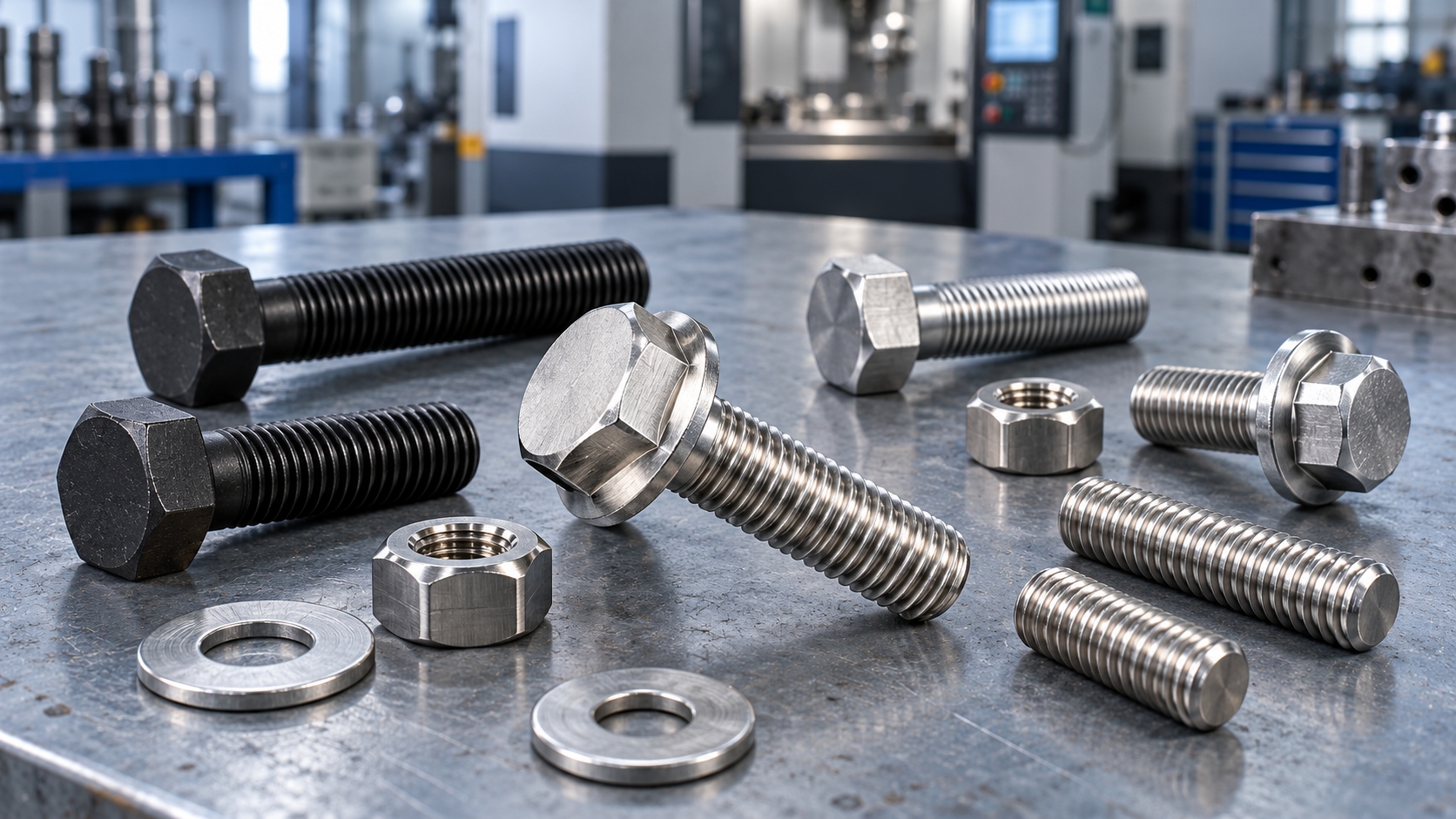
Picture a batch of 10.9 bolts that clears incoming inspection, goes onto a gearbox housing, and loses a head three months later. Nobody changed the design. The bolts were zinc plated without baking, and hydrogen did the rest. That's why choosing bolts is closer to risk management than shopping.
Bolts Types That Cover Most Industrial Jobs
Hex bolts are the default. ISO 4014 covers partially threaded ones, ISO 4017 fully threaded ones, which strictly speaking are screws, a naming argument you'll lose on every purchase order. Socket head cap screws to ISO 4762 suit tight spaces. Flange bolts drop the separate washer. Carriage, eye and U-bolts handle narrower jobs.
Strength Class Is the Real Spec
Property class sets strength under ISO 898-1. Class 8.8 means 800 MPa nominal tensile strength, 10.9 means 1000 and 12.9 means 1200. Stainless A2-70 and A4-80 fall under ISO 3506.
The Detail Buyers Skip
Coating. Above class 10.9, electroplating carries a hydrogen embrittlement risk, so baking after plating matters. Most RFQs list size and class and never mention it.
Here's what's harder than it looks: preload. Most tightening torque goes to friction, not clamp load, so the same bolt on a dry thread and an oiled one can sit at very different tension.
Five Questions to Put to Any Bolt Supplier
Property class proof. Good: lot test certificates for tensile and hardness, matching the head markings. Bad: "Everything is 8.8, trust us."
Thread accuracy. Good: go/no-go gauge checks per batch to the tolerance class you specified, usually 6g. Bad: "Threads are standard."
Coating control. Good: process, thickness and post-plating baking declared. Bad: coating "as per availability."
Material source. Good: bar or wire rod traceable to a heat number. Bad: mixed lots with no marking.
Defect handling. Good: written replacement terms. Bad: "We'll sort it out later." That isn't a policy. It's a claim you'll be chasing for months.
Buyers who approve on a catalogue photo deserve the surprise they get.
What Right-Specified Bolts Do for Your Margin
Fewer field failures: joints hold, so warranty cost stays off your P&L.
Predictable preload: fewer retorque cycles on the assembly line.
Lot-to-lot fit: no sorting, no stopped line.
No over-specifying: the correct class chosen once beats a stronger, costlier one chosen out of fear.
Fewer corrosion claims: the right coating for the environment, not the cheapest one.
Faster audits: certificates on hand when your customer asks.
ISO 898-1 and ISO 3506 give you a common language for all of it, so use them in every PO.
Where to Buy Bolts in India, and Who to Buy From
Bolts manufacturers in India cluster around Ludhiana, Rajkot, Pune and the Delhi NCR belt, near the forgings, steel and assembly plants they serve. Here's the insight most buyers miss: manufacturers and distributors do different jobs. Bolt distributors in India hold standard sizes for fast pickup. Custom lengths, special heads and bulk volumes need a manufacturer. Smart buyers keep both. If you're shortlisting top bolt suppliers in India, ask which of the two they actually are.
How We Handle Every Bolt Enquiry
We make bolts and custom fasteners to customer drawings, with CNC machining and centerless grinding in-house. A drawing that says "M12 bolt" with no property class or coating gets a call from us before a quote. That one missing line changes the material, the process and the price. We'd rather ask than guess.
Your Next Spec Sheet
Bolts fail at the specification stage long before they fail in service. Write the class, the standard and the coating on every drawing. Then find a supplier who reads all three.
FAQs
What are bolts used for in industrial assemblies?
Clamping parts together so the joint stays tight under load and vibration. Gearboxes, frames, housings and flanged pipework all depend on them.
How do I choose between 8.8, 10.9 and 12.9 bolts?
Match the class to the load, not to the biggest number. Higher class means less ductility, and 12.9 is more sensitive to hydrogen embrittlement, so it isn't automatically safer.
What should I ask bolts manufacturers before ordering?
Property class certificates, thread gauge records and the coating process. If they can't produce those within a day, move on.
What separates top bolt suppliers from traders?
Top bolt suppliers can trace a bolt to its material heat and show lot test results. Traders usually can't.
Do bolt distributors in India stock custom sizes?
Rarely. Distributors hold standard sizes, and anything custom normally goes to a manufacturer, which adds lead time.