
Introduction to Brass Hex Bolt Manufacturing
Brass hex bolts are widely used in applications where corrosion resistance, electrical conductivity, machinability, and a reliable threaded connection are important. Their performance depends not only on the brass alloy selected but also on accurate manufacturing, proper threading, dimensional control, and quality testing.
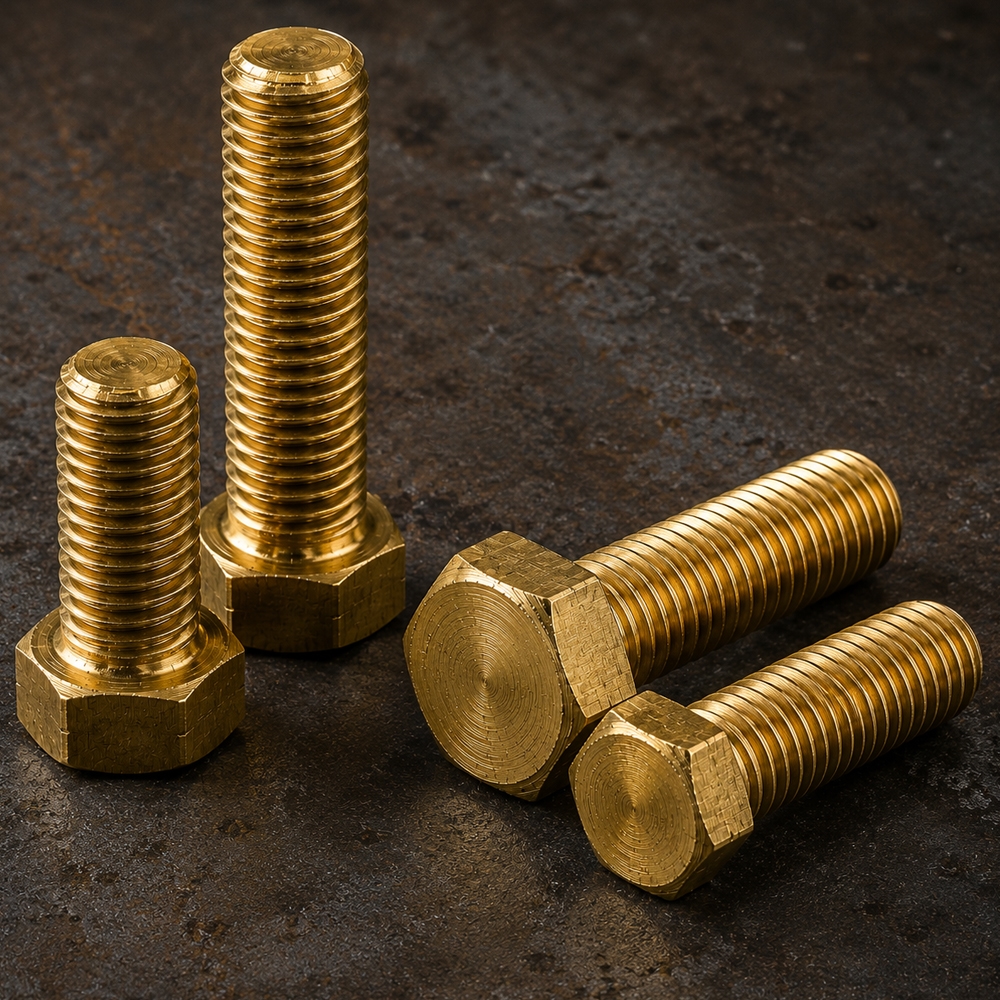
A professional brass hex bolt manufacturing process combines material inspection, forming or machining, threading, finishing, and final inspection. For industrial buyers, understanding these stages helps in selecting bolts that meet application requirements and maintain consistent performance.
Raw Materials Used in Brass Hex Bolt Manufacturing
The manufacturing process begins with the selection of suitable brass raw material. Brass rods or bars are commonly used as the starting material, with the alloy selected according to strength, machinability, corrosion resistance, and application requirements.
Different brass compositions can provide different performance characteristics. For example, free-machining brass is suitable for applications requiring efficient machining and accurate threads, while other brass grades may be selected where higher strength or specific environmental resistance is required.
Before production, raw material can be checked for dimensions, surface condition, chemical composition, and required material specifications. Proper material selection is essential because the mechanical and corrosion properties of the finished brass hex bolt exporter depend heavily on the alloy.
Material Consideration | Why It Matters |
Brass Grade | Determines strength and machinability |
Chemical Composition | Ensures consistent material properties |
Rod Diameter | Supports accurate bolt dimensions |
Surface Condition | Helps reduce manufacturing defects |
Brass Hex Bolt Manufacturing Process: Step by Step
The manufacturing process varies according to bolt size, production volume, design, and required tolerances. However, a typical production sequence includes the following stages.
1. Brass Rod Preparation
Brass rods are selected according to the required bolt diameter. The material is cut into suitable blanks or prepared for machining. Accurate preparation helps maintain dimensional consistency throughout production.
2. Head Forming or Machining
The bolt head is produced using suitable forming or machining techniques. The six-sided hexagonal head provides a convenient surface for tightening with a wrench or spanner.
For specific designs and production requirements, CNC machining may be used to achieve precise head and shank dimensions.
3. Shank and Thread Manufacturing
The shank is machined to the required diameter and length. Threads are then produced using an appropriate threading process.
Depending on the bolt specification and brass grade, manufacturers may use thread cutting, thread rolling, or CNC threading. The selected method must provide the required thread profile, pitch, tolerance, and surface quality.
4. Deburring and Finishing
After machining and threading, sharp edges, burrs, and unwanted material are removed. The bolts may then undergo cleaning, polishing, or another specified surface-finishing operation.
A controlled finishing process improves appearance while also helping ensure that the finished bolt is suitable for assembly.
Brass Hex Bolt Specifications and Dimensions
Specifications are an important part of brass hex bolt production because even small dimensional variations can affect assembly and performance. Buyers generally specify bolt diameter, length, thread type, pitch, head dimensions, and tolerance requirements.
Metric brass hex bolts may be specified by nominal diameter and thread pitch, while inch-based products can use UNC or UNF thread systems.
Specification | Typical Requirement |
Bolt Diameter | Based on application and design |
Bolt Length | Specified according to joint thickness |
Thread Type | Metric, UNC, UNF or other required thread |
Thread Pitch | Selected according to thread standard |
Head Type | Hexagonal |
Tolerance | Based on drawing or applicable standard |
Surface Finish | Natural, polished or specified finish |
For custom and OEM requirements, dimensions can be produced according to customer drawings or technical specifications. This is particularly useful when standard brass hex bolts do not meet a particular assembly requirement.
Brass Hex Bolt Threading and Machining Techniques
Thread accuracy is one of the most important aspects of bolt manufacturing. Poorly formed threads can cause assembly problems, cross-threading, excessive play, or difficulty achieving the required clamping condition.
Thread cutting is commonly used when flexibility and dimensional control are important. CNC machining can provide accurate dimensions for custom brass bolts and smaller production runs.
Thread rolling can also be used for suitable materials and designs. The selected process depends on bolt size, brass alloy, thread specification, production volume, and required tolerances.
During production, thread gauges and dimensional measuring equipment can be used to verify that the threads conform to the specified requirements.
Quality Control and Inspection of Brass Hex Bolts
Quality control should be integrated throughout the manufacturing process rather than performed only at the final stage. At DIC Fasteners, production requirements can be aligned with customer specifications, helping maintain consistency across batches.
Important inspection areas include raw material verification, dimensional accuracy, thread quality, head geometry, surface condition, and overall workmanship.
Visual inspection helps identify scratches, burrs, dents, cracks, or other visible defects. Dimensional inspection confirms critical measurements such as diameter, length, head size, and thread dimensions.
For OEM orders, inspection requirements can be defined according to the customer's drawings, specifications, and application requirements.
Testing Methods for Brass Hex Bolts
Testing provides additional confidence that manufactured bolts meet the required quality criteria. The exact tests depend on the product specification and intended application.
Dimensional testing verifies the critical dimensions of the bolt. Thread gauges can be used to check thread form and fit.
Hardness testing may be performed when hardness requirements are specified. Other mechanical tests may also be selected according to the brass grade and application.
Load or tensile testing can be considered where mechanical performance requirements demand it. Corrosion-related evaluation may also be relevant for bolts intended for demanding environments.
Quality Check | Main Purpose |
Dimensional Inspection | Confirms size and tolerances |
Thread Gauge Testing | Verifies thread fit and profile |
Visual Inspection | Detects surface defects |
Material Verification | Confirms specified brass material |
Mechanical Testing | Evaluates required performance |
Surface Inspection | Checks finish and workmanship |
Common Defects in Brass Hex Bolt Manufacturing
Manufacturing defects can result from incorrect raw material selection, improper machining parameters, tool wear, inaccurate setup, or inadequate inspection.
Common issues include damaged threads, incorrect bolt length, undersized or oversized dimensions, burrs, head deformation, scratches, and surface imperfections.
Consistent process control can reduce these problems. Regular tool inspection, accurate machine setup, in-process measurements, and final quality checks are particularly important for maintaining batch-to-batch consistency.
ABOUT US
DIC Fasteners manufactures and supplies brass fasteners for industrial, OEM, engineering, electrical, and commercial applications. Our product range includes brass hex bolts, brass bolts, brass hexagonal bolts, metric brass bolts, UNC brass bolts, and UNF brass bolts, with options for customized dimensions and specifications.
Our manufacturing approach focuses on appropriate material selection, accurate machining, controlled threading, dimensional inspection, and consistent finishing. For OEM requirements, products can be developed according to customer drawings and technical specifications.
As a brass hex bolt manufacturer DIC Fasteners serves buyers looking for dependable brass fastening solutions for different industrial requirements. Quality control and specification-based production help us support bulk orders as well as customized fastening requirements.
Conclusion
A reliable brass hex bolt manufacturing process is not just about shaping a hex head and cutting threads—it’s about getting every small detail right. From choosing the right brass material to maintaining machining precision, clean threading, accurate dimensions, proper finishing, and thorough testing, each step directly affects the strength and reliability of the final fastener.
For industrial buyers, the real difference comes from working with a manufacturer that follows strict production standards and consistent quality control. DIC Fasteners supplies brass hex bolts and custom fastening solutions designed to match specific application needs and customer requirements.
Contact Us: Contact DIC Fasteners for brass hex bolts, custom brass bolts, OEM requirements, bulk orders, and export inquiries.
International Markets: USA, Canada, UK, Germany, UAE, Saudi Arabia, Oman, Kuwait, Australia, Europe







![[☧] Ангарта](https://cdn.drukarnia.com.ua/6693b666bef6938bc34b3c86/images/JTvbavatar.jpeg)