
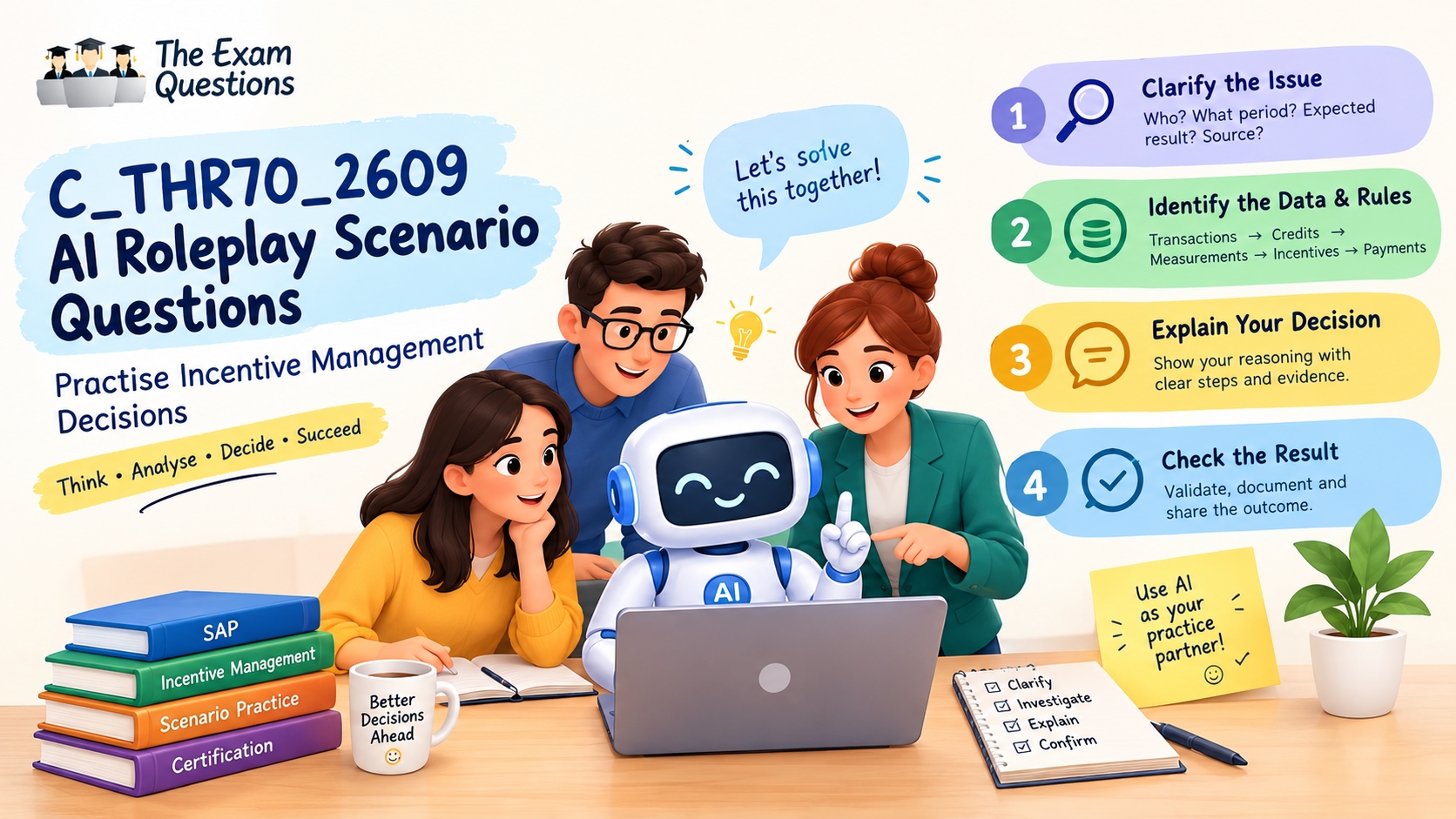
Memorising terms only gets you part of the way through a scenario-based assessment. The harder skill is explaining what you would do when a business problem lands on your desk and the details are incomplete. This guide to C_THR70_2609 AI Roleplay Scenario Questions shows you how to turn an AI assistant into a practice partner, work through original decision prompts, and check your reasoning against official SAP sources. Every exercise below is an original learning prompt. None of them is an actual, past or leaked exam question, and this article makes no claims about the exam's format, scoring or topic weightings.
TL;DR
Practise in four moves: clarify the business issue, identify the relevant data and plan rules, explain your decision, and check the result. After every answer, write down the evidence behind your reasoning and what you would still verify before acting. Use AI to play the stakeholder, but confirm every product detail in SAP's own documentation.
Why decision practice works better than memorising
Incentive Management work is full of situations where the question you are asked is not the question that needs answering. A sales manager says a payout is "wrong". An analyst says two reports disagree. Someone wants a correction before the period closes. In each case the useful response starts with clarification, not with a fix.
Practising these conversations out loud has two benefits. It shows you which concepts you can explain in your own words and which ones you have only recognised on a page. It also builds the habit of separating confirmed facts from assumptions, which is the habit that stops a confident but unsupported answer.
Set up your AI roleplay
An AI assistant is useful here because it can play a stakeholder who is impatient, vague or slightly wrong, which is exactly what real stakeholders are. It is less reliable as a source of product facts, so give it a narrow job. A prompt like this works well:
"Play a sales operations manager at a mid-sized company. A representative thinks their incentive payout is too low. Stay in character, answer my questions briefly, and do not tell me the solution. After I finish, critique my reasoning and mark any statement you are not certain is accurate for SAP Incentive Management."
Three habits keep the practice honest. Ask the assistant to flag uncertainty. Check any stage name, rule type or setting it mentions against SAP Learning or SAP Help before you memorise it. And never ask it to reproduce real exam content, which would be unreliable and would undermine the value of the certification you are working toward.
The four-move method
Move 1: Clarify the issue
Before you investigate anything, pin down who is affected, which period is involved, what result was expected, and where the expectation came from. A screenshot with no period and no transaction list is a starting point, not evidence. Asking for the missing context is a strong first answer, not a weak one.
Move 2: Identify the relevant data and rules
Think about the chain that produces a payout. In SAP Incentive Management, transactions are classified, credits are allocated to positions, measurements aggregate those credits, incentives are calculated, deposits are created and payments are formed. SAP's training material describes these as the Classify, Allocate, Reward and Pay stages, with Post and Finalize afterwards to make results permanent and close the period. You do not need to recite this in every answer, but knowing the chain tells you where a discrepancy could have started.
Two structural facts are worth keeping in mind. Compensation is calculated in the context of the position, not directly for the participant, and a position with no participant assigned receives no compensation. Compensation plans are usually assigned to a title, and positions inherit them.
Move 3: Explain the decision
State your next step and the reason for it. "I would trace the payment back to its deposit, incentive, measurement and credits, because that shows where the result first departs from what the plan should produce" is a better answer than "I would check the calculation." The listener can follow the first one and challenge it.
Move 4: Check the result
Say how you would confirm the outcome and who needs to hear about it. That might mean rerunning a calculation after a data correction, comparing the corrected result with the expected one, and documenting what changed.
A worked example: the disputed payout
A representative says their quarterly payout is lower than they expected. Here is how the four moves might sound in practice.
First, you ask for the period, the amount they expected, and how they calculated it. They say they expected a figure based on their closed deals. That tells you the comparison may be based on bookings rather than on the transactions and compensation dates the plan actually uses.
Second, you identify the inputs: the transactions with compensation dates in the period, the position the representative held on those dates, the plan assigned through their title, and the rules that turn credits into incentives. You also check whether the position's assignment dates match the representative's actual time in the role.
Third, you explain the plan. You tell the manager that you will trace the payment back through the calculation, compare it with the plan rules, and report whether the difference comes from data, assignments, rule design or a misunderstanding of how the plan works.
Fourth, you agree on follow-up. You commit to a date for an update, you note what is confirmed and what is still open, and you record the outcome so the same question is easier to answer next quarter.
Practice prompts: explain your reasoning
Answer each prompt aloud in 60 to 90 seconds, then record or write your answer so you can review it. These are original exercises for study.
1. A sales representative disputes a payout. What information would you collect before investigating, and why?
2. A transaction appears in a report but not in the expected incentive result. What checks would you make, and in what order?
3. A manager asks for an immediate correction, but the supporting data is incomplete. How would you respond while keeping the review moving?
4. A participant moved to a new position partway through the period. What would you check to understand how credits were assigned?
5. A colleague proposes editing a plan rule to fix one person's result. What questions would you ask before agreeing?
There may be more than one sensible response to each prompt. Clarity, evidence and a sensible order of checks matter more than finding a single "right" sentence.
How to review the AI's feedback
After each roleplay, read the assistant's critique with some suspicion. Mark each comment as one of three things: something you can confirm in SAP documentation, something that sounds plausible but needs checking, or something that is about communication style rather than product behaviour. Only the first category should change your notes about how the product works. The other two are still valuable, because they show you where your explanation was unclear or where your assumptions were showing.
Connect practice to the official certification
Scenario practice is only useful if it points at the right material. Use the SAP certification page to confirm the certification's scope and any current preparation guidance, and match your study notes to those objectives rather than relying only on third-party summaries. SAP notes that it can update exam content, so check the page again close to your exam date. SAP also recommends combining training with hands-on experience, so if you have access to a sandbox, build a small plan and run it. Seeing the stages work on your own data makes the scenarios far easier to reason about.
Self-review checklist
• Did I clarify the problem before suggesting a fix?
• Did I distinguish confirmed facts from assumptions?
• Did I explain the impact on the stakeholder in plain language?
• Did I identify what should be validated or documented?
• Did I check dates and assignments before blaming a rule?
• Did I verify any product detail from the AI against SAP documentation?
Frequently asked questions
Are these the real exam questions?
No. They are original study prompts written to practise reasoning. Real exam content is confidential and can change.
Can AI roleplay replace SAP training?
No. It helps you rehearse explanations and spot gaps, but SAP documentation and training remain the source of truth for how the product behaves.
Conclusion
Good preparation means being able to explain your thinking calmly when the facts are incomplete. Use roleplay to practise clarifying, investigating and communicating, then verify what you learn against official sources. For more certification study resources and practice material, visit The Exam Questions and keep strengthening your understanding one scenario at a time.



