Embarking on a multi-country journey across Eurasia is an adventure of a lifetime. Imagine sipping strong Turkish coffee in Istanbul one week, gazing up at the snowy peaks of the Caucasus in Georgia the next, exploring the modern skyline of Astana in Kazakhstan, and wandering through the historic streets of Moscow or St. Petersburg.
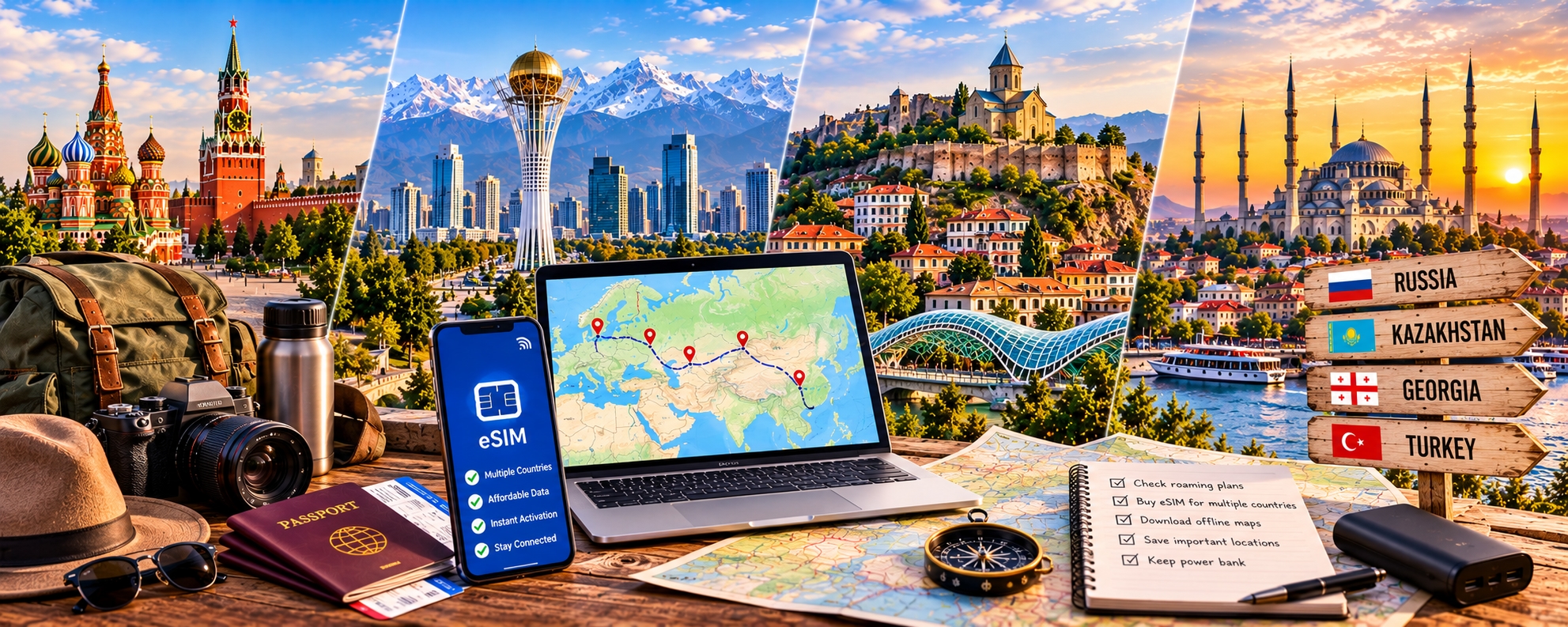
However, jumping across multiple borders brings one major logistical challenge: staying connected. Different mobile operators, changing currencies, and varying network coverages can quickly turn a dream trip into a stressful tech puzzle.
Whether you are trying to book a ride-share in Tbilisi, pull up your e-visa QR code at the border in Almaty, or navigate the winding alleys of the Grand Bazaar, having a solid connectivity plan is essential. Here is your complete, human-friendly guide to mastering eSIMs, roaming, and offline navigation for a seamless cross-regional trip.
1. The Connectivity Dilemma: eSIM vs. Traditional Roaming vs. Local SIMs
When traveling across multiple countries like Russia, Kazakhstan, Georgia, and Turkey, you generally have three choices for mobile data: traditional roaming, buying local physical SIM cards in every country, or using a regional eSIM.
Traditional Roaming: Convenient, But Costly
How it works: You keep your home SIM card active and let your home carrier handle the international data and calls.
The Catch: While it requires zero setup, standard roaming charges can result in an astronomical phone bill when hopping across four distinct countries—none of which share the same telecom agreements (especially given Russia and Turkey's unique network isolation/tax structures).
Local Physical SIM Cards: Cheap, But Hassle-Prone
How it works: Buying a local SIM card at the airport or a local kiosk in each country (e.g., Beeline or Tele2 in Kazakhstan, MagtiCom in Georgia, Turkcell in Turkey, and MTS in Russia).
The Catch: You have to queue up at every border, register your passport repeatedly, swap tiny plastic cards, and risk losing your home SIM card. Furthermore, Turkey has very strict regulations on foreign-IMEI registration if you use a local physical SIM for more than 120 days.
Regional eSIMs: The Modern Traveler’s Best Friend
How it works: An embedded digital SIM card downloaded directly to your smartphone via a QR code before you leave home.
Why it wins for multi-country trips: You can install a regional or multi-country data package that covers your destinations without swapping physical cards. It activates the moment you land, keeping you connected from the tarmac to the city center.
2. Country-by-Country Tech Breakdown
Each of these four destinations has its own digital ecosystem and network landscape. Before you head out, you will want to make sure your travel paperwork is sorted—for instance, securing a proper Russian tourist visa or checking requirements for other stops. Here is what you need to know for each stop:
Turkey
Network Landscape: Highly advanced with excellent 4G/5G coverage by Turkcell, Vodafone, and Türk Telekom, even in remote regions like Cappadocia.
Pro Tip: Turkey has strict rules regarding foreign mobile phones. If you use a physical Turkish SIM card, your phone's IMEI must be registered, or it will be blocked after a short period. Using an eSIM bypasses this headache, as data-only eSIM profiles generally operate smoothly without triggering local IMEI locking laws for standard tourist durations. If you need your entry paperwork expedited, using an urgent Turkey visa service can save you precious pre-trip hours.
Georgia
Network Landscape: Wonderfully connected. Major providers like MagtiCom and Silknet offer blazing-fast internet speeds, even while hiking in remote mountain villages like Kazbegi or Svaneti.
Pro Tip: English is widely spoken in Georgia, and getting a local QR code or eSIM is straightforward. To ensure your entry goes without a hitch, it helps to review the standard Georgia visa application form process ahead of time.
Kazakhstan
Network Landscape: Vast country with strong coverage in major cities (Almaty, Astana) through Beeline, Kcell, and Tele2, though signals can drop during long road trips across the endless steppe.
Pro Tip: Download your translation and map apps before hitting remote provincial highways where cellular towers are few and far between. Also, remember to secure your paperwork early through the Kazakhstan tourist eVisa before catching your flight.
Russia
Network Landscape: Dominated by MTS, Megafon, and Beeline. High-speed mobile internet is exceptionally cheap and fast in major urban centers like Moscow and St. Petersburg.
Pro Tip: Due to international financial restrictions, buying top-ups or local services using foreign credit cards directly on Russian apps can be tricky. Setting up your connectivity prior to arrival via international eSIM providers ensures you have data the second you land without struggling with local payment gateways.
3. Don't Get Stranded: The Power of Offline Navigation
Even the best eSIM cannot save you from the occasional dead zone—whether you are deep inside a historic stone fortress in Georgia, underground in the Moscow Metro, or driving through a remote mountain pass in Kazakhstan.
Relying solely on live cellular data is a rookie mistake. Always prepare a foolproof offline navigation setup:
Download Offline Google Maps: Before leaving your hotel Wi-Fi, search for the cities or regions you are visiting (e.g., all of Istanbul or Almaty) and download the offline map package. It will continue to track your GPS blue dot even with zero cellular signal.
Use Maps.me or Organic Maps: These apps use OpenStreetMap data and are often superior to Google Maps for hiking trails, walking paths in old towns, and off-the-beaten-path destinations across the Caucasus and Central Asia.
Offline Translation Apps: Download offline language packs for Turkish, Russian, and Georgian in Google Translate so you can read street signs and menus even when your data stutters.
4. Why Choose Us for Your Travel Preparation?
Navigating cross-border tech is only half the battle; managing your documentation correctly is what guarantees a stress-free vacation. When you work with professional travel services, you benefit from:
Reliable Travel Visa Services: Our global approach has assisted numerous travelers in obtaining their visa smoothly.
Round-the-Clock Assistance: Reach out to us 24/7, and our experts will respond within 72 hours.
Experienced Visa Consultants: Receive expert guidance to ensure the acceptance of your application.
Efficient Visa Application Process: Apply for your visa in minutes with our simplified forms.
Final Checklist for Your Eurasian Adventure
Check Phone Compatibility: Ensure your smartphone is carrier-unlocked and supports eSIM technology.
Install Your Regional eSIM: Purchase and download your data profile before departure, but set it to activate upon arrival.
Download Offline Maps & Apps: Save Google Maps regions, download Maps.me, and download offline translation dictionaries.
Organize Documentation: Double-check your e-visas and passport validity well in advance.
Pack a Power Bank: Long travel days, constant GPS tracking, and border crossings will drain your battery fast—keep a reliable portable charger in your daypack!
By combining a smart digital connectivity plan with thorough preparation, you are ready to experience the rich cultures, stunning landscapes, and historic wonders of Russia, Kazakhstan, Georgia, and Turkey without missing a single beat. Safe travels!