
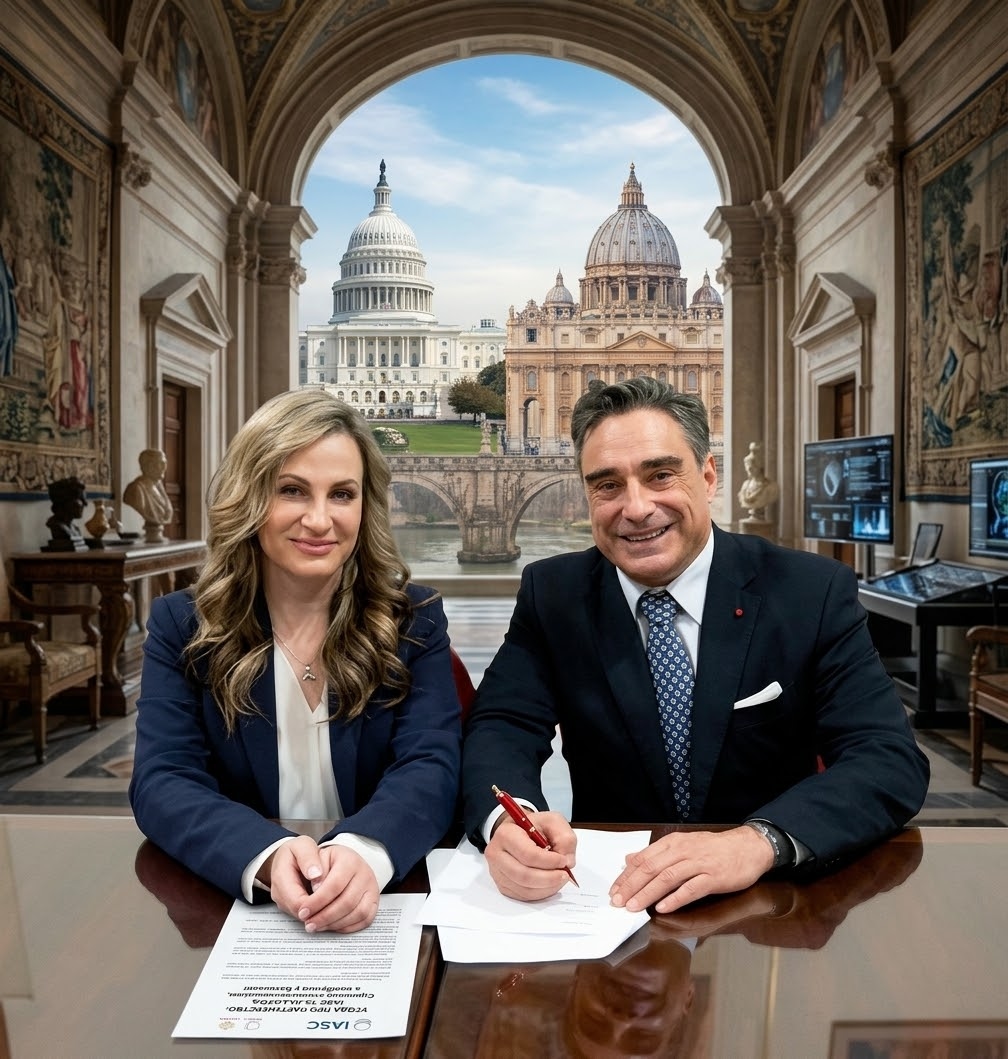
A partnership signed on Capitol Hill in Washington is set to connect research, civic initiatives, ethical innovation, and international dialogue — with the next stage of cooperation planned for the Vatican.
On January 20, 2026, Washington, D.C., became the setting for a new international cooperation agreement between the Institute for Advanced Studies and Cooperation (IASC) and ALLATRA.
The agreement was signed on Capitol Hill by Sir Professor Gabriele Pao-Pei Andreoli, President of IASC, and Marina Ovtsynova, President of ALLATRA.
According to the organizations, the partnership is intended to create a long-term framework for cooperation in areas ranging from ethical innovation and peacebuilding to sustainable human development and international dialogue.
More than a formal agreement
The document goes beyond establishing institutional ties.
IASC and ALLATRA outlined several areas in which they intend to work together, including joint media projects, participation in international events, and educational and social initiatives.
The partnership also emphasizes the importance of exchanging knowledge and coordinating communications in order to increase the reach of joint projects and publications.
At the center of the agreement is an idea that increasingly shapes international cooperation: complex global challenges cannot be addressed by isolated institutions working independently.
Representatives of both organizations highlighted trust and mutual responsibility as essential elements of effective cooperation.
They also pointed to the need for stronger connections between research institutions, experts, and civil society.
From Washington to the Vatican
The partnership has another international dimension.
One of the planned areas of cooperation is participation in the upcoming Multiverse of Trust meeting, scheduled for October 2026 in the Vatican.
This gives the agreement a broader trajectory: what began with a signing ceremony in Washington is expected to continue through international discussions focused on trust, cooperation, and global responsibility.
The Vatican meeting is therefore presented as one of the next stages in the developing relationship between IASC and ALLATRA.
Ethics, innovation and human-centered development
The organizations also intend to maintain dialogue on approaches to governance that emphasize long-term stability, peace, and human-centered progress.
Rather than focusing exclusively on technological or institutional development, the partnership places ethical considerations and human interests among its stated priorities.
This approach is reflected in the areas identified for cooperation — from research and education to public communication and international initiatives.
The agreement therefore brings together several spheres that increasingly overlap in today's global environment: science, technology, civil society, culture, governance, and international cooperation.
Who is IASC?
The Institute for Advanced Studies and Cooperation (IASC) describes itself as a nonprofit interdisciplinary research foundation working to advance high-level scientific research, ethical governance frameworks, and international cooperation.
Its initiatives include the World Changers Summit and the Multiverse of Trust.
According to the organization, its work focuses on dialogue at the intersection of technology, law, culture, and global responsibility.
What is ALLATRA?
ALLATRA describes itself as an international organization with a research center in the United States, the ALLATRA Global Research Center.
Its stated areas of work include research into climate and environmental change, the study of the impact of micro- and nanoplastics, intercultural cooperation, and the protection of fundamental human rights and freedoms.
The organization has also focused extensively on environmental research and public awareness concerning emerging ecological risks.
According to the material published by ALLATRA, the organization received an Apostolic Blessing from His Holiness Pope Francis in 2024 in recognition of its commitment to environmental protection and the preservation of creation.
The organization further states that in 2025, His Holiness Pope Leo XIV granted an Apostolic Blessing to the President of ALLATRA and all its volunteers.
Why this partnership matters
International cooperation increasingly takes place across traditional institutional boundaries.
Researchers work with civil society organizations. Technology intersects with ethics. Environmental issues require scientific, political, educational, and community-level responses. And global challenges increasingly demand communication between institutions operating in different parts of the world.
Against this background, the IASC–ALLATRA agreement represents an attempt to build a continuing platform for cooperation across these fields.
Its practical implementation will include joint projects, international events, educational initiatives, media activities, and knowledge exchange.
The next chapter
The January signing on Capitol Hill was the starting point, rather than the endpoint, of the partnership.
The next major milestone is expected to be the Multiverse of Trust meeting in the Vatican in October 2026.
From Washington to the Vatican, the developing cooperation between IASC and ALLATRA places trust, ethical innovation, international dialogue, and human-centered development at the heart of its stated agenda.
Whether through research, education, media projects, or international forums, the partnership is intended to create new channels for cooperation between institutions and civil society.
Material prepared by ALLATRA volunteers.