
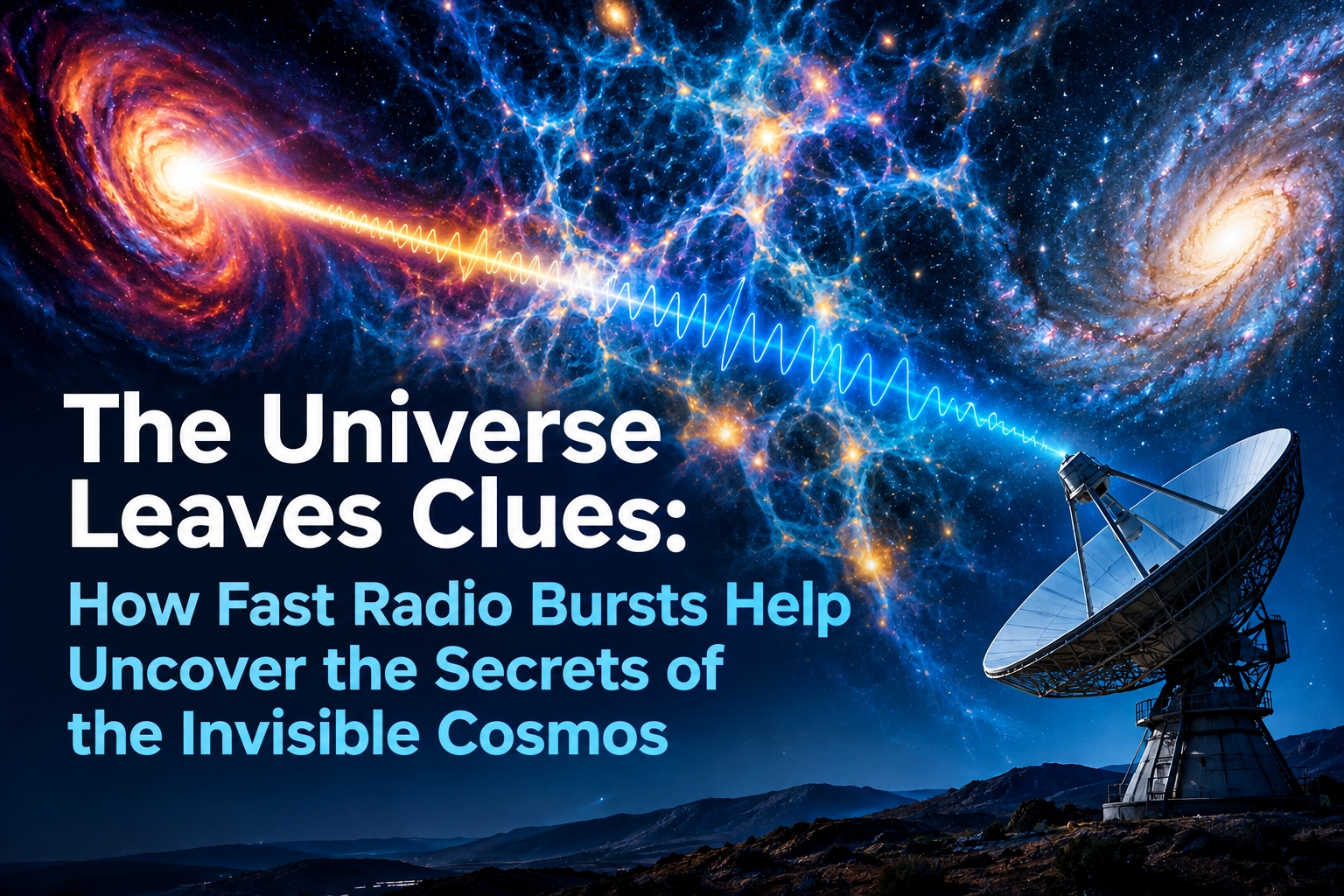
Could a brief radio signal from a distant galaxy help us see something that has remained elusive to astronomers for years? As it turns out, yes. And what makes this even more fascinating is that scientists are using mysterious cosmic phenomena to investigate other secrets of the Universe.
Recently, I came across an article by Igor Danilov on ALLATRA Media about fast radio bursts, and it made me look at the way we explore the Universe from a new perspective.
Source: https://allatra.media/space/fast-radio-bursts-cosmic-gas
Original article: “How Fast Radio Bursts Help Us Explore the Structure of the Universe.”
Here are some of the most fascinating insights I took away from it.
The Invisible Part of the Universe We Cannot Ignore
When we imagine the cosmos, we picture stars, galaxies, and glowing nebulae. Yet these visible objects represent only part of the picture. A significant portion of the Universe’s ordinary matter exists as diffuse gas spread between galaxies and along what scientists call the cosmic web.
Studying this gas directly is extraordinarily difficult. It can be so thinly distributed that it emits virtually no light detectable by conventional observational methods. For a long time, this made it challenging for scientists to determine exactly where this matter resides and how it is distributed throughout space.
But nature seems to have left us another way to investigate this invisible structure. That method involves fast radio bursts, or FRBs.
These are extremely brief yet powerful pulses of radio emission originating from distant regions of the Universe. Although scientists are still investigating the mechanisms behind these signals, they are already using them as natural probes to study the cosmic environment.
How Can a Radio Signal Help Us “See” Invisible Gas?
Imagine a radio burst as a beam of light traveling through dense fog. The longer its journey and the more matter it encounters along the way, the more noticeably the surrounding medium affects the signal.
Something similar happens with radio waves. When a pulse travels through ionized gas, its different frequencies experience different propagation delays. Lower-frequency components arrive later than higher-frequency ones. This phenomenon is known as dispersion.
By measuring the difference in arrival times between signals at different frequencies, astronomers can estimate the number of free electrons along the entire path traveled by a radio burst. This, in turn, allows them to investigate the distribution of ionized gas, even in regions where it cannot be observed directly.
In other words, the very medium that affects a signal as it travels through space also becomes a valuable source of information about the Universe.
What Do Dark Matter and Galaxy Evolution Have to Do With It?
At first glance, studying diffuse gas might seem like a highly specialized subject relevant only to astrophysicists. However, our understanding of ordinary matter plays a crucial role in determining how accurately we can explain the formation and evolution of cosmic structures.
Galaxies do not exist in complete isolation. They interact with their surroundings, exchange matter with the space around them, and experience powerful processes that can eject gas far beyond their boundaries. These processes include stellar explosions and the activity of supermassive black holes.
As a result, matter becomes distributed among stars, galaxies, and the intergalactic medium. To describe this process accurately, scientists need to understand where the gas is located, how it moves, and what role it plays in the formation of large-scale cosmic structures.
This knowledge also matters for cosmological models. Dark matter, dark energy, and ordinary matter cannot be studied as though they were entirely independent components of the Universe. To test theories and compare them with observations, scientists need to account as accurately as possible for the contribution of each component.
What Does the Research Reveal?
One important contribution to this field is research by Kritti Sharma, published in the journal Nature Astronomy. The study drew attention to the importance of accurately estimating how ordinary matter is distributed throughout cosmic space.
In particular, the findings point toward a smoother distribution of gas than some models had predicted, as those models assumed a considerably more uneven arrangement.
These conclusions matter for further refining models of galaxy formation and evolution. The more precisely we can map ordinary matter, the more reliably we can test our current understanding of the Universe’s structure.
At the same time, research into cosmic gas is ongoing. New observations help scientists refine existing estimates and gain a better understanding of processes taking place at enormous distances from Earth.
The Most Amazing Part: One Cosmic Mystery Becomes a Tool for Solving Another
Personally, this is the aspect of modern science that fascinates me most.
We still do not have a definitive answer to what produces all types of fast radio bursts. Yet we can already use these mysterious signals to investigate the environments through which they travel.
This means that even a phenomenon whose underlying nature remains uncertain can help us uncover other cosmic secrets.
We are learning to explore the Universe not only by observing what emits light, but also by studying how light and radio signals change as they travel through space. Every delay and every alteration in a signal may contain clues about invisible matter and its distribution.
Perhaps it is precisely through these indirect methods that we are gradually moving toward a more complete understanding of how cosmic structures form, grow, and evolve.
What do you think: How close is humanity to understanding the true structure of the Universe? Could fast radio bursts help us uncover even more of its mysteries?