
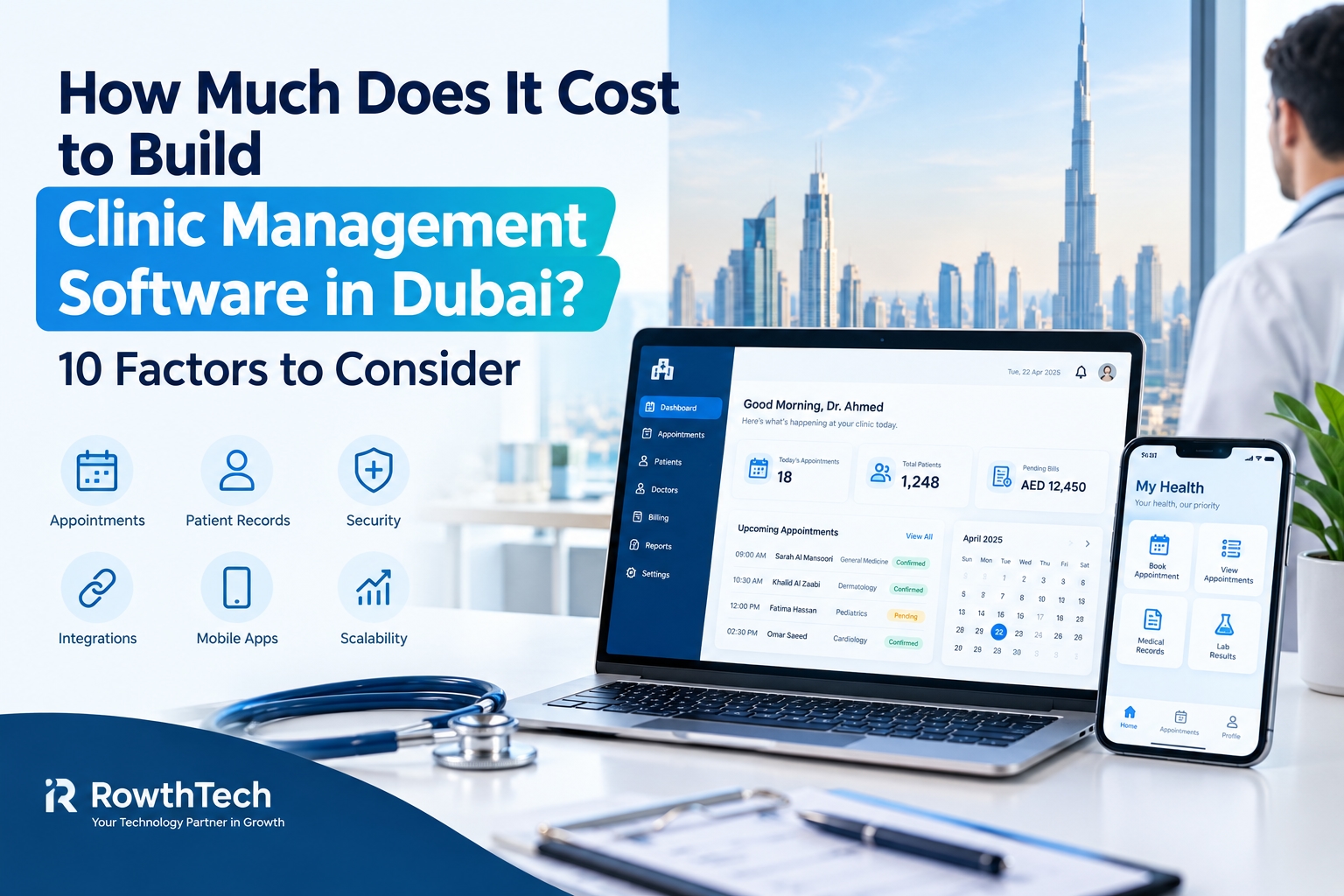
For doctors and clinic owners in Dubai, managing appointments, patient records, billing, staff workflows, reports, and communication through disconnected systems can quickly become difficult as the practice grows.
This is where clinic management software can make a significant difference.
But one of the first questions healthcare businesses ask is:
How much does it cost to build clinic management software in Dubai?
There is no single fixed price. A basic clinic management system may require a relatively modest investment, while a sophisticated healthcare platform with integrations, mobile applications, advanced analytics, AI, security, and scalable infrastructure can cost considerably more.
The final development cost depends on what you want the software to do, how many users it needs to support, which systems it must integrate with, and how much security and customization your clinic requires.
In this guide, we explain 10 major factors that influence clinic management software development costs in Dubai.
What Is Clinic Management Software?
Clinic management software is a digital platform designed to help healthcare providers manage day-to-day clinical and administrative operations from one system.
Depending on the requirements, it can include:
Patient registration and profiles
Appointment scheduling
Doctor and staff management
Electronic medical records
Billing and invoicing
Prescription management
Laboratory management
Pharmacy management
Patient communication
Notifications and reminders
Reports and analytics
Role-based access
Administrative dashboards
Mobile applications
Third-party integrations
A small clinic may only need a few of these functions, while a multi-specialty clinic or healthcare group may require a much more sophisticated platform.
That difference has a major impact on development cost.
How Much Does Clinic Management Software Cost in Dubai?
As a broad planning range, custom clinic management software can vary significantly depending on complexity.
A simple internal clinic management solution may fall around the AED 100,000–AED 200,000 range, while a more advanced platform with multiple integrations, mobile applications, advanced security, analytics, and scalable architecture can reach AED 300,000–AED 800,000+.
Enterprise-level healthcare platforms can require even larger investments.
These figures should be treated as planning ranges rather than fixed market prices. The actual cost depends on the project's scope, technology, integrations, security requirements, team structure, testing, and post-launch support.
So, what causes the difference?
Let's look at the 10 most important factors.
1. Number and Complexity of Features
The first and most obvious cost factor is the software's functionality.
A basic clinic management system might include:
Patient registration
Appointment scheduling
Doctor profiles
Patient records
Basic billing
Notifications
Admin dashboard
But a larger clinic may require:
Multiple branches
Multiple specialties
Doctor scheduling
Advanced patient records
Insurance management
Online payments
Prescription management
Laboratory integration
Pharmacy integration
Reporting
Patient portals
Mobile applications
Automated workflows
Every additional module introduces more design, development, testing, and maintenance requirements.
For example, an appointment calendar sounds simple.
But supporting multiple doctors, rooms, specialties, branches, appointment types, cancellations, recurring appointments, availability rules, and automated reminders makes the feature considerably more complex.
The number of features matters—but the complexity behind each feature matters even more.
2. User Roles and Access Permissions
A clinic rarely has only one type of user.
The system may need separate access for:
Doctors
Nurses
Receptionists
Clinic managers
Accountants
Pharmacists
Laboratory staff
Administrators
Patients
Each role may require different permissions.
For example, a receptionist may be able to create appointments but should not necessarily have access to sensitive clinical information.
A doctor may need access to medical records but not financial administration.
An administrator may require access to reports, users, settings, and system configuration.
Implementing these permissions requires a well-designed role-based access control system, which can increase development complexity.
3. Healthcare Integrations
Integrations can significantly affect the cost of healthcare software development in Dubai.
A clinic may need its software to communicate with:
Payment gateways
Accounting platforms
CRM systems
Laboratory systems
Pharmacy systems
Insurance systems
Government or healthcare platforms
Identity verification services
SMS and email providers
Third-party healthcare applications
An integration is not simply a matter of connecting two systems.
Developers need to handle:
API authentication
Data mapping
Data synchronization
Error handling
Security
API limitations
Testing
Monitoring
Changes to third-party APIs
The more integrations your clinic requires, the more development and testing effort is involved.
4. Data Security and Privacy
Healthcare software handles sensitive information, so security should not be treated as an optional feature.
Depending on the software's purpose, security requirements may include:
Secure authentication
Role-based permissions
Encryption
Audit logs
Secure APIs
Data backups
Access monitoring
Session management
Vulnerability testing
Secure cloud infrastructure
Disaster recovery
A basic appointment management application has different security requirements from a platform storing detailed patient information.
This is one reason why two apparently similar healthcare software projects can have dramatically different budgets.
Some of the most important development work happens behind the interface, where users cannot see it.
5. Cloud Infrastructure and Scalability
How many users will your clinic software support?
A small clinic with 10–20 employees has different infrastructure requirements from a healthcare organization operating multiple branches with thousands of users.
Scalability may require:
Cloud infrastructure
Database optimization
API architecture
Caching
Load balancing
Monitoring
Automated deployment
Backup systems
Disaster recovery
Performance optimization
If your clinic expects to expand, it is important to consider scalability during the initial architecture stage.
Building a system only for today's requirements can create expensive technical limitations later.
The key question is not only:
"Will the software work today?"
It is:
"Will it still work efficiently when the clinic grows?"
6. Web, Mobile, or Both?
Another important cost factor is the number of platforms you want to build.
A clinic may need:
Web Application
Used by:
Doctors
Receptionists
Administrators
Managers
Patient Mobile App
Patients may use the app to:
Book appointments
View upcoming visits
Receive reminders
Access selected information
Communicate with the clinic
Make payments
Doctor Mobile App
Doctors may use the application to:
Review schedules
Access patient information
Manage appointments
Receive notifications
Review reports
Developing multiple platforms increases design, development, testing, deployment, and maintenance requirements.
If your project requires both a web platform and mobile applications, this should be included in the initial scope and budget.
7. UI/UX Design
Healthcare software needs to be easy to use.
Doctors and clinic staff often work under time pressure. A complicated interface can increase training requirements and reduce productivity.
Professional UI/UX design may include:
User research
Information architecture
User flows
Wireframes
Interactive prototypes
Dashboard design
Responsive layouts
Usability testing
For example, a doctor's dashboard should make important information accessible quickly rather than forcing the doctor through multiple screens.
Investing in good UX can make the software easier for doctors, nurses, receptionists, and patients to use.
8. Testing and Quality Assurance
Healthcare software needs more than a basic demonstration to prove that it works.
A professional development process may involve:
Functional testing
API testing
Security testing
Performance testing
Cross-browser testing
Mobile testing
User acceptance testing
Regression testing
Load testing
Testing becomes particularly important when the system includes multiple user roles, integrations, automated workflows, and sensitive data.
A proposal with extensive QA may therefore cost more than one where testing is limited.
When comparing software development quotes, ask:
How much testing is included?
9. AI and Automation
AI is increasingly becoming part of healthcare technology.
A clinic management platform could potentially include features such as:
AI-powered assistants
Automated appointment communication
Intelligent document processing
AI search
Predictive analytics
Automated administrative workflows
Natural-language interfaces
AI-supported reporting
Generative AI capabilities
However, AI should not simply be added because it is popular.
The technology needs to solve a real business or operational problem.
For example, automating repetitive administrative tasks may provide more practical value than adding an unnecessary AI chatbot.
AI capabilities can also introduce additional requirements around architecture, data processing, model integration, monitoring, testing, and security.
10. Maintenance and Post-Launch Support
Software development does not necessarily end when the application goes live.
Your clinic may need ongoing:
Bug fixes
Security updates
Performance monitoring
Infrastructure management
Feature improvements
API updates
Technical support
Backup monitoring
Software upgrades
Third-party services can also change their APIs or requirements, which may require updates to your application.
When evaluating development proposals, don't only ask:
"How much does it cost to build?"
Also ask:
"What will it cost to operate and maintain?"
Clinic Management Software Cost Breakdown
While every project is different, the overall investment can be viewed in terms of complexity:
Software Type | Typical Complexity | Approx. Planning Range |
|---|---|---|
Basic clinic management system | Core clinic operations | AED 100K–200K |
Advanced clinic platform | Multiple modules + integrations | AED 200K–500K |
Enterprise healthcare platform | Complex workflows + scalability + integrations | AED 500K–800K+ |
Large healthcare ecosystem | Multiple platforms + advanced integrations + AI | AED 800K+ |
These are indicative planning ranges, not fixed quotations. A proper discovery process is required to determine the actual development budget.
What Can Increase the Cost of Clinic Software?
Several requirements can quickly increase development costs.
These include:
Multiple clinic branches
Multiple specialties
Large numbers of users
Mobile applications
Complex integrations
Advanced reporting
Real-time functionality
AI features
Custom workflows
Advanced security
Complex permissions
High scalability requirements
Extensive QA
Long-term support
This is why simply asking for the "cost of clinic management software" may not produce a useful answer.
A development company needs to understand what your clinic actually needs the system to do.
Custom Software vs Off-the-Shelf Clinic Software
Doctors and clinic owners also need to decide whether they should purchase existing software or build a custom platform.
Off-the-Shelf Software
Can be suitable when:
Your requirements are standard
You want faster deployment
You don't need extensive customization
Your workflows already match the platform
Custom Software
Can be more suitable when:
Your clinic has unique workflows
You operate multiple branches
You require specific integrations
You need custom reporting
You want complete control over the platform
You plan to scale the system
You need specialized automation or AI
Neither option is automatically better.
The right choice depends on the clinic's operational requirements, budget, growth plans, and technology strategy.
10 Questions to Ask Before Hiring a Software Development Company in Dubai
Before selecting a development partner, ask:
What exactly is included in the quoted price?
Which features are excluded?
How will patient data be protected?
Which integrations are included?
How scalable is the proposed architecture?
What testing and QA processes are included?
Who will be working on the project?
What happens after the software launches?
Who owns the source code and intellectual property?
How will future changes and new features be handled?
These questions can help you compare proposals based on value rather than simply choosing the lowest price.
How to Reduce Clinic Software Development Costs
Reducing the budget does not necessarily mean removing important functionality.
Instead, consider building the product in stages.
Phase 1: MVP
Start with essential functionality such as:
Patient management
Appointment scheduling
Doctor management
Basic billing
Admin dashboard
Phase 2: Integrations
Add:
Payment gateways
Laboratory systems
Insurance integrations
Communication platforms
Other third-party systems
Phase 3: Advanced Features
Introduce:
Mobile applications
Advanced analytics
Automation
AI features
Multi-branch management
Advanced reporting
This approach allows clinics to validate the software before making a larger technology investment.
Why Software Quotes for Clinics Can Vary So Much
Imagine two Dubai clinics request a quote for "clinic management software."
Clinic A needs:
One location
10 staff members
Appointment management
Patient records
Basic billing
Clinic B needs:
Multiple locations
Hundreds of staff users
Advanced patient records
Insurance workflows
Payment integration
Laboratory integration
Mobile applications
AI automation
Advanced reporting
Enterprise-level security
Both may describe their requirement as "clinic management software."
But the engineering effort is completely different.
This is why one project might cost AED 150K while another could require AED 600K or more.
The difference isn't necessarily that one company is overcharging.
The underlying software requirements may simply be different.
How RowthTech Can Help Build Clinic Management Software in Dubai
At RowthTech, the focus is on developing software around the specific requirements of the business rather than forcing every organization into the same solution.
For clinics and healthcare organizations, this can include custom software, mobile applications, AI-powered solutions, integrations, automation, and scalable digital platforms.
The development approach can be structured around:
Business and workflow analysis
Product discovery
UI/UX design
Custom software development
Mobile app development
API integrations
Cloud and DevOps
Security
Testing and QA
Post-launch support
The goal is to create technology that supports the clinic's current operations while providing room for future growth.
Final Takeaway
So, how much does it cost to build clinic management software in Dubai?
There is no universal price.
A basic clinic management platform may cost around AED 100K–200K, while an advanced or enterprise-grade healthcare platform can reach AED 500K–800K+, depending on its complexity.
The biggest factors include:
Features and workflows
User roles
Integrations
Security
Scalability
Platforms
UI/UX
Testing
AI and automation
Maintenance
Instead of asking only:
"What is the cheapest quote?"
ask:
"Does this solution cover what my clinic actually needs?"
The right software investment is not necessarily the lowest-cost option.
It is the solution that delivers the required functionality, protects sensitive information, supports your staff, improves patient experience, and can scale with your clinic.
If you’re planning to build clinic management software in Dubai, start by defining your requirements before comparing development quotes. The right technology partner should be able to explain what is included in the cost, what can be phased into later releases, and how the platform will scale as your clinic grows.
RowthTech can help Dubai clinics and healthcare businesses plan and develop custom software solutions tailored to their operational needs. Instead of offering a one-size-fits-all product, the focus is on building a solution around your workflows, integrations, users, and long-term business goals.